.avif)

Blog Summary
- What tax return outsourcing means, from first document to final HMRC filing.
- Why UK firms are outsourcing tax returns right now, backed by current sector data.
- How to judge if a partner is right for your firm, with a clear comparison table.
- What changes for your clients, your team, and your risk once you switch to this model.
INTRODUCTION
It is 20 January. Your team has forty tax returns left. You have four days to file them. Sound familiar?
Every January, UK accounting firms hit the same wall. Staff work weekends. Partners check files at midnight. Clients still want it done right.
This is why tax return outsourcing for UK accounting firms is now a common way to work. Firms use it to handle self assessment, corporation tax, and year-end work without hiring more staff.
This guide shows you how tax return outsourcing works. It covers what to expect from a partner and where the real risks sit. No sales pitch. Just the process, the facts, and the questions to ask before you sign anything.
What Is Tax Return Outsourcing for UK Accounting Firms?
Tax return outsourcing means you hand tax return prep to an outside team. Your firm keeps the client and gives final sign-off.
Your practice stays the agent with HMRC. The outsourced team prepares the return inside your own systems. Your named accountant checks the file before you file it.
This is different from tax preparation outsourcing as a broad term, which also covers VAT and bookkeeping. Tax return outsourcing means self assessment (SA100), corporation tax (CT600), and the schedules that go with them.
The work usually covers three return types. The table below shows each one.
Source: GOV.UK Self Assessment deadlines and GOV.UK Corporation Tax accounting periods.
Your practice never loses the client relationship. The outsourced team acts as an extra pair of hands, not a replacement for your firm.
Why UK Accounting Firms Are Outsourcing Tax Returns
Firms outsource tax returns because they cannot hire staff fast enough. Three in four UK accounting firms say staff shortages now stop them taking on new work. This comes from a 2026 sector survey reported by Accountancy Today.
This gap hits hardest in January and at year end. Outsourcing fixes it without adding permanent staff.
A second reason is cost. A new UK tax senior costs salary, National Insurance, pension, and training time. A fixed monthly fee replaces all of that with one clear number.
A third reason is quality. Junior staff make more mistakes under deadline pressure. A dedicated outsourced accountant checks each file with AI-assisted review before your partner sees it. This catches errors early.
Here is how the main reasons compare.
For a full cost breakdown, read our guide on accounting outsourcing cost in the UK.
Who Should Outsource Tax Return Preparation?
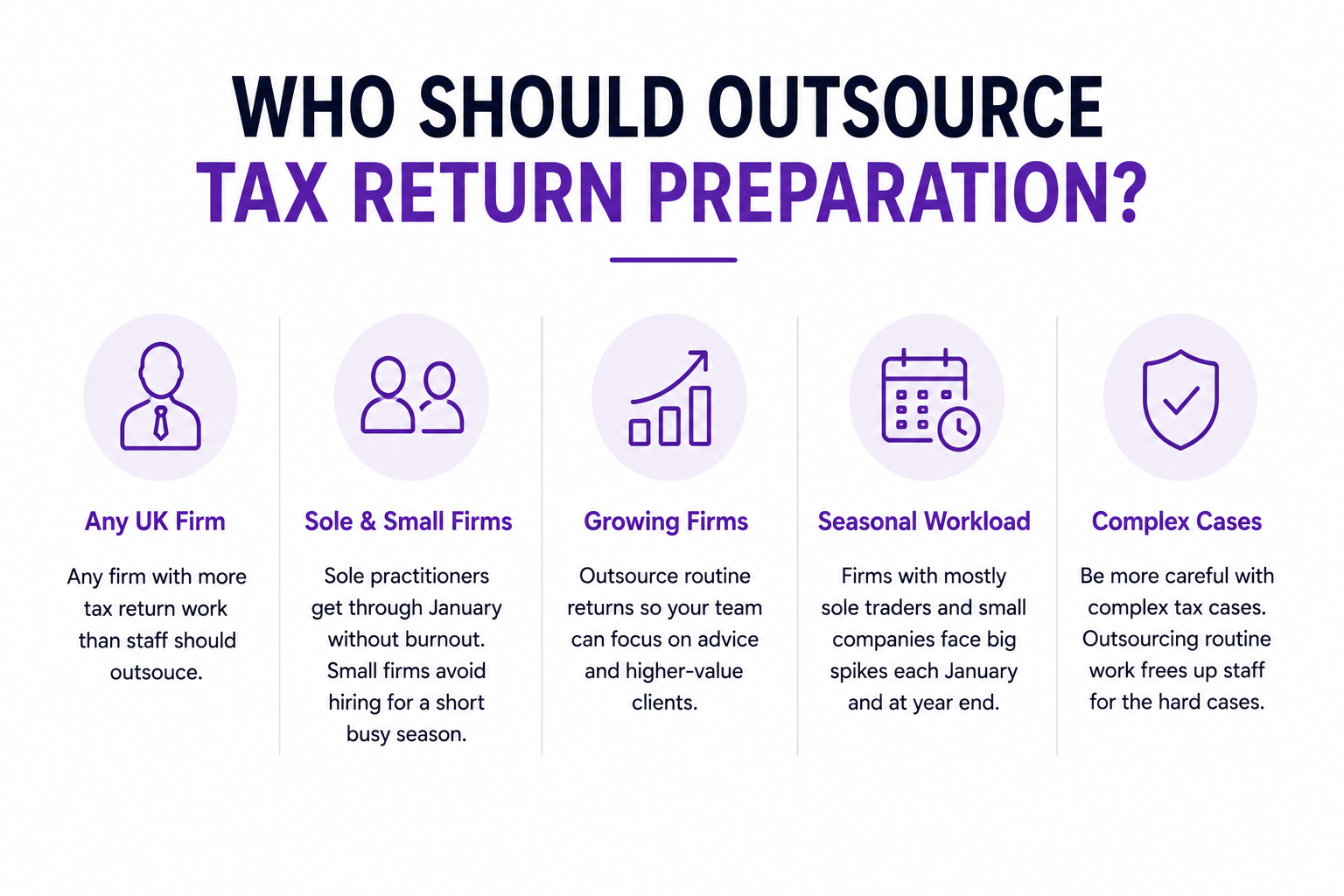
Any UK firm with more tax return work than staff should think about outsourcing. This covers sole practitioners, small firms, and mid-size practices alike.
Sole practitioners use it to get through January without burning out. A one or two-partner firm cannot hire a full-time senior just for eight weeks of busy season.
Growing firms use it a different way. They outsource routine returns so their own staff can focus on advice and higher-value clients.
Firms with a seasonal client mix gain the most. If most of your clients are sole traders and small companies, your workload spikes hard each January and at each company year end.
Firms with very complex tax cases should be more careful. Even so, outsourcing the routine self assessment work still frees up in-house staff for the hard cases. Our guide on self assessment outsourcing UK covers this split in more detail.
When to Start Outsourcing Your Tax Return Workload
Start at least eight to ten weeks before your busiest filing period. This gives the outsourced team time to learn your systems, your client files, and how you like a file reviewed.
October or November works well for self assessment season. Three months before your busiest company year end works for corporation tax.
Do not wait until the deadline rush has already started. Setting up a new process under pressure raises the risk of mistakes on both sides.
Many firms start with a small test batch of returns first. This lets you check quality and speed before you hand over your full workload.
Where the Outsourced Work Actually Happens
The outsourced team works inside your own software, not a new system. This includes Xero, QuickBooks, Sage, FreeAgent, or any other software your firm already uses.
You do not move client data to a new platform. The outsourced accountant logs into your systems, much like a remote team member would.
Data security sits at the heart of this. A proper outsourcing partner signs a data processing agreement. This follows the same rules any UK firm must follow under GDPR. See the ICO's guide to controllers and processors for the full legal picture.
Where the team sits matters less than how they protect your data. What matters is secure access, limited permissions, and a clear record of who touched each file and when.
How the Tax Return Outsourcing Process Works
The process runs in five clear steps, from setup to final filing.
Step one: setup and access. Your firm gives secure access to the right client files inside your own software. No data leaves your platform.
Step two: gathering documents. The outsourced team asks for missing information, either directly or through your firm. You choose which way works for you.
Step three: return prep. The dedicated accountant prepares the SA100, CT600, or SA800 return. They follow your firm's house style and last year's approach.
Step four: review. An AI-assisted check flags anything odd, missing, or out of line before the file reaches your partner.
Step five: sign-off and filing. Your firm reviews the finished return and files it with HMRC under your own agent login.
This keeps your firm in charge at every step. The outsourced team helps with the prep work. Your partner keeps the final say.
What Happens If HMRC Queries an Outsourced Return
This is the first question most practice owners ask. Most other guides skip it.
If HMRC raises a query, your firm handles the reply. This is because your firm stays the client's registered agent. The outsourced team helps by pulling the working papers and explaining how a figure was worked out.
A good outsourcing partner keeps a clear record for every return. Every change, source document, and calculation can be traced back to where it came from.
Ask any partner how they keep their working papers before you sign. If they cannot show you a sample file, treat that as a warning sign.
Comparing Tax Return Outsourcing Partners
Not all outsourcing partners work the same way. Use this table to compare your options before you choose.
This choice matters. The wrong model creates new problems. A rotating pool of preparers means your client's history gets re-learned each season. An unclear IR35 setup creates risk for your firm, not just the provider.
Real Scenario: A Kent Accounting Practice Before and After Outsourcing
Ashford Tax & Accounts is a two-partner practice in Kent. They hit the same wall every January. Their team of four handled 180 self assessment clients. By mid-January, thirty returns still sat unfinished.
Before: Staff worked six-day weeks from early January. Two returns went in late with extensions the year before. Client complaints about slow turnaround rose each season.
What they tried first: The practice hired a temp for two months. The temp needed three weeks to learn the firm's systems and client history. This barely helped before the deadline hit.
After: The firm outsourced sixty routine self assessment returns to one dedicated accountant. The accountant worked inside the firm's own Xero and FreeAgent setup. They handled the first draft. The AI review flagged two missing dividend vouchers before the partner even opened the files.
The result: every return filed by 28 January, three days early. Staff worked their normal hours. The partners spent their time on hard cases and client calls, not data entry.
How FinQube Can Help
FinQube builds tax return outsourcing around one idea: your client relationship stays yours, and the heavy lifting moves off your desk.
You get one dedicated named accountant for your practice, not a shared pool that changes each season. Your named accountant learns your clients, your house style, and how you like a file reviewed.
Every file goes through FinQube's own AI review before it reaches your partner. This catches missing schedules and common errors early, not after your partner has already spent an hour on the file.
FinQube works inside the software you already use, whether that is Xero, QuickBooks, Sage, FreeAgent, or any other software your firm runs on. There is no data move and no new platform for your team to learn.
The price is fixed and agreed each month. You know your cost before the work starts. There is no hourly billing and no surprise bill in February.
FinQube's setup works as a services agreement, not a labour supply deal. This keeps your IR35 position clear from day one.
There is no minimum contract term. You can scale the work up in busy season and down after, based on what your practice needs.
Ready to see how this would work for your practice? Book a fit call with FinQube. No minimum commitment, no long contract. Just a chat about your workload and whether tax return outsourcing fits your firm.
Conclusion
Tax return outsourcing for UK accounting firms solves a real problem. There is too much filing work and not enough staff to do it. Firms that get this right keep the client relationship and the final review, while an outside team handles the prep work. The best results come from firms that treat it as a clear process and start early. If your practice is heading into another hard January, tax return outsourcing is worth a serious look. Talk to FinQube about a trial with no minimum commitment.
One month. No contract.
See how a dedicated Finqube accountant fits into your MTD workflow before you decide.
Start your free pilotFAQ
Is it legal to outsource tax returns for UK clients?
Yes. Your firm stays the registered agent with HMRC and stays responsible for accuracy and filing. This is confirmed in ICAEW's guidance on outsourcing. The outsourced team only helps with prep.
Do I need to tell my clients that their tax return is outsourced?
Most firms note this in their engagement letter as good practice. It is not always a strict rule. Being open about it builds trust and avoids awkward questions later.
How much does tax return outsourcing cost for a UK accounting firm?
Cost varies by provider and by how many returns you send. Most firms pay a fixed monthly fee rather than a per-return charge. See our full breakdown on accounting outsourcing cost.
Can outsourced teams work inside Xero or QuickBooks directly?
Yes. A proper outsourcing partner works inside your own software, whether that is Xero, QuickBooks, Sage, FreeAgent, or any other software your firm uses. You do not need to move client data.
What happens if the outsourced team makes an error?
A good partner checks every file for quality before it reaches your firm. Your partner still checks the file before filing. Ask any provider to show you their review process before you sign.
Is my client data safe with an outsourced tax team?
Data safety depends on the provider's own controls, not just the model. Check for secure access, a signed data agreement, and limited permissions. This should match the ICO's guidance on controllers and processors.
How is tax return outsourcing different from hiring a temp or contractor?
A temp has to learn your systems and client history from scratch, often mid-season. An outsourcing partner brings a trained accountant who already works inside a clear process from day one.