
.avif)

Blog Summary
- Outsourcing accounting frees up owner time without the cost of a full-time hire
- The biggest risk is not cost. It is losing visibility over your numbers
- A dedicated remote accountant, working inside your systems, solves that problem
- Most small businesses see the value within the first month
- The decision comes down to one question: do you want to own the accounting, or just the outcome?
Most small business owners we speak to are not sitting on a shortage of ambition. They are sitting on a shortage of time. Bookkeeping, VAT returns, payroll, month-end close. Every task that needs doing is a task that is not selling, building, or serving clients.
So the question of outsourcing your accounting is not really about cost. It is about control. Who is doing the work, can you see it, and what happens when something goes wrong?
This article answers all of it.
What Does Outsourcing Accounting Actually Mean for a Small Business?
Outsourcing accounting means handing off some or all of your financial administration to a person or team outside your business. That can mean anything from a freelance bookkeeper to a full accounting support service handling payroll, VAT, management accounts, and year-end.
The scope depends on what you need. Most small businesses start with bookkeeping and VAT. Some extend to payroll, AP and AR, or monthly management accounts.
What outsourcing does not mean, when done properly, is losing sight of your own numbers. That is the version of outsourcing that gives the whole model a bad name.
Why Do Small Businesses Outsource Their Accounting?
The honest answer is capacity. Most small businesses reach a point where the owner is spending two days a week on admin that someone else could handle, and those two days are expensive.
The secondary driver is accuracy. Accounting errors are not just annoying. They cause cashflow problems, missed deadlines, HMRC penalties, and occasionally the kind of creditor situation that takes six months to untangle.
A third reason, less talked about but real, is timing. A good accountant catches the problem before it becomes a crisis. An owner doing their own books at 11pm on a Sunday catches it after.
Who Should Consider Outsourcing Their Accounting?
Outsourcing works well for businesses that:
- Are growing faster than their internal capacity
- Have the owner doing most of the financial admin themselves
- Have had a bookkeeping or VAT error in the last 12 months
- Are preparing to take on investment or scale headcount
- Are spending more than 8 hours a week on accounting tasks
It works less well for businesses where the owner wants to stay closely involved in every financial decision, or where the accounting function is genuinely simple enough to manage in under an hour a week.
If you are on the fence, the question to ask yourself is: could a reliable, qualified person handle this work to a standard I would be happy to review and sign off on?
If yes, outsourcing is worth exploring.
When Is the Right Time to Outsource?
There is no single trigger point. But most business owners tell us they wish they had done it 6 to 12 months earlier than they did.
The common signs that the timing is right:
- You are filing VAT returns late or spending the week before a deadline in a panic
- You have missed something small that cost you money
- You are growing and know the workload is about to increase
- You have just hired your first member of staff and payroll has become more complex
- Your accountant is asking for information you cannot find quickly enough
None of these are emergencies. All of them are signals.
Where Do Most Small Businesses Get Outsourced Accounting Wrong?
The two most common problems are choosing on price and losing visibility.
Choosing on price means picking the cheapest option and then being surprised when the work is slow, inaccurate, or both. Accounting support is not a commodity. The person doing your books needs to understand your business, your software, and your filing obligations.
Losing visibility means handing over the function and then having no clear way of knowing whether the work is being done correctly until something goes wrong. This is the version of outsourcing that puts people off entirely.
The fix for both is the same: work with someone who operates inside your systems, who is accountable for their output, and who you can check on without micromanaging.
How Does Outsourced Accounting Work in Practice?
With Finqube, it works like this.
You are matched with a dedicated remote accountant. They work inside your existing accounting software, whether that is Xero, QuickBooks, or something else. They follow your processes. They do not ask you to adapt to theirs.
Every piece of work goes through Finqube's AI-powered review before it reaches you. That review flags inconsistencies, catches errors before sign-off, and produces a quality score for every task. You can see what was done, what was checked, and what passed review.
That is not a tech feature. It is the mechanism that makes remote accounting trustworthy.
You are not hoping the work is correct. You have a system that checks it.
What Tasks Can a Small Business Outsource?
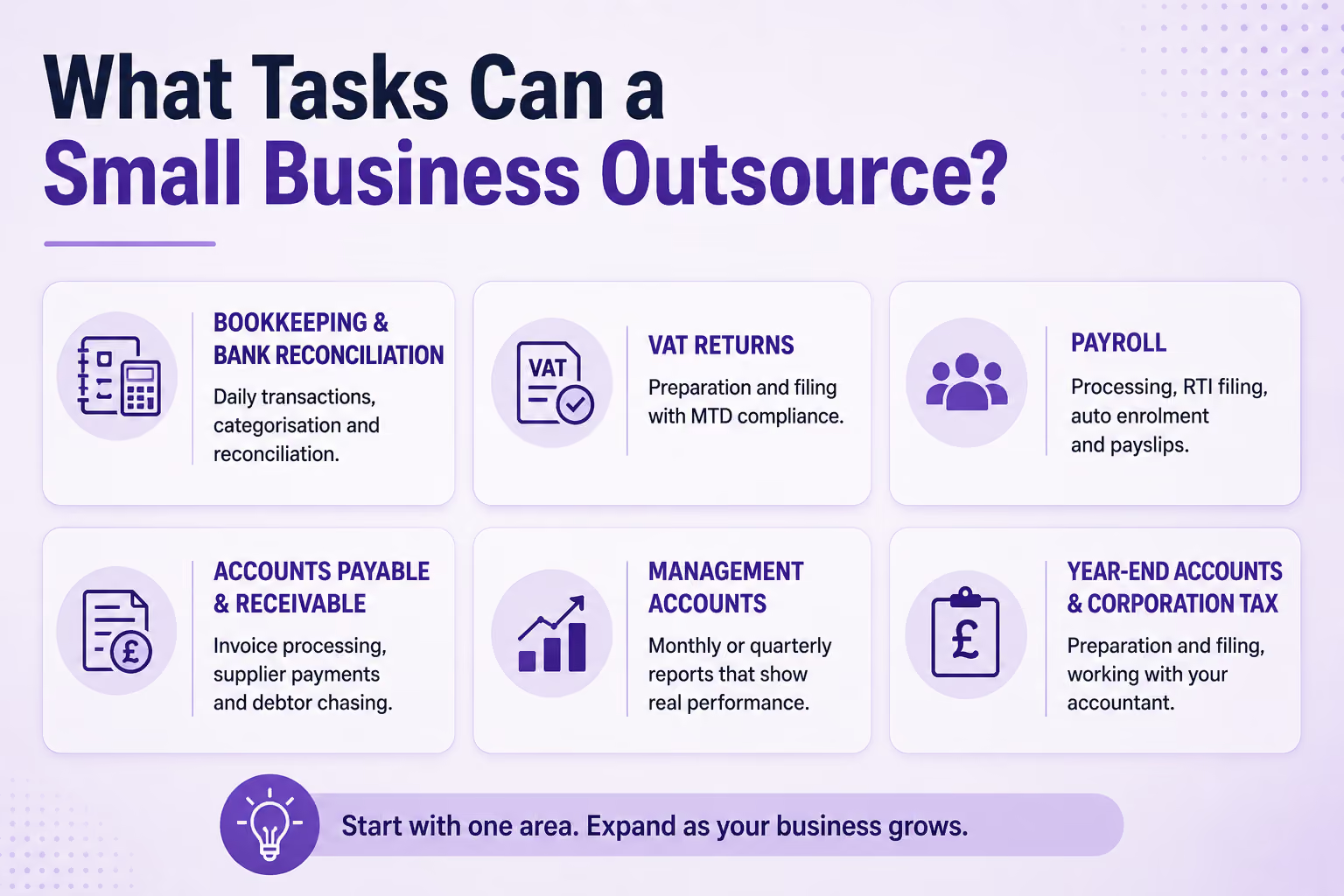
Most of the routine accounting function can be handled by a capable remote accountant:
Bookkeeping and bank reconciliation. Day-to-day transaction recording, categorisation, and reconciliation against your bank statement.
VAT returns. Preparation and filing, including MTD compliance. A good remote accountant will flag anything unusual before submission, not after.
Payroll. Processing, RTI filing, auto enrolment, payslips. This is one of the most time-consuming tasks for a small business and one of the easiest to hand off cleanly.
Accounts payable and receivable. Invoice processing, supplier payments, debtor chasing. This is where cashflow lives. Getting it right matters.
Management accounts. Monthly or quarterly reporting that tells you how the business is actually performing, not just what the bank balance is.
Year-end accounts and corporation tax. Preparation and filing, working alongside your appointed accountant where relevant.
You do not have to hand over all of it at once. Most businesses start with one area and expand from there.
Is Outsourcing Accounting Worth It for Small Businesses?
For most small businesses, yes. But the answer depends on what you are comparing it to.
Compared to the owner doing it themselves: almost always worth it. The owner's time has a cost, and accounting is rarely the highest-value use of it.
Compared to a part-time hire: usually worth it, particularly for businesses that do not have consistent enough volume to justify a salaried role. Outsourcing gives you the output without the overhead.
Compared to a cheap, faceless service: it depends entirely on the quality. A low-cost bookkeeping service that produces work you cannot verify is not saving you money. It is deferring the cost of a problem.
The comparison that matters is this: what would it cost you to get the same standard of work, with the same visibility, from an in-house hire?
For most small businesses, the answer makes outsourcing look straightforward.
Real Scenario: What This Looks Like Month to Month
A business owner running a 12-person consultancy in Manchester. Billing around 80k per month. The owner was doing payroll, chasing invoices, and preparing VAT returns herself. It was taking approximately 10 hours a week.
In month one with Finqube, a dedicated remote accountant took over payroll, VAT, and AP. The owner reviewed the work through the dashboard and signed off. Total review time: around 45 minutes a week.
By month two, management accounts were added. The owner started using them to track utilisation by team member for the first time. That insight changed how she staffed projects.
The time saved was 9 hours a week. The visibility she gained was worth more than the time.
Frequently Asked Questions
Is outsourcing accounting safe for a small business?
Yes, provided you choose a service that gives you clear visibility over the work being done. The risk is not outsourcing itself. The risk is outsourcing to someone you cannot check on.
Will I lose control of my finances if I outsource?
Not if you work with a service that operates inside your systems and gives you access to the work in real time. You remain in control of decisions. You hand off the execution.
How much does outsourcing accounting cost for a small business in the UK?
It varies by scope. Bookkeeping and VAT can start from a few hundred pounds a month. A more complete service covering payroll, AP, and management accounts will be higher. The right comparison is not against zero. It is against what it costs you to do it yourself or hire internally.
Can I outsource just one part of my accounting?
Yes. Most businesses start with one function and expand over time. Starting with VAT or payroll is common.
What accounting software do I need?
Finqube works with the major cloud platforms including Xero and QuickBooks. If you are on older software, a migration is often part of the onboarding conversation.
Conclusion
Outsourcing accounting is worth it for most small businesses. The question is not whether to do it. It is how to do it in a way that keeps you in control of your numbers without keeping you buried in the work.
A dedicated remote accountant, working inside your systems, accountable to a quality review process, is not a compromise on your standards. It is how you maintain them without doing everything yourself.
If you want to see how it works before committing to anything, Finqube runs a one-month free pilot. No contract. No obligation. Just a month of properly supported accounting so you can judge for yourself.