.avif)

Blog Summary
- What outsourced bookkeeping means for a UK practice in 2026 and what it actually covers
- The difference between outsourcing and offshoring, and why the distinction matters for quality control
- Which bookkeeping services can be outsourced without losing partner oversight
- How a dedicated remote team with proprietary AI review keeps you in full control of client work
Introduction
Most practice owners we speak to are not looking for cheaper. They are looking for reliable. They have tried a cheaper option before. It cost them a client, or a deadline, or a weekend they will never get back.
Outsourced bookkeeping gets discussed at every accountancy event in the UK. But the term covers everything from a VA working across 30 different clients in a time zone several hours behind, to a dedicated qualified accountant embedded directly in your Xero or QuickBooks workflow. Those two things are not the same, and treating them as equivalent is how practices end up with a bad first experience and a conclusion that outsourcing does not work.
This guide is for UK practice owners who want to understand what outsourced bookkeeping services actually look like in practice. What they cover. What the genuine risks are. And how to keep full visibility of client work quality without becoming a part-time quality controller.
What Is Outsourced Bookkeeping?
Outsourced bookkeeping means engaging a third-party provider to handle the day-to-day recording and reconciliation of financial transactions on behalf of your practice clients. The preparation work sits outside your firm. The review, sign-off, and client relationship remain with you.
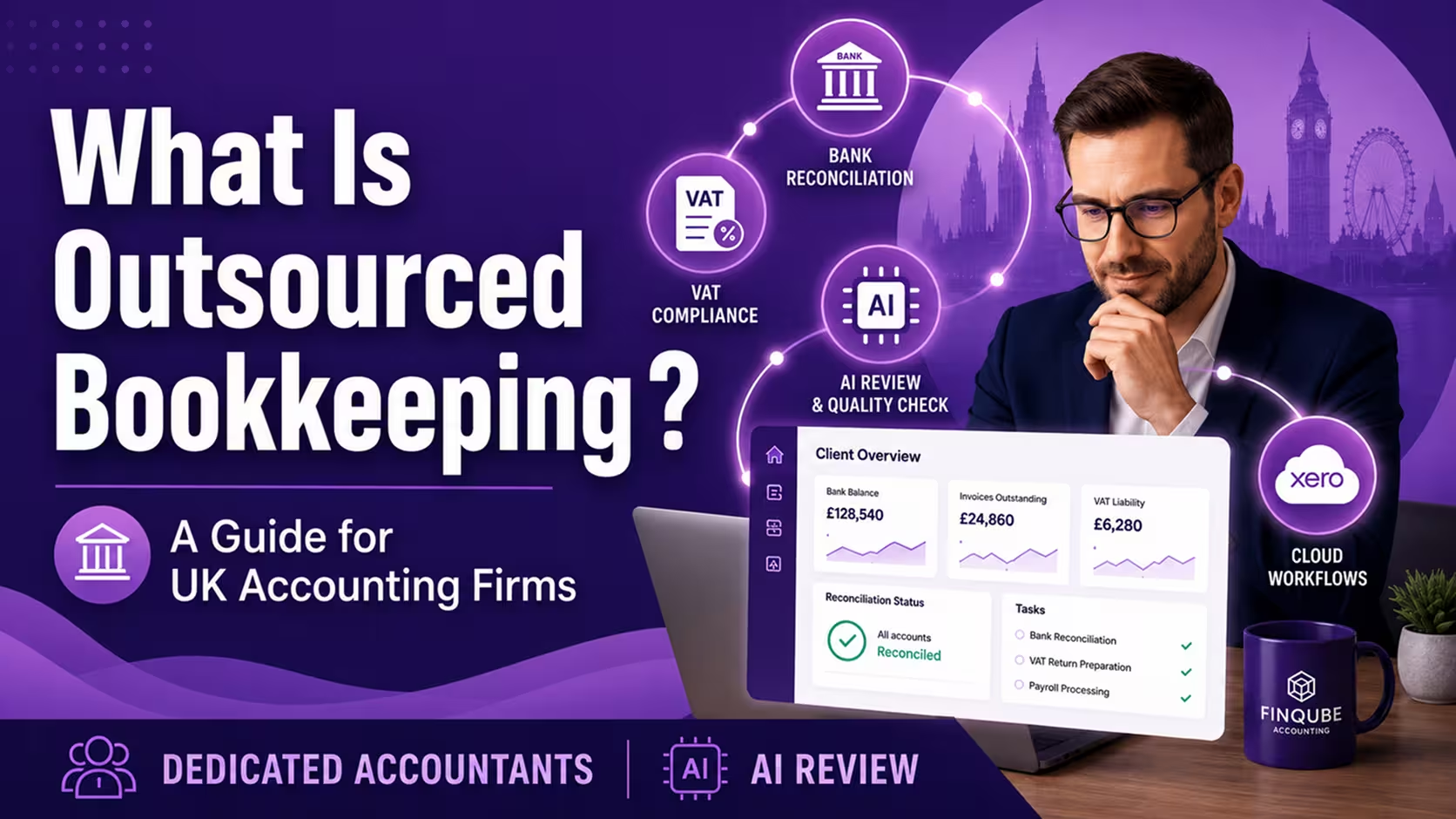
For a UK accounting firm, the scope of outsourced bookkeeping services typically includes bank reconciliation, transaction coding, VAT return preparation, payroll processing, accounts payable and receivable management, management accounts preparation, and year-end accounts preparation ahead of partner review.
This is different from cloud bookkeeping software, which automates classification but not judgement. It is different from hiring a freelance bookkeeper through a marketplace, which gives you a contractor with no formal accountability structure. And it is different from what most people picture when they hear the word offshoring, which we will come to shortly.
What Outsourced Bookkeeping Services Cover for a UK Practice
What Is the Difference Between Outsourcing and Offshoring?
These terms are used interchangeably and should not be. The distinction matters when you are evaluating a provider.
Outsourcing is a business arrangement. You engage a third party to perform work rather than employing staff directly. The third party could be based in the UK, in India, in South Africa, or anywhere else.
Offshoring is a geographic descriptor. It means the work is performed in a different country, typically to take advantage of lower labour costs. Offshoring is often a method within an outsourcing arrangement, but not all outsourcing involves offshoring.
For UK accounting firms, the relevant question is not where the team is based but whether you have visibility into what they are doing and accountability when something goes wrong. A well-structured outsourced bookkeeping arrangement in a lower-cost country with proper review tools beats a poorly structured local contractor with no audit trail.
Here is a section introducing these two specific engagement models, written to match the structured, direct style of the rest of your blog draft. You can insert this right before the comparison table to expand on how firms can structurally work with an outsourcing provider.
Bookkeeping Outsourcing Engagement Models
When partnering with an outsourced bookkeeping provider, UK accounting firms generally choose between two primary engagement structures, depending on their predictable volume and capacity needs.

Full-Time Employee (FTE) Model
The FTE model provides your practice with a dedicated, named remote accountant who works exclusively on your firm's clients.
- How it works: You secure a fixed amount of monthly capacity (e.g., 40 hours a week), and the same accountant integrates directly into your team, learning your specific coding preferences and client nuances over time.
- Best suited for: Growing mid-sized practices with a steady, predictable baseline of bookkeeping work who want an extension of their local team without the permanent overhead of local recruitment.
- Primary advantage: High consistency and deeper client context, which significantly minimizes communication handoff errors over time.
Ad-Hoc Model
The ad-hoc model operates on a flexible, pay-as-you-go or per-file basis rather than committing to a dedicated staff member.
- How it works: You submit client files or specific bookkeeping tasks to a shared pool of accountants only when your internal team hits a bottleneck.
- Best suited for: Smaller practices or firms experiencing sudden, temporary seasonal spikes, such as January Self Assessment or heavy VAT quarter ends, who need to offload excess volume immediately.
- Primary advantage: Maximum scalability with zero ongoing fixed costs, allowing you to only pay for the exact volume of transactional preparation work you need processed at that moment.
Why Do UK Accounting Firms Outsource Their Bookkeeping?
The honest answer is capacity. Not cost. Cost is what gets mentioned in the meeting. Capacity is what drives the decision.
Practice owners are managing client acquisition, regulatory deadlines, staff development, and the technical work itself. When a bookkeeper leaves at short notice in March, during VAT quarter end, the choice is between working weekends or finding a way to absorb the load without hiring someone who will take three months to contribute meaningfully.
According to ICAEW, capacity is the most consistently cited operational constraint for small and mid-size UK accounting practices. A firm of 5 to 15 staff cannot justify a bench of qualified bookkeepers sitting underutilised in quiet periods. Outsourced bookkeeping services let practices scale preparation work up or down without a permanent headcount decision.
Cost does come into it. But practice owners who approach outsourcing as a cost-cutting exercise almost always have a poor first experience. The ones who approach it as a capacity and accuracy play tend to see results within the first two months.
The Advantages of Outsourcing Bookkeeping to Accounting firms in the UK
For a growing UK practice, the advantages of outsourcing bookkeeping extend far beyond simple cost reduction. By offloading the time-consuming preparation layer, such as daily bank reconciliations, transaction coding, and initial VAT preparation, firms instantly unlock critical internal capacity. This shift allows senior staff and partners to redirect their hours away from administrative data entry and toward high-value advisory services, proactive tax planning, and client relationship management.
Furthermore, leveraging a structured outsourcing model with built-in AI review safeguards data accuracy upstream. This ensures that digital records remain seamlessly compliant with HMRC’s strict Making Tax Digital (MTD) frameworks without increasing the partner's review burden.
Ultimately, outsourcing provides a highly scalable operational foundation. It enables firms to easily absorb seasonal volume spikes or take on new clients without the overhead, recruitment delays, or long-term financial commitments of permanent in-house hiring.
Who Is Responsible for Quality When You Use an Outsourced Bookkeeping Service?
You are. This does not change when you outsource.
Outsourcing the preparation layer does not transfer your professional responsibility to the provider. Your name is on the accounts. Your firm's reputation is at stake if errors reach the client. The practice partner retains sign-off authority, and with it, accountability.
This is why visibility matters more than cost when evaluating a bookkeeping outsourcing provider. You need to see what has been done, what has been reviewed, and what has been flagged before the file reaches your desk. A provider who delivers completed files with no audit trail is asking you to trust work you cannot verify.
Finqube's proprietary AI review software addresses this directly. Before any file reaches the partner review stage, the software completes a reconciliation health check, flags outstanding accounts payable and receivable items, and runs an AI scan for common preparation errors. You review what is already clean. The work has already been filtered before it lands with you.
When Does Outsourced Bookkeeping Work Well for a UK Practice?
Outsourced bookkeeping services are not a universal solution. They work well in specific conditions. They tend to fail in others.
Conditions Where Outsourcing Works
- You use cloud accounting software, Xero, QuickBooks, Sage, or FreeAgent, that allows remote access without a VPN or desktop sharing workaround
- You have a repeatable client onboarding process the outsourced team can follow from day one
- You have a partner or senior manager who will carry out proper review rather than redo the work themselves
- You are growing faster than you can hire, or losing staff during peak periods
- You have a defined standard for what a completed bookkeeping file looks like before review
Where Do Most Errors Occur in Outsourced Bookkeeping?
The risk is not the bookkeeping work itself. Qualified bookkeepers working within a structured process make fewer coding errors than overworked in-house staff under deadline pressure. The risk is in the handoff.
Errors in outsourced bookkeeping arrangements tend to cluster around three points. First, the initial setup, when the outsourced team does not yet have full context on a client's business structure, coding preferences, or chart of accounts. Second, the review stage, when a partner signs off a file without checking because they trust the outsourced team has handled it. Third, the period end, when accruals, prepayments, and intercompany entries require judgement calls that were not agreed in advance.
A dedicated remote bookkeeper, one who works on your clients consistently rather than as part of a shared pool, mitigates the first problem because context builds over time. Proper review tools, specifically the ability to see reconciliation status and flagged items before opening a file, solve the second. Clear escalation protocols agreed at the start of the engagement address the third.
How Does a Dedicated Outsourced Bookkeeping Team Work in Practice?
A well-structured outsourced bookkeeping arrangement looks nothing like sending work to an anonymous team. It looks like adding a qualified member of staff who works in your systems, follows your processes, and is accountable to your review.
Here is what the working model looks like for a Finqube engagement.
The Finqube Outsourced Bookkeeping Working Model
Real Scenario: Hughes Accountancy
Real situation
This is not an exceptional outcome. It is what happens when the review layer functions properly. The problem was never that Daniel's team lacked skill. The problem was visibility. He had no way of knowing which files were ready for review without opening each one individually. The AI review software solved the visibility problem. The dedicated outsourced bookkeeper solved the capacity problem.
Outsourced Bookkeeping and Making Tax Digital Compliance
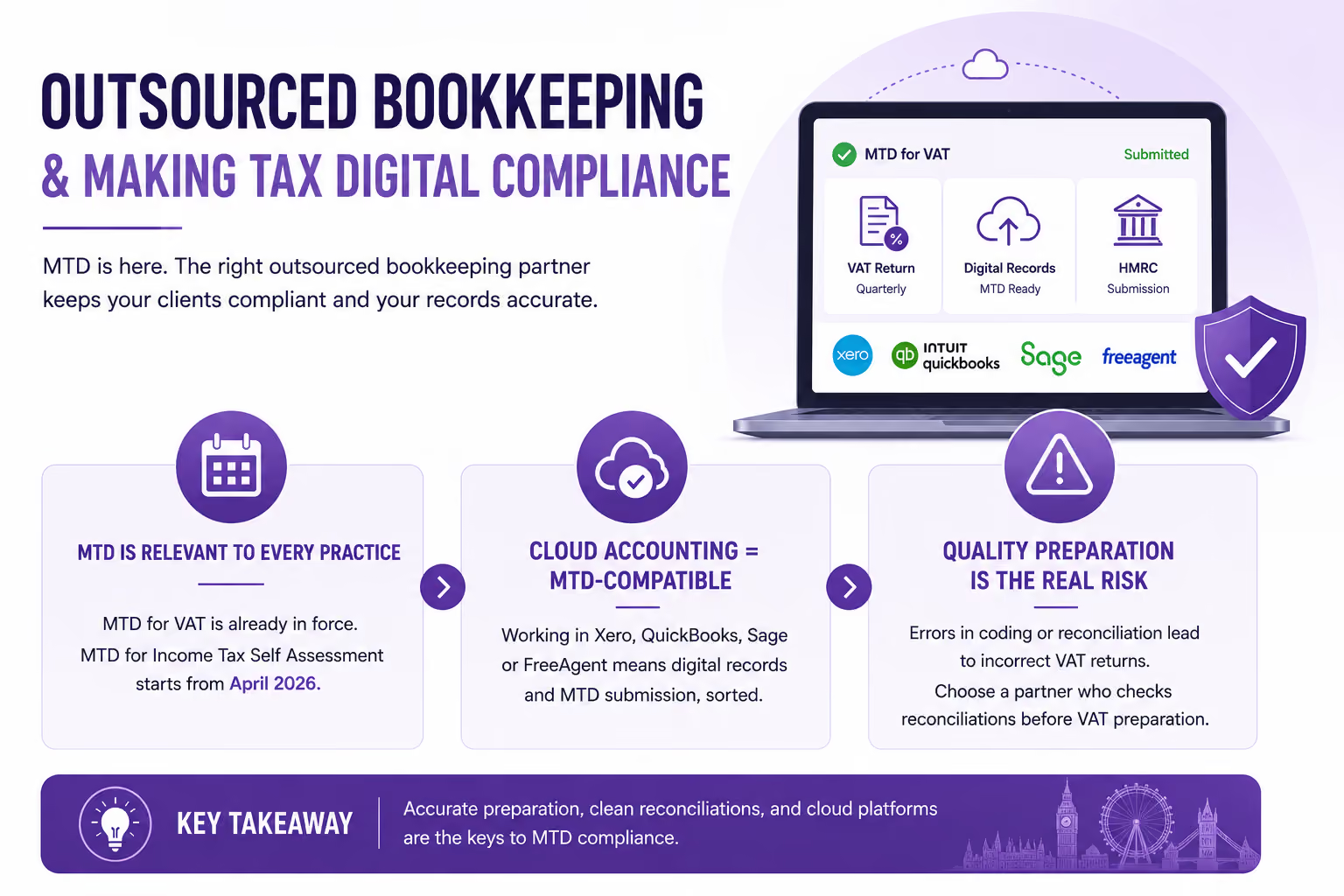
Making Tax Digital is relevant to every UK practice offering bookkeeping or accounting support to clients. MTD for VAT is already in force for all VAT-registered businesses. MTD for Income Tax Self Assessment is being phased in from April 2026, starting with self-employed individuals and landlords earning above the threshold.
Outsourced bookkeeping teams that work within cloud accounting platforms are inherently MTD-compatible. Xero, QuickBooks, Sage, and FreeAgent are all HMRC-recognised platforms for digital record-keeping and MTD submission. If your outsourced bookkeeping provider works inside these tools, your clients are already in the right environment.
The risk with MTD compliance sits in the preparation quality, not the submission method. Errors in transaction coding or bank reconciliation upstream will flow through into an incorrect VAT return regardless of whether it is submitted digitally. An outsourced bookkeeping service that includes a reconciliation health check before VAT preparation is a more reliable MTD compliance partner than one that simply submits whatever the records show.
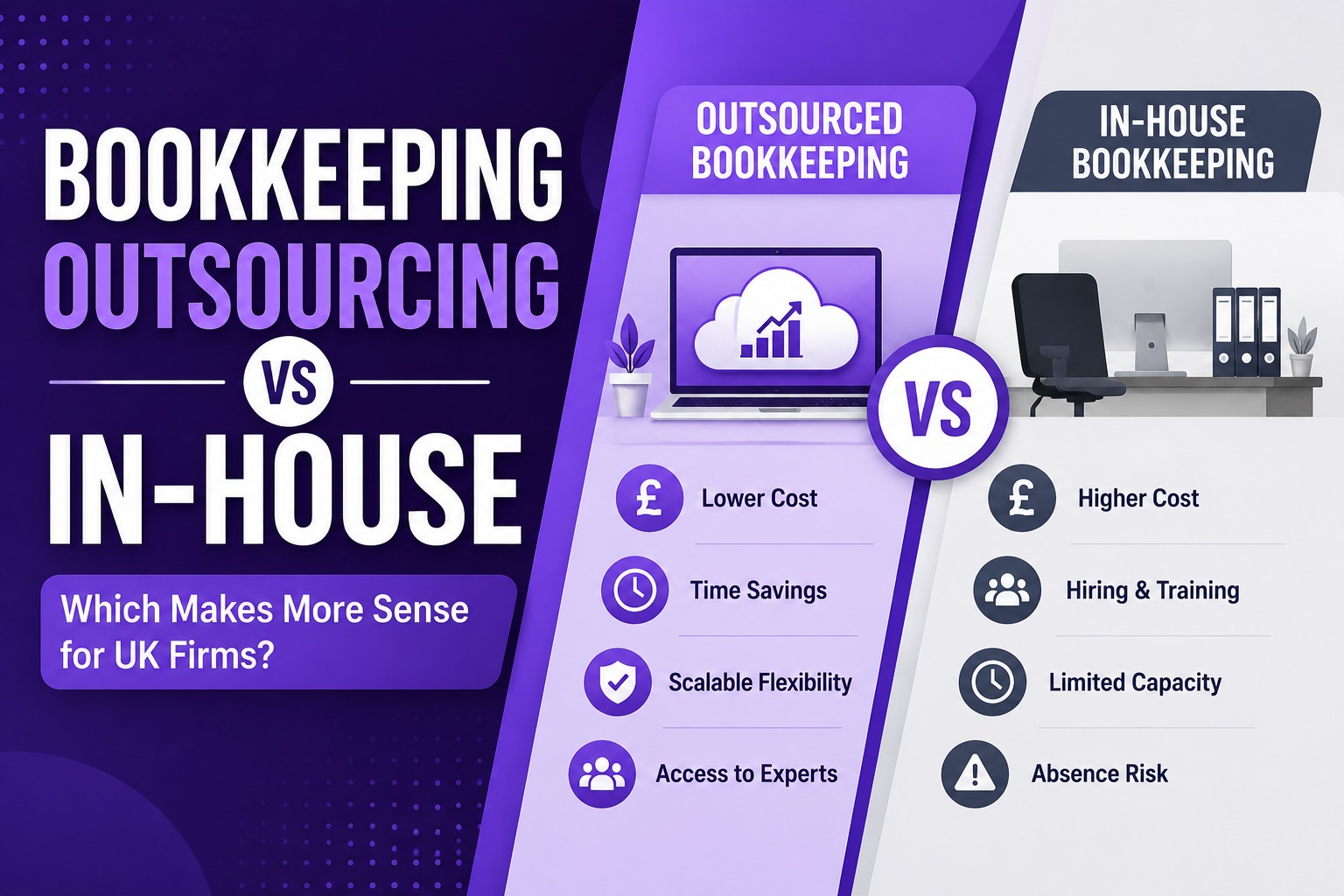
Outsourced Bookkeeping vs Other Arrangements: A Direct Comparison
How Finqube Can Help Your Practice
Finqube provides UK accounting firms with dedicated remote accountants who work inside your existing cloud accounting systems. Every engagement includes our proprietary AI review software with practice management capabilities. This gives the practice partner a live view of every file, every reconciliation status, and every flagged item before the review stage begins.
Before any file reaches the partner, the software has already completed a reconciliation health check, surfaced outstanding accounts payable and receivable items, and run an AI-powered error scan for common preparation mistakes. You review what is already clean.
There is no shared staff pool. You get one accountant assigned to your practice. They work in Xero, QuickBooks, Sage, or FreeAgent, whichever your clients use. They learn your clients, your coding preferences, and your service standards. They are accountable to your review, and to a clear escalation process when a judgement call is needed.
Most practices see a meaningful reduction in partner review time within the first two months. Daniel Hughes at Hughes Accountancy recovered 12 hours per week by month two. The one-month free pilot is the lowest-risk way to see whether that outcome is achievable for your practice.
One month. No contract. See how it works before you decide.
Start your free pilot at finqubeaccounting.com
Book a Free CallConclusion
Outsourced bookkeeping is not a shortcut. It is a structural decision about how your practice handles the preparation layer of client work. Done properly, it frees up the hours your qualified staff are currently spending on work that does not need their level of experience. Done poorly, it creates more work for the partner than doing nothing at all.
The practices that make outsourced bookkeeping services work have three things in common. They have a clear internal review process. They use a provider who gives them visibility, not just completed files. And they approach the arrangement as adding accountable capacity to the team, not removing responsibility from it.
If you are at the point where capacity is affecting your ability to serve existing clients or take on new work, the conversation is worth having.
Frequently Asked Questions
1. What does outsourced bookkeeping mean for a UK accounting firm?
Outsourced bookkeeping means engaging a dedicated remote accountant or specialist provider to handle transaction coding, bank reconciliation, VAT return preparation, payroll processing, and management accounts on behalf of your practice clients. The practice partner retains sign-off authority and client relationship ownership. The outsourced team handles the preparation work upstream of the review.
2. What is the difference between outsourced bookkeeping and offshoring?
Outsourcing is a business arrangement. You engage a third party to perform work rather than employing staff directly. Offshoring is a geographic descriptor, meaning the work is performed in another country. Not all outsourcing involves offshoring, and not all offshore teams are unaccountable. What matters for a practice is whether the provider gives you visibility into the work, not where the team is located.
3. How do I maintain quality control with an outsourced bookkeeping provider?
Quality control depends on two things: a defined review process on your side, and visibility tools from the provider. Finqube's AI review software gives partners a live view of reconciliation status and flagged items before any file reaches review. You are not opening completed files hoping they are right. You are reviewing work that has already been filtered.
4. Does outsourced bookkeeping work with Making Tax Digital?
Yes, provided the outsourced team works within HMRC-recognised cloud accounting platforms. Xero, QuickBooks, Sage, and FreeAgent are all MTD-compatible. Finqube's team works inside your existing cloud software, making all bookkeeping and VAT preparation inherently MTD-compliant.
5. How quickly can an outsourced bookkeeper start working on my clients?
A Finqube dedicated accountant is typically deployed within 1 to 2 weeks of engagement. In-house hires take 3 or more months from job posting to meaningful contribution. This difference is particularly significant when a practice loses a bookkeeper during peak periods such as VAT quarter end or year-end accounts.
6. What accounting software does an outsourced bookkeeping team use?
Finqube's team works across Xero, QuickBooks, Sage, and FreeAgent. There is no data migration, no new software requirement, and no disruption to existing client records. The outsourced accountant is set up in whichever platform you already use for each client.
7. Is outsourced bookkeeping suitable for a small UK accounting practice?
Yes, particularly for practices of 2 to 20 staff that cannot justify a full bench of bookkeeping staff but are consistently running at capacity during peak periods. The Finqube model is structured specifically for small and mid-size UK practices. The one-month free pilot is designed to let you assess fit without a long-term commitment.