
.avif)

Blog Summary
- What MTD VAT compliance actually requires
- Why digital links, not the return itself, trip up most firms
- When MTD for VAT applies to new and voluntarily registered clients
- How a dedicated remote accountant closes the gap without adding headcount
Introduction
Your team files the VAT return on time. Every quarter. HMRC accepts it. Nothing bounces back. On paper, you look MTD VAT compliant.
But someone may still be retyping numbers. A client sends a spreadsheet. Your team types those figures into bridging software, or any other software. That one manual step breaks the digital link HMRC requires. Nobody sees the problem. Not until an inspector asks for the audit trail.
MTD VAT compliance UK rules cover more than the software you submit through. They cover the whole journey. From the client's first record to the final return. Every step must stay digital. This guide explains what that means for a practice with dozens of VAT clients across Xero, QuickBooks, Sage, or any other software.
It also covers what most guides skip. What happens when that digital chain breaks. And what your practice needs to catch it early. By the end, you will know exactly where the real risk sits in your VAT process.
What Is MTD VAT Compliance?
MTD VAT compliance means two things. You keep digital records. You submit returns through HMRC-approved software. No manual retyping anywhere in between.
It covers the full journey. From the first record to the final return. Not just the submission, according to IRIS. A practice can file on time every quarter and still fail this standard. If the records behind that return were typed by hand, the practice is not compliant.
According to AccountingWeb, MTD for VAT has applied to every VAT-registered business since April 2022. Turnover does not matter. There is no size exemption. Every VAT-registered client, big or small, falls under these rules.
This is the trap. "Filed on time" is not the same as "properly compliant." HMRC's system will accept a return without checking how the numbers got there. That check only happens at inspection. This is why many practices assume they are fine, until someone asks for proof.
Why Do Accounting Firms Still Get MTD Wrong?
Most firms get the submission right. They get the record-keeping wrong. The problem starts with how VAT data reaches the software in the first place.
According to IRIS, practices lose two to three hours per VAT return switching between systems. Most of that time is unbillable. That switching is where manual retyping creeps in.
A digital link is stricter than most teams think. HMRC defines it as any electronic transfer of data between software programs. Copying a number from a spreadsheet and typing it into bridging software does not count. Copy-paste is allowed in narrow cases. Retyping from memory, or from a printout, is not.
This matters. Per IRIS, broken digital links from manual retyping are one of the most common errors firms face at review. Wrong VAT rates and missed input VAT come up just as often. A firm can pass every submission and still carry this risk across its whole client book.
The problem is not a lack of knowledge. It is structure. A nine-person practice with 40 VAT clients across three or four platforms has dozens of handover points every quarter. Each one feels small on its own. The risk only becomes visible when someone adds them all up. That rarely happens until an inspection forces the question.
Who Is Responsible for MTD VAT Compliance in a Small Practice?
The client owns the VAT liability. The firm holding agent authorisation owns how that data gets kept and filed.
HMRC's VAT (MTD) end-to-end service guide is clear. Accountants need an Agent Services Account to sign clients up to MTD for VAT. Clients get signed up one at a time, not all at once. Each client authenticates through their own Government Gateway account. That grants the software permission to talk to HMRC on their behalf.
In a small practice, this job usually falls to whoever handles client onboarding. Often a partner. Sometimes a senior bookkeeper. Managing authorisation, digital links, and submissions across 30 or more clients, on different software, gets unmanageable fast without a dedicated process.
This is also where responsibility quietly slips. A partner assumes the bookkeeper owns MTD compliance day to day. The bookkeeper assumes the partner checks it at review. Neither person is wrong. But that gap is exactly where a broken digital link can sit for several quarters, unnoticed.
When Does MTD for VAT Apply to Your Clients?
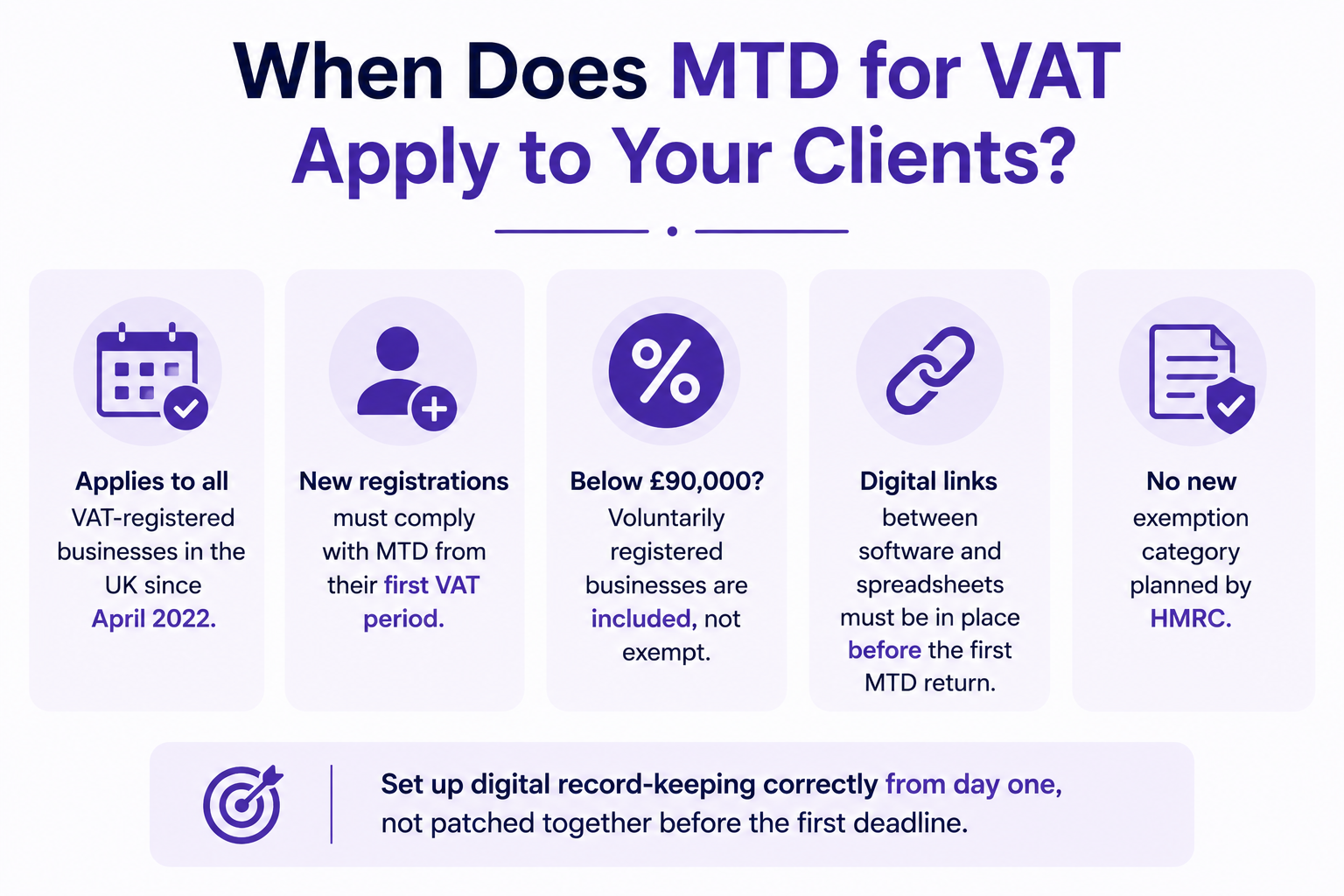
MTD for VAT applies to every VAT-registered business in the UK. Turnover does not matter. This has been true since April 2022. There is no threshold exemption anymore.
A few timing details matter for practices:
- New VAT registrations must comply with MTD from their first VAT period
- Voluntarily registered businesses below the £90,000 threshold are included, not exempt
- Digital links must be in place before the first MTD return, not added afterwards
- HMRC's MTD timeline confirms no new exemption category is planned
This catches out practices most often with voluntary registrations. Many still assume "small clients don't need to worry about this yet." That stopped being true in April 2022. If a client onboards mid-cycle, digital record-keeping needs to be right from day one. Not patched together before the first deadline.
Where Do Most VAT Errors Happen in the Filing Process?
Most VAT errors happen at the handover points. Not inside the software itself. Every time data moves between systems, someone might retype it instead of transferring it properly.
Per IRIS, the most common review issues are broken digital links from manual retyping, wrong VAT rates, and missed input VAT. A common example: charging 20% VAT on zero-rated items like food or children's clothing.
Under MTD, every VAT client must keep digital records and file through compatible software. The whole journey, from source data to final return, must stay digital, according to IRIS. A client book spread across several bookkeeping platforms multiplies the number of places that journey can break.
Timing causes problems too. A client with mixed VAT rates on one invoice raises the risk of miscoding. This gets worse when staff work through a backlog instead of reviewing invoices as they arrive. Backlogs invite shortcuts. Shortcuts are where digital links break first.
How Does a Dedicated Remote Team Handle MTD VAT at Scale?
A dedicated remote accountant works inside the client's own systems. Figures never leave the software to get retyped elsewhere.
That accountant follows the same quarterly process for every client. They check digital links. They check VAT coding. They check input VAT recovery. All before the return reaches partner review. Finqube's proprietary AI review flags mismatches and coding errors first, so the partner reviews a file that is already clean.
Because the accountant is named and dedicated, not shared across a pool, the same person learns each client's VAT history every quarter. That continuity is what saves the two to three hours of unbillable switching time most firms lose per return.
This setup also catches slow problems early. A dedicated accountant who has run the same client's VAT for four quarters in a row will notice when a digital link stops working. Long before an inspection would ever find it.
What Happens If a Practice Gets MTD Wrong?
HMRC generally treats a broken digital link as something to fix, not an automatic fine. This applies as long as the practice shows it is taking reasonable steps to correct it. But penalties can still apply for late filing, late payment, or inaccurate returns. These are separate issues from a broken digital link.
For most practices, the real risk is not a fine. It is time. An inspection asks for an audit trail that does not exist cleanly. Then comes the harder part: explaining to the client why the record-keeping fell short. Rebuilding a broken digital link across several past quarters takes far longer than setting it up correctly the first time.
Real Life Scenario
Priya Shah runs Shah & Co Accountants in Leeds. Her nine-person practice handles 40 VAT-registered clients, spread across Xero, QuickBooks, and Sage, or any other software her clients happened to use already.
Before working with Finqube, her team retyped VAT figures from client spreadsheets into bridging software every quarter. Two clients still sent data as unlinked Excel files. It worked, until HMRC asked for the digital audit trail on one return. Her team could not fully prove it.
Priya brought in a dedicated Finqube accountant to own VAT compliance across the whole client book. That accountant rebuilt the two problem clients' record-keeping with a proper digital link. They also started flagging coding issues before returns reached Priya's desk. Six months later, every VAT return in the practice has a clean, provable digital trail. Priya no longer worries about what an inspection might find.
What changed was not the software. It was having one person accountable for the whole digital journey, across every client, every quarter. Before, compliance meant something slightly different to each staff member, depending on whose file they happened to be working on that day.
How Finqube can Help
Your team already knows the MTD VAT rules. What eats their time is enforcing those rules consistently. Across every client. Every quarter. Across four or five different systems.
Finqube gives your practice a dedicated named accountant, not a shared pool. That accountant works inside your clients' existing software, whether that is Xero, QuickBooks, Sage, FreeAgent, or any other software. Every VAT return passes through Finqube's proprietary AI review before your partner sees it. This catches broken digital links, wrong VAT rates, and missed input VAT before submission.
Pricing is fixed monthly, not hourly. VAT compliance work does not become a variable cost every time HMRC tightens the rules. There is no long-term contract required to start. The engagement runs as a services agreement, not a labour supply arrangement.
Because the same accountant works your clients every quarter, digital link failures get caught early. Not at year-end. Not during an HMRC query. That continuity is the difference between VAT compliance as an ongoing, checked process and VAT compliance as something you hope is still working.
See how a dedicated accountant handles your VAT compliance. Explore our models or find out more about our VAT return filing UK support.
Conclusion
MTD VAT compliance UK rules have applied to every VAT-registered business since April 2022. There is no exemption coming. The real risk is not the submission. It is the manual retyping that happens before the return ever reaches the software.
Closing that gap across a full client book is hard for a stretched team. Especially one working across several platforms, with no single person owning the whole digital journey. A dedicated remote accountant, working inside your existing systems and backed by proprietary AI review, closes that gap. No extra headcount needed. No change to the software your clients already use.
Explore our models to see how it works for your practice, or learn more about our VAT return filing UK service.
One month. No contract.
See how a dedicated Finqube accountant fits into your MTD workflow before you decide.
Start your free pilotFAQ
What counts as a digital link under MTD for VAT?
A digital link is any electronic transfer of data between software programs. An API connection counts. An automated CSV import counts. Typing a figure from one system into another does not count, even if both systems are MTD-approved.
Does MTD for VAT apply to businesses below the VAT threshold?
Yes. Any VAT-registered business must comply, including those registered voluntarily below the current £90,000 threshold.
Can a spreadsheet still be used for MTD VAT records?
Yes, but it must link digitally to MTD-compatible software through bridging software. A spreadsheet with no digital link to submission software is not compliant on its own.
What happens if a digital link is broken during the VAT period?
The return can still go through. But the record-keeping behind it fails the MTD digital link rule. This becomes a real problem if HMRC asks for the audit trail during a check.
Who signs a client up to MTD for VAT, the client or the accountant?
The accountant signs clients up, one at a time, using their Agent Services Account. But the client still needs to authorise this through their own Government Gateway account.
How often must VAT returns be submitted under MTD?
Most VAT-registered businesses file quarterly, matching their existing VAT return periods. Some businesses on annual accounting schemes file once a year, with interim payments.
Can outsourcing VAT compliance reduce the risk of MTD errors?
Yes. A dedicated accountant working consistently across a client's systems cuts down the handover points where manual retyping happens. That is where most digital link failures start.
Does getting a digital link wrong always trigger a penalty from HMRC?
No, not automatically. HMRC usually expects a practice to fix the issue once flagged. But penalties can still apply separately for late filing, late payment, or inaccurate returns.