.avif)

Blog Summary
- What P11D forms cover and which benefits in kind you must report to HMRC.
- The exact 2026 deadlines for P11D, P11D(b), and Class 1A National Insurance payments.
- How the shift to mandatory payrolling of benefits changes P11D work from April 2027.
- How outsourcing P11D and benefits reporting protects your practice from penalty risk during busy season.
INTRODUCTION
It is 4 July. Your team has three client P11D forms unfinished, two directors arguing over a company car benefit, and a deadline two days away.
P11D forms cause this exact panic every single July, at almost every UK accounting practice. HMRC does not move the deadline for you.
This guide walks through what P11D forms cover, who must file them, the 2026 deadlines, and the penalties for getting it wrong. It also covers the biggest change in a decade: HMRC's move toward mandatory payrolling of benefits in kind.
If your practice handles P11D forms for clients, you need this information before the next filing season, not during it.
WHAT IS A P11D FORM?
A P11D form reports the benefits in kind and expenses an employer gives an employee outside of payroll. HMRC uses it to calculate the extra tax the employee owes.
Employers file one P11D per employee who receives taxable benefits. A separate form, the P11D(b), declares the total Class 1A National Insurance the employer owes on those benefits.
Benefits in kind are non-cash perks. A company car, private medical insurance, and a low-interest loan all count. A salary payment does not.
Employers do not need a P11D for every benefit. Anything already taxed through payroll — a practice called "payrolling benefits" — does not need separate P11D reporting for that item.
This is where confusion starts for many small practices. Some benefits go through payroll. Others go through P11D. Mixing the two up is the single biggest cause of HMRC queries.
Common Benefits in Kind: P11D vs Payrolled
WHY DO P11D FORMS MATTER FOR UK PRACTICES?
P11D forms matter because HMRC penalises late or inaccurate filing hard, and clients blame their accountant first.
Your client trusts your practice to know the rules. A missed deadline damages that trust fast, even when the underlying error came from messy client records.
For example, a director who forgets to mention a new company car creates a P11D gap your practice did not cause. However, HMRC still fines the employer, and the employer still calls you.
Therefore, P11D compliance is not just a filing task. It is a relationship-protecting task for every practice that handles payroll or year-end work. This is exactly why more practices bring in hr and payroll outsourcing support before busy season hits, rather than during it.
WHO NEEDS TO FILE A P11D FORM?
Any UK employer that provides taxable benefits or expenses to employees, outside of payroll, must file a P11D form.
This includes limited companies, partnerships, and sole traders with staff. It applies regardless of company size.
Directors count as employees for this purpose. A single-director limited company with a company car still needs a P11D.
However, employers do not need to file anything for an employee who received no reportable benefits. An empty year means no form for that person.
If every benefit is already payrolled, the employer still files a P11D(b) to report the Class 1A National Insurance due. The individual P11D forms become unnecessary.
WHEN ARE THE 2026 P11D DEADLINES?
The P11D and P11D(b) filing deadline is 6 July 2026, for the tax year ending 5 April 2026. Class 1A National Insurance payment follows on 22 July.
Employers must also give employees a copy of their P11D information by 6 July. This lets employees check their tax code is correct.
Key P11D Deadlines for 2026
As a result, late filing carries a real cost. HMRC charges £100 per 50 employees for every month or part-month the P11D(b) stays outstanding.
Inaccurate reporting can trigger separate penalties on top of that, according to guidance from HWB Accountants. Late Class 1A payments also accrue interest daily.
WHERE DO YOU SUBMIT A P11D FORM?
Employers submit P11D forms through HMRC's PAYE Online service or through payroll software, such as Xero, QuickBooks, Sage, FreeAgent or any other software with HMRC-recognised payroll functionality.
Employers with 500 or more employees must file through commercial payroll software. Smaller employers can still use HMRC's own online portal.
However, HMRC no longer accepts paper P11D forms for most employers. Digital submission is now the standard route, according to GOV.UK guidance on payrolling benefits.
For accounting practices, this means your software stack matters. Whether your clients run Xero, QuickBooks, Sage, FreeAgent or any other software, your team needs to pull benefit data cleanly from wherever the client's records sit.
HOW DO YOU COMPLETE A P11D FORM CORRECTLY?
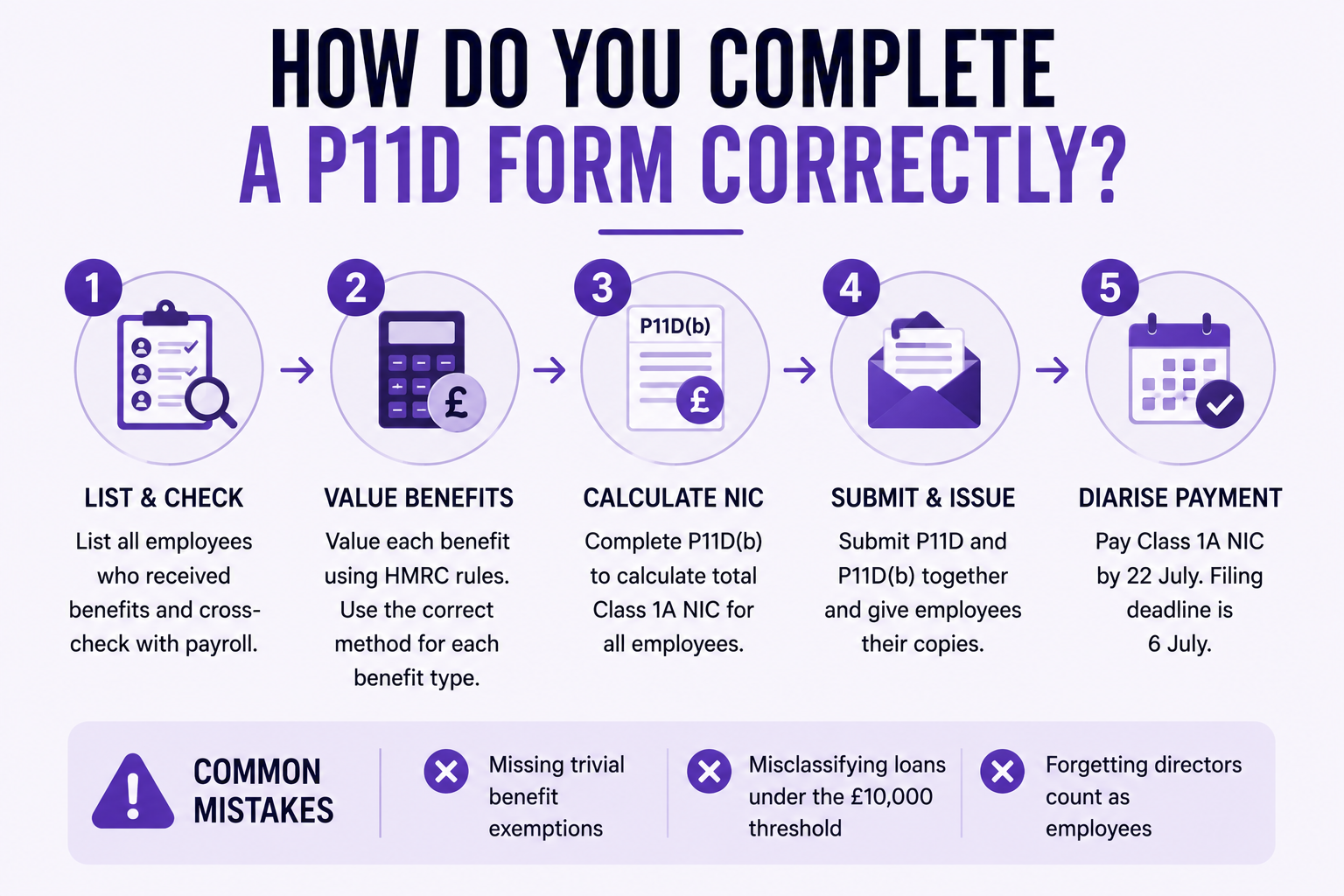
You complete a P11D form correctly by gathering every benefit provided, matching each one to the right HMRC category, and calculating the taxable value before the 6 July deadline.
Start by listing every employee who received a benefit during the tax year. Cross-check this against payroll records to avoid double-counting anything already payrolled.
Next, value each benefit using HMRC's specific rules. A company car uses list price and CO2 bands. A loan uses the official interest rate. Get this step wrong, and the whole form is wrong.
Then, complete the P11D(b) to calculate total Class 1A National Insurance owed across all employees. This is a single company-wide figure, not per employee.
Finally, submit both forms together, give employees their copies, and diarise the Class 1A payment date separately from the filing date. These are two different deadlines with two different consequences.
Common mistakes include missing trivial benefit exemptions, misclassifying loans under the £10,000 threshold, and forgetting that directors count as employees. Each one invites an HMRC query.
THE SHIFT TO MANDATORY PAYROLLING OF BENEFITS
HMRC is moving toward mandatory payrolling of almost all benefits in kind, replacing most P11D reporting from April 2027.
This change was originally planned for April 2026 but was delayed. According to ICAEW, the government pushed the mandatory start date back after feedback from employers and software providers.
Under the new rules, employers report most benefits through payroll in real time, spreading the tax across the year instead of settling it after year end. This mirrors how salary and bonuses already work.
However, two benefit types stay outside the new system: employer-provided loans and living accommodation. According to Deloitte's UK Tax Policy Map, a P11D and P11D(b) process remains for these two categories only.
P11D Reporting vs Mandatory Payrolling
Practices should start preparing client payroll systems now. Firms that wait until 2027 to test their software will face the same crunch they already know from July P11D season, according to Xero's P11D guide.
If your clients still run manual payroll processes, now is the time to review RTI payroll UK practices before mandatory payrolling arrives.
REAL SCENARIO: HOW ONE PRACTICE FIXED ITS P11D PROCESS
Ashcroft & Reeves, a nine-partner accounting practice in Leeds, handled P11D forms for 40 client companies every July.
The problem: Every June, two junior staff spent three weeks chasing directors for benefit details. Client records lived across Xero, Sage, and spreadsheets, with no consistent format.
What they tried: The practice built an internal spreadsheet template and emailed it to every client in May. Response rates stayed low. By late June, the team was still missing data from 15 clients.
What changed: Ashcroft & Reeves moved P11D data collection into their clients' existing payroll software instead of a separate spreadsheet. A single named contact tracked outstanding benefits weekly from April onward, rather than chasing everyone in June.
The result: The practice filed all 40 P11D forms by 28 June 2026, nine days ahead of the deadline. Zero late-filing penalties, and two clients specifically praised the earlier communication.
The lesson here is simple. P11D problems are rarely about tax knowledge. They are about data collection and deadline tracking across many clients at once.
HOW FINQUBE CAN HELP
Your practice already knows the P11D rules. What eats your July is chasing scattered client data across different systems and different partners' priorities.
FinQube gives your practice a dedicated named accountant for P11D and payroll work — not a shared support pool that changes every week. You always know who is handling which client.
We work inside your clients' existing systems. Whether they use Xero, QuickBooks, Sage, FreeAgent or any other software, our team pulls benefit data from wherever it already lives. No client migration required.
Every P11D file goes through our proprietary AI review before it reaches your partner for sign-off. It flags missing benefit categories, threshold breaches, and mismatched loan values automatically.
You get fixed monthly pricing for this work, not an hourly bill that spikes every July when P11D season hits. Budgeting stays predictable across the year.
There is no minimum contract term. You start when it suits your practice, and you scale the support up or down as your client list changes. If you are still weighing up providers, our guide to outsourced payroll providers uk walks through what to check before you commit.
Ready to stop chasing P11D data every July? Talk to FinQube about how a dedicated accountant handles your practice's benefits-in-kind reporting, inside the systems your clients already use — with no minimum contract.
CONCLUSION
P11D forms are not going away in 2026, even with mandatory payrolling on the horizon for 2027. The 6 July deadline still applies, and the penalties for missing it still bite.
Practices that treat P11D as a year-round data collection task, rather than a June scramble, file earlier and avoid HMRC penalties. Ashcroft & Reeves proved that a small process change makes a real difference.
However, if your team is stretched thin during busy season, outsourcing P11D and wider payroll support is a practical way to build in that year-round consistency. Talk to FinQube about a dedicated accountant for your practice's benefits-in-kind reporting.
One month. No contract.
See how a dedicated Finqube accountant fits into your MTD workflow before you decide.
Start your free pilotFAQ
What is a P11D form used for?
A P11D form reports taxable benefits in kind that an employer gives an employee outside of payroll, so HMRC can calculate the correct tax due.
Do I need to submit a P11D if there are no benefits?
No. You only file a P11D for employees who received a reportable benefit during the tax year. An employee with none needs no form.
What is the P11D deadline for 2026?
The P11D and P11D(b) deadline is 6 July 2026, for the tax year ending 5 April 2026. Class 1A National Insurance payment is due by 22 July 2026.
What happens if I file my P11D late?
HMRC charges £100 per 50 employees for each month or part-month the P11D(b) remains outstanding, plus possible penalties for inaccurate figures.
Do directors need a P11D form?
Yes. Directors count as employees for P11D purposes, and any benefits they receive must be reported the same way as for other staff.
What is the difference between a P11D and payrolling benefits?
A P11D reports benefits after the tax year ends. Payrolling taxes the benefit through payroll in real time, avoiding separate year-end reporting for that item.
Will P11D forms disappear completely?
No. From April 2027, most benefits move to mandatory payrolling, but P11D reporting stays in place for employer loans and living accommodation.