.avif)

Blog Summary
- The real price range for outsourcing VAT returns in the UK, from per-return fees to fixed monthly packages.
- Five things that push VAT outsourcing costs up or down, from transaction volume to software.
- A side-by-side cost comparison of doing VAT in-house, hourly outsourcing, and fixed-fee outsourcing.
- How one UK practice cut VAT season overtime by switching to a fixed-fee outsourced model.
INTRODUCTION
Your VAT deadline lands the same week as three self assessment queries. And a new client is starting.
Sound familiar?
Most practice owners who search for the cost to outsource VAT returns are not lazy. They just want to survive quarter end without burning out their team.
The honest answer is this. VAT return outsourcing costs between £50 per return and a few hundred pounds a month. It depends on volume and how the provider prices it.
But that number alone tells you little.
This guide breaks down what drives that price. It shows what a fair fixed fee looks like. And it shows where firms lose money without knowing it. We built this using real UK market pricing, so you can check your own quotes against it.
What Does It Cost to Outsource VAT Returns in the UK?
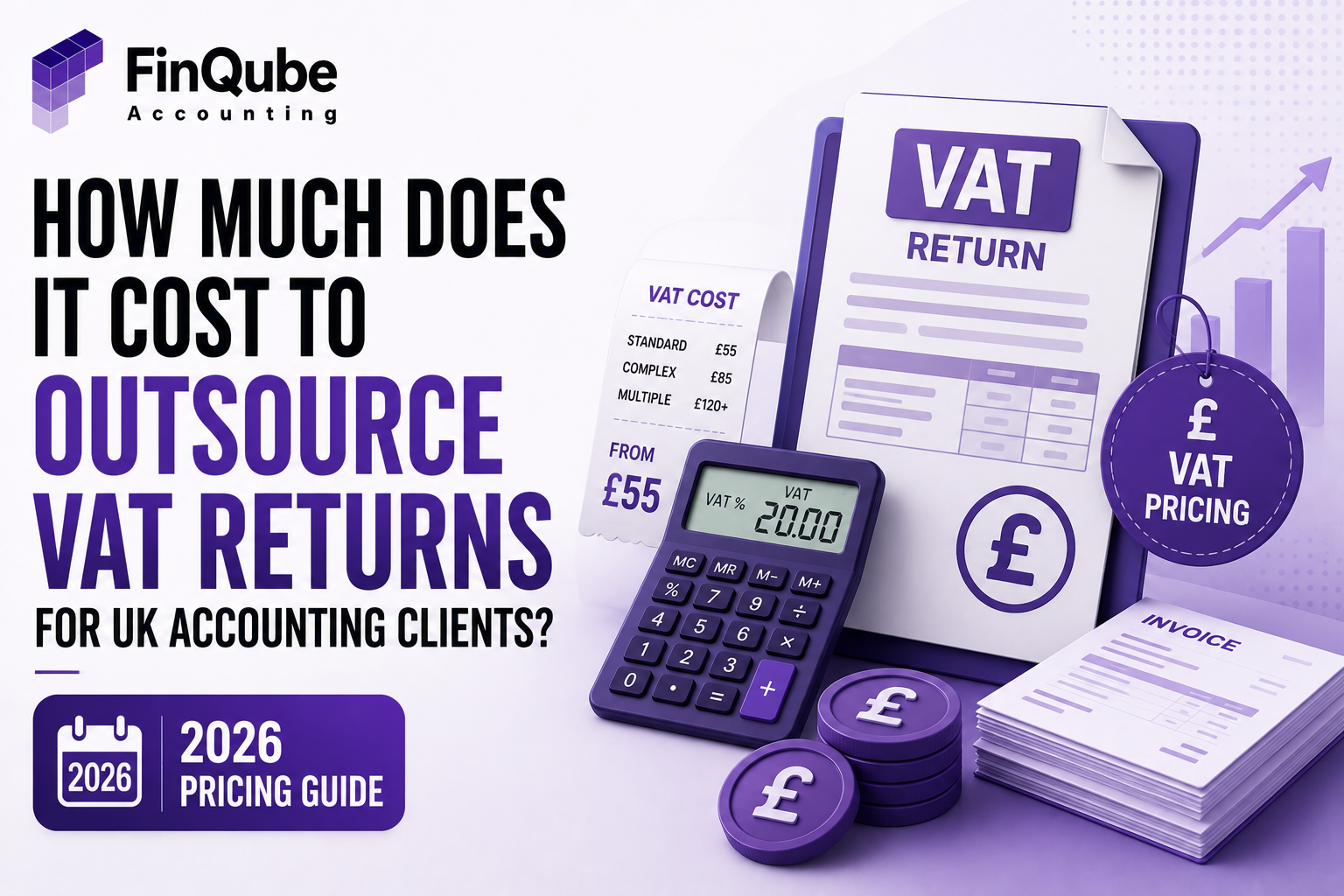
Outsourcing VAT returns in the UK usually costs between £50 and £250 per return. Or £30 to £100 extra per month inside a bundled package. Fixed-fee providers tend to sit in the middle of that range.
The price depends on how the provider sets its fees. Some charge per VAT return. Others fold VAT work into a monthly bookkeeping fee.
The table below shows typical UK price ranges for 2026.
These numbers come from two sources. Better Account's fee guide. And Wise UK's cost guide. Want the wider picture on price? See our outsourced bookkeeping cost guide.
These figures cover preparation and filing. They do not always cover fixing errors or VAT software. Ask your provider what sits inside the fee before you sign anything.
Why Do VAT Return Outsourcing Costs Vary So Much?
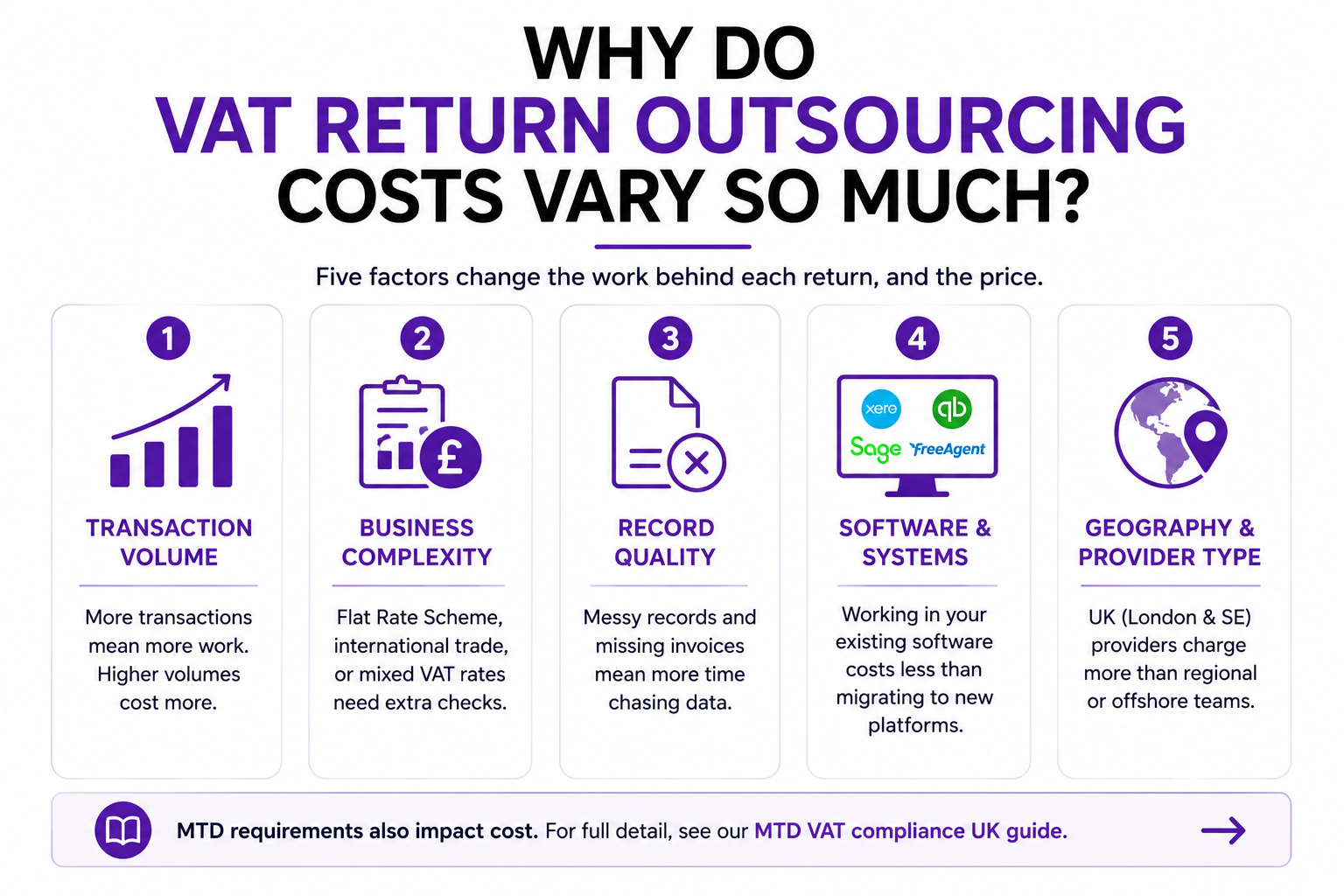
VAT outsourcing costs vary because five things change the work behind each return. Transaction volume is the biggest one. A shop with 2,000 monthly transactions costs more to process than a small firm with 40.
The type of business matters too. Clients on the Flat Rate Scheme, clients who trade abroad, or clients who mix VAT-exempt and standard sales all need extra checks.
Record quality changes the price as well. Messy bank feeds and missing invoices force the provider to chase data instead of filing returns. Poor records almost always cost more, no matter which software you use.
The software you use plays a part too. A provider that works inside your existing Xero, QuickBooks, Sage, FreeAgent, or any other software will cost less than one that wants to move your clients to a new system first.
Location and provider type matter too. UK providers in London and the South East often charge more. Regional and offshore teams often charge less for the same work. See QX Accounting's cost guide for more on this. Want more on how MTD affects your costs? Read our MTD VAT compliance UK guide.
Who Should Outsource VAT Return Preparation?
Practices with 10 or more VAT clients should think about outsourcing VAT returns. So should firms that always run short on time at quarter end. Smaller practices with only a few VAT clients often manage fine on their own.
Does your firm feel one of these three pressures? If so, look at outsourcing:
- Your team works weekends every VAT quarter to hit the deadline.
- You have turned away new VAT clients because you have no spare time.
- Your partner checks every return by hand. Juniors keep making mistakes.
Does this sound like you? Weigh the cost of outsourcing against overtime, hiring, and lost new business.
When Does Outsourcing VAT Returns Start Saving Money?
Outsourcing VAT returns usually starts to save money once a practice handles more than 15 to 20 VAT returns a quarter. Below that number, a fixed fee can cost more than doing it in-house.
Here is a simple way to check the maths. Work out your current cost per return. Include staff time, software, and partner review time. Then compare it against a provider's fixed fee per return.
The switch point usually comes when overtime, hiring costs, or partner review hours push up your per-return cost. So look at your total cost. Do not just look at the price tag.
Where Do the Hidden Costs Sit in VAT Outsourcing?
Hidden costs in VAT outsourcing usually sit in three places. These are error fixes, software fees, and slow start-up. A cheap headline price can hide all three.
Error fix costs appear when a provider makes a mistake and then charges you to fix it. Always ask if error fixing sits inside the fixed fee or gets billed on top.
Software fees add up fast. Bridging software for Making Tax Digital, extra user seats, and other tools can add £20 to £50 a month per client. This happens if the provider does not already work inside your systems.
Start-up time is the quiet cost most firms forget. A provider that takes six weeks to learn your Xero, QuickBooks, Sage, FreeAgent, or any other software setup still costs you. It costs your partner's time during that gap, even before you get the first invoice.
HMRC says all VAT firms need digital records that meet MTD rules. So software fit is a real cost. It is not a small detail. Read more in our MTD for accountants guide.
How Do Practices Compare Outsourced VAT Pricing Models?
Practices should compare outsourced VAT pricing on three things. Total cost per client. What sits inside the fee. And how long you must commit. Hourly pricing looks cheap until the hours add up.
The table below compares the three common choices.
FinQube sets a fixed monthly fee based on your client volume and how complex the work is. You see the number before you commit to anything. There is no minimum contract and no commitment beyond the month you are in.
ICAEW tells firms to put scope and exit terms in writing before they sign. That is how you dodge the lock-in that hourly and annual-licence models often bring.
Real Scenario: How One Leeds Practice Cut VAT Season Chaos
Bridgeford Accountants is a three-partner practice in Leeds with 34 VAT clients. Every VAT quarter ran the same way. Two juniors worked weekends. One partner checked every return before it went out.
The practice tried hiring a part-time bookkeeper to help at quarter end. But training took two months. The cost barely cut the overtime bill.
Bridgeford then switched to a fixed-fee outsourced VAT desk that worked inside their existing Xero setup. One named accountant handled their files every quarter. Not a rotating pool of staff.
Within two quarters, weekend overtime dropped to zero. The partner still checked returns, but AI-flagged checks caught errors before the file reached her desk. Her review time fell by roughly half.
The total monthly cost came in lower than the part-time bookkeeper's salary. Bridgeford took on six new VAT clients the next year without hiring anyone new.
How FinQube Can Help
FinQube prices VAT return outsourcing on one fixed monthly fee. It is based on your actual client volume and the work involved. No hourly surprises. No annual licence. No minimum commitment beyond the month you are in.
Here is what that fee actually includes:
- One named accountant for your practice. Not a shared pool that changes every quarter.
- Work done inside your existing Xero, QuickBooks, Sage, FreeAgent, or any other software. So there is no delay while you switch systems.
- Our own AI review tool flags errors before your partner sees the file.
- Fixed monthly pricing, agreed upfront, so you can quote your own clients with confidence.
- A services agreement, not a labour supply setup. This keeps your IR35 position clean.
Want the full picture on outsourcing VAT work? Read our guide on outsource VAT returns UK. Want to see how we run outsourced work day to day? Read outsourced accounting services UK.
CTA BOX: Want a fixed monthly quote for your VAT workload? Book a 20-minute call with FinQube. We will show you the exact fee for your client volume. No minimum commitment. No contract beyond the current month.
One month. No contract.
See how a dedicated Finqube accountant fits into your MTD workflow before you decide.
Start your free pilotCONCLUSION
The cost to outsource VAT returns in the UK usually falls between £50 and £300 per return. But the fee alone does not tell you the full story. What matters more is what sits inside that price. Think about error fixes, software, and how long you must stay locked in. Firms that look at total cost, not just the headline price, tend to make the better call. FinQube prices VAT outsourcing on one fixed monthly fee with no minimum commitment, so you always know what you pay. Book a call to get a quote built around your own client volume.
FAQ
How much does it cost to outsource VAT returns UK?
Outsourcing VAT returns in the UK usually costs between £50 and £250 per return. Or £30 to £100 a month as part of a bundled package, depending on volume.
Is it cheaper to outsource VAT returns than do them in-house?
For practices with 15 or more VAT clients, outsourcing is usually cheaper. This is true once you count overtime, hiring, and partner review time in your in-house cost.
What is included in a VAT return outsourcing fee?
A fair fixed fee covers preparation, filing, and a standard review. Always check if error fixes and MTD software cost extra.
Do outsourced VAT providers work with Xero or QuickBooks?
Most providers, FinQube included, work inside your Xero, QuickBooks, Sage, FreeAgent, or any other software. So you skip a costly switch.
Is there a minimum contract for outsourced VAT services?
It depends on the provider. Many ask for a 12-month contract or annual licence. FinQube has no minimum commitment beyond the current month.
How does Making Tax Digital affect VAT outsourcing costs?
MTD needs digital records that meet its rules. This can add software costs if your provider does not already support your system.
Can outsourcing VAT returns help my practice take on more clients?
Yes. Firms that remove VAT season limits often win new clients without hiring more staff. See the Bridgeford Accountants example above.