.avif)

Blog Summary
- What separates a genuine outsourced payroll partner from a software reseller
- The five criteria that actually predict whether a provider will work out
- How the main types of UK payroll providers compare on visibility, compliance depth, and system fit
- Where practices go wrong when they choose on price alone
Introduction
Payslips go out late. A client calls before you know there's a problem. This is what happens when payroll outsourcing goes wrong.
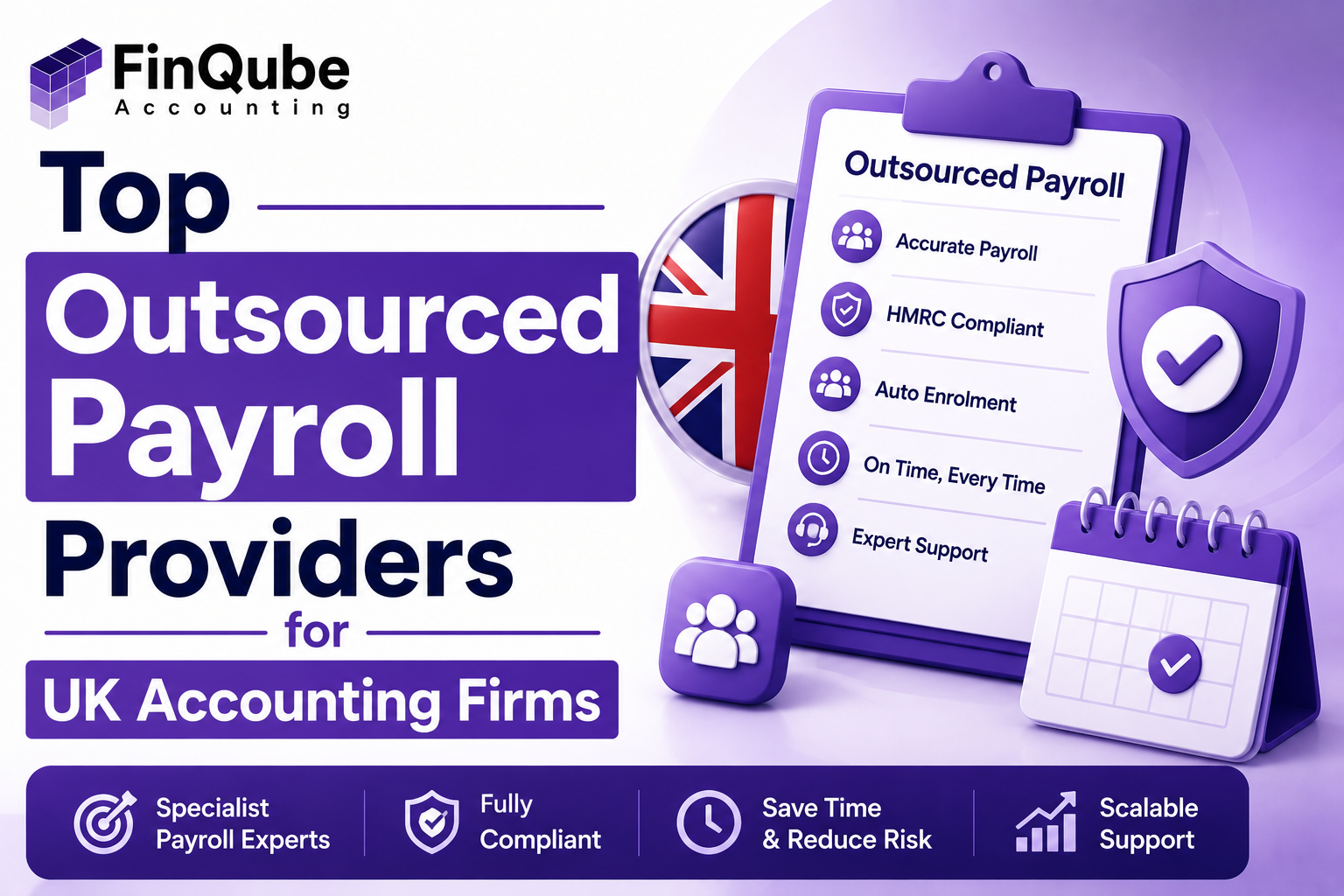
Finding the right outsourced payroll providers UK should remove that risk, not add to it. Yet many practices switch providers once, get burned, and go straight back to doing it all in-house.
This guide breaks down what actually separates a reliable payroll partner from a risky one. No rankings based on marketing copy. Just the criteria that matter when your name is on the payslip.
What Is an Outsourced Payroll Provider, and What Do They Actually Do?
An outsourced payroll provider runs payroll processing, RTI submissions, and auto enrolment on behalf of your practice. They work as an extension of your team, not a replacement for it.
The best providers handle the full cycle. Payslip calculation, pension assessment, EPS filings, and year-end reporting all sit inside their remit. Your practice keeps the client relationship and final sign-off.
Some providers only supply software and leave you to run it. Others supply a dedicated person who works inside your existing system, whether that's Xero, QuickBooks, Sage, FreeAgent, or any other software. The distinction matters more than most practices realise before they sign.
Why UK Accounting Firms Are Outsourcing Payroll
Practices outsource payroll because capacity, not cost, is usually the real constraint. Payroll deadlines don't move, and one missed RTI submission creates a penalty that lands on your desk, not the client's.
Recruiting a payroll specialist takes months in a tight market. Outsourcing gets a trained person working inside your systems far faster than hiring ever could.
There's also a compliance angle. Auto enrolment rules and RTI requirements change often enough that keeping one in-house person fully current is a real ongoing cost, not a one-off training exercise. HMRC publishes updated RTI and auto enrolment guidance every tax year, and staying current with it is a job in itself.
Who Should Be Accountable for Payroll Once You Outsource It?
You are still accountable to your client. The provider is accountable to you. That chain needs to be explicit before you sign anything, not assumed.
A named contact who owns the file matters more here than almost anywhere else in outsourcing. Payroll queries are time sensitive, and a ticket queue doesn't cut it when a client needs an answer before Friday's pay run.
Ask any prospective provider exactly who signs off each payslip run and what happens if that person is unavailable. If the answer is vague, that's your answer. ICAEW guidance on outsourcing arrangements is clear that ultimate responsibility for the work stays with the engaging firm, regardless of who performs it.
When Is the Right Time to Switch Providers?
The best time to switch is at the start of a tax month or tax year, never at year-end or during peak season. Migrating employee records mid-cycle creates errors that follow you for months.
Watch for the warning signs before you're forced into an urgent switch. Recurring late RTI submissions, no visibility into what's been checked, or a provider who can't explain an edge case like the non-eligible jobholder band are all reasons to start looking now, not later.
Give yourself at least one full pay cycle of overlap. A rushed handover is where most transition errors happen.
Where Payroll Outsourcing Goes Wrong
Most failures trace back to one root cause: no visibility. The practice hands payroll over completely and only finds out something is wrong when a client complains.
Established practice-focused outsourcers deliver payroll under your brand, while larger managed-payroll and HR bureaus tend to suit bigger or more complex payrolls. Size alone doesn't guarantee the right fit for a small or mid-sized practice. A provider built for enterprise clients can leave a firm of two to twenty people without the hands-on attention it needs.
System mismatch is the other common failure. If payroll sits outside your existing Xero, QuickBooks, Sage, FreeAgent, or any other software setup, you inherit reconciliation work you didn't have before switching.
What to Look for in an Outsourced Payroll Provider
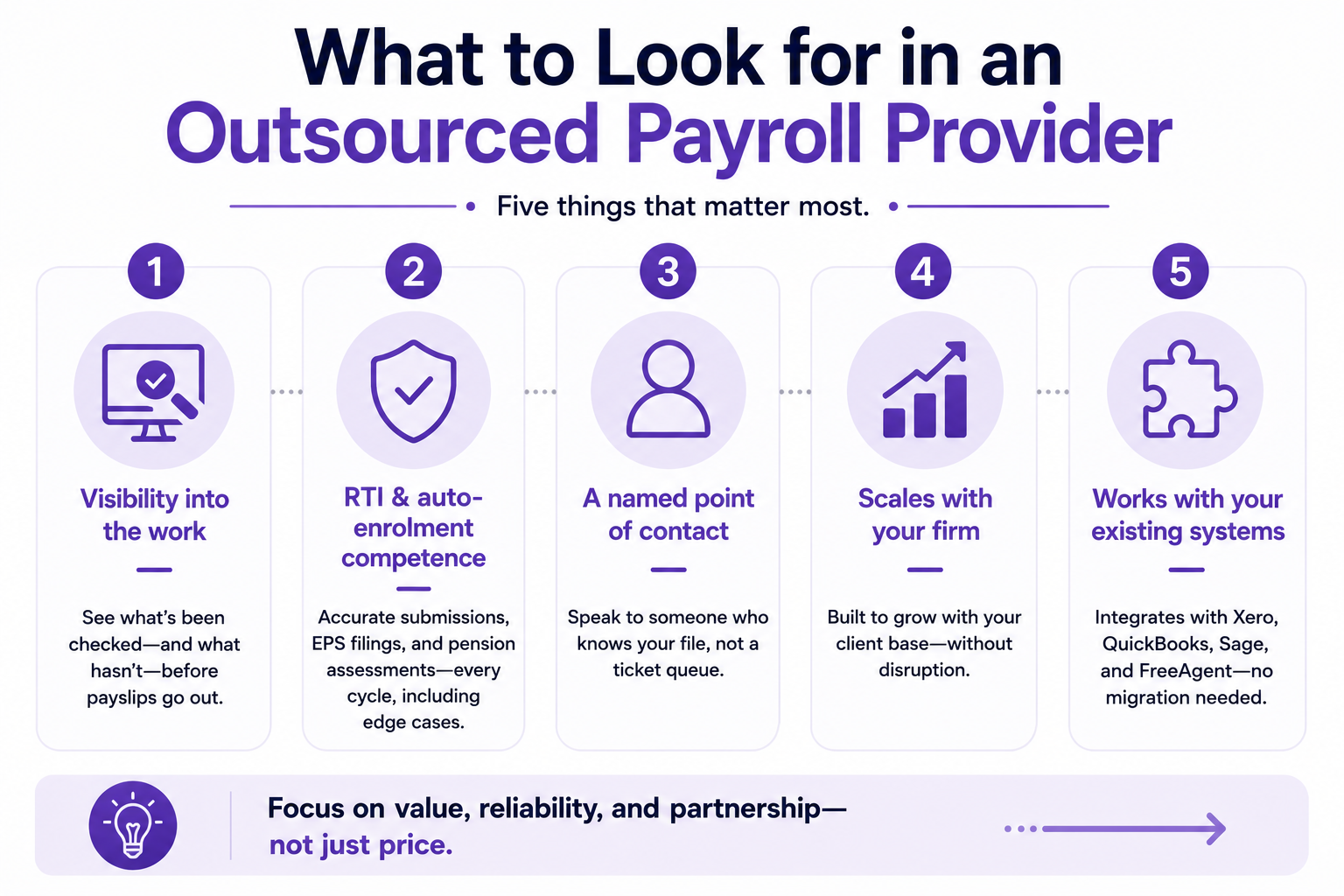
Before comparing providers, get clear on what actually matters. Price is rarely the right starting point. Five things are.
Visibility into the work, not just the output. Can you see what has been checked before payslips go out, or do you only find out something was wrong when a client calls?
RTI and auto enrolment competence as standard. Submissions, EPS filings, and pension assessments should be handled correctly every cycle, and the provider should be able to explain edge cases like the non-eligible jobholder band without hesitation.
A named point of contact, not a ticket queue. When something needs explaining to a client at short notice, you need someone who knows the file.
The ability to scale with your client base. A provider that works well for 10 clients and falls over at 50 will cost more in switching disruption than it ever saved.
Integration with your existing systems. Payroll that sits outside Xero, QuickBooks, Sage, FreeAgent, or any other software you run creates reconciliation work you didn't have before.
How the Main Types of UK Payroll Providers Compare
UK payroll outsourcing splits roughly into three groups: practice-focused outsourcers, managed-payroll bureaus, and software-only platforms you run yourself. Each suits a different kind of practice.
Treat payroll outsourcing as a strategic service rather than a cost line. Before comparing price, check compliance and UK expertise, service model and SLAs, security and data controls, integration and workflow fit, and client support model.
Managed payroll bureaux typically charge in the range of £5 to £15 per employee per month for handling RTI submissions, pension auto-enrolment, and year-end reporting — worth modelling against a dedicated accountant's fixed monthly cost before deciding.
REAL SCENARIO SECTION
Priya Shah runs Shah & Co Accountants in Leeds, a nine-person practice with just under 60 payroll clients. Her previous provider ran payroll well enough in quiet months but had no spare capacity every April.
Two RTI submissions went in late during the same tax month. One triggered a penalty notice that landed with the client before Priya's team even knew there was an issue. She had no visibility into what had been checked and no single person she could call to explain it.
She moved to a dedicated accountant model instead, with one named person working directly inside her firm's Xero, or any other software, setup. Reconciliation flags now surface before payslips go out, not after a client calls. Two tax years on, she hasn't had a late RTI submission since.
HOW FINQUBE CAN HELP
FinQube pairs your firm with one dedicated, named accountant for payroll, not a shared pool working across dozens of clients at once. You always know exactly who is handling the file.
That accountant works directly inside your existing systems, whether that's Xero, QuickBooks, Sage, FreeAgent, or any other software your practice already runs. Nothing new to migrate, nothing extra to reconcile.
Before any payslip run reaches you, our proprietary AI review software flags reconciliation mismatches, RTI inconsistencies, and common preparation errors. You see clean work, not a black box.
Pricing is fixed monthly, not hourly, so you can model the cost against an in-house hire with confidence. Minimum commitment is none. You can scale up during peak season and scale back down when things are quiet, without a contract holding you to either.
CONCLUSION
The right outsourced payroll provider gives you visibility, not just output. Price matters, but it should never be the first filter you apply.
Score providers against compliance depth, a named contact, system fit, and scalability before you look at cost. A provider that fits your practice today should still fit it in two years, once your client base has grown.
If your current setup only surfaces problems after a client calls, it's worth comparing what a dedicated accountant model looks like instead.
One month. No contract.
See how a dedicated Finqube accountant fits into your MTD workflow before you decide.
Start your free pilot11. FAQ
What is the best outsourced payroll provider for a UK accounting firm?
There's no single best provider. The right fit depends on your client base size, existing software, and how much visibility you need before payslips go out. Compare providers against compliance depth, system fit, and named accountability rather than price alone.
How much does outsourced payroll cost in the UK?
Costs range from software-only options at a low monthly fee up to managed bureaux charging roughly £5 to £15 per employee per month, with fully managed services costing more depending on headcount and service level.
Is outsourced payroll safe for UK accounting firms?
Yes, provided the provider follows UK GDPR and Data Protection Act 2018 requirements, holds relevant security accreditation, and gives your practice clear visibility into what's being processed and checked.
What is the difference between payroll outsourcing and payroll software?
Payroll software is a tool you run yourself. Outsourcing means a provider's team runs the process for you, including RTI submissions, auto enrolment, and error checking, inside or alongside your existing software.
Do outsourced payroll providers handle auto enrolment?
Reputable providers handle full auto enrolment, including pension assessment, category classification, and re-enrolment cycles. Confirm this explicitly, since some software-only platforms leave assessment to you.
Can outsourced payroll integrate with Xero or QuickBooks?
Most established UK providers integrate with Xero, QuickBooks, Sage, FreeAgent, or any other software your practice already uses. Confirm this before switching, as forced migration to a new platform creates extra reconciliation work.
How long does it take to switch payroll providers?
A clean switch takes roughly one full pay cycle of overlap. Time the transition to the start of a tax month or tax year, and avoid switching during peak season or year-end.