
.avif)

Blog Summary
- What Making Tax Digital means for UK accounting practices and their clients in 2026
- Which MTD phases are live, which are coming, and the exact HMRC deadlines you cannot miss
- The most common compliance failures practices are still making and how to prevent them
- How to structure your MTD workflow so client filings are accurate, on time, and reviewable without partner bottlenecks
Introduction
Most UK accounting practices have had MTD for VAT sorted for years. MTD for Income Tax Self Assessment is a different problem entirely.
The rules are broader. The client base is wider. And the volume of quarterly submissions is unlike anything most practices have dealt with before. For a firm managing 50 to 150 self-employed clients or landlords, the admin burden of MTD ITSA is not incremental. It is a structural change to how client work flows through the practice.
This guide covers what is live, what is coming, and what you need to have in place right now to keep your practice and your clients on the right side of HMRC in 2026.
What is Making Tax Digital and why does it matter in 2026?
Making Tax Digital is HMRC's programme to move the UK tax system to fully digital record-keeping and reporting. The aim is to reduce errors, improve compliance, and give HMRC real-time visibility into taxpayer income.
For accounting practices, MTD means your clients can no longer file tax returns using paper records or desktop software that does not connect to HMRC's systems. Every affected taxpayer must use HMRC-recognised software that can submit returns digitally.
In 2026, MTD matters more than it did in previous years for one reason: MTD for Income Tax Self Assessment is now in its rollout phase. The clients affected are not large corporates with IT departments. They are sole traders and landlords who rely on their accountant to navigate the whole process. If your practice is not ready, your clients are not ready.
The three MTD phases at a glance
Which MTD phases apply right now?
MTD for VAT has been mandatory for all VAT-registered businesses since April 2022. If your practice still has clients filing VAT manually, that is a compliance problem that needs resolving immediately, not a future concern.
MTD for Income Tax Self Assessment Phase 1 went live in April 2026. Clients with self-employment or property income above £50,000 per year must now keep digital records and submit quarterly updates to HMRC using compatible software. This is not optional and HMRC is not in a grace period for this cohort.
MTD for ITSA Phase 2, covering those earning above £30,000, comes into effect in April 2027. That is twelve months away. Practices that wait until January 2027 to start preparing will not have enough time to onboard all affected clients before the deadline.
Who does MTD for Income Tax Self Assessment affect?
MTD for ITSA affects sole traders and landlords who have qualifying income above the threshold. Qualifying income means income from self-employment or property, not total income from all sources.
For 2026, the affected population is anyone with qualifying income over £50,000. For 2027, that drops to £30,000. According to HMRC, this will ultimately bring over 4 million taxpayers into the MTD ITSA system.
For most accounting practices, this is not a small number of edge cases. It is a substantial portion of your personal tax client list. The question is not whether your practice will be affected. It is whether your workflow is ready to handle the volume.
Clients you need to identify now
- All sole traders with self-employment income above £50,000 (mandatory from April 2026)
- All landlords with rental income above £50,000 (mandatory from April 2026)
- All sole traders and landlords earning above £30,000 (mandatory from April 2027)
- Clients with combined sources of qualifying income across self-employment and property
- Clients who currently file their own self assessment and may need to be brought onto your systems
When are the key MTD ITSA deadlines?
MTD for ITSA requires quarterly submissions, not just an annual return. This is the most significant operational change for practices. Instead of one submission per client per year, you are now managing four updates plus an end of period statement and a final declaration.
Six submissions per client per year instead of one. For a practice with 80 MTD ITSA clients, that is 480 submissions annually. Workflow design is no longer optional.
Where are practices making mistakes with MTD compliance?
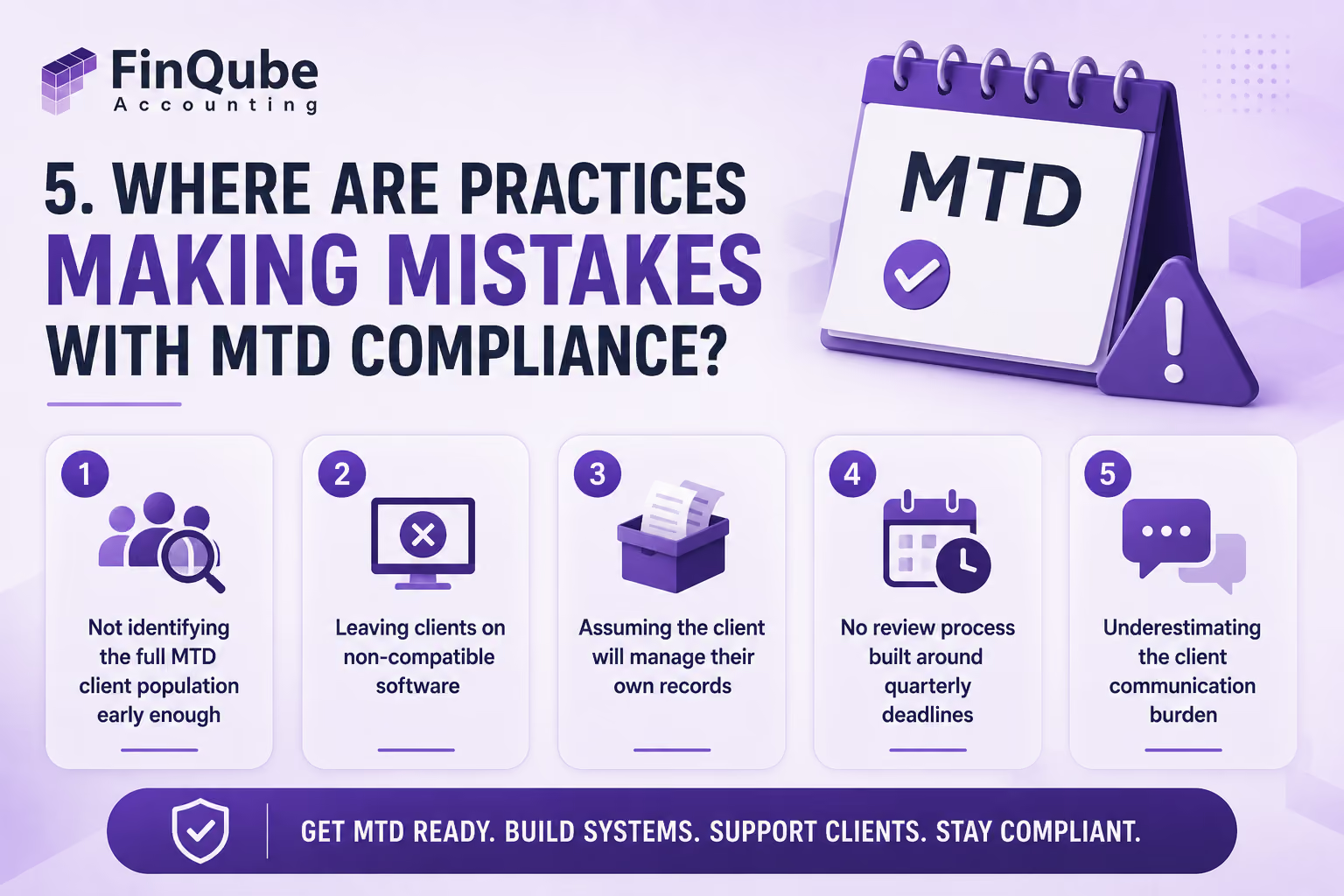
Most MTD compliance failures at practice level are not about misunderstanding the rules. They are about underestimating the operational change and not building systems to support it.
The five most common MTD mistakes practices are making right now
- Not identifying the full MTD client population early enough. Practices that wait until April to review their client list have already missed the preparation window.
- Leaving clients on non-compatible software. Some clients still use desktop software or spreadsheets that do not connect to HMRC. Bridging software can work temporarily, but it is not a sustainable solution for quarterly submissions at volume.
- Assuming the client will manage their own records. MTD requires digital record-keeping throughout the quarter, not just at submission time. Clients who collect receipts in a shoebox until January will not be able to meet quarterly deadlines without support.
- No review process built around quarterly deadlines. Annual returns allowed practices to manage their own timing. Quarterly submissions do not. Without a structured review workflow, errors get to the client before the partner sees them.
- Underestimating the client communication burden. Every affected client needs to understand what MTD means for them, what software they will use, and what you need from them each quarter. That is not a letter. It is an ongoing conversation.
How should accountants structure MTD workflows in 2026?
MTD for ITSA requires a fundamentally different approach to personal tax work. The practices that handle it well are not working harder. They are working with a system.
The four-part MTD workflow structure
The practices making this work are the ones that treat quarterly MTD submissions the same way they treat monthly management accounts. There is a process. There is a deadline. There is a review step before anything goes to HMRC.
Practices without that structure are finding that quarterly deadlines compress into the same bottleneck as annual returns: everything lands on the partner's desk in the last week.
How Finqube helps practices stay MTD-compliant at scale
MTD for ITSA does not fail because practices do not understand the rules. It fails because the volume of quarterly work is not matched by the capacity to do it. That is where a dedicated remote accounting team changes the equation.
A Finqube accountant works inside your existing systems, whether that is Xero, QuickBooks, Sage, or FreeAgent. They handle the ongoing bookkeeping support, quarterly review, and submission prep for your MTD clients. Your partner reviews the final file. Our proprietary AI review software has already flagged any reconciliation mismatches or outstanding issues before that review happens.
For practices managing 50 or more MTD ITSA clients, that is 300 or more quarterly submissions per year. A dedicated Finqube accountant removes the submission burden from your in-house team and gives the partner a reviewed, clean file to sign off rather than a raw set of records to work through.
What MTD support looks like with Finqube
- Your dedicated accountant handles client record-keeping support and quarterly update preparation
- Our AI review software checks each submission for reconciliation issues and common errors before partner review
- You retain full visibility through our practice management dashboard. Every client file, every submission status, one view
- Deployment takes one to two weeks. You are not waiting three months for a new hire to start
- One-month free pilot. No contract. See how it works before you commit
Conclusion
MTD for ITSA is live for your highest-income self-employed and landlord clients from April 2026. In twelve months, that threshold drops to £30,000, which means the majority of your personal tax client base will be inside the MTD regime.
The practices that are ahead of this are not those with the most sophisticated software. They are those that identified their affected clients early, built a quarterly workflow, and have the capacity to execute it reliably every three months.
If your current team cannot absorb that volume without the partner becoming a bottleneck, that is a capacity problem worth solving before the next quarterly deadline arrives.
One month. No contract.
See how a dedicated Finqube accountant fits into your MTD workflow before you decide.
Start your free pilotFrequently Asked Questions
What is Making Tax Digital for Income Tax?
Making Tax Digital for Income Tax Self Assessment (MTD for ITSA) requires sole traders and landlords with qualifying income above the relevant threshold to keep digital records and submit quarterly income and expense updates to HMRC. The final tax position is confirmed through an end of period statement and a final declaration each January.
When does MTD for ITSA become mandatory?
MTD for ITSA is mandatory from April 2026 for those with qualifying income above £50,000. From April 2027, the threshold drops to £30,000. Qualifying income means income from self-employment or property lettings, assessed individually or combined where a taxpayer has both.
How many submissions does MTD for ITSA require per year?
Each taxpayer within MTD for ITSA must submit four quarterly updates, one end of period statement, and one final declaration per tax year. That is six submissions per client per year. For practices with large personal tax client books, the volume of quarterly work is the main operational challenge to plan for.
What software is compatible with MTD for ITSA?
HMRC publishes a list of compatible software on its website. The main cloud accounting platforms including Xero, QuickBooks, Sage, and FreeAgent are all MTD-compatible. Clients currently using desktop software or spreadsheets will need to move to a compatible platform before their mandatory start date.
What happens if a client misses an MTD quarterly deadline?
HMRC operates a points-based penalty system for late MTD submissions. Each missed deadline adds a point to the taxpayer's record. When a threshold is reached, a financial penalty is charged. The thresholds vary by submission frequency. For quarterly filers, the threshold is four points. A practice with no workflow system for quarterly deadlines is at significant risk of accumulating client penalties.
Can an accountant submit MTD quarterly updates on behalf of a client?
Yes. Accountants can submit MTD quarterly updates as an agent, provided they are authorised through HMRC's agent services account. The client must grant digital authorisation before the first submission. Setting up that authorisation for every affected client is one of the first steps in MTD onboarding and takes time to do at volume.
Do partnerships have to comply with MTD for ITSA?
General partnerships are not included in the current MTD for ITSA rollout. HMRC has stated that partnerships will be brought into MTD at a later date, but no confirmed deadline has been announced. Practices with partnership clients should monitor HMRC guidance and plan for future inclusion.