.avif)

Blog Summary
- What peak season capacity means for a UK practice, and why it differs from general busyness
- Why even well-run practices get squeezed every January, VAT quarter, and payroll year end
- A practical way to build a capacity plan that survives deadline season
- How a dedicated remote accountant with AI review can absorb peak load without a permanent hire
Introduction
Peak season should sharpen a practice. For most UK firms, it does the opposite. The last two weeks of January feel less like accountancy and more like triage. Partners review at midnight. Clients chase updates nobody has time to give.
The problem is rarely a lack of skill. It is capacity. A team sized for an average month cannot absorb a January, a VAT quarter, or a payroll year end without something giving. Usually review quality, staff wellbeing, or both.
This guide covers what peak season capacity really means. It covers why it catches practices out every year, and how a structured plan keeps deadlines on track without wearing your team down.
What Is Peak Season Capacity in an Accounting Practice?
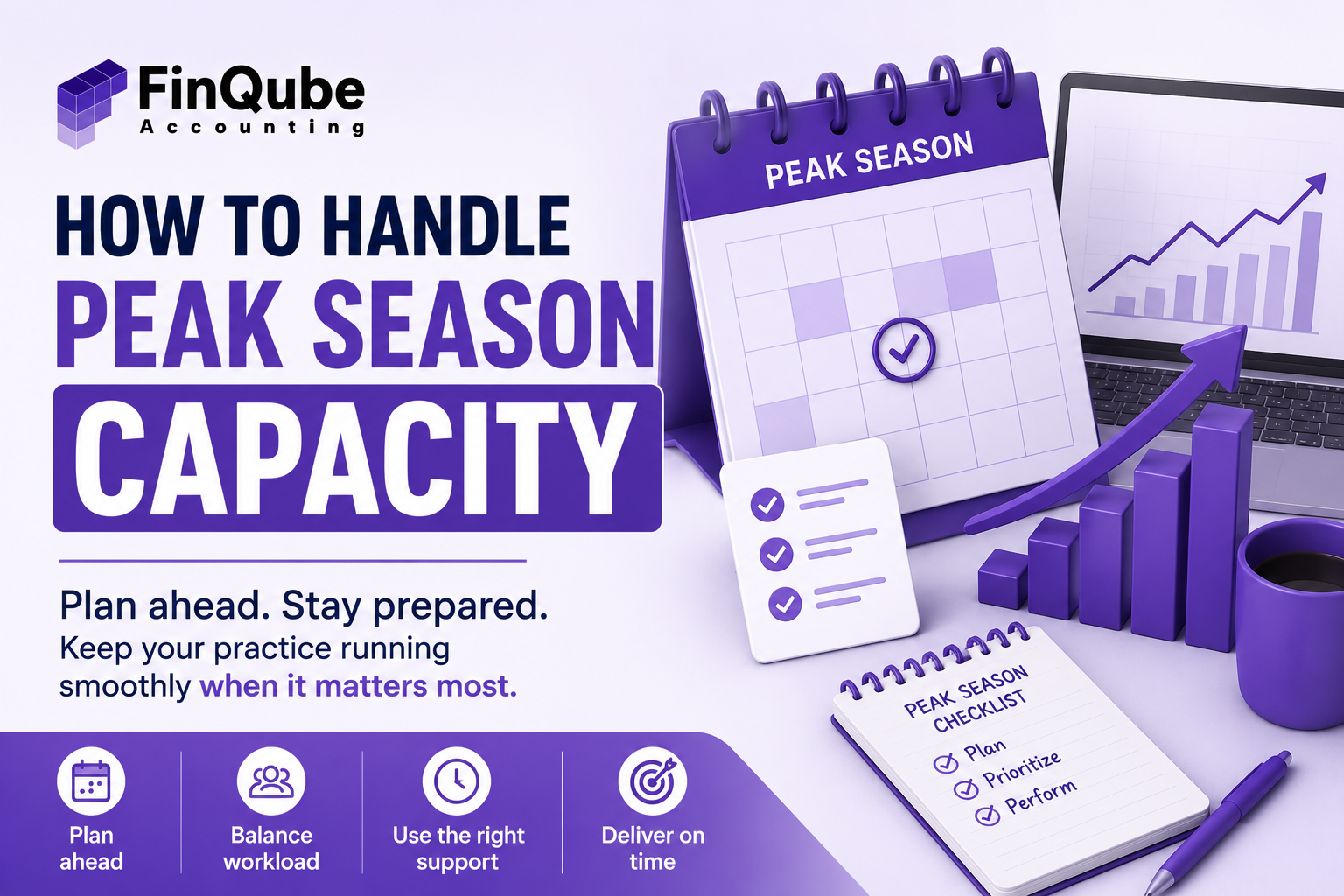
Peak season capacity is the extra output a practice needs during predictable, deadline-driven spikes. Without growing headcount for good. It covers Self Assessment in January, VAT quarters, payroll year end, and Companies House filing clusters around client year ends.
Most practices staff for an average week. When workload doubles or triples for a set stretch, something has to close that gap. Either a plan closes it, or unpaid overtime and rushed review do.
Capacity planning means deciding, ahead of time, where that extra output will come from. Overtime, temporary hires, or a flexible resource.
Why Does Peak Season Strain Even Well-Run Practices?
Even disciplined practices get squeezed. Peak season workload is lumpy, not steady. A practice handling 300 Self Assessment clients cannot spread that work evenly across the year. Most of it lands in the final six weeks, because that is when clients hand over their records.
According to HMRC's own figures, 8.6 million people had filed with just over a week left before the 2026 Self Assessment deadline. Several million returns get filed in the final fortnight alone, across the whole UK market. Most practices see the same pattern in their own client base.
Layer a hiring shortage on top of that. Recruiting experienced tax and accounts staff takes months. Skilled candidates are hard to find exactly when practices need them most. Firms end up overworking existing staff, or turning away work they would otherwise take on.
A recent AccountingWeb review of in-demand skills for 2026 points to the same issue. Firms still running on fragmented, manual processes carry more risk into every deadline period. There is no easy way to flex capacity when demand spikes.
Who Is Responsible for Managing Capacity Planning?
In most practices, capacity planning falls to the partner or practice manager. Usually as a reactive call made in November or December, not a planned one made in spring.
That timing is the root cause of most peak season chaos. By the time a partner realises the team cannot cope, recruitment takes too long for a permanent hire. Temporary cover is either unavailable or too costly on short notice.
A practice manager who owns capacity planning as a year-round job, checking workload against team hours every quarter, catches the gap early. That is also the point where a flexible engagement, brought in before the crunch rather than during it, does the most good.
When Do UK Accounting Practices Face Their Busiest Periods?
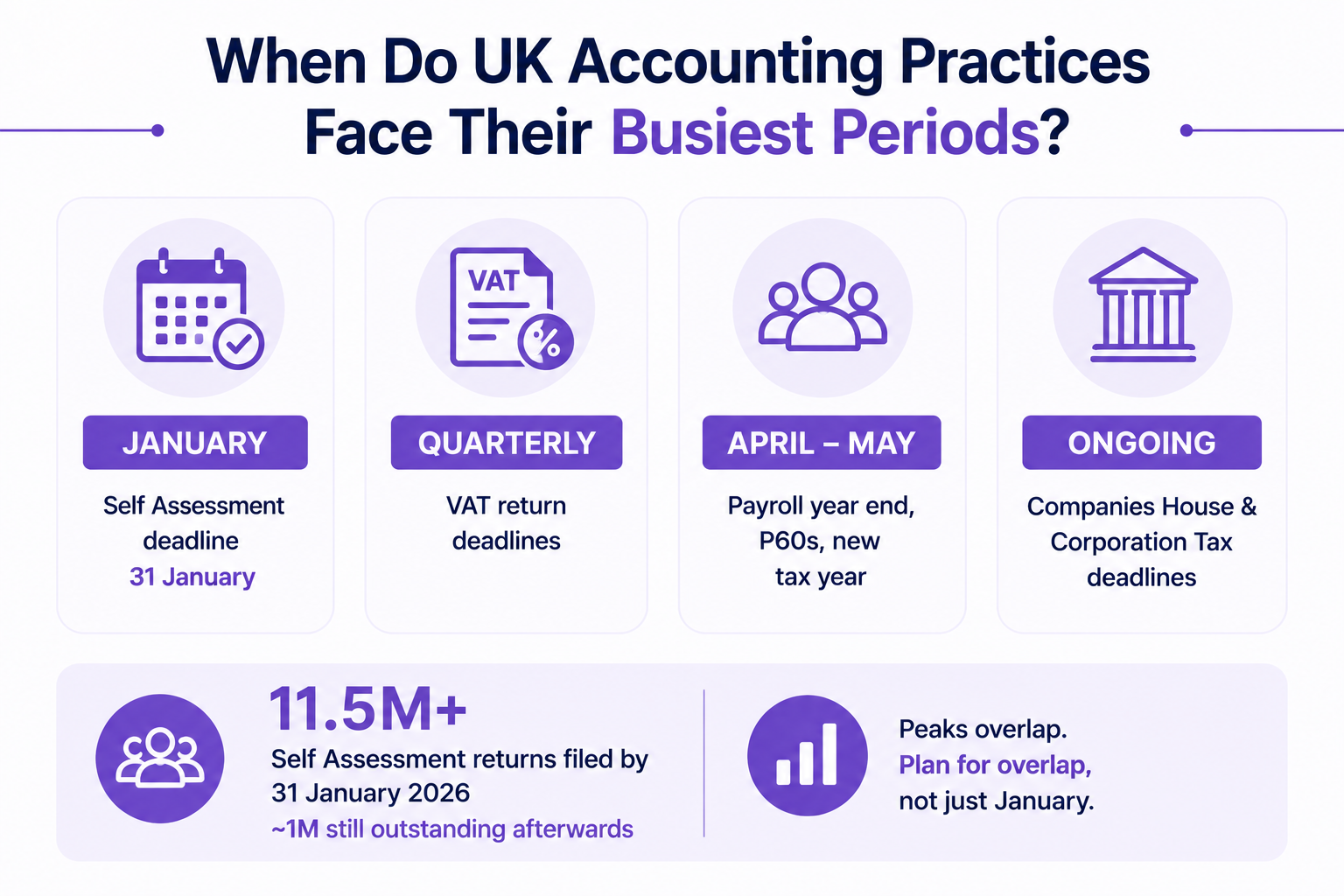
UK practices hit several predictable peaks through the year, not just January:
- January. Self Assessment filing and payment deadline on 31 January
- Quarterly. VAT return deadlines, staggered across client quarter ends
- April to May. Payroll year end, P60s, and new tax year setup
- Ongoing. Companies House and Corporation Tax deadlines clustered around client year ends, which bunch heavily around common dates
The Low Incomes Tax Reform Group reported that roughly 11.5 million Self Assessment returns got filed by the 31 January 2026 deadline. An estimated 1 million stayed outstanding afterwards. Every one of those late filers becomes urgent work for a practice in February and March, on top of whatever else is already in the pipeline.
For firms running payroll, VAT, and year-end accounts, these peaks rarely line up neatly. A capacity plan needs to account for overlap. Not just the headline January spike.
Where Do Capacity Gaps Usually Appear First?
Capacity gaps tend to show up in review, not data entry. Junior staff can usually keep pace with processing by working longer hours. What breaks down is the partner or senior review layer. There is only so much a qualified reviewer can sign off in a day without cutting corners.
This is also where errors slip through. A rushed final review, done at the end of a 12-hour day, is exactly where a reconciliation mismatch or a missed relief goes unnoticed. The bottleneck is rarely the capacity to produce work. It is the capacity to check it properly before it reaches the client.
Cash flow and admin work make up the second common gap. Chasing debtors, processing supplier payments, and managing AP and AR queues get pushed aside during peak season. They feel less urgent than a filing deadline. But letting them slide creates a second backlog once deadline season ends.
How Do You Build a Capacity Plan That Survives Peak Season?
A capacity plan that holds up has three parts. Forecasting, flexible resourcing, and a review structure that does not collapse under volume.
- Forecast workload by client type and deadline, at least two quarters ahead. Not two weeks ahead.
- Work out which tasks can go to a flexible resource, without losing quality control or client relationships.
- Bring in extra capacity before the peak starts. New team members should already know your processes when volume hits.
- Protect senior review time, so quality does not drop as volume rises.
The engagement model matters here. A firm with only one lever, hire permanently or do nothing, ends up choosing between overspending or under-resourcing every peak. Finqube's engagement models range from ad hoc overflow support with no minimum commitment through to a full team of specialists. They are built so a practice can flex capacity up for a defined peak, then back down once it passes. Without a permanent headcount decision.
Finqube vs In-House Hire vs Traditional Remote Provider
Every way of closing a capacity gap comes with trade-offs. The table below compares a dedicated Finqube resource with hiring in-house or using a traditional remote provider.
A permanent in-house hire carries full salary, employer National Insurance, pension contributions, and the cost of recruiting in a tight market. A dedicated Finqube resource works on a different basis. You pay for the work, not for a full-time headcount. To see what this looks like against your own numbers, talk it through on a discovery call before deciding what peak season cover should look like for your practice.
Real Scenario
Rachel Ainsworth runs a nine-person practice in the Midlands. Her client base leans heavily on sole traders and small limited companies.
Every January, her team of three accounts staff worked six-day weeks through the whole month. Reviews still slipped to the last two or three days before the deadline.
By the second week of January, junior staff were producing work faster than Rachel could review it properly. She was signing off returns at 9pm, having barely looked at the working papers. She knew it. Two years running, a reconciliation error reached a client's return and had to be fixed after filing.
Ahead of the following January, Rachel brought in a dedicated Finqube accountant to absorb the bookkeeping and first-pass return preparation for her Self Assessment clients. Finqube's AI review software flagged reconciliation issues before anything reached her desk.
The team still worked hard in January. But Rachel's own review time dropped from full evenings to roughly two hours a day. She was reviewing files that had already been checked, not raw first drafts. No returns went out with unresolved reconciliation issues that year. Her team left the office before 7pm for most of the month.
How Finqube Can Help
Peak season capacity is not really a headcount problem. It is a visibility problem. You need to know work is accurate before it reaches your desk, so your review time goes into judgement calls, not catching basic errors.
Every Finqube engagement includes AI review software at no extra cost. Before a file reaches your review, it has already been checked for reconciliation mismatches, outstanding AP and AR items, and common preparation errors. You review work that is already clean. That is the difference between a two-hour review and a six-hour one, in the busiest week of the year.
This sits alongside dedicated accountants who work inside your existing systems, whether that is Xero, QuickBooks, Sage, FreeAgent, or any other software. Support covers corporation tax and self assessment as well as bookkeeping and accounts finalisation during year end.
Because there is no minimum commitment, you can bring in extra capacity for the specific weeks you need it. Then scale back down once the deadline has passed, without carrying a permanent cost through the quieter months.
Conclusion
Peak season will keep coming round every year, whether your practice is ready or not. The firms that get through January without burnout, and without review shortcuts, are the ones that treat capacity as something to plan for in spring. Not something to panic about in December.
If you want to see what flexible capacity would look like for your own practice, book a discovery call. There is no minimum commitment, so you can bring in support for exactly the weeks you need it.
One month. No contract.
See how a dedicated Finqube accountant fits into your MTD workflow before you decide.
Start your free pilotFAQ
How much extra capacity does a typical UK practice need during January?
It depends on client mix. Practices with a large Self Assessment book often need 30 to 50% more reviewing and processing capacity in the final six weeks of January, compared with an average month. Forecasting against your own client list beats using an industry-wide average.
Is it better to hire temporary staff or use a flexible remote accountant for peak season?
Temporary staff still need recruiting, training on your systems, and managing, all within a tight window. A dedicated remote accountant, already trained on your processes and ready within days, usually gets productive faster and carries less recruitment risk.
What is the difference between Finqube and a traditional outsourcing provider for peak season cover?
A traditional provider often sets a minimum contract of three to six months, which does not suit a short seasonal peak. Finqube's model has no minimum commitment, so you pay for the specific weeks of extra capacity you need.
Can outsourced support work inside our existing practice management software?
Yes. Finqube accountants work inside your existing systems, including Xero, QuickBooks, Sage, FreeAgent, or any other software your practice already uses. No disruptive migration before peak season starts.
How does AI review software help during the busiest weeks of the year?
It checks files for reconciliation mismatches and common preparation errors before they reach your desk. Your review time goes into judgement calls, not catching basic mistakes. That matters most exactly when review time is scarcest.
When should a practice start planning for January capacity?
Ideally by autumn, once you can see roughly how many Self Assessment clients still need to submit records. Waiting until December usually leaves only two options: overtime, or turning work away.
Does bringing in extra capacity for peak season affect client relationships?
Not when it is set up correctly. A dedicated resource works under your firm's name and processes, reviewed by your team. Clients experience a well-run practice, not a visible change in who is doing the work.
Is there a minimum contract length with Finqube?
No. Finqube's engagement models come with no minimum commitment, so you can scale support up for peak weeks and down once they pass.