.avif)

Blog Summary
- Why practice owners hesitate to outsource management accounts, and what that fear is really about.
- Five checkpoints that keep you in control while someone else does the work.
- A side-by-side look at hiring in-house, using an offshore provider, and working with a dedicated remote accountant.
- How Hughes Accountancy outsourced its management accounts without losing sign-off or visibility.
Introduction
Your management accounts are two weeks late. Again. The client is asking questions. Your team is buried in bookkeeping, not analysis.
This is the moment most practice owners start to look at outsourcing management accounts. Then a second worry hits. What if outsourcing means losing sight of the numbers?
That fear makes sense. Handing your accounts to an outside team can mean losing the review trail. It can mean losing the client relationship too. And it can mean losing the final say on what goes out the door.
Many practice owners have tried an offshore package before. They got a lower invoice. They got a black box in return. Files went out with no clear review step. Nobody could say who touched a client's numbers, or when.
It does not have to work that way. You can outsource management accounts and still approve every line before it reaches a client. This guide shows you where control usually breaks down. Then it shows you how to keep it.
What Are Outsourced Management Accounts
Outsourced management accounts are monthly or quarterly reports. An outside accountant prepares them instead of your in-house team. They cover the profit and loss statement, the balance sheet, cash flow, and commentary against budget.
The report looks the same either way. The only difference is who prepares it.
A good outsourcing partner works inside your existing software. This could be Xero, QuickBooks, Sage, FreeAgent, or any other software your clients use. They follow your templates. They flag variances before you see the file, not after a client calls asking why revenue dropped.
According to the Institute of Chartered Accountants in England and Wales (ICAEW), clients now expect clear reports as standard. It is not an extra anymore. Practices that deliver late reports risk losing clients to firms that do not.
Why Practices Outsource Management Accounts
Practices outsource management accounts because monthly reporting takes more time than most firms have. Staff shortages, busy seasons, and higher client demands push the workload past what teams can handle.
Capacity is the biggest driver. Hiring a qualified management accountant in the UK takes months. It also costs tens of thousands of pounds a year once you add salary, National Insurance, pension, and training.
Consistency is the second driver. When one person owns management accounts, illness or leave stalls the whole cycle. A dedicated outsourced accountant does not disappear when your in-house preparer takes two weeks off.
Client retention is the third driver. Clients who get late or patchy management accounts start asking other firms for quotes. According to AccountingWeb, speed and clarity are now top reasons SME clients switch accountants.
Outsourcing solves all three. And it does this without adding a permanent headcount to your practice.
Who Should Outsource Management Accounts
Any UK practice with more than a handful of management accounts clients should think about outsourcing. This fits three types of firms best.
Growing practices feel the pressure first. They have added clients faster than they have added staff. Their team cannot take on more reporting work without missing other deadlines.
Practices with one management accounts specialist carry a real risk. If that person leaves, the whole service line stalls. You then have to hire and train a replacement from scratch.
Firms moving into advisory work need their team freed up. Outsourcing the report writing lets your staff spend more time on advice. That is the work clients pay the most for.
When Is the Right Time to Outsource
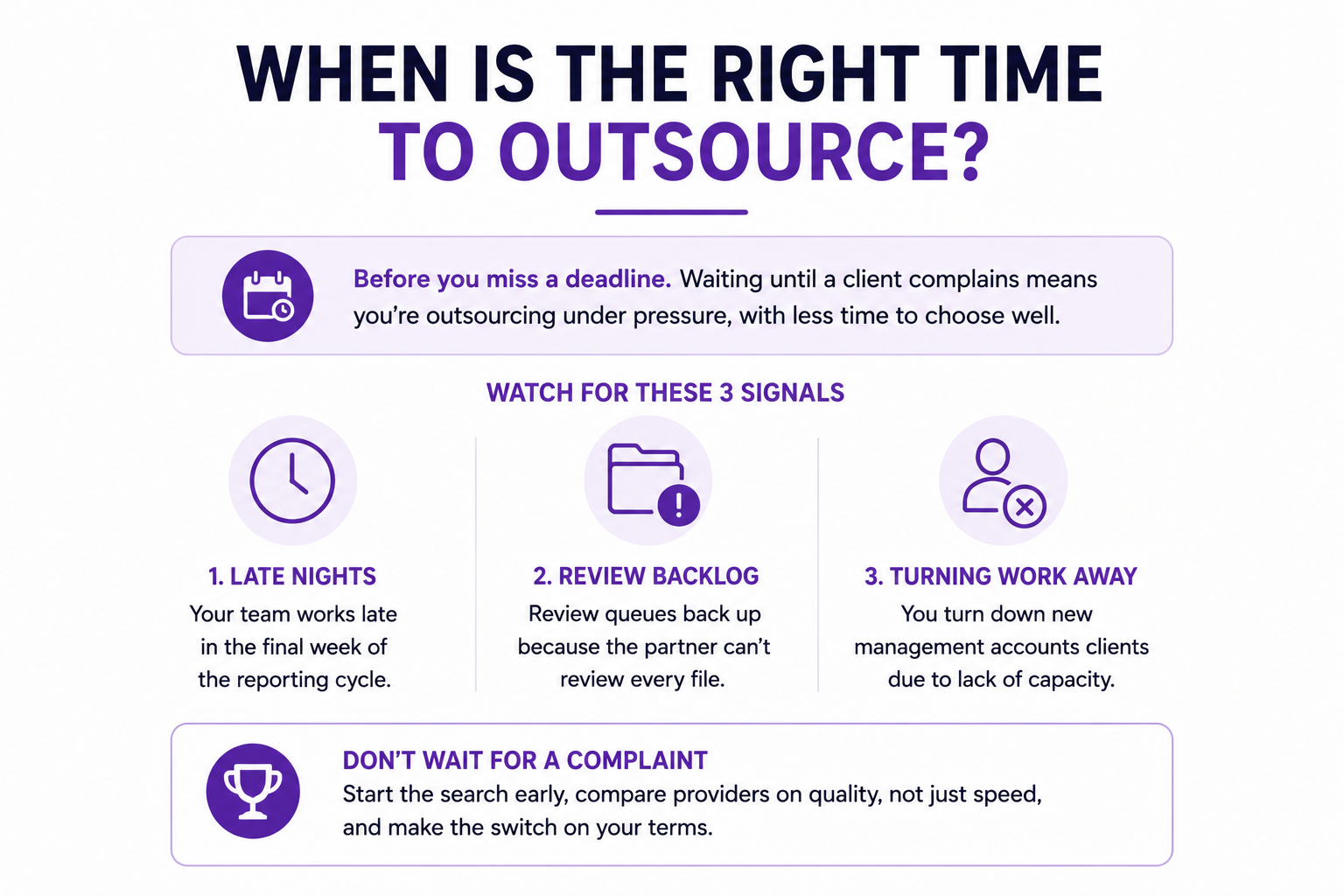
The right time to outsource management accounts is before you miss a deadline. Not after. Waiting until a client complains means you outsource under pressure. You get less time to check a partner properly.
Watch for three signals. Your team works late every month during the final week of the reporting cycle. Review queues back up because the partner cannot get to every file in time. You have turned away new management accounts clients because you lack the capacity to serve them well.
Any one of these signals means it is time to start the conversation. You do not need to switch right away. You just need to start looking.
Practices that wait for a formal complaint end up choosing fast, not well. There is less time to check references. There is less time to test the review process. Starting the search early gives you room to compare providers on quality, not just on speed.
Where Practices Lose Control When Outsourcing
This is the question every practice owner really wants answered. Where does control go missing?
Pooled teams remove ownership. Many providers rotate staff across clients. You never work with the same person twice. Nobody builds real knowledge of your client base.
No visibility removes oversight. If you cannot see what has been reviewed, what is still open, and what has been flagged, you are trusting a black box. That is not outsourcing. That is hoping.
Vague review steps remove quality control. Without a clear check before a file reaches you, mistakes travel further before anyone catches them.
Contract lock-in removes flexibility. Long minimum terms mean you cannot leave a provider that is not working, even once you know it is not working.
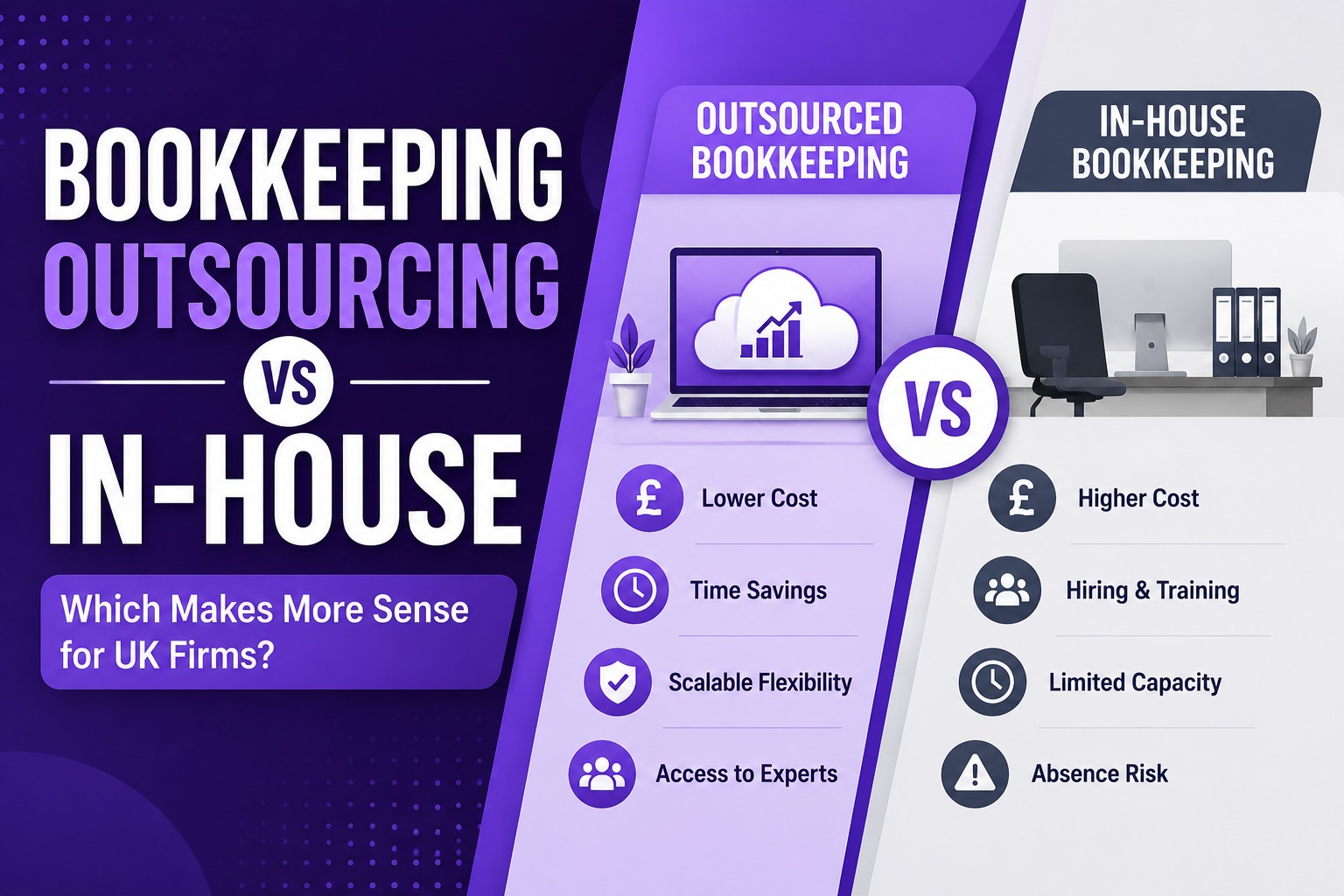
The table below shows how these control gaps play out across different outsourcing models.
Fixed pricing matters here. Hourly billing punishes you for a busy month. An annual licence fee locks you in no matter the workload. A flat monthly fee keeps your cost the same in January and in July.
Ask any provider three direct questions before you sign anything. Who will work on my files, and will that person change month to month? What happens to a file before it reaches me, step by step? What does it take to leave, if the service does not meet my standard? If a provider cannot answer all three clearly, do not hand them your clients' numbers.
How Management Accounts Outsourcing Actually Works
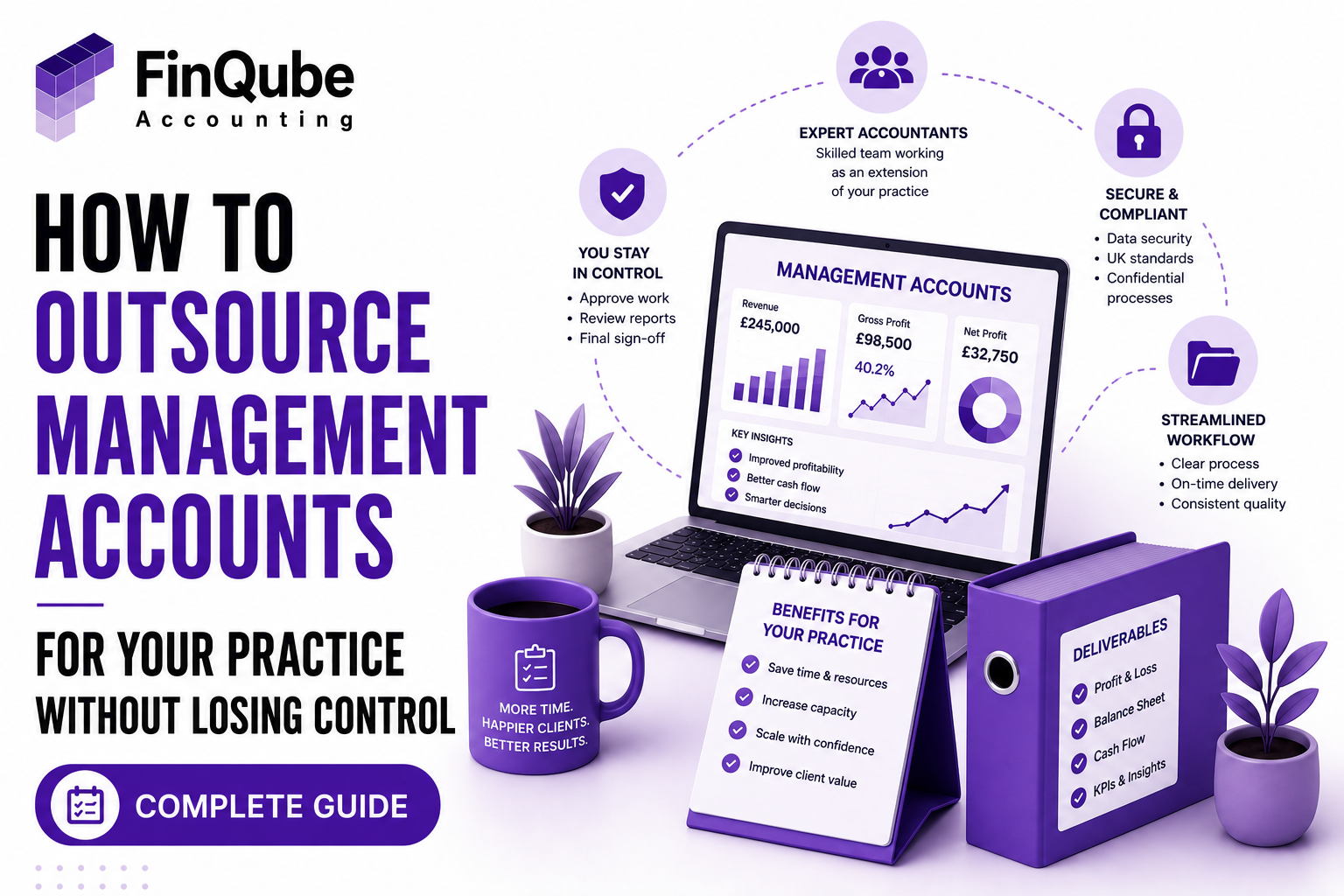
Management accounts outsourcing runs through four steps. Setup, monthly work, review, and delivery. Each step has its own check.
Setup starts with access to your systems. A good partner does not ask you to change software. They work inside Xero, QuickBooks, Sage, FreeAgent, or any other software you already use.
Monthly production follows your own templates, not a generic format. Bank reconciliation, accruals, and journal entries all follow your reporting calendar.
Review is where control lives. A file should pass through an automated check before any human signs off. This catches mismatches and odd variances early.
Delivery puts the finished report in front of you for final approval. Nothing reaches the client until you say so. You keep the last word, every time.
This structure matters because it adds a check at every stage, not just one at the end. Errors get caught close to where they happen. A mistake never reaches your desk dressed up as a finished report.
According to ACCA, a clear review process leads to fewer restated reports. It also means fewer client queries. A clear process cuts errors you would otherwise fix later.
Hughes Accountancy: A Real Scenario
Daniel Hughes runs Hughes Accountancy. His UK practice manages accounts for over 40 clients. Before outsourcing, he spent the last ten days of every month chasing his own team for sign-offs.
He had no clear view of which files were reviewed. He had no view of which were still stuck in a queue. Deadlines slipped. Clients noticed.
Hughes brought in a dedicated FinQube accountant. That accountant worked inside his own Xero and QuickBooks setup. FinQube's AI review tool scanned every file for mismatches and errors first. Only then did it reach Hughes for sign-off.
By month two, Hughes had recovered 12 hours a week. He stopped chasing his team entirely. He could see exactly where every file stood, without asking anyone.
How FinQube Can Help
FinQube removes the two biggest fears in outsourcing management accounts. Losing your named point of contact. And losing sight of the work.
You get one dedicated accountant assigned to your practice, not a rotating pool. That accountant learns your clients, your templates, and your review standards over time.
Every file passes through FinQube's AI review first. Your outsourced accountant sees it only after. The system flags mismatches, odd account movements, and common errors on its own. Problems surface before your partner sees the file.
Your accountant works inside the systems you already use. This could be Xero, QuickBooks, Sage, FreeAgent, or any other software your clients run on. There is no migration project. There is no retraining your team.
Pricing is a fixed monthly fee, agreed upfront. It is not an hourly bill that punishes a heavy reporting month. There is no minimum contract term. You stay because it works, not because you are locked in.
UK practices often worry about IR35. FinQube sets up every engagement as a services agreement, not a labour supply deal. This keeps the work clearly outside employment status.
Ready to see how this works for your practice? Book a call with FinQube and get a named accountant reviewing your first client file this month.
One month. No contract.
See how a dedicated Finqube accountant fits into your MTD workflow before you decide.
Start your free pilotConclusion
Outsourcing management accounts does not mean giving up control. It means putting a clear review process between the numbers and the client, with a named accountant who answers to you.
The practices that get this right choose one dedicated accountant. They choose a documented review step. They choose pricing that does not lock them in. The practices that get it wrong choose the cheapest offshore package. They lose visibility within a month.
Start with the checkpoints in this guide before you sign anything. Then book a call with FinQube to see how a dedicated accountant and AI review fit your workflow.
FAQ
What are outsourced management accounts?
Outsourced management accounts are monthly or quarterly reports. They cover profit and loss, balance sheet, and cash flow. An outside accountant prepares them inside your existing systems and templates.
How much does it cost to outsource management accounts in the UK?
Costs vary by provider. They depend on how many clients you have and how complex your reports are. FinQube uses a fixed monthly fee, agreed upfront. Your cost stays the same no matter the workload.
Is outsourcing management accounts safe for client data?
Good providers encrypt access and follow GDPR rules for data. They also write down their review steps. Ask any provider for their security policy. Check their ICO registration before you share client files.
Will I lose control of the numbers if I outsource management accounts?
No, as long as your provider gives you final sign-off on every file. You also need full visibility into what has been reviewed. A named accountant with a documented review step keeps you in control the whole way through.
Can I outsource management accounts without switching accounting software?
Yes. A proper outsourcing partner works inside the software you already use. This includes Xero, QuickBooks, Sage, FreeAgent, or any other software. You should never need to migrate.
How is management accounting different from statutory accounting?
Management accounting is for internal use. It helps you make decisions. Firms prepare it monthly or quarterly. Statutory accounting is different. It is the annual report filed with Companies House.
How long does it take to start outsourcing management accounts?
Most practices onboard a dedicated accountant within one to two weeks. Hiring and training someone in-house takes three months or more.