.avif)

Blog Summary
- What is bookkeeping outsourcing?
- Why do UK firms outsource bookkeeping?
- Who should outsource bookkeeping?
- When does in-house bookkeeping stop working?
- Where do bookkeeping errors happen most?
- How does outsourced bookkeeping work?
Introduction
Most practice owners do not plan to build a bookkeeping bottleneck. It just happens. One staff member leaves. Another goes on leave. The rest of the team picks up the slack.
Soon a partner is checking reconciliations at 9pm on a Wednesday. Sound familiar? You are not alone.
This is not a staffing problem. It is a structural one. That is why more UK firms now weigh bookkeeping outsourcing against their current in-house setup.
This guide covers the real differences. What each model costs. Where each one fails. And what to check before you switch.
What Is Bookkeeping Outsourcing for UK Accounting Firms?
Bookkeeping outsourcing means handing daily bookkeeping tasks to a team outside your practice. This covers bank reconciliations, transaction coding, VAT prep, accounts payable and receivable, and period-end close.
The key difference is how that external team works with you. Some providers work alone and hand back finished files. Others place a dedicated accountant inside your own systems. This second model gives you visibility at every step.
Outsourced bookkeeping is not the same as sending work offshore with no oversight. It is a clear setup. One named person handles your bookkeeping, inside the systems your practice already uses, such as Xero (or any other software).
Why Are UK Firms Reconsidering the In-House Model?
In-house bookkeeping carries costs that rarely show up as one line on the P&L. That is why owners often underestimate the true cost until they try to replace a bookkeeper.
Recruiting a mid-level bookkeeper in the UK typically costs 20% to 30% of their annual salary. This includes agency fees, onboarding time, and the productivity lost while they learn the role. On a £28,000 salary, that adds up to £5,600 to £8,400 before the new hire reconciles a single account.
Three pressures push firms to reconsider:
Capacity is unpredictable. VAT quarters, year-end, and MTD deadlines often land at once. A stretched in-house bookkeeper creates a queue. The partner ends up managing it personally.
Accuracy depends on one person. When a bookkeeper is under pressure, mistakes reach review. The partner catches them. Or, on a bad week, they do not.
Flexibility is limited. You cannot scale a permanent hire down in a quiet month. You cannot scale one up quickly when a big client signs on.
Who Should Consider Outsourced Bookkeeping?
Outsourced bookkeeping does not suit every practice at every stage. The firms that benefit most share a few traits.
Practices with 2 to 15 staff tend to fit best. They have enough client volume to justify dedicated support, but not enough scale to carry a full in-house team without strain.
Practices with seasonal peaks benefit the most. If your team runs fine for nine months and scrambles for three, outsourcing handles the spike without a permanent hire.
Owners who want out of daily review are a strong fit too. If a partner keeps catching bookkeeping errors before accounts prep, the problem sits upstream. Good outsourced bookkeeping should fix files before they reach the partner.
Firms unlikely to benefit include those tied to one large client needing on-site work, or those running bespoke systems that cannot be accessed remotely.
When Does In-House Bookkeeping Stop Making Sense?
The in-house model breaks down at one clear point. That is when it costs more to run than the work it produces is worth.
This tipping point is hard to spot because the costs are spread out. A partner spending 40 minutes a day fixing bookkeeping does not show up on any invoice. Neither does the time lost re-training after someone leaves.
Watch for these three signs together:
Repeat staff turnover in bookkeeping. If you have hired for the same role twice in three years, the in-house model has already cost more than its salary line shows.
Review bottlenecks caused by errors. If files sit stuck at review because reconciliations are incomplete, the problem is not the reviewer. It sits earlier in the process.
You cannot take on new clients without hiring first. If every growth conversation ends with "we need another person first," your capacity model is not working.
Where Do Bookkeeping Errors Happen Most Often?
Knowing where bookkeeping breaks down matters when you compare providers. Not every outsourced arrangement works the same way.
The most common failure points in UK bookkeeping are:
Bank reconciliation mismatches. Transactions coded to the wrong period or account create mismatches. These compound through the month. By the time a partner sees the file, fixing it can take hours.
Accounts payable coding errors. Supplier invoices coded to the wrong project or cost centre skew management accounts. That affects decisions the client is making right now.
Unflagged AR items. Debtors left unchecked through the period create cash flow risk. This should be visible before the management pack goes out.
Missed or misapplied accruals. Prepaid expenses booked in the wrong period, or accruals left out at month end, create gaps that take time to trace.
The real question for any provider: how do they catch these before the file reaches the partner?
How Does Outsourced Bookkeeping Work in Practice?
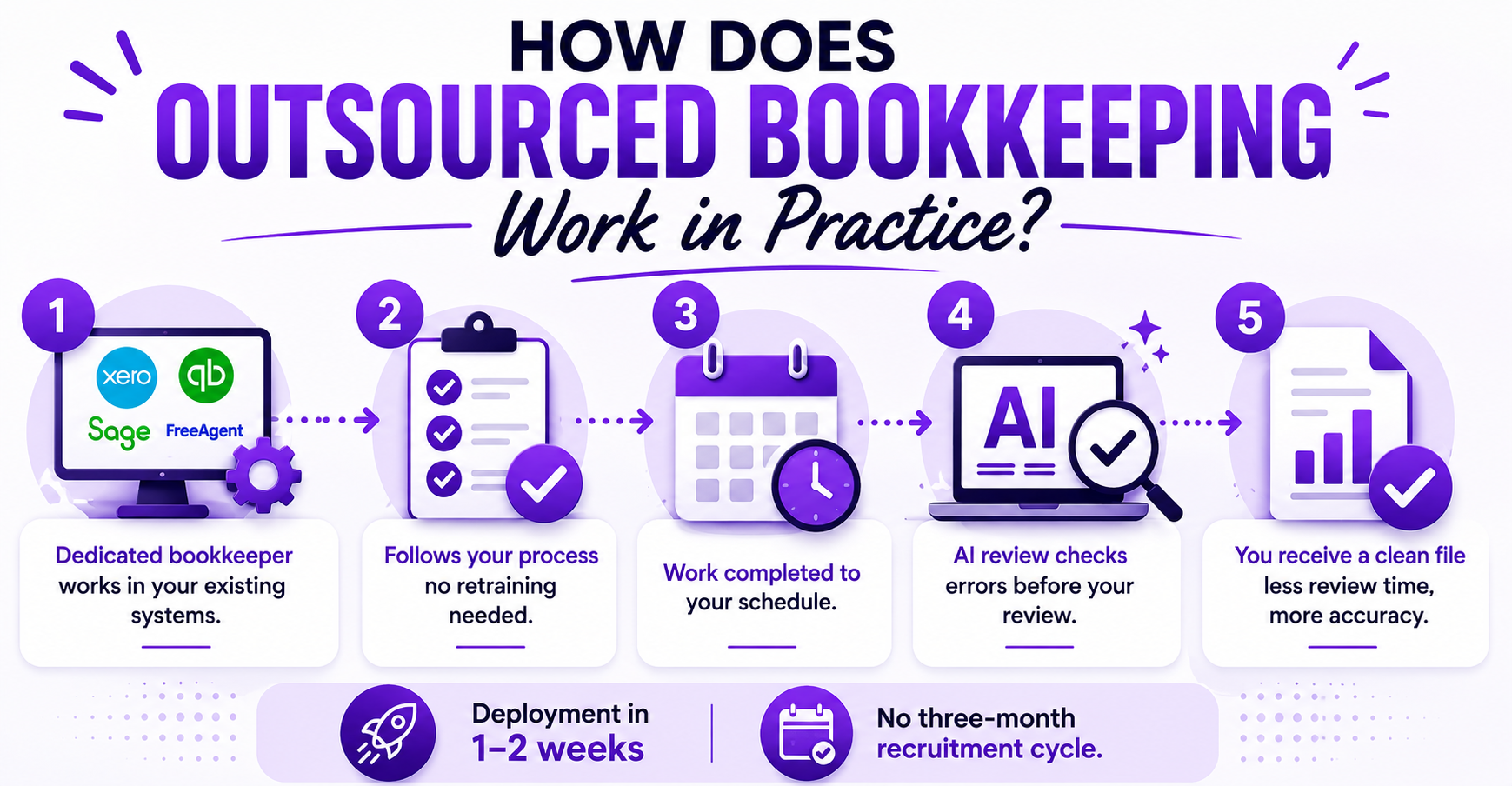
A well-run outsourced bookkeeping setup uses one named person. They work inside your systems and follow your review process.
At Finqube, the model runs in five steps:
- A dedicated bookkeeper joins your practice and gets access to your existing tools, such as Xero, QuickBooks, or Sage (or any other software).
- They follow the process your practice already uses. Your review team does not need retraining.
- Work runs to your schedule: daily coding, weekly reconciliation checks, and period-end prep as needed.
- Before the file reaches you, our AI review software scans for reconciliation mismatches, unflagged AP and AR items, and common prep errors.
- You get a file that is already clean. Your review time drops because the errors were caught first.
Deployment takes one to two weeks. There is no three-month hiring wait.
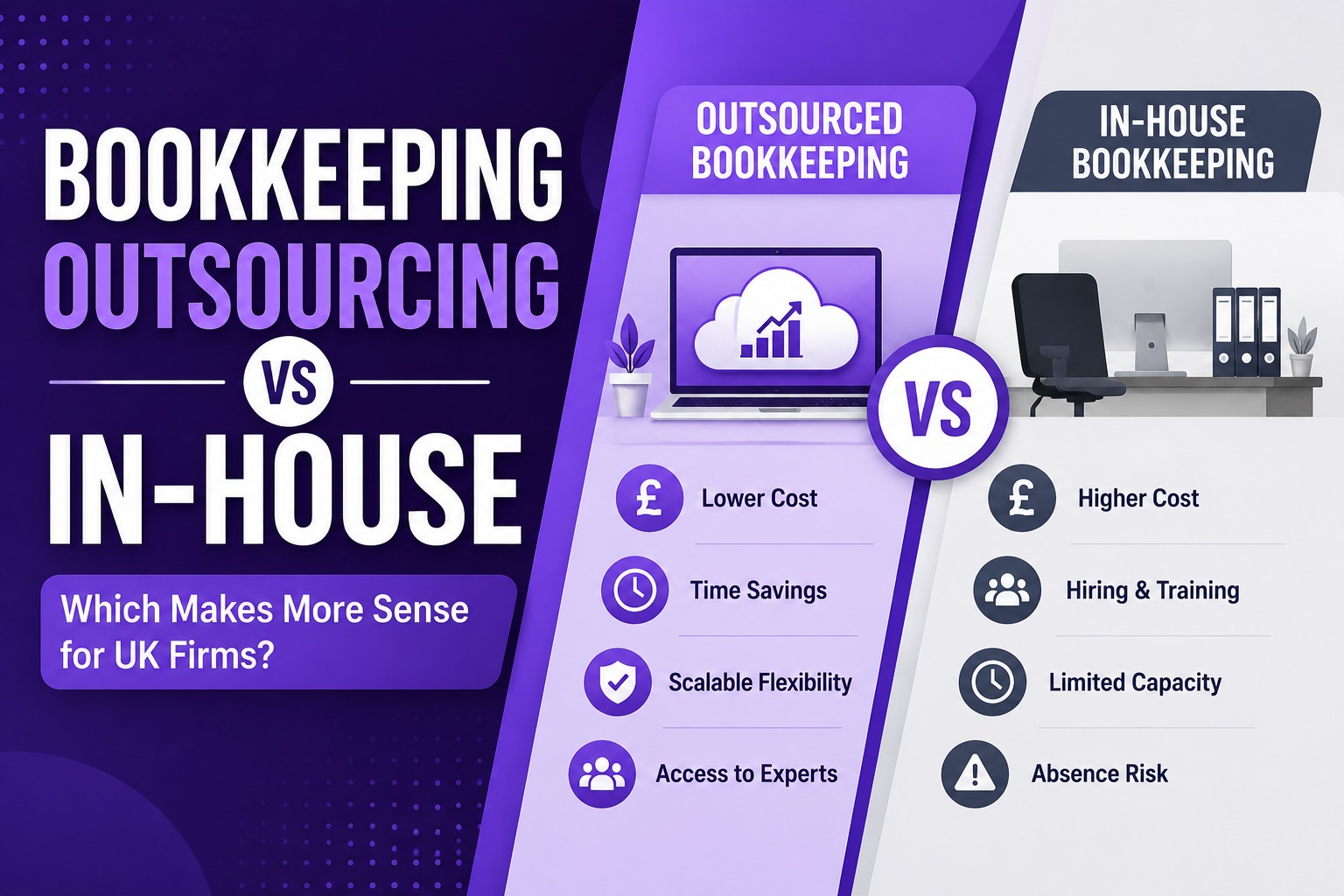
Outsourcing vs In-House: A Side-by-Side Comparison
Real Cost Comparison: Outsourcing vs In-House
Owners often compare the monthly cost of outsourcing straight against a bookkeeper's salary. That comparison misses the full picture.
A straight salary comparison only favours in-house if the bookkeeper stays, stays accurate, and stays busy all year. Most practices find at least one of those conditions fails within two years.
Compliance and MTD Considerations
Bookkeeping quality feeds straight into compliance risk. MTD for VAT already applies to VAT-registered businesses above the threshold. MTD for Income Tax Self Assessment is now live too, following a phased rollout from April 2026.
Errors that reach VAT return stage create amendment risk. For a practice with 30 to 50 VAT clients, even a small error rate in the underlying records adds real filing time and real risk.
An outsourced bookkeeping setup with structured review before submission removes that risk at the source. It does not wait for the partner to catch it.
Real Scenario: A Practice That Made the Switch
Priya Shah runs Shah & Co Accountants in Leeds, a nine-person practice. Her bookkeeper left in early 2026, right before VAT quarter-end. Two clients' files sat unreconciled for three weeks while she interviewed replacements.
Priya brought in a dedicated Finqube bookkeeper instead of hiring again. The bookkeeper worked inside her existing Xero (or any other software) setup from day one. Within the first month, the AI review flagged a run of miscoded AP entries that had gone unnoticed for two quarters.
By month two, Priya was no longer checking reconciliations herself before client sign-off. She now spends that time on client advisory work instead.
How Finqube Can Help
Finqube provides dedicated remote bookkeepers who work inside your existing systems, whether that is Xero, QuickBooks, Sage, or any other software. Every engagement includes our AI review software, which gives you a live view of every file your bookkeeper is working on.
Before a file reaches your review, the software has already flagged reconciliation mismatches, unflagged AP items, and common prep errors. You review a file that is already clean.
There is no minimum contract term. The commitment level is none. Deployment takes one to two weeks.
Relevant pages:
- Our Dedicated Accountant Model: how a dedicated remote bookkeeper works
- Bookkeeping and Accounts Finalisation: full service scope
- Compare Your Costs: see how the numbers stack up against your current setup
Conclusion
The in-house versus outsourced bookkeeping decision is not really about cost. It is about whether your current setup gives you the accuracy, capacity, and visibility your practice needs.
For most UK practices with 2 to 15 staff, the in-house model puts a ceiling on growth. It limits how fast you can take on clients, how well you handle busy periods, and how much partner time goes into fixing errors instead of reviewing work.
A well-run outsourced setup, with one dedicated person inside your systems and a review layer before files reach you, removes that ceiling. You keep control.
Talk to Finqube and see the difference in your first month.
One month. No contract.
See how a dedicated Finqube accountant fits into your MTD workflow before you decide.
Start your free pilotFrequently Asked Questions
What is bookkeeping outsourcing for a UK accounting firm?
It means working with an outside provider to handle ongoing bookkeeping: bank reconciliations, transaction coding, VAT prep, and period-end close. The best setups place a dedicated bookkeeper inside your own systems, rather than working apart from you.
How does outsourced bookkeeping cost compare to hiring in-house?
A salary-only comparison hides the true cost of hiring. Employer NI, pension, recruitment, and untracked partner time spent fixing errors add 30% to 50% on top of the headline salary. Outsourcing rolls those costs into one fixed monthly fee.
Will I lose control of my clients' accounts if I outsource bookkeeping?
Not with a well-run provider. Your dedicated bookkeeper works inside your existing systems. You see every file at every stage. Our AI review flags issues before they reach you, so you keep full oversight without doing the prep work yourself.
How long does it take to switch to outsourced bookkeeping?
With Finqube, deployment takes one to two weeks. Hiring and onboarding an in-house bookkeeper usually takes three months or more. Most traditional remote providers take four to eight weeks.
What bookkeeping tasks can be outsourced?
Bank reconciliations, transaction coding, accounts payable and receivable, VAT return prep, payroll support, period-end close, and management account prep can all be outsourced. You agree the exact scope at the start.
Is outsourced bookkeeping suitable for firms under MTD rules?
Yes. A setup with structured review before submission cuts the risk of errors reaching VAT or MTD filings. Our AI review flags reconciliation and coding issues before they reach submission stage.
What happens if my outsourced bookkeeper makes an error?
Every piece of work goes through our AI review before it reaches you. Errors get flagged before partner review, not after. If something needs fixing, your dedicated bookkeeper handles it before the file leaves their queue.