.avif)

Blog Summary
- Why late or wrong RTI filings put your firm at real financial risk, and how outsourcing removes that risk.
- How payroll outsourcing UK frees your best staff from repetitive work, so they can focus on advisory services.
- What a proper outsourced payroll partner should offer: a named accountant, your existing software, and fixed pricing.
- How a real UK practice cut payroll stress and HMRC penalty risk after it switched to outsourcing.
INTRODUCTION
It's 4 p.m. on a Friday. Payroll is due tomorrow.
Your payroll clerk is off sick. Three clients still haven't sent their hours.
This is the reality behind every payroll outsourcing UK search. Practice owners aren't looking for theory. They want a way out of this exact scenario.
Payroll outsourcing UK means handing your clients' payroll runs to a specialist provider. They process the payslips. They file RTI to HMRC. They manage auto enrolment. Your firm stays the face of the relationship.
This isn't about giving up control. It's about removing the parts of payroll that eat your week and add no value to your client relationships.
Below, we walk through exactly why UK firms make this switch. We also show what changes for your team, your clients, and your bottom line once they do.
WHAT IS PAYROLL OUTSOURCING FOR UK ACCOUNTING FIRMS?
Payroll outsourcing means an external provider runs your clients' payroll on your behalf. You keep the client relationship. They handle the processing.
This covers three main jobs. First, payslip generation. Second, RTI submissions to HMRC. Third, auto enrolment pension duties.
Most providers work inside your existing software. That includes Xero, QuickBooks, Sage, BrightPay, or any other software your practice already uses. You don't need to switch systems to outsource payroll.
Firms often confuse outsourcing with simply buying better payroll software. These are not the same thing. Software still needs a skilled person to run it correctly every single month.
An outsourced payroll uk provider supplies that person, or a full team, alongside the software you already own. You get the finished output without the staffing headache behind it.
Think of it this way. Software is the tool. A provider is the skilled hand that uses the tool correctly, every time, on deadline.
Table 1: Payroll Outsourcing vs In-House Payroll vs Payroll Software Alone
WHY UK ACCOUNTING FIRMS OUTSOURCE PAYROLL
Firms outsource payroll for three main reasons. They want to protect deadlines. They want to cut HMRC penalty risk. They want to free senior staff for higher-value work.
Payroll is deadline-driven and unforgiving. Miss an RTI submission, and HMRC penalties start automatically. There's no grace period once the free annual default is used up.
According to RossMartin's summary of HMRC penalty rules, late filing penalties range from £100 a month for firms with 1 to 9 employees. They rise to £400 a month for firms with 250 or more staff on the payroll.
Now multiply that risk across dozens of clients. One missed deadline becomes an expensive, repeating problem fast.
Outsourcing removes much of that exposure. A dedicated provider tracks every deadline, across every client, every single month. Nothing slips through during your busiest weeks.
There's also a talent problem worth naming. Payroll specialists are hard to recruit. They're even harder to retain once trained. Every time one leaves, your firm restarts the hiring clock.
Outsourcing sidesteps that cycle completely. You get continuity without needing to manage a payroll career path in-house.
Firms also outsource because payroll rules keep changing. Auto enrolment thresholds move. National Insurance rates shift. Student loan repayment bands update most tax years. Staying current takes real, ongoing effort.
A specialist provider tracks these changes as their full-time job. Your firm benefits without needing to monitor every legislative update yourself.
WHO BENEFITS MOST FROM OUTSOURCED PAYROLL?
Small and mid-sized UK accounting practices benefit most. This is especially true for firms running payroll for 20 or more clients without a dedicated payroll team.
Sole practitioners benefit in a very direct way. Many run payroll themselves, late at night, after billable work is done. Outsourcing gives that time back immediately.
Growing firms benefit too, but for a different reason. Payroll headcount doesn't scale smoothly. You either overstaff for quiet months, or you understaff for busy ones. Outsourcing removes that guessing game.
Larger firms benefit as well, particularly with complex payroll types. CIS payroll for construction clients is one clear example, since deduction rules add real complexity. Our guide on CIS payroll outsourcing covers that scenario in more detail.
Firms with multiple payroll frequencies also benefit. Weekly, fortnightly, and monthly runs for different clients strain a small in-house team fast.
One group may not need to outsource yet. Firms with a strong, stable in-house payroll team and genuine spare capacity can often manage well on their own. Everyone else usually benefits from some level of support.
WHEN SHOULD YOUR FIRM CONSIDER OUTSOURCING?
The right time is before payroll errors happen, not after. Watch for three clear signals.
First, payroll consistently gets pushed to the last possible day. This means your capacity has already run out.
Second, adding new payroll clients feels risky rather than exciting. That's a growth ceiling caused by staffing, not by client demand.
Third, one staff member's holiday or illness puts deadlines at real risk. That's a single point of failure your firm can't afford.
Auto enrolment re-declaration dates are another common trigger point. Year-end P60 season is another. Many firms start their outsourcing search right after a stressful April.
Waiting until a penalty notice arrives is the most expensive way to make this decision. By then, the damage to client trust has often already started.
A better approach is to review your payroll capacity every year. Do this before your busiest season, not during it.
WHERE DOES OUTSOURCED PAYROLL PROCESSING HAPPEN?
Reputable UK-facing providers process payroll within secure, access-controlled systems. This applies whether the team is onshore or offshore, as long as data protection standards align with UK GDPR.
Location matters less than process. What actually matters is who can access client data, how that data is encrypted, and whether the provider is contractually accountable to your firm.
Ask any prospective provider three direct questions. Where is their team based? How is data stored? What happens if something goes wrong? A serious provider answers all three without hesitation.
Firms should also confirm how the provider is structured legally. A services agreement is different from a labour supply arrangement, and this distinction matters directly for IR35 exposure.
This isn't a minor detail. Getting it wrong can create compliance risk for your own firm, not just for the provider. Always ask for this in writing before you sign anything.
HOW PAYROLL OUTSOURCING WORKS, STEP BY STEP
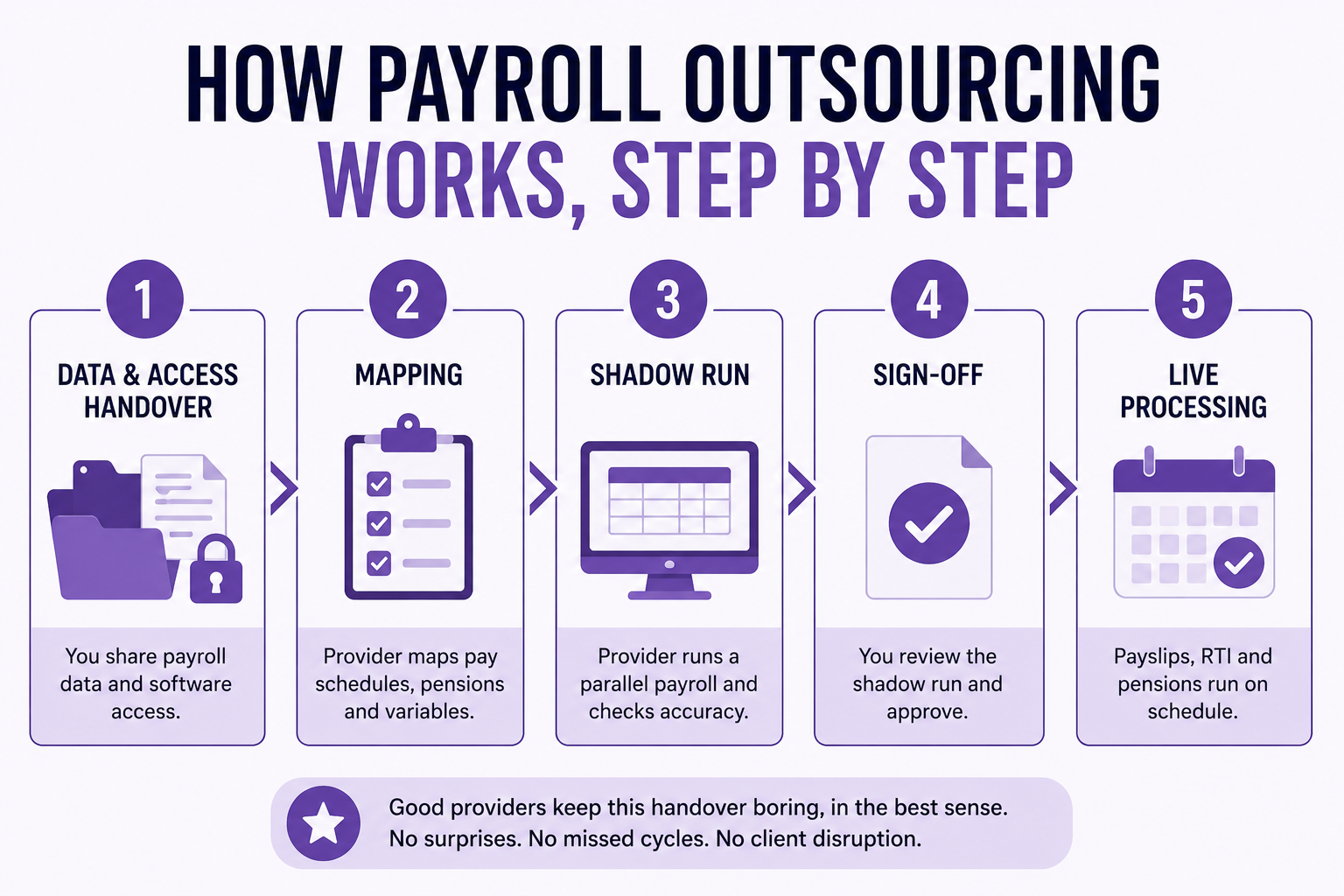
The process moves from data handover to live payroll runs. This typically takes one to two payroll cycles from start to finish.
Step one: data and access handover. Your firm shares client payroll data and existing software access with the provider.
Step two: mapping. The provider maps each client's pay schedule, pension scheme, and any variable elements. This includes overtime, bonuses, and commission structures.
Step three: a shadow run. The provider runs a parallel or shadow payroll. They check the results against your last real payroll run for accuracy.
Step four: sign-off. Your firm reviews the shadow run. Once it matches, you approve the provider to take over live processing.
Step five: live processing. Payslips, RTI submissions, and pension contributions continue on schedule. Your firm reviews outputs before they reach clients, at least during the early months.
Good providers keep this handover boring, in the best sense. No surprises. No missed cycles. No client disruption.
If a provider can't explain their own onboarding process clearly, treat that as a warning sign.
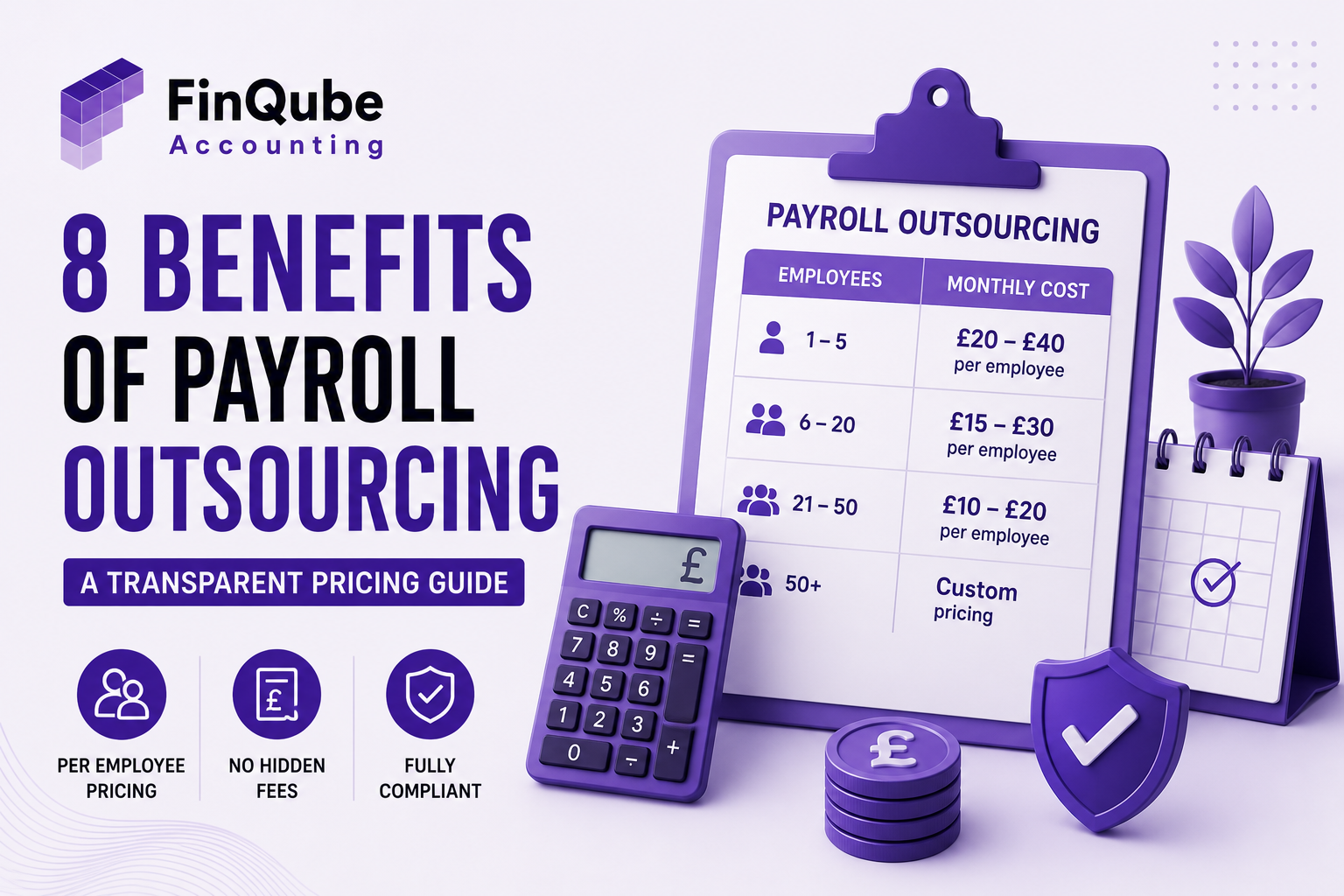
THE 8 BENEFITS OF PAYROLL OUTSOURCING
Here are the eight benefits UK accounting firms report most often once they switch.
1. Fewer HMRC penalties. A dedicated team tracks every RTI deadline. This cuts the risk of the £100 to £400 monthly penalties HMRC applies for late filing.
2. Time back for advisory work. Partners and senior staff stop losing hours to payslip processing. That time moves to advisory services clients actually pay a premium for.
3. Built-in cover for absence. Payroll doesn't stop because one employee is on holiday or off sick. The provider's team covers continuity automatically, every time.
4. Easier capacity scaling. Adding 10 or 50 new payroll clients doesn't require a hiring decision. The provider absorbs the extra volume without extra strain on your team.
5. Access to specialist knowledge. Auto enrolment re-declarations, CIS deductions, and multi-scheme pensions get handled by people who work with these rules daily.
6. Reduced software and training costs. You stop paying for extra payroll software licences. You also stop funding ongoing staff training on every legislative update.
7. Consistent, predictable output. Clients get payslips and reports on the same schedule every month. This holds true regardless of your internal staffing situation.
8. Fixed, predictable monthly cost. Firms plan around a flat monthly fee per client. This replaces variable overtime costs and unpredictable recruitment spend.
Table 2: Benefit Impact Summary
COMMON WORRIES ABOUT OUTSOURCING PAYROLL (AND THE REAL ANSWERS)
Most firms hesitate for the same three reasons. Each one has a straightforward answer.
"I'll lose control of client relationships." This doesn't have to happen. Your firm stays the point of contact. The provider works behind the scenes, inside your branding and your systems.
"My clients will notice a change in service." With a good provider, they shouldn't. Payslips look the same. Deadlines stay the same. The only real change is who processes the numbers.
"Outsourcing is only for firms that are struggling." This is a myth. Many of the strongest UK practices outsource payroll specifically so their best people can focus on growth, not paperwork.
Table 3: Worry vs Reality
REAL SCENARIO: A MANCHESTER PRACTICE BEFORE AND AFTER
Ashcroft & Reeves is a nine-partner practice in Manchester. The firm ran payroll for 47 clients using two part-time staff and Sage.
Before outsourcing: Payroll ran late in three of the last six months. One RTI submission missed its deadline entirely, which triggered an HMRC penalty. Staff overtime during auto enrolment re-declaration season cost more than a full-time salary would have.
What they tried first: The firm hired a third part-time payroll clerk. Recruitment took four months. The new hire left within a year, and the whole cycle started again.
After switching to outsourcing: Ashcroft & Reeves moved all 47 payroll clients to an outsourced provider. The provider worked inside the firm's existing Sage setup, so nothing changed for clients.
Within two payroll cycles, every RTI submission went in on time. Partner Claire Ashcroft reported that her team recovered roughly six hours a week. That time moved straight into advisory conversations with existing clients.
The firm has since added 15 new payroll clients. It did this without any additional internal hiring.
This is the pattern most firms see. The first two payroll cycles build trust. After that, capacity opens up for growth.
HOW FINQUBE CAN HELP
At FinQube, you get one named accountant on your payroll account. You don't get a rotating pool of unfamiliar contacts.
We work inside the software you already use. That includes Xero, QuickBooks, Sage, FreeAgent, or any other software your firm runs today. Nothing changes for your clients.
Every file goes through our proprietary AI review before it reaches your named accountant's desk. This flags anomalies early, so errors get caught before they ever become client-facing problems.
Our pricing is fixed and monthly, not hourly. You can quote clients with confidence and never face a surprise invoice at month end.
There is no minimum contract term with FinQube. You can start, scale, or step away without being locked into a long agreement.
We also structure our work as a services agreement, not labour supply. This keeps your firm's IR35 position clean and defensible.
Ready to see how outsourced payroll would work for your client base? Book a discovery call with FinQube and get a straight answer on fit, timeline, and process within one conversation.
One month. No contract.
See how a dedicated Finqube accountant fits into your MTD workflow before you decide.
Start your free pilotCONCLUSION
Payroll outsourcing UK isn't about handing over control of your client relationships. It's about removing repetitive, deadline-heavy work that puts your firm at risk.
That risk shows up in two places. HMRC penalties hit your firm's finances. Burnout hits your best staff.
The firms that switch early, before a missed deadline forces the decision, tend to see the benefit fastest. Fixed costs, specialist cover, and freed-up partner time compound with every payroll cycle.
If your practice feels the strain of payroll during peak season, now is the moment to look at outsourcing properly. Talk to FinQube about your payroll clients and see what a dedicated named accountant could take off your plate.
FAQ
What is payroll outsourcing for accounting firms?
It means an external provider runs your clients' payroll. This includes payslips, RTI filing, and pension duties, while your firm keeps the client relationship.
Is payroll outsourcing safe for client data?
Yes, provided the provider uses UK GDPR-aligned data handling and clear access controls. Always confirm this in writing before signing any agreement.
How much does payroll outsourcing cost for a UK firm?
Costs vary by provider and client volume. Ask for a per-client monthly quote, rather than an hourly rate, so your own pricing stays predictable.
Can I outsource payroll for just some clients, not all?
Yes. Most providers, including FinQube, let you outsource specific client segments. CIS clients or high-volume payrolls are common starting points, while others stay in-house.
Will my clients notice if I outsource payroll?
No, not if the provider works inside your existing software and your branding stays consistent. Clients should see no change in their payslips or reporting.
What happens if HMRC deadlines are missed by the outsourced provider?
A reputable provider's contract should clearly assign responsibility for missed deadlines. Confirm this in writing before you switch providers.
How long does it take to switch to an outsourced payroll provider?
Most firms complete the transition within one to two payroll cycles. This includes a parallel run to check accuracy against your existing figures.
Does outsourcing payroll mean giving up my payroll software?
No. Good providers work inside the software you already use, whether that's Xero, Sage, QuickBooks, or any other software your firm has chosen.