.avif)

Blog Summary
- Why recruitment has stopped being a reliable growth lever for UK accounting firms
- The capacity model that lets a practice take on more clients without adding headcount
- What a dedicated extended team actually costs compared to a hire
- How Daniel Hughes at Hughes Accountancy scaled client capacity without a single new hire
Introduction
Every accounting firm hits the same wall. Client demand grows, but the team does not grow with it fast enough to keep up. The instinct is to hire. But a Senior or Manager-level hire now takes months to find, costs more than budgeted, and might leave within two years anyway. This guide covers how firms are scaling client capacity without adding a single seat to the payroll, including what it actually costs to do it this way.
What Does It Mean to Scale Without Hiring
Scaling without hiring means increasing the number of clients your firm can serve without increasing your permanent headcount. It works by adding capacity through a dedicated extended team rather than through direct employment.
This is not about doing more with less. It is about separating the compliance-heavy, process-driven work from the advisory work only your partners and senior staff can do, then resourcing each differently. The routine work, whether that is bookkeeping in Xero or any other software, VAT preparation, or payroll, moves to a dedicated remote team. Your partners stay focused on the client relationships and judgement calls that actually grow the firm.
Why Hiring Has Stopped Working as a Growth Strategy
Recruitment used to be the default answer to a capacity problem. That answer has become slower and less reliable in the current market.
Recent ICAEW research involving managing partners at 35 mid-tier firms found that offshoring and outsourcing are both expected to increase as firms look for a more cost-effective way to add capacity. That shift is not happening by accident.
The supply side of the problem is structural. According to industry analysis reported by PSD Group, the accountancy talent pipeline has thinned considerably in recent years, with an estimated 180,000 ACCA and ICAEW students still sitting in the system more than five years after registering, well behind the pace firms need to fill senior roles. Separate research covered by Sheridan Maine confirms that the hardest vacancies to fill are no longer trainee roles. They are Senior, Assistant Manager and Manager positions, the exact level a growing practice needs most.
The regional picture makes this worse for firms outside London. Data compiled for ICAEW found some regional cities had as few as two applicants for every accountancy role advertised, leaving hiring partners with almost no pool to choose from.
Even when firms do recruit successfully, retention is unstable. Reporting from Accountancy Age this year found that 92% of finance employers currently recruiting report severe skills shortages, despite record levels of hiring activity. A hire made today is not a guaranteed capacity gain in twelve months.
Put together, hiring has become slower, more expensive, and less durable at exactly the moment client demand and compliance complexity are both rising.
Who Should Consider This Approach
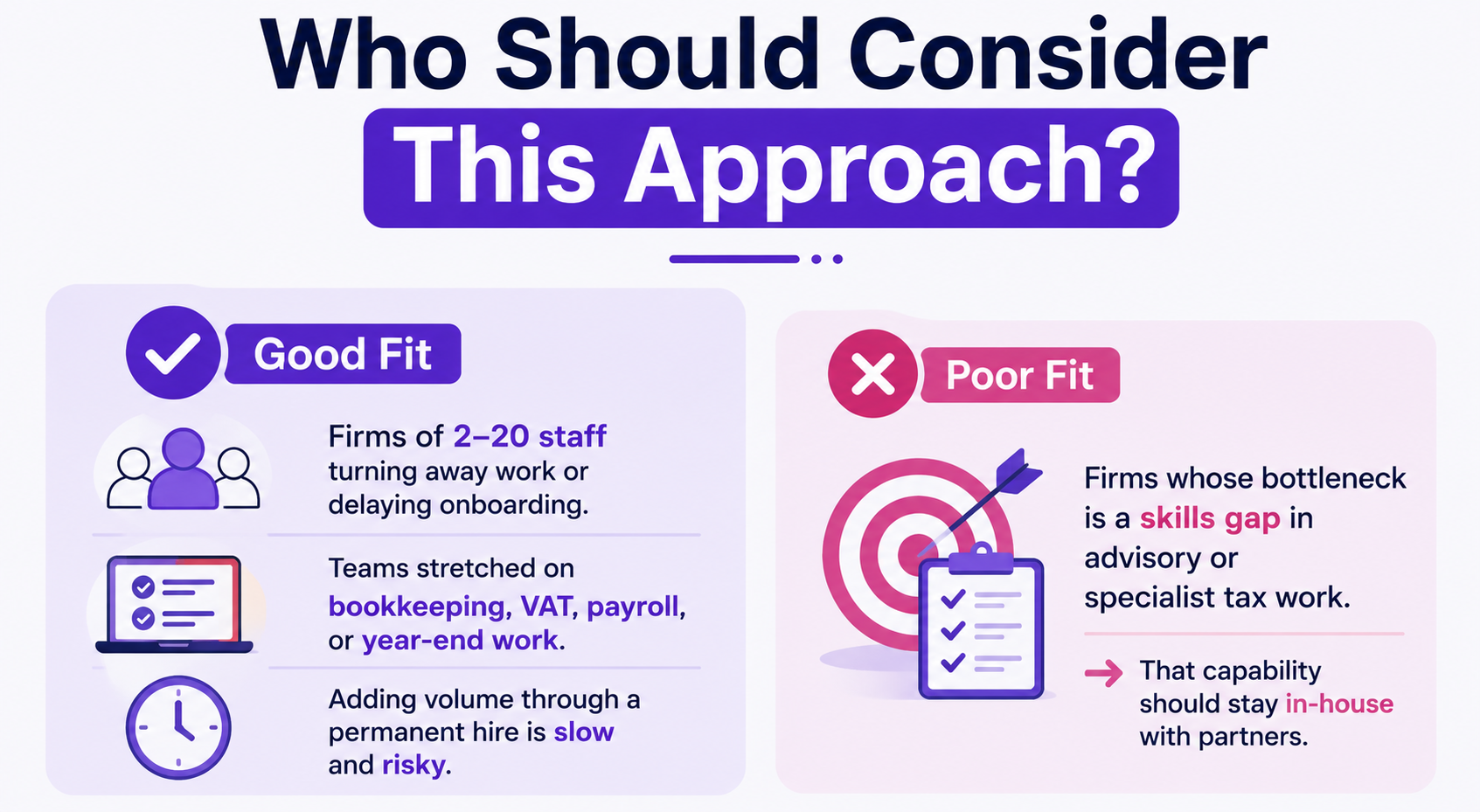
This model suits firms of 2 to 20 staff who are turning away work, delaying client onboarding, or watching partners get pulled into compliance tasks instead of advisory work. If your team is already stretched thin on bookkeeping, VAT, payroll, or year-end work in Xero, QuickBooks, Sage, FreeAgent, or any other software, adding volume through a permanent hire is the slowest and riskiest way to solve it.
It is a poor fit for firms whose bottleneck is genuinely a skills gap in advisory or specialist tax work. That kind of capability usually needs to sit in-house, close to the partners making the judgement calls.
When Is the Right Time to Scale This Way
The signal is usually capacity strain that shows up before revenue strain. If your team is working evenings and weekends to hit filing deadlines, if partner time is going into file review instead of client conversations, or if you are quoting new clients a longer onboarding window than you are comfortable with, that is the point to act. Waiting until a hiring decision becomes urgent removes your ability to choose the right model calmly, and usually means paying a premium for whichever option is fastest rather than best.
Where Firms Lose Capacity Without Realising It
Capacity does not usually disappear in one obvious place. It leaks out through a few recurring patterns.
Partner review bottlenecks. Every file waits for the same one or two people to sign off, regardless of how simple the work is. This is consistently flagged as one of the biggest hidden costs in growing practices, as noted in coverage from AccountingWeb.
Manual reconciliation and error-checking. Time goes into catching mistakes after the fact rather than preventing them before a file reaches review.
Recruitment and onboarding cycles. Every new hire, even a good one, needs weeks of training before they are genuinely productive, and that time comes out of someone else's capacity, not a separate budget line.
Software switching and data cleanup. Moving between Xero, QuickBooks, Sage, FreeAgent, or any other software creates a backlog that eats into billable time for weeks, and often gets deprioritised until it becomes urgent.
How a Dedicated Remote Team Replaces the Need to Hire
A dedicated remote team is not the same as a freelancer or a generic outsourced call centre. It is one or more accountants who work inside your existing systems, whether that is Xero, QuickBooks, Sage, FreeAgent, or any other software, following your processes and reporting into your review structure exactly as an internal hire would.
The difference from hiring is deployment speed and flexibility. A dedicated remote accountant can typically be deployed in 1 to 2 weeks, against 3 or more months for a traditional hire. The team can also flex up during filing season and down outside it, something a permanent employee cannot do.
The part that makes this work at scale, rather than just shifting risk somewhere else, is review visibility. Partners need to know a file is accurate before it reaches a client, without personally checking every line. This is where proprietary AI review software changes the equation. Every file worked on by your extended team is scanned for reconciliation mismatches, outstanding AP and AR items, and common preparation errors before it reaches your review. You are not being asked to trust a black box. You are seeing exactly what has been checked and what has not, before you sign anything off.
What This Actually Costs
This is usually the first question on a sales call, so it is worth answering directly rather than leaving it for a demo.
UK outsourced accounting support typically runs between £300 and £3,500 a month, depending on scope. Providers in this space, Finqube included, commonly report savings of 40 to 60% against the equivalent in-house hire once you account for salary, National Insurance, pension contributions, software licences, training, and the productivity lost every time a staff member leaves.
Finqube's own pricing sits within that same range. It is structured around the engagement model you choose, whether that is one dedicated accountant covering a defined set of workflows or a small pod covering multiple clients, and the number of hours of dedicated support your practice needs each month. There is no annual licence fee and no long-term contract required to start. Every engagement opens with a one-month free pilot, so you see actual invoiced cost against actual delivered work before committing to anything ongoing.
Comparing Your Options
The gap that matters most here is not just headline cost. It is what you get included in that cost. A traditional remote provider at a similar monthly rate to Finqube usually does not include AI-backed review, which means the partner review bottleneck described earlier does not actually go away.
Real Scenario: Hughes Accountancy
Daniel Hughes at Hughes Accountancy was spending the last 10 days of every month chasing his team for client file sign-offs. He had no visibility into which files were reviewed and which were still waiting. Taking on new clients meant either delaying onboarding or accepting that quality checks would slip.
After bringing in a dedicated Finqube accountant with proprietary AI review software built into the workflow, he recovered 12 hours per week by month two. He stopped chasing his team entirely, because he could see exactly where every file stood without asking. That freed-up capacity meant he could take on new clients without a single new hire, and without increasing his fixed monthly cost base beyond what he had already budgeted for the pilot.
How Finqube Can Help
Finqube builds dedicated extended teams that work as part of your firm, not alongside it. Every engagement includes access to our engagement models, so you can match the structure to how your practice actually operates, whether that is one dedicated accountant or a small pod covering multiple workflows. You can see how this fits practices like yours on our page for accounting practices.
Every file your extended team works on passes through our proprietary AI review software before it reaches you. Reconciliation mismatches, outstanding AP and AR items, and common preparation errors are flagged automatically. You review what is already clean, not what might have errors buried in it.
You can start with a one-month free pilot. No contract, no annual licence, no long procurement process, just a working test of whether the model fits your practice at a cost you can see upfront.
Conclusion
Hiring is no longer the fastest or most reliable way to grow an accounting firm's capacity. The talent pool is thinner, the process is slower, and a new hire is not a guaranteed long-term capacity gain. A dedicated extended team, backed by proprietary AI review software for full visibility and priced at roughly 40 to 60% less than an equivalent in-house hire, lets you take on more clients without adding permanent headcount or losing control of quality.
See what this looks like for your firm, and what it costs, with a one-month free pilot at finqubeaccounting.com.
One month. No contract.
See how a dedicated Finqube accountant fits into your MTD workflow before you decide.
Start your free pilotFAQ
Q: Can an accounting firm really grow without hiring more staff?
A: Yes. Firms are increasingly using dedicated extended teams to add capacity instead of permanent hires, which avoids recruitment delays and lets capacity flex with workload.
Q: How is an extended team different from hiring a freelance bookkeeper?
A: A freelance bookkeeper works independently with limited accountability to your review process. An extended team member works inside your systems, whether that is Xero, QuickBooks, Sage, FreeAgent, or any other software, follows your processes, and every piece of work is reviewable through AI review software before it reaches the client.
Q: How quickly can a dedicated remote accountant start?
A: Typically within 1 to 2 weeks, compared with 3 or more months for a traditional in-house hire.
Q: Does this work with our existing software?
A: Yes. Extended teams work inside your existing systems, including Xero, QuickBooks, Sage, FreeAgent, or any other software you already use.
Q: How much does an outsourced accounting team cost compared to hiring?
A: Outsourced accounting support in the UK typically costs 40 to 60% less than an equivalent in-house hire once salary, National Insurance, pension, training, and software costs are included. Finqube's pricing sits within that range, scoped to hours and engagement model, with no annual licence fee.
Q: Will we lose visibility into the quality of the work if it is not done in-house?
A: No. Proprietary AI review software flags reconciliation mismatches and errors before a file reaches your review, giving partners more visibility than most in-house workflows provide.
Q: What is the easiest way to try this without committing to a contract?
A: A one-month free pilot with no contract and no annual licence, so you can see both the working model and the actual cost before making a longer-term decision.
Q: Is this only for firms struggling to recruit, or also for firms that are growing fast?
A: Both. Firms struggling to recruit use it to fill capacity gaps immediately. Fast-growing firms use it to take on new clients without waiting out a multi-month hiring cycle that would slow growth down.