.avif)

Blog Summary
- The exact VAT return deadlines UK practices work to, broken down by stagger group and scheme.
- Why VAT deadlines slip even in well-run practices, and where the risk actually sits.
- The penalty points and late payment rules HMRC applies from April 2025 onwards.
- How a dedicated remote accountant keeps every client's VAT return filed on time, every quarter.
Introduction
VAT season should take your team two days per client. For most practices juggling 30 to 50 VAT-registered clients across three stagger groups, it takes a fortnight. It still ends with a last-minute amendment.
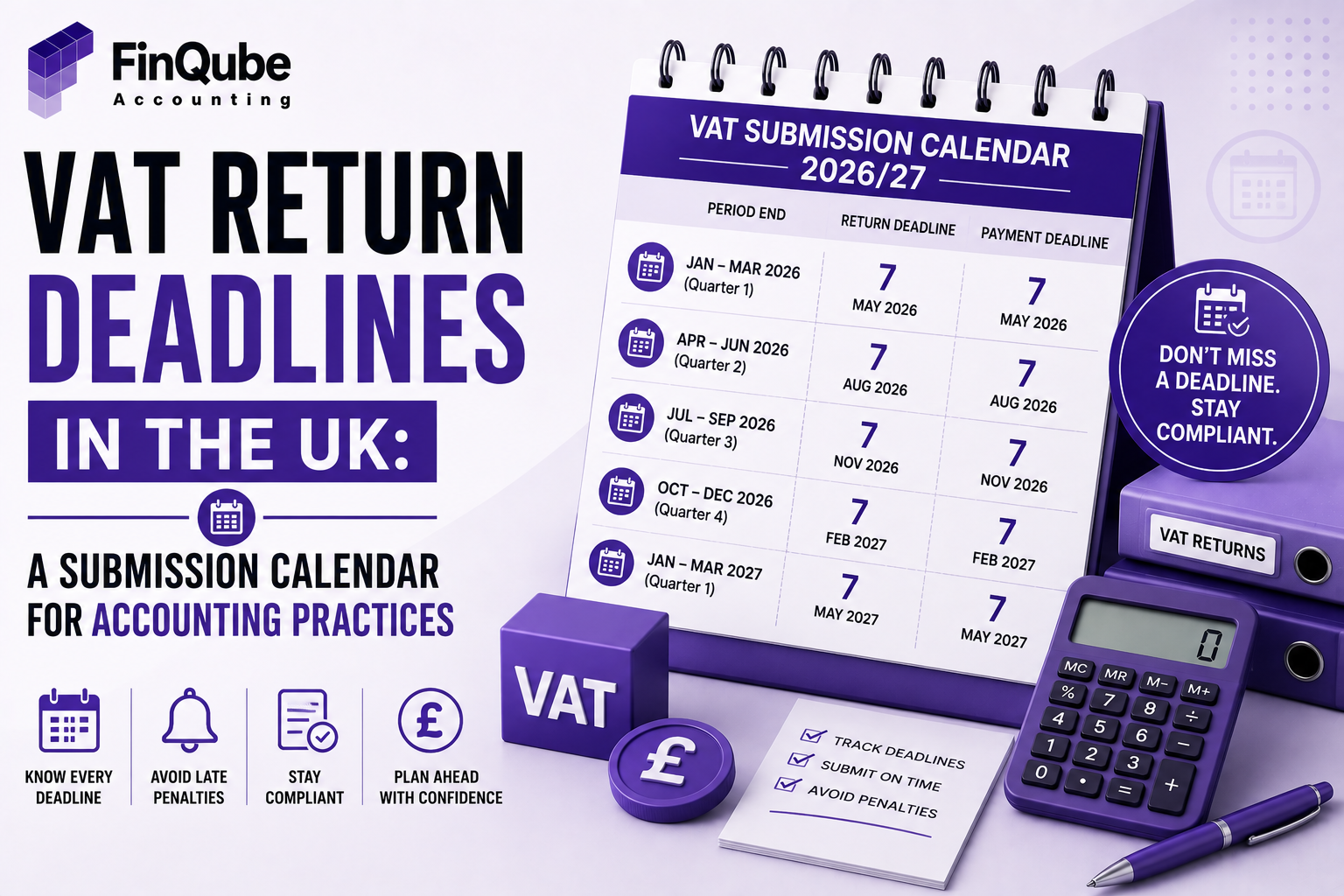
VAT return deadlines UK practices work to sound simple on paper. One calendar month and seven days after the quarter ends. In practice, three stagger groups, an annual accounting scheme, payments on account, and MTD software quirks turn one rule into a moving target.
This guide gives you the full submission calendar. It shows you where practices lose time, and how a dedicated remote accountant changes the equation. If you manage other filing dates alongside VAT, our tax calendar uk covers every key deadline your practice needs across the tax year.
What Are VAT Return Deadlines?
A VAT return deadline is the date HMRC requires a VAT-registered business to submit its return and pay any VAT owed. For most businesses, this falls one calendar month and seven days after the end of their VAT quarter.
Miss it, and HMRC applies a penalty point. Miss enough of them, and a fine follows automatically.
Most UK businesses file quarterly. HMRC groups VAT registrations into three stagger periods, so returns land on a rolling cycle throughout the year. According to GOV.UK, you must pay even if your deadline falls on a weekend or bank holiday.
VAT Stagger Groups and Quarter-End Dates
Your client's stagger group depends on their VAT registration date, not their financial year-end. Check the VAT online account for the exact date. Do not assume.
Two schemes change this standard rule. The annual accounting scheme lets businesses under £1.35 million turnover file one return a year, due two months after the period ends, with interim payments spread across the year instead of one lump sum. The payments on account scheme works the opposite way. It applies to businesses with VAT liability above £2.3 million a year, according to GOV.UK's payments on account guidance, and it removes the usual seven-day extension on the final balancing payment. If your practice manages clients on either scheme, flag them separately from your standard stagger calendar. Their deadlines do not follow the same pattern.
Why Do Accounting Practices Miss VAT Deadlines?
Practices miss VAT deadlines because one team reviews every client's return in the same narrow window, not because staff lack the skill to file on time. The bottleneck sits at review, not at data entry.
A five-partner practice with 40 VAT clients on the same stagger group faces 40 reviews in roughly ten working days. Add a sickness day or a client who sends records late, and the queue backs up fast.
Common causes stack on top of each other:
- Client records arrive late, so the team starts the return with days left, not weeks.
- One partner reviews every file, so their calendar becomes the deadline.
- MTD-compatible software throws bridging errors nobody notices until submission day.
- Staff turnover during peak season leaves gaps nobody planned for.
Therefore, deadline misses rarely come from one big failure. They come from small delays that compound across a client list.
The cost of those small delays rose sharply from April 2025. Late payment penalties increased across the board, as confirmed by GOV.UK's penalty reform notice. A late payment now costs a client more than it did two years ago, which raises the stakes on every deadline your team manages.
VAT Late Payment Penalty Rates (From April 2025)
On top of this, HMRC charges daily interest on any late payment. A client who pays three weeks late no longer gets away with a warning. They pay real money for it, and they will ask their accountant why.
Who Is Responsible for VAT Compliance in a Practice?
The VAT-registered business is legally responsible for its own return, but the accounting practice carries the operational and reputational risk when a deadline slips.
Clients expect their accountant to catch errors before submission. When a return goes out late or wrong, the client blames the practice first and HMRC second.
Inside the practice, responsibility usually splits three ways: the bookkeeper who prepares the figures, the accountant who reviews them, and the partner who signs off. As a result, a single missed handoff between any of these three people can delay the whole return.
When Does MTD for VAT Apply to Your Clients?
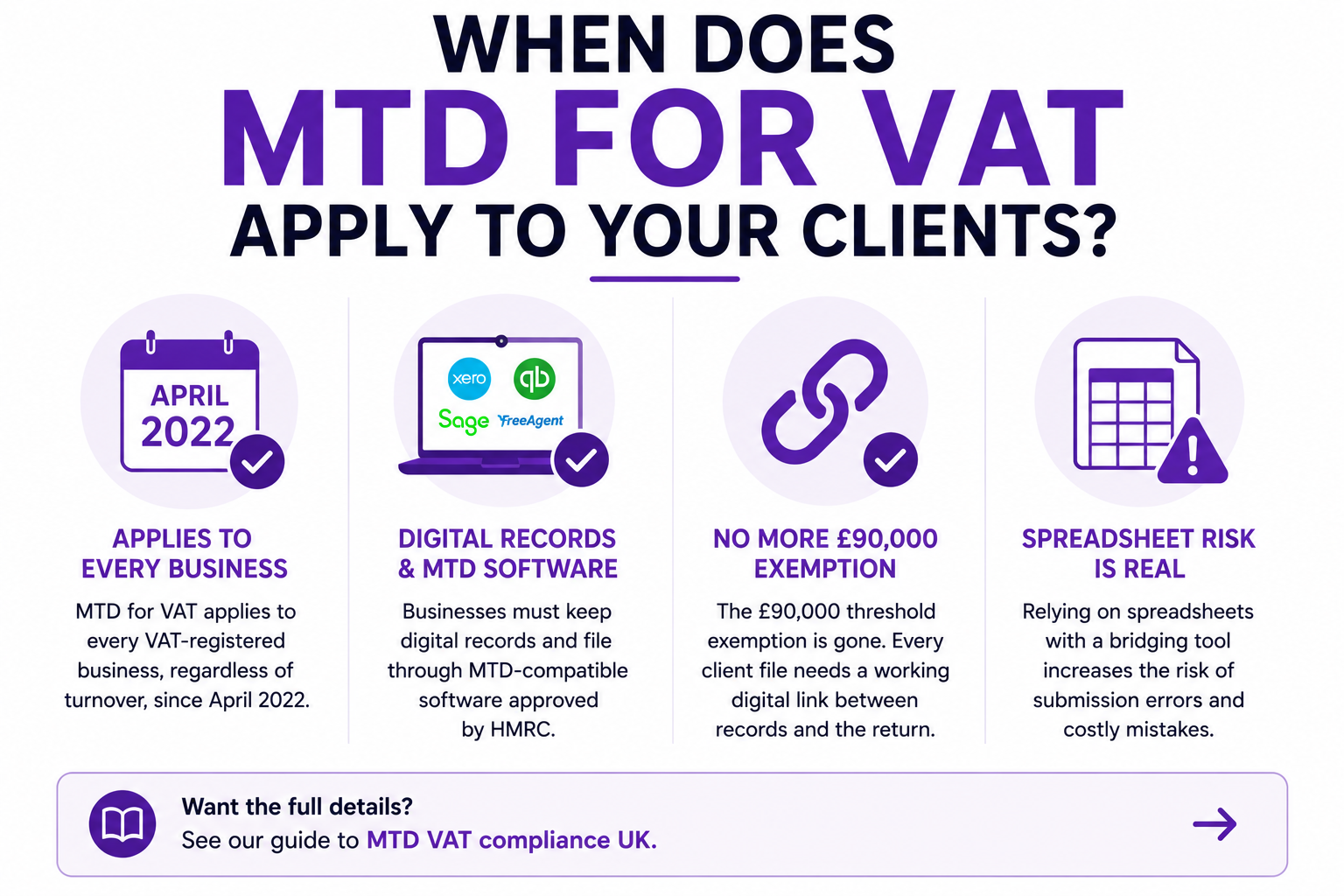
MTD for VAT applies to every VAT-registered business, regardless of turnover, since April 2022. Businesses must keep digital records and file through MTD-compatible software such as Xero, QuickBooks, Sage, FreeAgent or any other software approved by HMRC.
This closed the exemption that used to apply to businesses below the £90,000 VAT threshold. For accounting practices, it means every client file needs a working digital link between records and the return, with no manual re-typing of figures between systems.
Practices that still rely on spreadsheets with a bridging tool run the highest risk of submission errors. Bridging software works, but it adds a manual step where a copy-paste mistake can slip through unnoticed. For a deeper look at what MTD requires and how to stay compliant, see our guide to MTD VAT compliance UK.
Where Do Most VAT Errors Happen in the Filing Process?
Most VAT errors happen at the reconciliation stage, before the return ever reaches HMRC. Bank feeds miscategorise transactions, duplicate invoices slip through, and reverse charge entries get missed.
The second highest-risk point is the manual review stage itself. When one partner reviews 40 files in a fortnight, fatigue sets in by file 25. Errors that would get caught in week one get missed by week three.
Where VAT Errors Typically Occur
However, most of this risk is preventable. A second set of eyes, or a system that flags anomalies before a human even opens the file, catches the majority of these errors early.
How Does a Dedicated Remote Team Handle VAT at Scale?
A dedicated remote accountant handles VAT at scale by working inside your existing software all quarter, not by batching everything into deadline week. They pick up reconciliation as records come in, so the file is nearly review-ready by the time the quarter closes.
This spreads the workload evenly across the stagger cycle instead of concentrating it into the same ten days every quarter. As a result, your partner reviews clean files, not raw ones.
Manual In-House VAT Process vs Dedicated Remote Support
For practices weighing up whether to bring in outside support, our guide on how to outsource VAT returns UK walks through the process step by step.
Real Scenario: How One Practice Fixed Its VAT Season
Daniel Hughes runs Hughes Accountancy, a nine-person practice in the Midlands with 38 VAT-registered clients spread across all three stagger groups.
Before working with FinQube, Daniel reviewed every VAT file himself. Three quarters running, he filed at least two clients' returns within 24 hours of the deadline. One return went in a day late after a software sync error went unnoticed until submission morning.
Daniel tried splitting reviews with his senior bookkeeper. It helped, but training took weeks, and he still felt he needed to double-check her work during the first two cycles. The bottleneck moved. It didn't disappear.
He started a FinQube pilot with three VAT quarters already pending. His dedicated accountant worked inside his firm's existing Xero setup, reconciling as records came in rather than waiting for quarter-end. FinQube's AI review flagged two reverse charge errors before Daniel ever opened the files.
All three pending quarters were filed clean within the first 30 days. Daniel now reviews finished files, not raw ones, and he has not filed a VAT return late since.
How FinQube Can Help
Your practice does not need more people during VAT season. It needs the review bottleneck removed.
FinQube gives every client one dedicated, named accountant, not a shared pool that rotates depending on who is available that week. Your accountant works inside your existing systems, whether that's Xero, QuickBooks, Sage, FreeAgent or any other software your clients already use, so nothing changes for your team or your clients.
Every file passes through FinQube's proprietary AI review before your partner ever sees it. Issues get flagged automatically, so your review time drops from an hour per file to fifteen minutes. Pricing is fixed and monthly, not hourly, so you know your cost before the quarter starts, not after.
FinQube's engagements are structured as a services agreement, not labour supply, which keeps IR35 exposure off your desk entirely.
Ready to stop reviewing VAT files at midnight? Talk to FinQube about a dedicated accountant for your practice. No minimum commitment beyond the first month, and you can stop any time after that.
Conclusion
VAT return deadlines UK practices manage are simple in theory and relentless in practice. Three stagger groups, MTD requirements, and a shrinking review window all land on the same ten days, every quarter, for every client.
A dedicated remote accountant working inside your existing systems spreads that workload evenly and catches errors before they reach your desk. Daniel Hughes filed three overdue VAT quarters clean within 30 days of starting his FinQube pilot.
Talk to FinQube about giving your practice one dedicated accountant, with no minimum commitment beyond the first month.
VAT is rarely the only deadline on your team's calendar. If Self Assessment season adds to the same pressure, read how self assessment outsource support keeps both running smoothly at once.
One month. No contract.
See how a dedicated Finqube accountant fits into your MTD workflow before you decide.
Start your free pilotFAQ
What is the deadline for a VAT return in the UK?
Most businesses must submit and pay one calendar month and seven days after their VAT quarter ends. Check the VAT online account for your exact date, since it depends on your stagger group.
How often do I need to submit a VAT return?
Most VAT-registered businesses file quarterly. Some file monthly if they regularly reclaim VAT, and some file annually under the annual accounting scheme.
What happens if I miss a VAT return deadline?
You receive a penalty point. Once you reach four points on quarterly filing, HMRC issues a £200 fine, and every further late return after that adds another £200 fine.
What are the VAT stagger groups?
HMRC splits VAT registrations into three groups so quarters land on a rolling cycle. Stagger 1 ends in March, June, September and December. Stagger 2 ends in April, July, October and January. Stagger 3 ends in May, August, November and February.
Do I still need to file a VAT return if there's nothing to pay?
Yes. You must submit a nil return even if you owe nothing and reclaim nothing for that quarter. Missing it still triggers a penalty point.
What is the VAT payments on account scheme?
Businesses with VAT liability above £2.3 million a year must make interim payments during the quarter, on top of their normal return. This removes the usual seven-day extension on the final balancing payment.
Can outsourcing help my practice hit every VAT deadline?
Yes. A dedicated remote accountant working inside your existing software spreads reconciliation across the full quarter instead of concentrating it in deadline week, which cuts partner review time and reduces late filings.