.avif)

Blog Summary
- The 2026/27 personal allowance, basic rate, higher rate and additional rate bands stay frozen, so more clients drift into higher bands this year.
- You will find a full breakdown of the £100,000 to £125,140 "60% trap" and how to explain it to clients in plain English.
- The guide covers National Insurance rates alongside income tax, plus how Scotland's bands differ from the rest of the UK.
- You get a practical scenario showing how one UK practice used outsourced support to handle the tax-year workload spike without hiring.
INTRODUCTION
Every April, clients ask the same question. "Am I in a higher tax band now?" In 2026/27, more of them will be, and the reason is not a pay rise. UK income tax brackets 2026/27 stay frozen at the same levels as the last few years, while wages keep climbing. That combination pulls ordinary earners into higher rates without a single policy change to the rate itself.
For a busy UK accounting practice, this is not just a client education problem. It is a workload problem. Frozen thresholds mean more self assessment queries, more tax planning conversations, and more pressure on your team right when self assessment deadlines already stretch capacity thin.
This guide breaks down the full 2026/27 income tax picture: the bands, the personal allowance, the National Insurance rates, and the quirks like the 60% trap that catch clients off guard. You will also see how one UK practice freed up capacity to handle the extra advisory work without adding headcount.
WHAT ARE THE UK INCOME TAX BRACKETS FOR 2026/27?
The 2026/27 tax year runs from 6 April 2026 to 5 April 2027. Income tax bands for England, Wales and Northern Ireland stay unchanged from 2025/26. Scotland sets its own bands, covered further down.
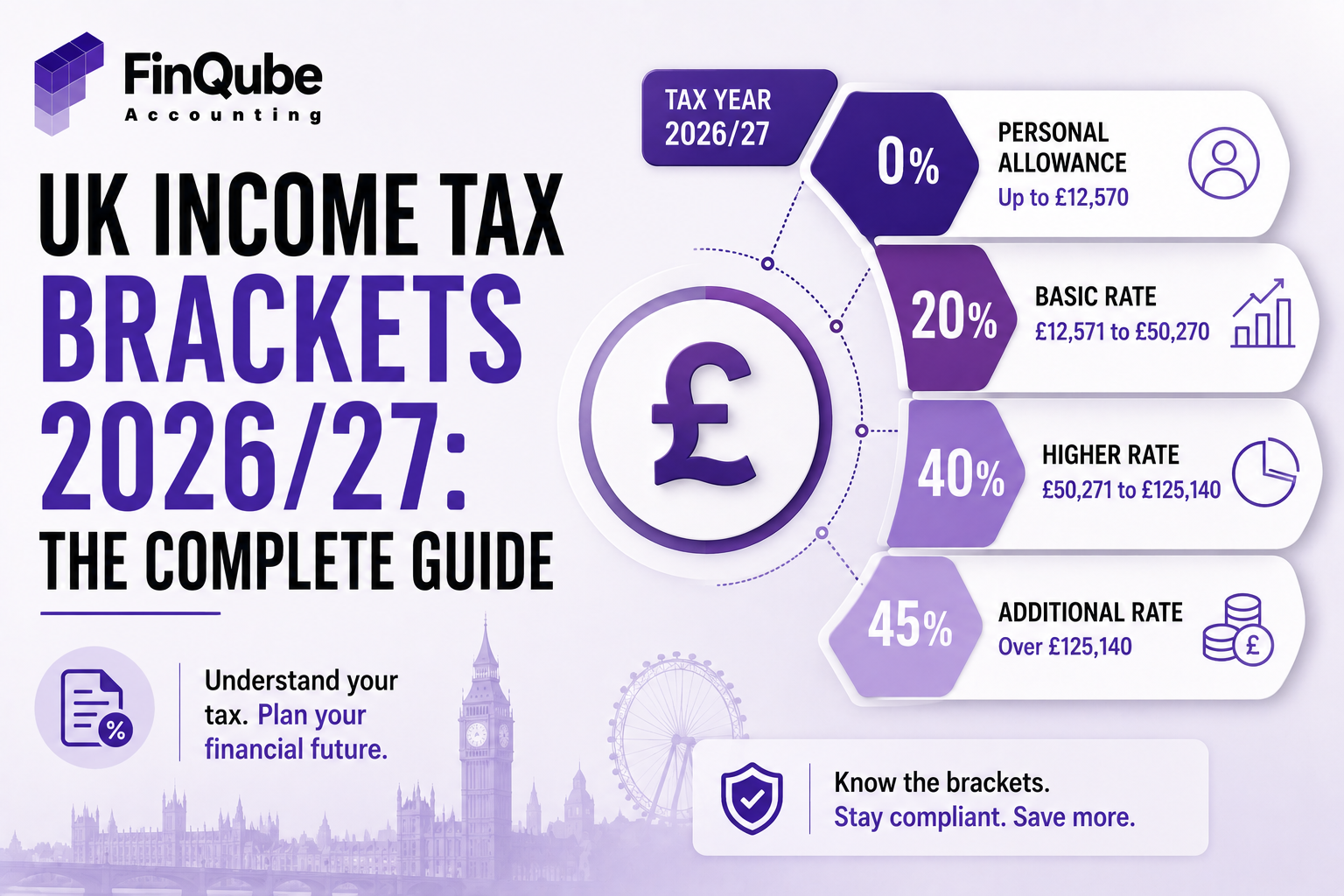
Here is the full breakdown for England, Wales and Northern Ireland.
These figures come directly from GOV.UK's Income Tax rates and Personal Allowances page. The personal allowance sits at £12,570. This is the amount your clients earn before they pay any income tax at all.
Above that, the basic rate applies at 20% up to £50,270. Cross that line and every extra pound gets taxed at 40%, right up to £125,140. Beyond that threshold, the additional rate of 45% kicks in.
Notice something important. These are marginal rates. Nobody pays 40% on their entire income once they cross £50,270. They pay 20% on the slice between £12,571 and £50,270, then 40% only on the portion above that. Many clients misunderstand this, and it is worth explaining clearly every year.
WHY THE THRESHOLDS ARE STILL FROZEN
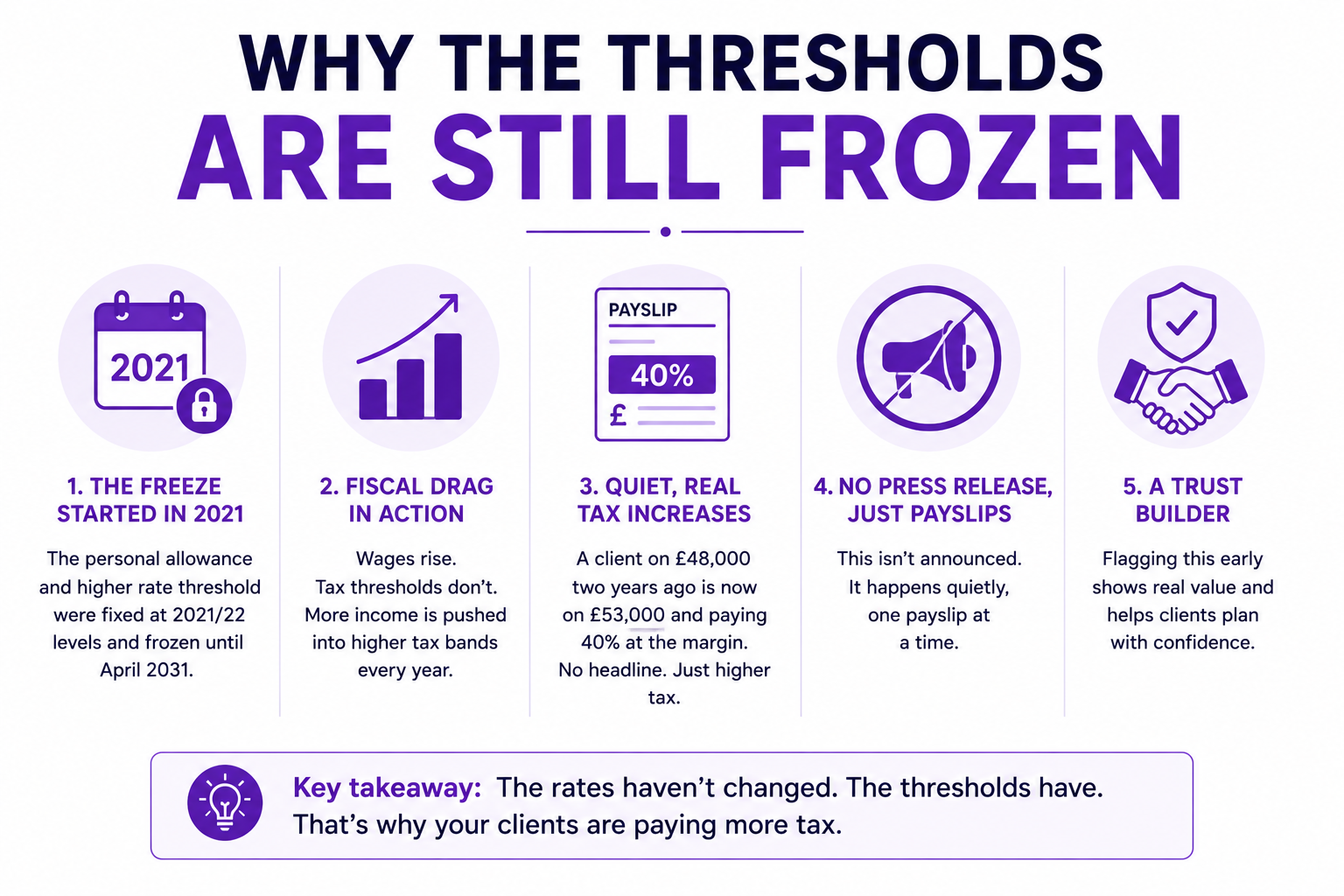
The freeze on UK income tax brackets 2026/27 traces back to 2021, when the government fixed the personal allowance and higher rate threshold at their 2021/22 levels. That freeze has been extended repeatedly and now runs until April 2031, according to the House of Commons Library briefing on direct tax rates and allowances.
This freeze creates what economists call fiscal drag. Wages rise with inflation and pay negotiations. Tax thresholds do not move. As a result, more income falls into higher bands every single year, even though the rates themselves never change.
For your clients, this means real tax increases without a headline rate rise. A client earning £48,000 two years ago and now on £53,000 has moved from paying 20% at the margin to paying 40%. No one told them that in a press release. It happened quietly, one payslip at a time.
This is exactly the kind of detail that builds trust with clients. Flagging it before they notice it themselves shows real value.
WHO FALLS INTO EACH TAX BAND
Roughly 6.3 million people paid the higher rate of tax at the last measured count, and that number keeps climbing as thresholds stay flat against rising pay. Most higher earners are not bankers or executives. They are teachers who took on management roles, tradespeople who grew their business, and professionals a few years into a steady career.
Here is a simple way to frame it for clients.
Self-employed clients and company directors need particular attention here. Dividend income, savings interest and rental income all stack on top of employment income to determine the band. A director drawing a modest salary plus dividends can easily tip into higher rate territory once you add it all together.
WHEN THE 2026/27 TAX YEAR RATES APPLY
The rates above apply from 6 April 2026. They stay in place until 5 April 2027, unless the Chancellor announces an in-year change, which is rare but not unheard of.
Payroll software, whether that is Xero, QuickBooks, Sage, FreeAgent or any other software, updates automatically at the start of the tax year to reflect these bands. However, always confirm the update has applied correctly before running the first payroll of April. A missed update means incorrect deductions from day one, and correcting that mid-year creates unnecessary client complaints.
Self assessment returns for 2026/27 income become due by 31 January 2028 for online filing. That deadline feels distant in April, but the workload it creates builds steadily across the year. Practices that plan ahead avoid the January scramble. If deadline pressure is already a pain point for your team, our guide on self assessment outsource covers how outsourcing smooths that pressure out.
WHERE THE RULES DIFFER: SCOTLAND AND WALES
Scotland sets its own income tax bands under devolved powers. Wales uses the same bands as England and Northern Ireland, though it holds the power to diverge in future. For any client based in Scotland, do not apply the standard UK bands. The rates differ significantly.
Scotland has six band, and its higher rate kicks in at a much lower income level than the rest of the UK. A Scottish client earning £48,000 already sits in the 42% band, while an equivalent client in England still pays 20%.
This distinction matters enormously for practices with clients north of the border. Get it wrong and you either overcharge or underpay tax on a client's behalf, both of which create real problems.
HOW TO WORK OUT A CLIENT'S TAX BAND
Start with total taxable income. Add employment income, self-employment profit, rental income, savings interest above the allowance, and dividends above the dividend allowance. Subtract any pension contributions and allowable expenses first, since these reduce taxable income before you check the band.
Once you have the taxable income figure, compare it against the tables above. Remember the marginal rate principle. A client on £70,000 does not pay 40% on the whole £70,000. They pay 0% on the first £12,570, 20% on the slice up to £50,270, and 40% only on the remaining £19,730.
For clients close to a threshold, small adjustments matter. Increasing a pension contribution, for example, can pull income back under the £100,000 mark and preserve the full personal allowance. This is exactly the kind of proactive advice that turns a compliance-only relationship into an advisory one, and it is where outsourced capacity pays for itself. Our MTD for accountants guide covers how digital record-keeping makes these calculations faster and more accurate throughout the year, not just at deadline time.
NATIONAL INSURANCE RATES FOR 2026/27
Income tax rarely sits in isolation. National Insurance runs alongside it and affects take-home pay just as much. Here are the 2026/27 rates, confirmed via GOV.UK's National Insurance rates and categories page.
Employer National Insurance sits at 15% above the secondary threshold, a cost that hits your business clients directly, not just their employees. When you advise on total tax burden, always include this employer cost in the conversation. Clients budgeting for a new hire need the full picture, not just the headline salary.
THE PERSONAL ALLOWANCE TAPER AND THE 60% TRAP
Here is the detail that trips up even experienced professionals. Once income crosses £100,000, the personal allowance starts shrinking. For every £2 earned above £100,000, the client loses £1 of allowance. By £125,140, the allowance disappears entirely.
This creates an effective marginal tax rate of 60% on income between £100,000 and £125,140. The client pays 40% higher rate tax on that slice, plus loses tax-free allowance on income that would otherwise sit at 0%. Combined, the real bite on that band works out far higher than the headline 40% rate suggests.
This is one of the most valuable conversations you can have with a client. Someone offered a bonus that pushes them from £98,000 to £115,000 might keep less of that extra £17,000 than they expect. Pension contributions, charitable giving through Gift Aid, or salary sacrifice arrangements can all pull income back below £100,000 and avoid the trap entirely.
Clients rarely know this exists until it costs them money. Flagging it proactively, ideally before the tax year ends rather than after, is advisory work that clients remember and pay for.
HOW FINQUBE CAN HELP
Frozen thresholds mean more client questions every single year, not fewer. Your team already carries a full compliance workload. Adding proactive tax band advice on top, without more hands, is not sustainable.
FinQube gives your practice a dedicated named accountant, not a rotating pool of unfamiliar faces. That accountant learns your clients, your workflow, and your standards, then works directly inside your existing systems, whether that is Xero, QuickBooks, Sage, FreeAgent or any other software your practice already runs.
Every file gets reviewed by our proprietary AI checks before a partner ever sees it, catching errors early rather than after they reach a client. Pricing runs on a fixed monthly fee, so you know your cost before the busy season hits rather than after an hourly bill arrives. There is no minimum commitment — start when it suits your practice, and scale support up or down as your workload changes.
For UK practices concerned about IR35, our arrangement is structured as a services agreement, not labour supply, keeping the relationship compliant and straightforward.
CTA: Talk to FinQube about handling your tax-year workload with a dedicated accountant inside your own systems. Book a call today.
CONCLUSION
UK income tax brackets 2026/27 stay frozen, but that stillness hides a real shift. More clients drift into higher bands every year, and the personal allowance taper quietly costs some of them thousands. Staying ahead of these changes, and explaining them clearly, is what separates a compliance-only practice from a trusted adviser.
If your team is already stretched thin during self assessment and year-end season, you do not have to choose between quality and capacity. Outsourced support inside your existing systems closes that gap without adding headcount or risk. Get in touch with FinQube to see how a dedicated accountant can support your practice through the next tax year.
FAQ
What are the income tax brackets in the UK for 2026/27?
The bands are 0% up to £12,570, 20% up to £50,270, 40% up to £125,140, and 45% above that, for England, Wales and Northern Ireland.
Has the personal allowance changed for 2026/27?
No. The personal allowance stays at £12,570, frozen since 2021/22 and fixed until at least April 2031.
What income level puts you in the 40% tax bracket UK?
Income above £50,270 falls into the higher rate band, taxed at 40% on the portion above that threshold.
Why do I lose my personal allowance over £100,000?
The allowance tapers by £1 for every £2 earned above £100,000, reaching zero at £125,140, creating an effective 60% rate on that income slice.
Are Scotland's income tax bands different in 2026/27?
Yes. Scotland uses six bands with rates from 19% to 48%, and its higher rate starts at a much lower income than the rest of the UK.
How much National Insurance do I pay in 2026/27?
Employees pay 8% on weekly earnings between £242 and £967, then 2% above that. Self-employed rates differ by class.
When does the 2026/27 tax year start and end?
It runs from 6 April 2026 to 5 April 2027, with self assessment returns for this period due by 31 January 2028 online.