.avif)

Blog Summary
- What HR and payroll outsourcing actually covers for a UK accounting practice
- Why more practices are moving payroll and HR off their own desk in 2026
- The real compliance risks hiding in RTI, auto enrolment, and IR35
- How a dedicated remote accountant with AI review software changes the picture
INTRODUCTION
Payroll day should not feel like a fire drill. For most UK practices, it does.
One late RTI submission. One missed pension deadline. One HR question nobody can answer.
HR and payroll outsourcing fixes this. You hand the processing and the compliance to a dedicated team. You keep the client relationship.
This guide covers what HR and payroll outsourcing means for a UK practice. It covers why firms are switching. It covers how to pick the right setup for your team.
What Is HR and Payroll Outsourcing?
HR and payroll outsourcing means an outside team handles payroll and HR admin for you.
That team runs your payslips. It files your RTI submissions. It manages pension enrolment. It handles HR paperwork like contracts and absence records.
You keep oversight. You do not keep the admin.
For a UK accounting practice, this work splits into three layers.
Some providers split payroll and HR into two deals. Others, like FinQube, use one accountant for both. That accountant works inside your systems. This could be Xero, QuickBooks, Sage, FreeAgent, or any other software your firm already uses.
This split matters more than it sounds. Two deals mean two bills. It means two people to chase when something goes wrong. One accountant means one person owns it all.
For a growing firm, that single point of contact often matters more than price.
Why Do UK Accounting Firms Outsource HR and Payroll?
Firms outsource HR and payroll because doing it in-house carries too much risk for too little reward.
Payroll rules change every tax year. A partner who runs payroll between client jobs is one distraction away from a missed deadline.
According to HMRC, a late payroll filing triggers a fine. The first late filing in a tax month is usually forgiven. After that, fines start at £100 a month for a small firm. They rise to £400 a month for the largest.
Pension auto enrolment adds a second risk. The Pensions Regulator can issue a fixed fine of £400. Daily fines follow. They grow with your staff count.
Three reasons come up most often when practice owners explain why they switched:
- Compliance risk is too high to run on spare capacity
- Payroll queries eat billable hours with no real value for the client
- HR admin, like contracts and absence tracking, needs specialist knowledge nobody in-house has time to learn
However, control matters most of all. Practice owners want proof the work is right before it reaches a client. They do not want to find out after HMRC sends a letter.
Cost matters too, but it rarely starts the conversation. Most practice owners we speak to have tried a cheaper option before. It cost them a client's trust. Sometimes it cost them the client.
For example, a practice that wins five new payroll clients in a quarter cannot just pile that work onto an existing team. Something breaks. Usually it is accuracy or timing, and the client notices first.
Who Should Consider Outsourcing HR and Payroll?
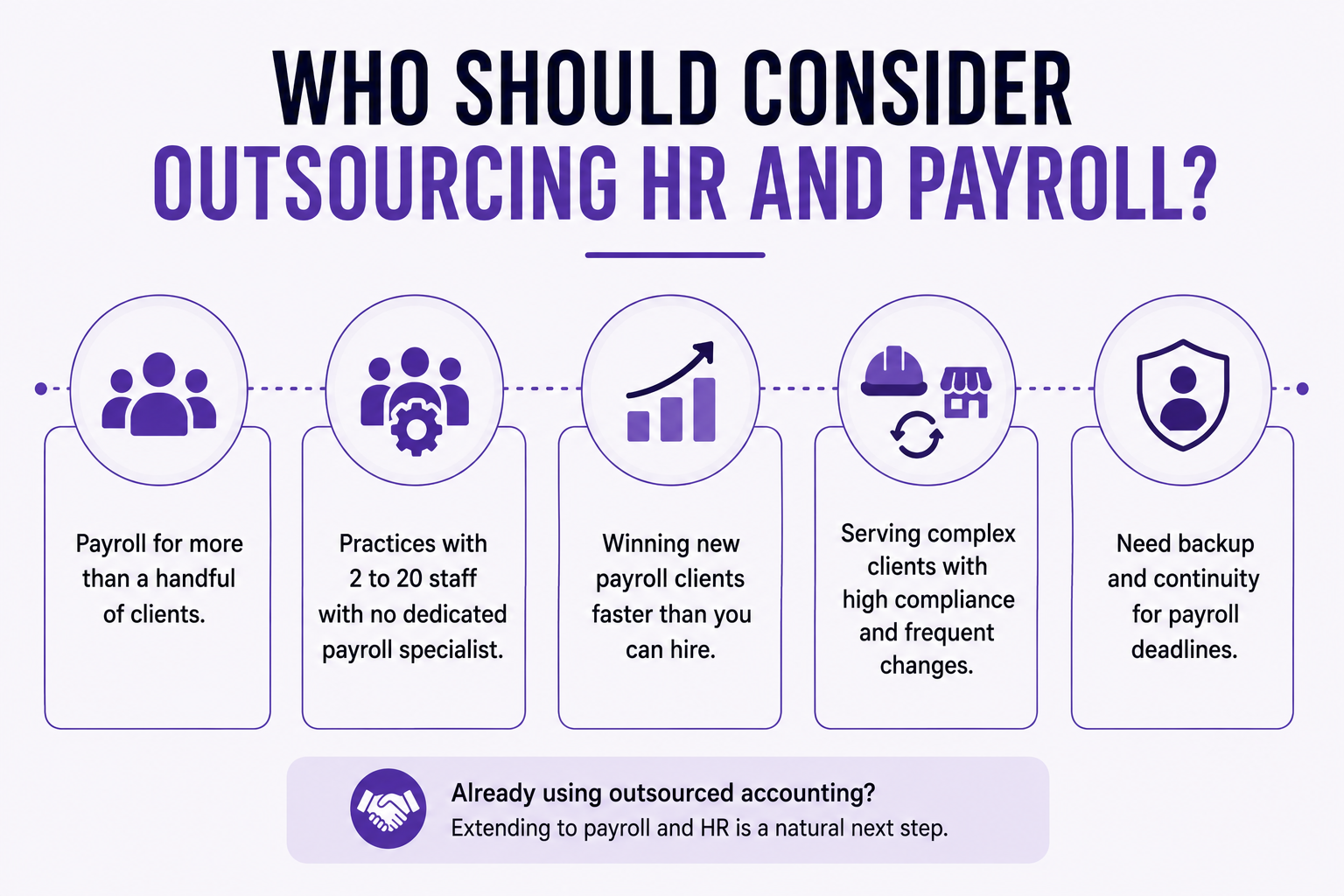
Any UK practice running payroll for more than a handful of clients should think about outsourcing.
This fits practices with 2 to 20 staff most of all. These teams are stretched across bookkeeping, tax, and payroll. Most have no dedicated payroll specialist.
It also fits practices that win new payroll clients faster than they can hire. Growth should not mean more risk.
Firms serving construction clients, multi-site retailers, or businesses with high staff turnover face extra work. CIS deductions, frequent starters and leavers, and shift patterns all add hours. Outsourcing removes those hours.
Sole practitioners benefit too, often more than larger firms. A one-person practice has no backup. If the owner is ill during a payroll deadline, nobody covers it. Outsourcing builds in that backup.
Practices that already use outsourced accounting services tend to extend the model to payroll and HR quickly. The trust is already there. The systems are already shared.
When Should a Practice Move Payroll and HR Off Its Own Desk?
The right time is before a compliance failure forces the decision. Not after.
Watch for three signals. Payroll takes longer each month, even though client numbers stay the same. Partners field HR questions they cannot answer with confidence. Letters from HMRC or the Pensions Regulator arrive more often than before.
Practices that wait until a penalty notice arrives usually pay twice. They pay the fine. They also pay in lost client trust.
Seasonal pressure is another trigger. Tax season and payroll deadlines often land in the same weeks. Firms that outsource payroll before that pressure hits keep their busiest season under control.
There is no perfect month to switch. Therefore, the simple rule is this: start once your current setup costs more in stress than a dedicated accountant would cost in fees.
Where Do Most Payroll and HR Compliance Risks Happen?
Most risk sits in three spots. These are RTI timing, pension re-enrolment dates, and IR35 status calls.
RTI filings are due on or before every payday. They are not due at month end. Firms that run payroll by hand often file late. They treat it as a month-end task, not a payday task.
Pension re-enrolment happens every three years. Many firms miss it. It does not sit on a monthly checklist.
IR35 rules bring a separate risk. Get a worker's status wrong, and the tax bill shifts onto the business, not the contractor. ACCA explains this in its technical guidance. This is why FinQube sets up every deal as a services agreement. It is not a labour supply contract. That keeps the risk away from the client relationship.
How Does HR and Payroll Outsourcing Actually Work?
A good HR and payroll outsourcing setup runs inside your existing systems. It does not sit alongside them.
The provider takes over payslip runs, RTI filing, pension contributions, and HR paperwork. You keep visibility through shared access to your own software. This could be Xero, QuickBooks, Sage, FreeAgent, or any other software your practice already uses.
The process usually follows four steps. First, onboarding maps your payroll calendar and client list. Second, a dedicated accountant is assigned and trained on your clients. Third, monthly processing runs on a fixed schedule, with review built in before anything reaches you. Fourth, ongoing monitoring covers RTI deadlines, re-enrolment dates, and year-end filings like P60s and P11Ds.
Some providers add software review on top of human checks. FinQube's AI review software scans every payroll and HR file for common errors first. Your dedicated accountant signs off after that. You review work that is already clean.
Handover usually takes one to two weeks, from signed agreement to first live payroll run. Compare that to the three months or more it takes to hire and train an in-house payroll person.
Ongoing communication matters just as much as setup. A named accountant who knows your clients by name beats a shared inbox or a rotating support desk every time.
REAL SCENARIO
Daniel Hughes runs Hughes Accountancy. It is a 12-person practice in the Midlands. His team handles payroll for around 40 clients.
The problem: Daniel's team ran payroll on spreadsheets. A part-time HR consultant helped one day a week. RTI submissions slipped twice in one tax year. A pension re-enrolment date was missed for one client. That triggered a warning letter from the Pensions Regulator.
What he tried first: Daniel hired a junior payroll assistant. It took three months to find one. The new hire still needed six months of training before running payroll alone. The HR gaps stayed untouched.
What changed: Daniel brought in a dedicated FinQube accountant. That accountant worked inside his existing Xero and Sage set up. Nothing got replaced. FinQube's AI review software flagged two reconciliation errors and one missed pension deduction before they reached a client file.
By month two, Daniel got back 12 hours a week. That time used to go on chasing payroll queries and HR paperwork. No RTI submission has been late since.
HOW FINQUBE CAN HELP
FinQube gives your practice one dedicated accountant for HR and payroll outsourcing. Not a shared pool that changes every month.
That accountant works inside your existing systems. This could be Xero, QuickBooks, Sage, FreeAgent, or any other software your firm already relies on. Nothing gets migrated. Nothing gets replaced.
Every file passes through FinQube's proprietary AI review software before your accountant signs off. It catches reconciliation errors, missed deductions, and RTI timing issues before they reach your desk.
Pricing is fixed and monthly. It is agreed upfront, based on your client volume and payroll complexity. It is not billed by the hour. It is not hidden behind a quote request. You see the exact cost before you commit to anything.
There is no minimum term. You can start, pause, or stop whenever it stops working for you.
FinQube also sets up every engagement as a services agreement, not a labour supply arrangement. That keeps your IR35 position clean.
Ready to see how it works for your practice? Book a call with FinQube to walk through your current payroll and HR setup. No minimum commitment, no long-term contract, just a straight look at what changes.
CONCLUSION
HR and payroll outsourcing is not about giving up control. It is about removing the admin that puts your compliance at risk.
RTI deadlines, auto enrolment re-enrolment, and IR35 decisions carry real costs when they slip. A dedicated remote accountant, backed by AI review software, closes that gap without adding headcount.
Is payroll taking longer each month? Are HR questions landing with no clear answer? That is your signal to act, not wait. Book a call with FinQube to see what a dedicated accountant looks like for your practice.
One month. No contract.
See how a dedicated Finqube accountant fits into your MTD workflow before you decide.
Start your free pilotFAQ
What is HR and payroll outsourcing?
An outside provider runs your payroll processing, compliance, and HR admin. You keep oversight. You keep the client relationship.
How much does HR and payroll outsourcing cost for a UK accounting firm?
Cost depends on client volume and payroll complexity. FinQube uses a fixed monthly fee agreed upfront. There is no hourly billing and no quote-based annual contract. You know the exact cost before you start.
Is outsourced payroll safe and compliant with HMRC rules?
Yes, as long as the provider files RTI on or before each payday. They must also track auto enrolment on schedule. Ask any provider how they track these dates before you sign.
What is the difference between payroll outsourcing and HR outsourcing?
Payroll outsourcing covers pay, tax, and RTI filing. HR outsourcing covers contracts, absence, and staff paperwork. Many UK firms, including FinQube, put both under one accountant.
Can outsourcing HR and payroll help with IR35 compliance?
Yes, in the right setup. The provider must set up the deal as a services agreement. It must not be a labour supply contract. This keeps IR35 risk away from your client work. ACCA covers this in its guidance on off-payroll working.
Does outsourcing payroll mean losing visibility over client files?
No, not with the right setup. A dedicated accountant works inside your existing software. This could be Xero, QuickBooks, Sage, FreeAgent, or any other software you use. You still see the same files.
What happens if a payroll deadline is missed under an outsourced setup?
The provider is accountable for the filing. But your practice still owes HMRC any penalties. This is why a fixed review process, like FinQube's AI review software, matters more than price alone.