.avif)

Blog Summary
- The eight core types of accounting, in plain terms
- Who owns each one inside a UK practice, and where that breaks down as you grow
- A simple way to pick which function to outsource first
- How a dedicated remote accountant with AI-backed review keeps every type accurate, without adding headcount
Introduction
A client asks for "management accounts". They mean a profit and loss statement. Another client calls a VAT return "tax accounting". They expect you to sort their corporation tax too.
Types of accounting sound like a textbook topic. But inside a busy practice, the mix-ups are real. They cost you time every week.
This guide explains each type of accounting in plain terms. You will see who owns each one in a typical UK practice. You will see where the handoffs go wrong. And you will see how to pick which job to hand off first when you are stretched.
What Are the Types of Accounting?
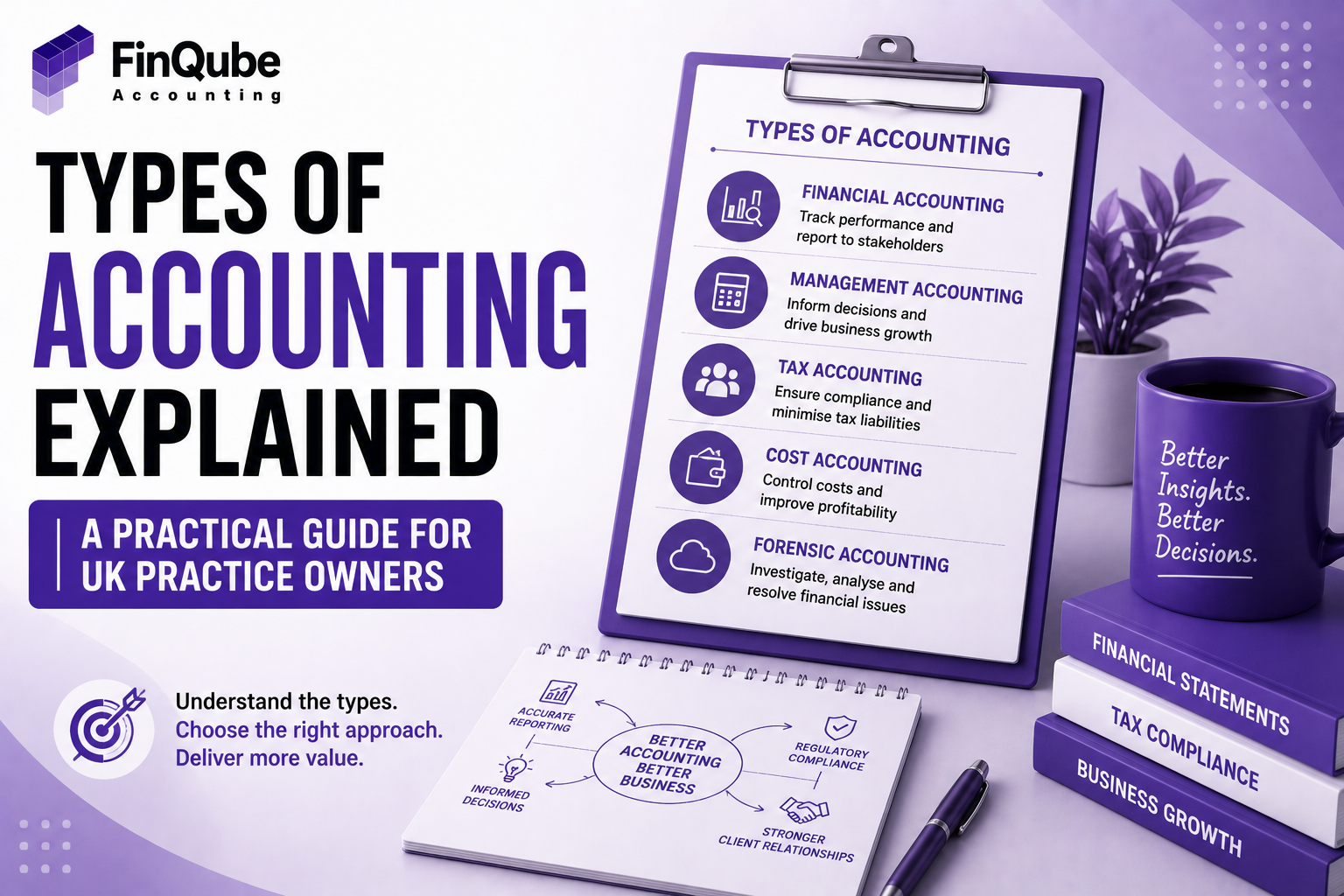
Accounting splits into different jobs. Each one serves a different reader. Each one drives a different decision. Financial accounting reports the past to outsiders. Management accounting guides choices inside the business. Tax accounting keeps you right with HMRC. The rest branch out from there.
Here is a plain guide to the eight types every UK practice owner should know.
Financial Accounting
Financial accounting produces the yearly accounts filed with Companies House. It follows fixed rules under UK GAAP or IFRS. It looks back at a set period.
Every limited company in the UK must file annual accounts. According to Companies House, private companies must file within nine months of their year end. Financial accounting builds those figures. They must be right and on time.
Management Accounting
Management accounting looks forward, not back. It gives owners the numbers they need this month. Not eight months after year end.
A monthly pack usually has a profit and loss report, a cash flow forecast, and a few KPIs the owner watches. There is no legal format for it. The output just has to be useful.
Cost Accounting
Cost accounting tracks what it costs to make a product or run a job. It sits under management accounting and feeds it detail. Labour cost per job. Material cost per unit. Overhead per client.
Builders, manufacturers, and agencies use cost accounting to price jobs well. Get the cost split wrong, and every quote built on it loses money quietly.
Tax Accounting
Tax accounting covers everything you file with HMRC. Corporation tax. VAT returns. Self assessment. Payroll taxes. It follows tax law, not accounting rules. So the numbers can differ from the financial accounts for the same period.
HMRC sets strict deadlines and fines for late or wrong filings. Making Tax Digital has made this job depend on software. That could be Xero or any other software.
Auditing
Auditing checks whether accounts are accurate. It looks for real mistakes, not small ones. External audits are done by an outside firm. They are a legal must for larger companies. Internal audits check controls inside a business.
The ICAEW sets the audit rules UK auditors follow. Most small practice clients will not need a statutory audit. But the habit behind it, checking work before it goes out, matters for every file.
Forensic Accounting
Forensic accounting digs into records for signs of fraud or disputes. It is used in court cases, insolvency work, and divorce settlements where money needs tracing.
This is expert work. Most practices send it to a specialist rather than build it in-house. But the warning signs matter for every accountant to know. Odd transactions. Changed records. Missing paperwork.
Fund and Not-for-Profit Accounting
Fund accounting tracks money by what it is meant for, not by profit. Charities and membership bodies use it. It proves that ring-fenced money went where it should.
If your practice serves a charity, this is not optional. The rules under the Charities SORP differ from normal company accounts. Get them wrong, and you risk trouble with regulators.
Fiduciary Accounting
Fiduciary accounting applies when someone manages money for another person. A trustee. An executor. A solicitor holding client funds. Every payment must be tracked and reported back to the owner of that money.
Client money rules are strict. Solicitors and letting agents need this handled with care. A gap in a client account is treated far more seriously than a gap in the firm's own accounts.
Why These Types Matter for Your Practice
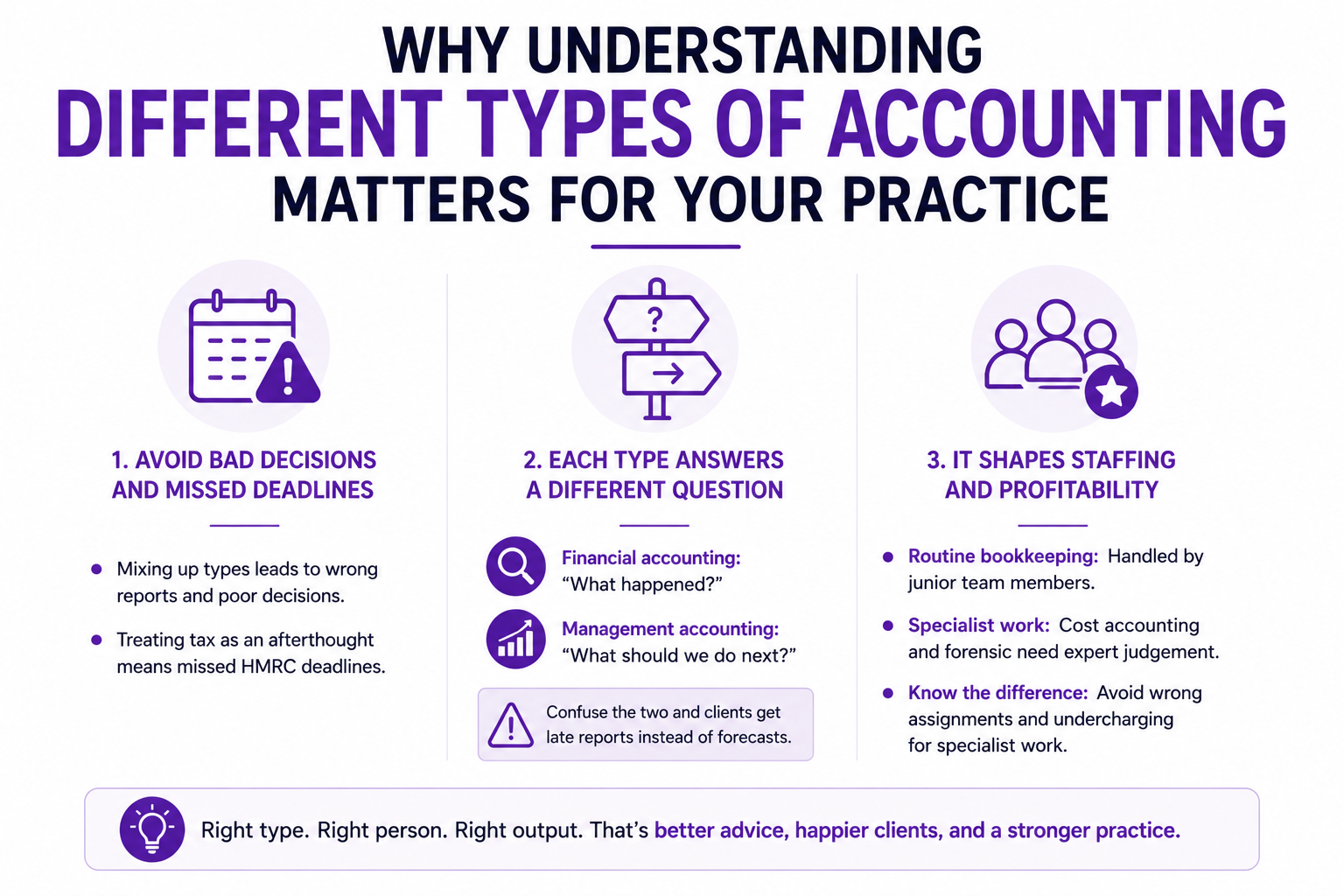
Mixing up these types leads to bad calls and missed deadlines. Treat management accounts like financial accounts, and you get reports nobody reads. Treat tax as an afterthought, and you miss HMRC deadlines.
Each type answers a different question. Financial accounting asks, "What happened?" Management accounting asks, "What next?" Mix the two up, and your client gets a late report when they needed a forecast.
This also shapes who does the work. A junior team member can handle routine bookkeeping. Cost work and forensic work need real judgement. Knowing the difference stops you giving the wrong task to the wrong person. It also stops you undercharging for expert work.
It matters for client trust too. A client who gets a clean management pack every month starts to trust your judgement. A client who gets a late VAT return starts to doubt it. The type of accounting behind each task shapes how the client sees your whole practice.
Who Handles Each Type of Accounting in a UK Practice
In a firm with two to twenty staff, one or two people often cover every type above. That works fine at first. It stops working once client numbers grow past what one person can hold in their head.
Bookkeepers usually enter the data that feeds financial and management accounts. Qualified accountants, ACA, ACCA, or AAT, produce the yearly accounts and tax filings. ACCA expects its members to keep their skills current across several accounting areas through ongoing training.
The partner or owner often reviews everything before it reaches the client. It does not matter which type of work it is. That review step is where most practices lose time. One person becomes the bottleneck for every file, every month.
When Should a Growing Practice Split These Functions?
Split these functions once one person can no longer review every file on time. For most practices, that point sits between 30 and 50 active clients. It depends on how complex the work is.
Before that point, one all-round accountant can cover bookkeeping, management accounts, and tax filings without much trouble. After it, deadlines start slipping. VAT gets filed at the last minute. Management packs go out a week late. Nobody notices until a client complains.
The fix is not always to hire. Split the work across a dedicated remote team instead. One person on bookkeeping and management accounts. Another on tax. This often solves the capacity problem faster than hiring and training someone new.
Watch for three warning signs. Clients start chasing you for reports, instead of the other way round. Your team works evenings during filing weeks, every single time. And you find mistakes only after a client points them out. Any one of these means it is time to split the work.
Where Do Accounting Errors Slip Through?
Errors slip through at the handoff points. This happens where bookkeeping data feeds management accounts, and where those numbers get reused in tax filings without a check. These gaps stay hidden until a client asks a question.
Here is a common failure. Bank items get coded wrong at the bookkeeping stage. That error flows into the management accounts and understates costs. Nobody catches it until year end. The tax accountant checks the full picture and finds a gap that should have been fixed months earlier.
AccountingWeb reports that miscoded transactions and matching errors are among the most common issues UK accountants raise in peer reviews. The fix is not more effort. It is one review step that catches errors before they move to the next stage.
How to Decide What to Outsource First
Start with the job that causes the most late nights. For most UK practices, that is bookkeeping and management accounts. The volume is highest there. Or it is tax accounting, because the deadlines are fixed and strict.
Ask three questions first. Which job has the most work compared to your team's time? Which job has the hardest deadlines, where a miss means a fine or a lost client? Which job needs the least client-specific judgement, so it is easy to hand to a remote accountant working in your own systems?
Bookkeeping and management accounts usually score highest on all three. The volume is high. The rules are clear once set up. And the work is easy to check before it reaches the client. That is why most practices outsource this job first. They add tax accounting once the model works.
No other guide on this topic answers this question directly. Most explain what each type of accounting is, then stop. The choice that matters most to a practice owner, what to hand off first, is the gap this section fills.
Real Scenario: Hughes Accountancy
Daniel Hughes at Hughes Accountancy ran financial, management, and tax accounting through the same two-person team. He checked every client file himself. It did not matter which type of work it was.
The last ten days of every month became a bottleneck. Management packs went out late. VAT returns got filed with hours to spare. Daniel had no view of which files were checked and which were still on his desk.
He brought in a dedicated Finqube accountant to run bookkeeping and management accounts. Our AI review software flagged errors before Daniel ever saw the file. By month two, he had recovered 12 hours a week. He stopped chasing his team. Tax accounting stayed in-house, with far more room to do it well.
How FinQube Can Help
You do not need to outsource every type of accounting at once. Most practices start with one job. Usually bookkeeping and management accounts. They prove the model works, then go further.
A dedicated FinQube accountant works inside your own systems. Xero, QuickBooks, Sage, FreeAgent, or any other software your clients already use. Nothing changes for your clients. Only the capacity behind the scenes changes.
Every file passes through our proprietary AI review software before it reaches your desk. It flags reconciliation errors, unpaid invoices, and common mistakes on its own. You review work that is already clean. You do not hunt through it for errors.
Your accountant works under a services agreement, not a labour supply deal. IR35 is handled correctly from day one. You get one named accountant, not a shared pool. Nothing gets lost between one type of accounting and the next.
Start with FinQube. See our outsourced accounting services uk page for how we build a dedicated team around your practice. Or start with a free pilot and see the work first.
Conclusion
Types of accounting are not just labels in a textbook. They are the different jobs your practice does every day, often through the same tired team. Financial accounting reports the past. Management accounting guides the future. Tax accounting keeps you compliant. Each one needs a clear owner and a proper check. Get that right, and deadlines stop slipping. Start a pilot with FinQube and see how a dedicated accountant with AI-backed review handles the job you struggle with most.
One month. No contract.
See how a dedicated Finqube accountant fits into your MTD workflow before you decide.
Start your free pilotFAQ
What are the main types of accounting?
The main types are financial, management, cost, tax accounting, and auditing. Specialist branches include forensic, fund, and fiduciary accounting. These fit specific cases, not every business.
What is the difference between financial accounting and management accounting?
Financial accounting reports past results to outside parties like Companies House. It follows fixed rules. Management accounting produces internal reports for owners. It has no fixed format. It looks at decisions, not compliance.
Is bookkeeping a type of accounting?
Bookkeeping is not a separate type of accounting. It is the data entry step. It records deals and checks accounts. This feeds every type of accounting above it, most of all financial and management accounting.
Which type of accounting is most important for a small UK business?
Management accounting matters most day to day. It drives choices on cash, pricing, and growth. Financial and tax accounting stay a legal must. But management accounting is what actually helps an owner run the business.
How does Making Tax Digital affect tax accounting?
Making Tax Digital requires VAT-registered firms above the threshold to keep digital records. They must file through compatible software, whether that is Xero or any other software approved by HMRC. It has moved tax accounting away from manual, spreadsheet-based work.
Can a UK accounting practice outsource just one type of accounting?
Yes. Most practices outsource one job first. Usually bookkeeping and management accounts. They keep tax accounting or client advice in-house. A dedicated remote accountant can work inside your own systems without upsetting the rest of the practice.
What qualifications do accountants need for different types of accounting?
Financial and tax accounting usually need ACA, ACCA, or AAT training, set by the ICAEW or ACCA. Forensic and fiduciary accounting often need extra training on top of a core accounting qualification.