.avif)

Blog Summary
- What: What is an outsourced accounting partner?
- Why: Why do practices move to an outsourced partner?
- Who: Who should be involved in choosing a provider?
- When: When is the right time to bring one in?
- Where: Where do outsourced partnerships usually break down?
- How: How do you evaluate a provider before you sign?
Introduction
Most practice owners do not choose an outsourced accounting partner carefully. They choose in a rush, usually mid-crisis, and live with the result for a year.
That is how mismatched providers happen. A vague sales pitch sounds fine in the moment. Then the first busy season hits, and the gaps show up fast.
This guide gives you a clear way to choose an outsourced accounting partner. It covers what to ask, who should be in the room, and what actually predicts a good working relationship.
What Is an Outsourced Accounting Partner?
An outsourced accounting partner is a third-party provider. They take on some or all of your client work, from bookkeeping and VAT to accounts finalisation. You do not add headcount in-house.
Some providers use a shared pool. Whoever is free picks up the next job. Others assign one named, dedicated accountant. That person works only on your clients, inside your own systems, much like an in-house hire but without the direct employment overhead.
The model you choose changes everything downstream. A shared pool trades consistency for flexibility. A dedicated accountant trades some flexibility for deeper knowledge of your clients over time.
Why Practices Move to an Outsourced Partner
Cost rarely starts the search. Capacity does.
According to ICAEW, outsourcing and offshoring have grown steadily across UK accountancy firms of every size. It is now a normal part of how many practices run, not a last resort for firms in trouble.
That means most practice owners will face this decision at some point. Some are struggling now. Others are simply planning ahead before the pressure builds.
The Cost of Getting This Decision Wrong
A bad outsourcing choice rarely fails loudly. It fails quietly, over months. A file gets missed. A deadline slips by a day. Nobody notices until a client calls to ask why.
By the time the pattern is obvious, you have often lost trust with the provider and with your own team. Switching providers mid-year adds its own disruption. This is why the evaluation stage matters more than most practice owners expect going in.
Take the time upfront. It is far cheaper than untangling a bad fit six months later.
Practices rarely budget time for this evaluation stage. It gets treated as a formality, something to rush through before the "real" work of onboarding begins. That mindset is exactly backwards. The evaluation conversation is where you learn the most about how a provider actually operates, long before you see a single file.
Where Outsourced Accounting Partnerships Usually Break Down
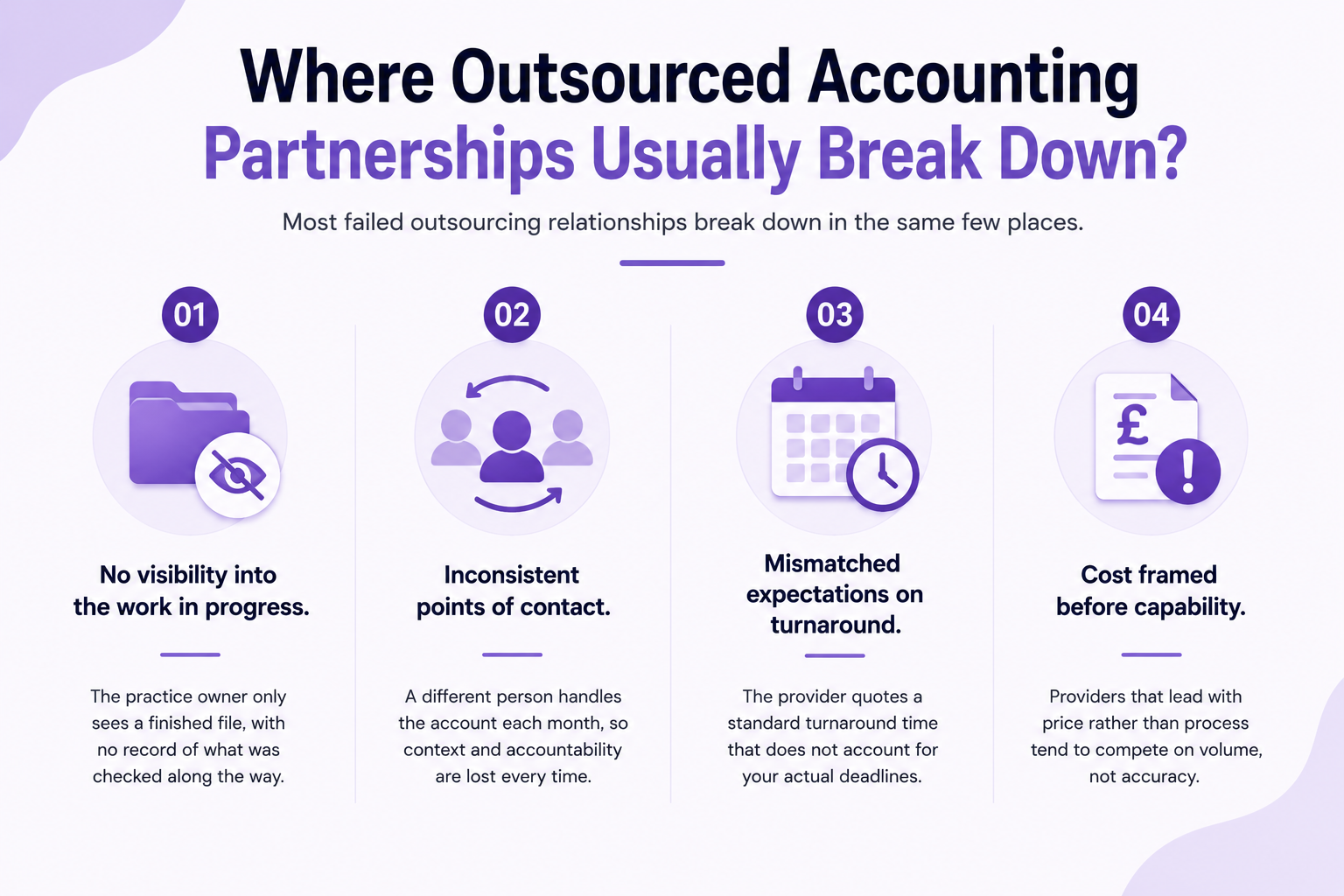
Four patterns explain most failed outsourcing relationships.
No Visibility Into Work in Progress
The practice owner sees only a finished file. There is no record of what got checked along the way. If something is wrong, you find out at the worst possible moment, right before a deadline.
Inconsistent Points of Contact
A different person handles your account each month. Context gets lost every time. You end up re-explaining your clients, your systems, and your standards on repeat.
Mismatched Turnaround Expectations
The provider quotes a standard turnaround. It does not account for your real filing deadlines. AccountingWeb has described UK filing periods as consistently demanding, with tight deadlines stacking pressure on already stretched teams. A generic turnaround promise causes the most damage exactly when you can least afford it.
Cost Framed Before Capability
Providers who lead with price, before explaining process, tend to compete on volume rather than accuracy. Notice this during the first sales conversation. It tells you more than any brochure will.
Who Should Be Involved in Choosing a Provider
This decision should not sit with one person alone.
Involve whoever owns client relationships day to day. They will spot quality issues first. Involve whoever owns the numbers too. They will be the one explaining any decision that goes wrong later.
Ask any provider to describe their own internal review layer. Not just their delivery process. A provider who can only explain how work gets done, not how it gets checked, has skipped the part that matters most.
When Is the Right Time to Bring One In?
The best time is before capacity becomes a crisis. Not during one.
A looming deadline is a weak signal. A better one is repeated overtime during the same period each year. That might be Self Assessment season, year end, or MTD VAT quarters.
If the same two or three weeks consistently push your team past what feels sustainable, start evaluating providers now. Waiting until the next crisis hits gives you less time to choose well.
How to Evaluate a Provider Before You Sign
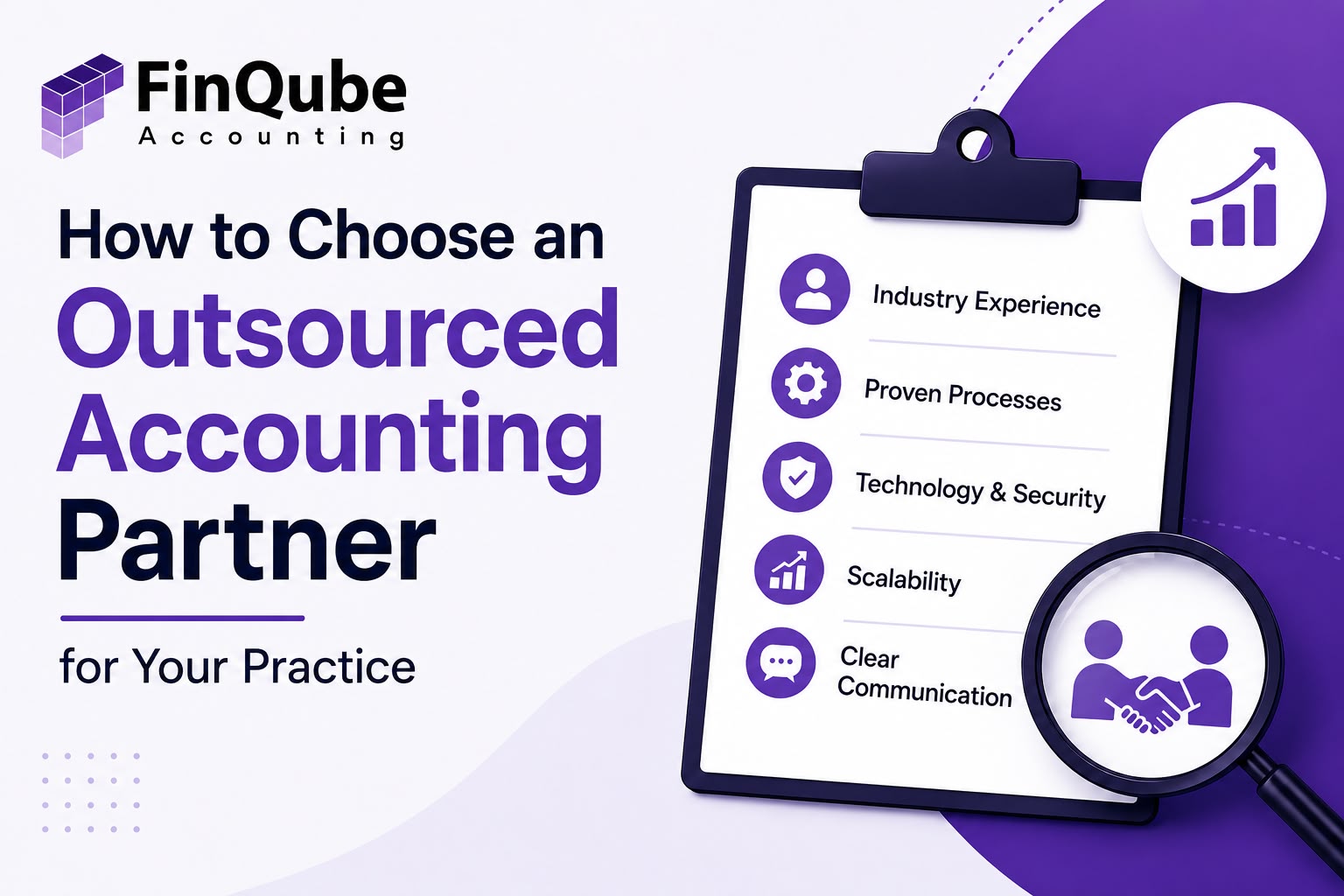
Work through this checklist in your first conversations.
Visibility Into Work in Progress
Ask what you can see before a file reaches your desk. Not just after. Finqube's proprietary AI review software flags reconciliation mismatches and common preparation errors before your dedicated accountant submits anything for your review. You end up reviewing work that is already clean, not work that still needs a first pass.
A Named, Consistent Point of Contact
Ask whether the same person handles your account every month. Continuity lets a remote accountant actually learn your clients, your Xero, QuickBooks, or any other software setup, and your review standards. Without it, every cycle starts from zero.
Realistic Turnaround Commitments
Ask the provider to quote turnaround against your actual filing deadlines. Not a generic service level agreement pulled from a template.
A Defined Selection Process
According to ICAEW guidance, practices should build a clear list of requirements before approaching providers. Cover security accreditation, data handling, and how a provider's delivery model fits your firm's size and client base. Rushing this stage is one of the most common reasons an outsourcing relationship underperforms.
Write the list down before your first call with any provider. It keeps the conversation focused on what actually matters to your practice, rather than whatever the provider chooses to lead with.
Data Handling and Compliance
Ask exactly where client data sits, who can access it, and what happens if the relationship ends. GOV.UK's guidance on UK GDPR sets out the baseline obligations your practice keeps, even when a third party processes client data on your behalf.
How the Provider Talks About Cost
Ask when a provider is willing to discuss cost, not just how much. A provider who dodges the topic until late in the sales process is telling you something about how they operate. Get a clear, direct answer early, and judge the relationship on process first.
Ask for a Reference
A serious provider should have no trouble connecting you with an existing client running a similar practice size and workload. If a provider hesitates, or offers only a written testimonial instead of a real conversation, treat that as information in itself. A short call with an actual client tells you more than any case study on a website.
Comparison: What to Expect Across Provider Types
Real Practice Scenario
Priya Shah runs Shah & Co Accountants in Leeds. Before Finqube, she worked with a different remote provider. It looked fine on paper.
In practice, she had no way to see what had been checked until a file landed in her inbox, ready to sign off. By then, it was too late to catch anything quietly. Turnaround times were quoted against a generic standard that never matched her own filing calendar.
Priya moved to a dedicated Finqube accountant, with AI review built into the workflow. She could see exactly where every client file stood at any point in the month. Within two months, she had stopped chasing her team for status updates entirely.
The change was not extra hands alone. It was knowing, at any moment, exactly where things stood.
Priya's team felt the shift too. Nobody had to field last-minute questions about a file's status, because the answer was already visible on the dashboard. The whole practice moved at a steadier pace, not just during her own review window.
How Finqube Can Help
Finqube pairs a dedicated remote accountant with proprietary AI review software, built into every engagement. You get one consistent person on your account. You get full visibility into what has been checked before a file reaches you.
Your accountant works inside your existing systems, whether that is Xero, QuickBooks, Sage, FreeAgent, or any other software your practice already runs. There is no minimum commitment attached to any engagement, so you can start with a single dedicated hire and scale only once you have seen the work firsthand.
Explore Finqube's engagement models to see which structure fits your practice.
One month. No contract.
See how a dedicated Finqube accountant fits into your MTD workflow before you decide.
Start your free pilotConclusion
The providers worth working with are the ones who make it easy to check their work. Not the ones who ask you to trust it blindly.
Before you sign anything, get clear answers on visibility, continuity of contact, and realistic turnaround. Ask how a provider handles review, not just delivery. That single question filters out most of the risk before you commit.
If you want to see what this looks like with a dedicated Finqube accountant and no minimum commitment, explore Finqube's engagement models to find the right fit for your practice.
Take your time on this decision. The right partner should welcome hard questions about review, continuity, and turnaround, not deflect them.
FAQ
What should I ask an outsourced accounting provider before signing a contract?
Ask how they give you visibility into work before it reaches your desk, whether you get a consistent point of contact, how they handle your actual filing deadlines, and how client data is stored and protected.
Is there a minimum contract length with Finqube?
No. Finqube's engagement models come with no minimum commitment.
What is the biggest red flag when evaluating an outsourced accounting partner?
A provider who leads with price before explaining process, or who cannot show you what gets checked before a file reaches you.
Does Finqube work with Xero, QuickBooks, or Sage?
Yes. Finqube works inside Xero, QuickBooks, Sage, FreeAgent, or any other software your practice already uses.
How is outsourcing different from offshoring?
Outsourcing typically means work is picked up by whichever member of a provider's team is available. Offshoring, in ICAEW's usage, refers specifically to work performed by staff outside the jurisdiction in which the practice reports.
How quickly can a practice get started with a dedicated outsourced accountant?
Typically 1 to 2 weeks with Finqube, compared with 3 or more months to recruit in-house, or 4 to 8 weeks with a traditional remote provider.
Can I outsource just one function, like bookkeeping or VAT, instead of everything?
Yes. Most providers, including Finqube, let you start with a single function and expand scope once you trust the workflow.
What happens to my data if I end the engagement with a provider?
A reliable provider should return or delete your data on request, and confirm this in writing before you sign. Ask this question during the evaluation stage, not after the relationship has already started.
Should I run a trial period before committing fully?
Yes, where possible. A short trial on a single function, such as bookkeeping for a handful of clients, shows you how the provider actually works, rather than how they describe working. Look for a provider willing to start this way without pushing for a longer commitment upfront.