

.avif)

Blog Summary
- What RTI payroll reporting actually requires from your practice every pay run
- The current auto enrolment thresholds and contribution rates for 2026/27
- The specific HMRC and Pensions Regulator penalties that follow a missed deadline
- How a dedicated remote accountant with proprietary AI review keeps RTI and auto enrolment error-free at scale
What Is RTI Payroll and Why Does It Matter
Real Time Information, or RTI, is the system that requires you to report PAYE data to HMRC every single time a client pays their staff, not once a year. Two submissions sit at the centre of it. The Full Payment Submission (FPS) is sent on or before payday. The Employer Payment Summary (EPS) is generally due by the 19th of the following month, for statutory reclaims or periods with no pay to report.
For most practices, RTI is not the part that goes wrong. It is the volume. A firm running 15 client payrolls is making 15 separate FPS deadlines every single pay cycle, weekly, fortnightly, and monthly, often on different days. Miss one payday and HMRC treats the submission as late from that point, with no extension for being busy that week.
Auto enrolment runs alongside RTI but is a separate legal duty entirely. Every employer must assess staff against the pension thresholds at each pay run, enrol anyone who qualifies, deduct the right contribution, and pay it into a qualifying scheme on time. The two systems touch the same payroll data, but a clean FPS does not mean auto enrolment was done correctly, and a correct pension contribution does not mean the FPS was filed on time. Practices need both right, every time.
Why Do UK Accounting Firms Struggle With RTI and Auto Enrolment
Most practices we speak to are not struggling with the rules in isolation. They are struggling with the volume of deadlines that never stop arriving. A practice running payroll for 30 clients on different pay frequencies is tracking dozens of FPS deadlines a month, alongside EPS dates, pension contribution dates, and the three-yearly re-enrolment cycle for every single client.
HMRC's April 2026 Employer Bulletin flagged a specific issue causing widespread RTI errors: employers entering a start date on a continuing employment, or failing to use the payroll ID change indicator when an ID changes. Either mistake can create a duplicate or incorrect employment record, which then produces a wrong year-to-date figure and an unnecessary HMRC query. These are not complex technical failures. They are small data entry slips that happen when a team is moving fast across many client payrolls.
Auto enrolment adds a second layer most generalist bookkeepers were never trained to manage closely. Every new starter has to be assessed against the earnings trigger. Every birthday that takes someone past age 22 has to be caught. Every re-enrolment date, due every three years, has to be tracked separately for every client. Miss one of these and the exposure is not a warning letter. It is a fine.
Who Is Responsible for RTI and Auto Enrolment Compliance
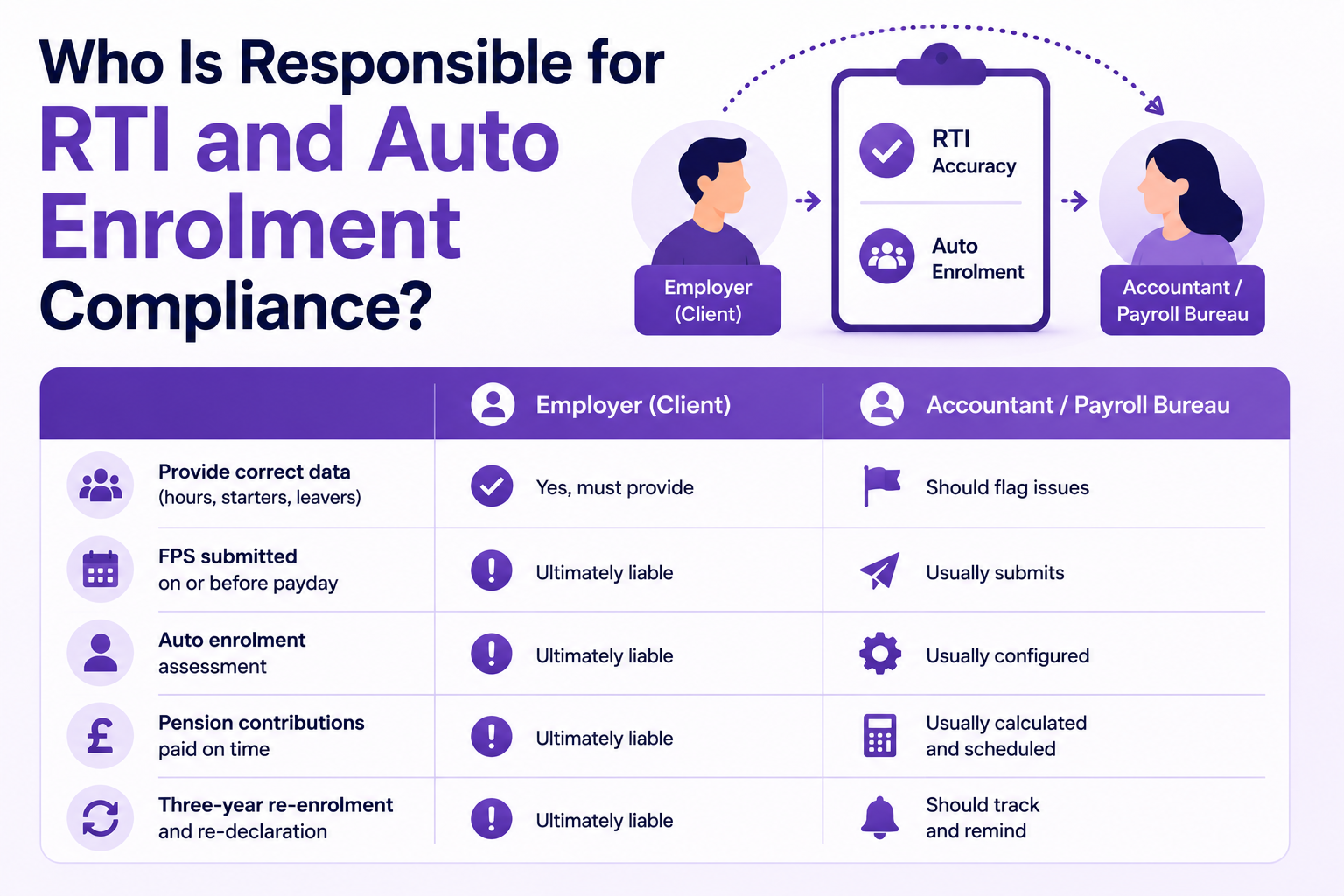
The employer is legally responsible for both RTI accuracy and auto enrolment duties, even when a payroll bureau or accountant runs the payroll on their behalf. If hours, start dates, leaver dates, or pay details are wrong before they reach the person processing payroll, the final FPS can still be wrong, regardless of how good the bureau is.
This is exactly why the accountant's role matters so much to a practice owner. You are the buffer between a client's messy internal data and HMRC's system. A practice that builds a clear checking step into every payroll run, rather than processing whatever the client sends through, is the practice that keeps clients out of penalty territory.
When Do RTI Submissions and Auto Enrolment Duties Fall Due
The FPS must reach HMRC on or before the date wages are paid to employees, known as the on-or-before rule. This requires employers to report income tax, National Insurance contributions, and other payroll deductions to HMRC when, or before, the payments are actually made. The EPS, used for statutory recoveries or to report a month with no pay, is generally due by the 19th of the following month.
HMRC does allow a small amount of flexibility. A three-day period of grace generally applies. HMRC will not normally charge a penalty if all payments are reported within three days of the date employees were paid. This is described as a concession for occasional lateness, not a routine extension, and persistent use of the window can still attract HMRC attention. The first late submission of the tax year is also typically ignored, unless the employer runs an annual PAYE scheme.
Auto enrolment timing runs on its own clock. Initial duties begin the day a firm takes on its first eligible employee, with a six-week window to assess and enrol. Re-enrolment then falls due every three years from the original duties start date, and a re-declaration of compliance must be submitted to The Pensions Regulator each time. These dates do not align with RTI deadlines and have to be tracked separately for every client.
Where Do Most Payroll Errors Happen
The error rarely happens in the software. It happens in the handoff, the point where a client's spreadsheet, timesheet, or verbal update gets typed into the payroll system. Employers are still required to keep reliable working time records for National Minimum Wage, holiday pay, statutory pay, and employment law purposes, and accurate hours remain the foundation of a correct holiday pay calculation, particularly for irregular-hours and part-year workers. When that source data is wrong, the FPS built from it is wrong too, no matter how carefully the submission itself is handled.
A second common failure point sits inside auto enrolment assessment. Payroll software generally automates the age and earnings check, but only if the underlying employee data, date of birth, pay frequency, and qualifying earnings, has been set up correctly in the first place. A practice running dozens of client payrolls on inconsistent setups is exposed every time a new starter is added without that check being confirmed.
A third sits in statutory pay changes landing mid-tax-year. From 6 April 2026, Statutory Sick Pay rules changed. The lower earnings limit was removed, and SSP is now paid from the first full day of sickness rather than day four. The rate is the lower of 80% of normal weekly earnings or the weekly flat rate of £123.25. Firms running payroll on outdated rate tables or unreviewed software updates can misapply these changes without noticing until a client or employee flags it.
How a Dedicated Remote Accountant Handles RTI and Auto Enrolment at Scale
This is where the dedicated accountant model changes the equation compared to a generalist bookkeeper juggling payroll between other work. A Finqube accountant works inside your existing systems, whether that is Xero, QuickBooks, Sage, FreeAgent or any other agent and is accountable to your review process for every single pay run.
Every Finqube engagement also includes our proprietary AI review software at no extra cost. Before an FPS or pension contribution reaches your review, the software has already checked the file for reconciliation mismatches, missing starter or leaver flags, and common preparation errors. You are not checking raw, unreviewed work. You are reviewing a file that has already been through a first pass.
How Finqube Can Help
Payroll and auto enrolment for 20 or 30 clients is not one task repeated many times. It is dozens of separate compliance clocks running at once, each with its own deadline and its own exposure if it slips. A dedicated Finqube accountant can be deployed inside your systems in one to two weeks. Hiring in-house typically takes three months or more. That speed takes the payroll volume off your internal team without taking the visibility away from you.
Our proprietary AI review software flags reconciliation issues and missing data before a pension contribution or FPS reaches your desk, so the review you do is a final check, not a full audit. This matters more as payroll obligations grow more complex, including the employer NIC rate increase to 15% and Secondary Threshold reduction to £5,000, alongside the Employment Allowance rise to £10,500 with the eligibility cap removed.
You can see exactly which client payrolls have been reviewed and which are waiting, at every point in the month, not just at month end. Explore the FTE model for dedicated payroll and auto enrolment support, or see how our AI review software works inside your existing review process.
Conclusion
RTI payroll and auto enrolment are two separate legal duties that run on different clocks but share the same underlying client data. The exact-hours RTI reporting change planned for April 2026 was withdrawn, but the existing on-or-before FPS rule, normal hours reporting, and auto enrolment thresholds remain firmly in place, and the penalties for getting them wrong have not softened.
For a growing practice, the risk is rarely the rules themselves. It is the volume of deadlines across every client payroll, each one a chance for a small data error to become a missed FPS or an unpaid pension contribution. A dedicated remote accountant with proprietary AI review built into the workflow turns that volume into something visible and controlled, rather than something you hope nobody drops.
See how it works for your practice with a one-month free pilot. No contract, just visibility into how your payroll and auto enrolment compliance would run with a dedicated Finqube accountant inside it.
One month. No contract.
See how a dedicated Finqube accountant fits into your MTD workflow before you decide.
Start your free pilotFAQ
Q: What is RTI payroll reporting?
A: RTI, Real Time Information, requires employers to report PAYE data to HMRC every time they pay employees, using a Full Payment Submission for pay and deductions and an Employer Payment Summary for statutory reclaims or periods with no pay.
Q: When does the FPS need to be submitted?
A: The FPS must reach HMRC on or before the date wages are paid, known as the on-or-before reporting rule. A short period of grace generally applies for occasional lateness, but it is not a routine extension.
Q: What happens if an FPS is filed late?
A: HMRC charges monthly penalties based on employer size: £100 for 1 to 9 employees, £200 for 10 to 49, £300 for 50 to 249, and £400 for 250 or more, with an additional 5% of tax and NICs due if the submission is over three months late.
Q: What are the current auto enrolment thresholds for 2026/27?
A: The earnings trigger stays at £10,000, the lower earnings limit remains at £6,240, and the upper earnings limit remains at £50,270 for the 2026/27 tax year, all unchanged from 2025/26.
Q: What is the minimum pension contribution under auto enrolment?
A: The legal minimum total contribution is 8% of qualifying earnings, with the employer required to contribute at least 3%. If the employer pays only the minimum, the employee makes up the remaining 5%, which includes basic rate tax relief.
Q: How often do employers need to re-enrol staff into a pension scheme?
A: Employers must re-enrol eligible staff who have opted out every three years, with the first re-enrolment date falling three years after the original duties start date, and a re-declaration of compliance must be submitted to The Pensions Regulator within a six-month window around that date.
Q: What penalties apply for auto enrolment non-compliance?
A: The Pensions Regulator can issue a fixed penalty notice of £400 for failing to comply with a statutory notice, followed by an escalating penalty notice charged daily at £50 to £10,000 depending on employer size if the breach continues.
Q: Did HMRC introduce exact-hours reporting through RTI in April 2026?
A: No. The proposal to report exact hours worked by every employee through RTI was considered, delayed, and then withdrawn before April 2026, so the existing broad "normal hours worked" bands remain in place.