.avif)

Blog Summary
- What sits inside the true cost of an in-house accounting hire, beyond salary
- The maths behind employer National Insurance and pension contributions on a typical offer
- Why a new hire takes roughly 60 days to reach full productivity, and what that costs
- How a dedicated remote accountant changes the maths, without hard pricing claims
Introduction
A partner at a growing UK practice budgets £32,000 for a part-qualified hire. The offer gets accepted. The cost question feels closed.
Six months later, the real number looks closer to £43,000. National Insurance, pension contributions, software seats, and onboarding time all add up quietly.
This guide breaks down what an in-house hire actually costs in full. It also explains how outsourced accounting changes the picture, without pretending the comparison is simple.
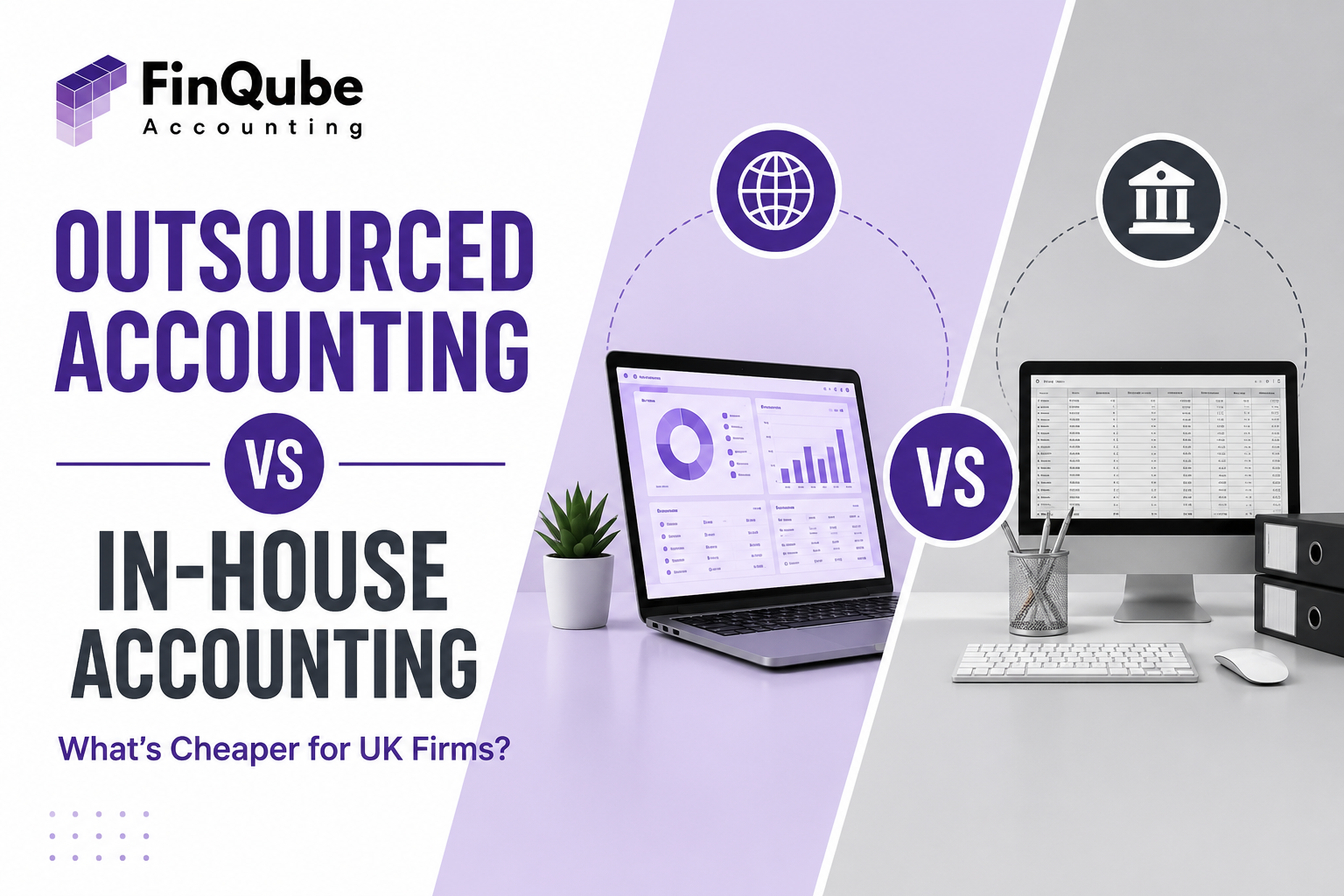
What Does Outsourced Accounting Cost Versus an In-House Hire?
Outsourced accounting bundles the accountant, the review process, and the technology into one predictable line. An in-house hire looks cheaper on the offer letter, but the full cost only appears once National Insurance, pension, software, and management time are counted.
Take the £32,000 example above. Under current employer National Insurance rules, contributions are due at 15% on earnings above the £5,000 secondary threshold, according to GOV.UK. That means £27,000 of the salary sits above the threshold. The direct NI bill comes to £4,050.
Add a 3% employer pension contribution under auto enrolment, roughly £960 on this salary band. The practice is now committed to just over £37,000. That is before a single laptop, software seat, or recruitment invoice gets paid.
This is why the gap between hiring and outsourcing is usually wider than firms expect going in.
Why Is In-House Accounting More Expensive Than It Looks on Paper?
In-house accounting costs more than the advertised salary because the true cost includes employer National Insurance, pension contributions, recruitment, training, software, and the ongoing risk of turnover.
Most partners budget for salary and stop there. But employers pay Class 1 National Insurance on top of salary for every employee above the secondary threshold. On a £32,000 salary, that is £4,050 in direct NI tax alone. Auto enrolment pension rules, overseen by the Pensions Regulator, add a further minimum of 3% of qualifying earnings.
Together, NI and pension push the £32,000 offer to just over £37,000 in year one. That is a 15.7% uplift, and it never appears on the letter the candidate signs.
That figure still excludes the practical costs of running the hire. Add a recruitment agency fee, typically 15% to 20% of first-year salary for a part-qualified role. Add a software seat for Xero, QuickBooks, Sage, FreeAgent, or any other software. Add a laptop and monitor setup, plus several weeks where the new hire produces little billable work. The true cost of a single hire regularly runs 30% to 40% above the base salary before a client file has been meaningfully touched.
The 60-Day Ramp to Full Productivity
The 60-day figure is not an abstract estimate. It reflects what actually happens inside a practice when a new hire starts.
Days 1 to 10, orientation and systems access. The new hire gets set up on practice management software, Xero or the firm's chosen platform, email, and document storage. A senior team member spends 1 to 2 hours a day walking through client files and processes. Almost no billable output happens in this window.
Days 11 to 25, supervised client work. The hire begins working live client files. Every piece of output gets checked line by line by a manager or partner. Review time during this phase typically runs at 40% to 60% of the time spent on the original task.
Days 26 to 45, spot-checked work. Output volume increases. Review shifts from full checks to spot checks on higher-risk items, such as VAT submissions, payroll runs, and year-end adjustments. Review overhead drops to roughly 20% to 25% of task time.
Days 46 to 60, near-independent work. The hire produces client-ready output with only exception-based review. This is usually the point where a new hire starts contributing what the firm expected from day one.
Across that 60-day window, a conservative estimate puts 25 to 35 hours of senior partner or manager time into direct supervision. At an internal partner rate of £75 to £100 an hour, that supervision cost alone adds £1,875 to £3,500 to the true cost of the hire in year one.
Turnover makes the problem worse. According to AccountingWeb, practice staff turnover has been cited repeatedly as one of the sector's most persistent cost drains. Every departure resets the recruitment and 60-day training clock, and repeats the full cost above from scratch.
Who Should Compare Outsourced Accounting Against Hiring In-House?
Practice owners running firms of 2 to 20 staff, weighing a new hire against extending their team, should run this comparison before signing an offer letter. Not after.
If your practice is turning down work because of capacity, or a partner is personally absorbing overflow that should sit with a qualified accountant, the comparison matters most right now. Firms preparing for a busy filing season, onboarding new clients, or replacing a departing team member are the ones most likely to overpay for capacity they only need part of the year.
A firm bringing on a hire purely to cover the January to April self assessment peak, for example, is committing to a 12-month NI and pension bill of over £37,000 to cover roughly four months of genuinely stretched capacity. That fixed cost then continues through the quieter months that follow.
When Does Outsourcing Become Cheaper Than Hiring?
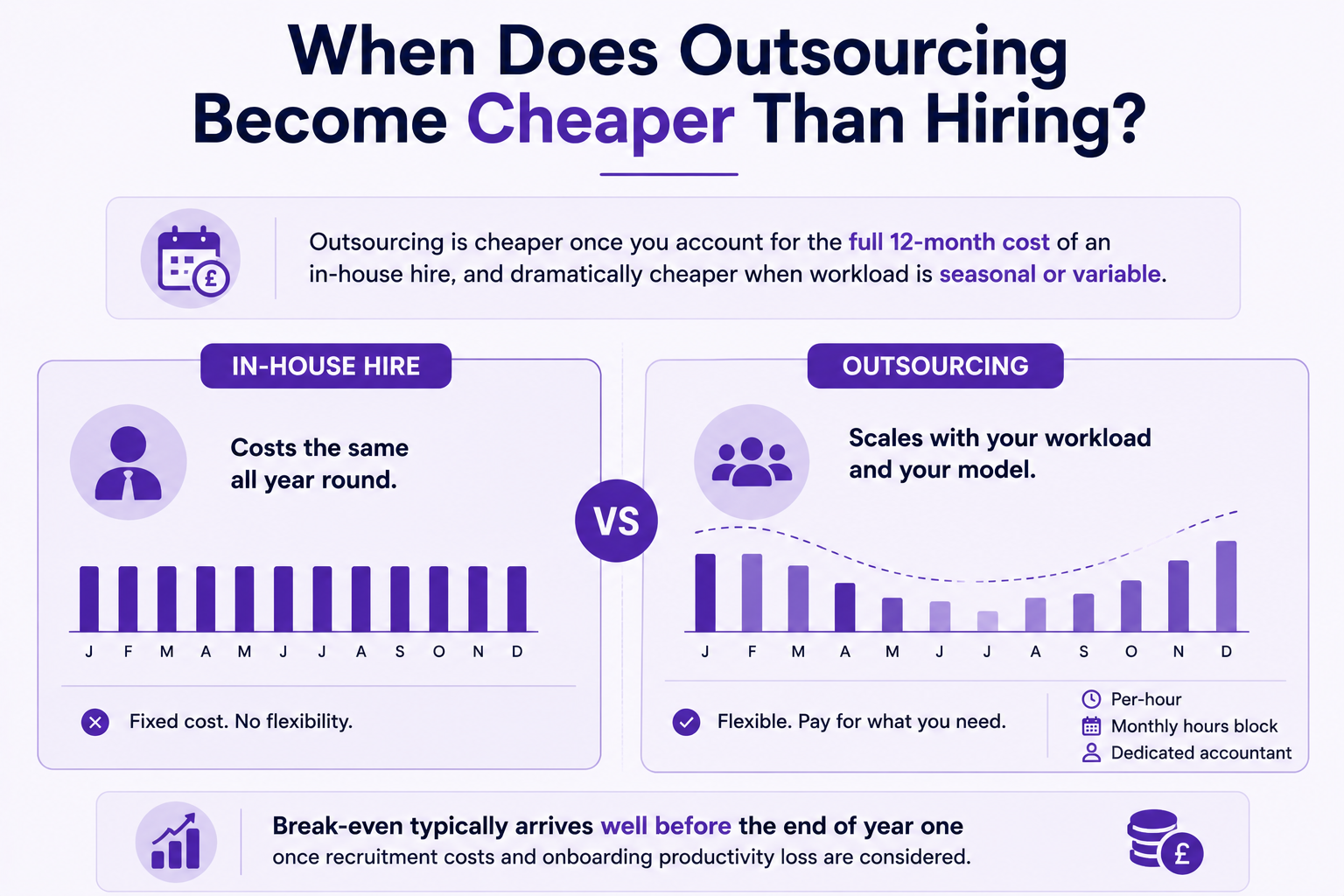
Outsourcing becomes cheaper than hiring as soon as you account for the full 12-month cost of an in-house employee, rather than just the advertised salary. It becomes dramatically cheaper when the workload is seasonal or variable.
A permanent in-house hire costs the same whether your workload is at its January peak or its quiet August trough. Take the fully loaded £37,000 figure from earlier and spread it across 12 months. That is roughly £3,084 a month, every month, regardless of whether the practice needs 160 hours of capacity that month or 60.
An extended team scales with the model you choose, whether that is a per-hour arrangement for overflow, a fixed monthly hours block, or a dedicated accountant working your hours on your systems. For most practices, the break-even point arrives well before the end of the first year, once recruitment costs and the productivity lost during the 60-day onboarding window are factored in.
Where Do the Hidden Costs of an In-House Hire Show Up?
Hidden costs in an in-house hire show up in recruitment fees, onboarding time, software licensing, management overhead, sick leave and holiday cover, and the cost of a hire that does not work out.
Recruitment. Agency fees of 15% to 20% of first-year salary on a £32,000 role add £4,800 to £6,400, plus 8 to 12 hours of partner time spent screening CVs and interviewing.
Onboarding. As set out above, 25 to 35 hours of senior review time across the first 60 days, worth £1,875 to £3,500 at typical internal rates.
Software. A full licence seat for Xero, QuickBooks, Sage, FreeAgent, or any other software, plus practice management and document storage tools, typically £600 to £1,200 a year. This gets paid in full even during quiet periods.
Cover. Sick leave, statutory holiday of at least 28 days including bank holidays, and any parental leave still need covering. This usually means extra cost or extra strain on the existing team.
Management time. Someone senior has to review, correct, and manage a junior hire on an ongoing basis. That is time not spent on client work or business development, even after the 60-day ramp ends.
None of this appears on the offer letter. That is exactly why it catches practice owners off guard when the first full year of employment costs gets totalled. Adding recruitment and software costs to the £37,000 NI and pension figure brings a realistic first-year total for a £32,000 hire to somewhere between £43,000 and £45,000. That is a 34% to 41% uplift over the advertised salary.
There is a further hidden cost that only shows up when a hire does not work out. According to ACCA, practices consistently report that a mismatched hire in a client-facing role costs far more than the salary paid during their tenure, once the cost of redoing work, managing affected client relationships, and restarting recruitment are included.
How Do You Calculate the True Cost Difference?
Calculate the true cost difference by adding gross salary, employer National Insurance, pension contributions, software, recruitment amortised over the expected tenure, and management overhead. Then compare that total against the all-in cost of an extended team engagement.
A working formula for the in-house side, using the £32,000 example throughout:
Gross salary (£32,000) plus employer NI at 15% above the £5,000 threshold (£4,050) plus employer pension at 3% of qualifying earnings (£960) plus a software seat (£900) plus recruitment cost amortised over an assumed two-year tenure (£2,600) plus 60-day onboarding review time at partner rate (£2,700). That comes to a true first-year cost of roughly £43,210.
That is 35% above the £32,000 headline figure. This is before accounting for any turnover risk, or the cost of a hire that leaves within the first year and resets the clock. Run your own numbers through the same formula for your specific salary band and recruitment route before making a hiring decision.
Cost Comparison Table
Confirm current NI thresholds, pension rates, and any specific figures with Sambhav before this goes live, since employer costs are set annually.
Real Scenario
Priya Shah runs Shah & Co Accountants in Leeds. Her team of six was carrying a rising client base without extra headcount.
She budgeted £30,000 for a part-qualified hire to cover the gap. Once she worked through National Insurance, pension contributions, a software seat, and the expected onboarding period, the realistic first-year cost sat closer to £41,000. Recruitment alone was projected to take two to three months, with no guarantee the right candidate would say yes.
Priya brought in a dedicated remote accountant instead, working inside her existing Xero setup. There was no NI or pension line to budget for, no recruitment agency fee, and no 60-day ramp before the accountant was fully productive on her client files.
The capacity gap closed within weeks, not months. Priya kept the flexibility to scale the engagement up during her busiest filing periods and back down once the peak passed.
How Finqube Can Help
Finqube gives you a dedicated accountant working inside your existing systems, whether that is Xero, QuickBooks, Sage, FreeAgent, or any other software. There is no employer National Insurance, pension contribution, recruitment overhead, or fixed commitment to plan around.
There is no 60-day supervised ramp to budget for either. Every engagement includes Finqube's proprietary AI review software at no extra cost, flagging reconciliation mismatches and common preparation errors before a file reaches your review. You see exactly what your accountant is working on, and what has already been checked, without adding a management layer to your own workload.
Finqube's engagement models range from per-hour overflow support to a dedicated full-time accountant, with no minimum commitment. You pay for the capacity you actually need. For firms weighing outsourced bookkeeping or accounts finalisation specifically, Finqube's bookkeeping and accounts finalisation service sits inside the same working model.
Conclusion
The true cost of an in-house hire is rarely the number on the offer letter. A £32,000 salary carries roughly £5,000 in direct National Insurance and pension costs before software, recruitment, and a 60-day productivity ramp are even counted. The realistic first-year figure often lands nearer £43,000 to £45,000.
That cost stays fixed regardless of how workload shifts through the year. It repeats in full if the hire does not stay. An extended team gives you the same accounting capability without those fixed costs, and without a long-term contract to unwind if your needs change.
If you want to work through the real numbers for your own practice, book a discovery call to talk through your workload and salary band.
One month. No contract.
See how a dedicated Finqube accountant fits into your MTD workflow before you decide.
Start your free pilotFAQ
Is outsourced accounting cheaper than hiring in-house in the UK?
In most cases, yes, once salary, employer National Insurance at 15% above the secondary threshold, pension contributions, software, and recruitment are all included on the in-house side.
What is the true cost of an in-house accountant beyond salary?
It includes employer National Insurance, auto enrolment pension contributions of at least 3%, software licensing, recruitment fees, a roughly 60-day onboarding ramp with elevated senior review time, and ongoing management overhead. Together these typically add 30% to 40% on top of the advertised salary.
How much does employer National Insurance actually add to a salary?
Employer National Insurance is charged at 15% on earnings above the £5,000 secondary threshold. On a £32,000 salary, that is £4,050 a year, before pension contributions are added on top.
How long does it take a new in-house hire to reach full productivity?
Roughly 60 days. The first 10 days are largely orientation. The next 15 involve heavily supervised work with review time running at 40% to 60% of task time. The following 20 days shift to spot checks. Only from around day 46 does output approach what the practice expected from the outset.
Does outsourced accounting work with Xero, QuickBooks, or Sage?
Yes. A dedicated remote accountant works inside your existing systems, whether that is Xero, QuickBooks, Sage, FreeAgent, or any other software, so there is no need to migrate platforms.
What is the minimum commitment for outsourced accounting with Finqube?
None. Finqube's engagement models have no minimum commitment, so you can scale up or down as your practice's workload changes.
Does outsourcing accounting mean losing visibility over client work?
No. With proprietary AI review software included in every engagement, partners keep full visibility into what work has been done and what has already been checked before it reaches their review.
Is outsourced accounting only cheaper for large practices?
No. Practices of 2 to 20 staff typically see the largest relative savings, since they avoid the fixed National Insurance, pension, and onboarding costs of a permanent hire while still accessing qualified accounting support.