
.avif)

Blog Summary
- The exact dates for corporation tax payment, CT600 filing and Companies House accounts, with worked examples.
- What happens when a client misses a deadline, including real penalty amounts and how they grow over time.
- How the £1.5 million instalment threshold splits between associated companies, and why this catches groups off guard.
- A simple compliance calendar your practice can build into its workflow, whatever software you use.
Introduction
A client emails you in month eleven. HMRC has charged them a penalty. Why?
You check the file. Nobody filed the CT600. Nobody flagged it.
This is how most corporation tax deadline problems start. It is rarely about not knowing the rules. It is about tracking dozens of clients at once. Each one has a different year end. Each one carries its own risk.
Corporation tax deadlines UK rules follow a fixed pattern. Every accounting period has a payment date. It has a filing date. It has a separate Companies House date too. Miss any one, and your client faces a penalty, interest, or both.
This guide sets out every deadline your practice needs to track. It covers the standard rules. It covers the instalment rules for larger companies. It covers the penalty changes that landed in 2026. And it shows how one UK practice stopped chasing deadlines and started managing them.
What Are the Corporation Tax Deadlines Every UK Company Must Meet?
Every UK company has three deadlines. Each one ties back to the accounting period end date. Mix them up, and you miss a filing.
Corporation tax payment is due nine months and one day after the accounting period ends. This applies to companies with profits up to £1.5 million.
CT600 filing is due twelve months after the period ends. That is three months after the payment deadline.
Companies House accounts are due nine months after the financial year end for private companies. Public companies get six months.
Most companies line up their accounting period with their financial year. So these three dates usually run side by side. According to GOV.UK, first accounts are due 21 months after the date of Companies House registration. This catches many new companies off guard.
Worked example. A company with a 31 March year end pays corporation tax by 1 January. It files its CT600 by 31 March the following year. It files accounts with Companies House by 31 December.
Notice the gap. Payment falls three months before filing. This trips up more directors than any other rule. Flag it to every client at the start.
Why Do the Payment and Filing Deadlines Fall on Different Dates?
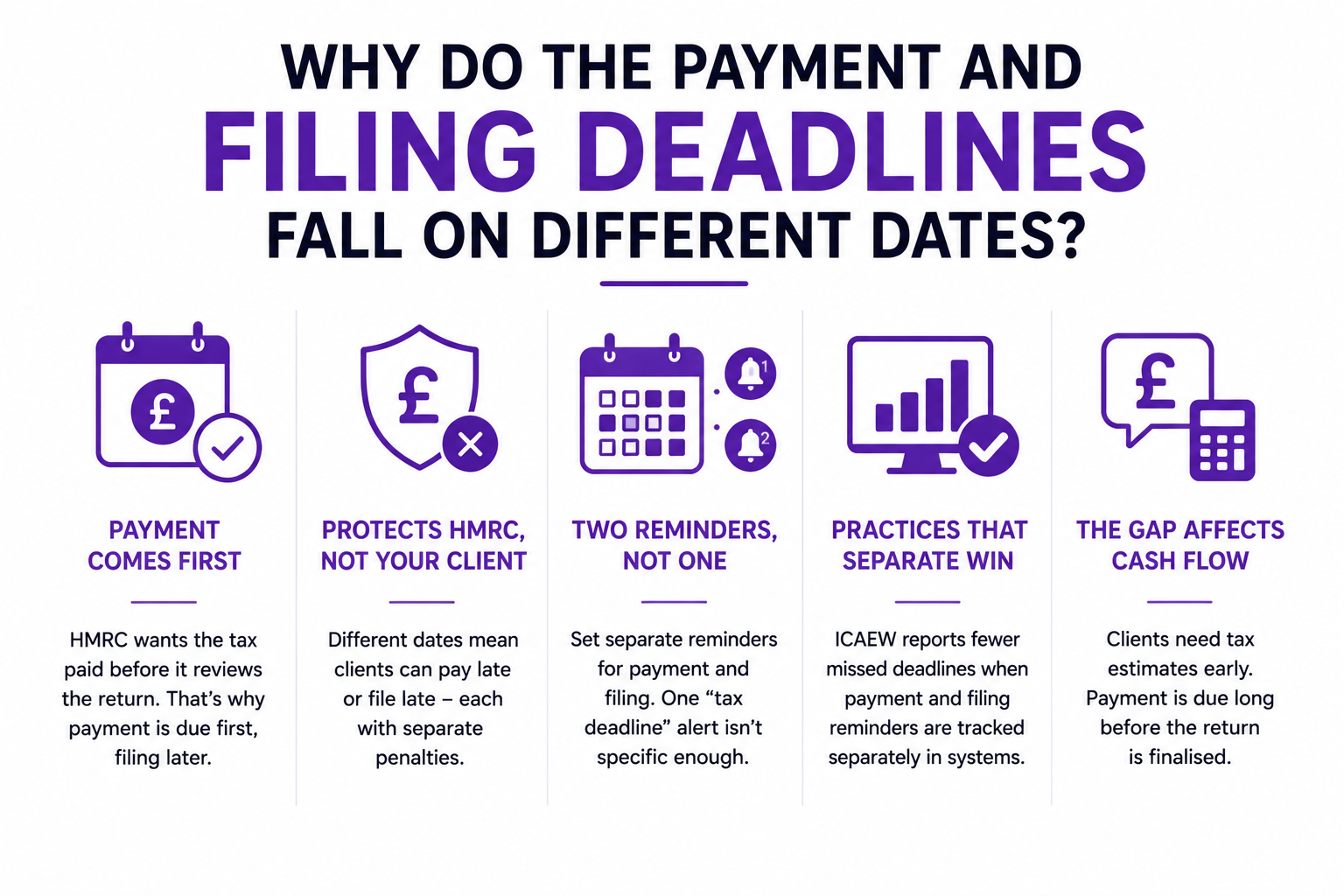
HMRC wants the tax paid before it checks the return in detail. That is why payment comes first. Filing follows three months later.
This order protects HMRC's cash flow. It does not protect your client's cash flow. A director who assumes both dates match will pay late, file late, or both. Each mistake carries its own penalty.
For your practice, this means two reminders per client, not one. A single "tax deadline" note in your calendar is not specific enough.
According to ICAEW, practices that split payment and filing reminders inside their client systems, whether that is Xero, QuickBooks, or any other software, miss fewer deadlines than practices using one combined date.
This gap matters for cash flow talks too. Clients often ask for a tax estimate long before the return is finished. Payment falls due well before the final figures are locked in.
Who Is Responsible for Meeting Corporation Tax Deadlines?
By law, the company director carries the responsibility. In practice, your firm manages the calendar.
This creates a gap. If a deadline slips, the client blames the practice. It does not matter what the engagement letter says.
Three roles usually share the load inside a practice.
The bookkeeper keeps the records accurate well before the deadline window opens. The accountant preparing the CT600 needs final figures four to six weeks before filing. The partner reviews the finished return and signs it off before it goes to HMRC.
When one of these steps runs late, the whole chain gets squeezed. This is where most practices lose control. It happens most often during busy season, when staff cover several clients with overlapping deadlines.
Give each client file one named owner. That person tracks the calendar from bookkeeping through to filing. Nothing falls between roles.
When Do Larger Companies Pay in Instalments?
Companies with profits over £1.5 million cannot use the standard nine-months-and-one-day rule. They pay in quarterly instalments instead.
According to GOV.UK, instalments for companies between £1.5 million and £20 million start in month seven of the accounting period. Very large companies over £20 million start paying in month three.
This threshold is not fixed. It splits across associated companies. A company with two associated entities has its threshold cut to £750,000. With three associated companies, the threshold falls to £375,000.
Groups that restructure often miss this. A client comfortably under £1.5 million on its own can fall into instalment territory the moment a related company joins the group.
Ask every new client about associated company status at the start of the engagement, not partway through the year. It changes the whole payment calendar.
Where Do You File and Pay Corporation Tax?
You file and pay corporation tax through HMRC's online services. This sits apart from Companies House accounts filing. The two regulators no longer share one joint submission route.
Practices file the CT600 using HMRC-recognised software, most commercial packages, or the Government Gateway. Accounts go to Companies House through its own portal, or through software that supports iXBRL tagging.
This split matters more from 1 April 2026. HMRC and Companies House have closed their joint filing service for good. It used to let smaller practices submit both in one pass. Every practice now needs a workflow, built on Xero, Sage, or any other software, that covers both filings on their own.
Payment goes straight to HMRC by bank transfer, using the company's Corporation Tax payment reference. According to GOV.UK, HMRC pays interest on early payments and charges interest on late ones. So timing the transfer close to the deadline rarely helps the client.
How Do You Build a Compliance Calendar That Works?
A working calendar tracks three dates per client, not one. It flags each deadline on its own, with enough lead time to act before it turns urgent.
Start with the accounting period end date for every client. From there, work out payment, filing, and Companies House dates automatically. Do not re-work them by hand each year.
Build in buffer time. Set internal deadlines at least four weeks ahead of the real HMRC and Companies House dates. This gives you room to chase missing client information before the true deadline hits.
Check associated company status every year. A client's instalment duties can shift even when nothing else in their business changes, simply because a related company joins or leaves the group.
Split the "prepare" deadline from the "submit" deadline in your own tracking. The gap between finishing a CT600 and actually filing it is where last-minute errors slip through unnoticed.
Missing any one of these deadlines carries a real cost. According to GOV.UK, the fixed late filing penalty doubled at Budget 2025. Returns due on or after 1 April 2026 now carry a £200 penalty for being one day late. This rises to 10% of unpaid tax at six months, and a further 10% at twelve months.
Real Scenario: How One Practice Fixed Its Deadline Problem
Harrow Bridge Accountants runs a 40-client corporation tax book. Its clients use a mix of Xero, QuickBooks and Sage. Before working with FinQube, the practice tracked deadlines on a shared spreadsheet. Staff updated it by hand, whoever touched the file last.
The problem. Two clients missed CT600 filing deadlines in the same quarter. Both paid the £200 fixed penalty. One client, a group that had grown to three associated entities, landed on quarterly instalments without the practice noticing. HMRC sent a payment demand before anyone caught it.
What they tried. The practice added a second staff member to check the spreadsheet each week. This caught more errors. But it also doubled the admin hours spent on deadline tracking, work that earned no fee income.
What changed. FinQube gave Harrow Bridge a dedicated accountant who works inside the practice's existing Xero and Sage files. The accountant tracks each client's accounting period, associated company status, and three key deadlines automatically. FinQube's AI review software flags any client nearing a deadline window before the partner even sees the file.
The result: zero missed CT600 filings over the following two quarters. The partner also got back roughly eight hours a week, time once spent chasing deadlines by hand.
How FinQube Can Help
Chasing corporation tax deadlines across dozens of clients should not eat up your team's week. FinQube gives every practice a dedicated, named accountant, not a shared pool, who works inside your existing systems. That means Xero, QuickBooks, Sage, FreeAgent, or any other software you already run.
Every file your accountant touches passes through FinQube's proprietary AI review software before it reaches your desk. It flags approaching deadlines, reconciliation mismatches, and missing information on its own. You review a file that is already clean, not one you have to chase under deadline pressure.
Pricing is fixed and monthly, not hourly. You know your cost before busy season starts, not after. And because FinQube structures every engagement as a services agreement rather than a labour supply arrangement, it stays clear of IR35 problems for your practice.
Ready to stop chasing corporation tax deadlines by hand?
Talk to FinQube about a dedicated accountant for your practice. There is no minimum commitment beyond the terms you agree, and you keep full sight of every client file from day one.
One month. No contract.
See how a dedicated Finqube accountant fits into your MTD workflow before you decide.
Start your free pilotConclusion
Corporation tax deadlines UK rules are simple on paper. Payment falls nine months and one day after the period end. Filing follows three months later. Companies House accounts sit on their own timeline.
The hard part is tracking all three, for every client, every year, without missing associated company changes or instalment triggers. A missed deadline now costs at least £200, and interest builds from day one.
Build a calendar that tracks each date on its own, with real lead time built in. If your practice needs help doing that at scale, FinQube's dedicated accountants and AI review software exist to catch this exact risk before it reaches your desk.
FAQ
What is the corporation tax deadline for a limited company?
Corporation tax payment is due nine months and one day after your accounting period ends. The CT600 return is due twelve months after the same date.
Do I pay corporation tax before or after filing the return?
You pay first. Payment falls due three months before the CT600 filing deadline. This catches many first-time directors off guard.
What happens if I miss the corporation tax filing deadline?
HMRC charges a £200 fixed penalty, even if you file just one day late. This follows the Budget 2025 change, effective from 1 April 2026. Penalties rise to 10% of unpaid tax at six months, and a further 10% at twelve months.
How do quarterly instalment payments work for corporation tax?
Companies with profits over £1.5 million pay in four quarterly instalments instead of one lump sum. Instalments start in month seven, or month three for companies over £20 million in profit.
Does the £1.5 million instalment threshold apply per company or per group?
The threshold splits across associated companies. A group with three associated entities shares a threshold of £375,000 between them.
When are Companies House accounts due for a private limited company?
Private company accounts are due nine months after the financial year end. Public companies get a shorter six-month deadline.
Can I still file corporation tax and accounts together through one joint service?
No. HMRC and Companies House closed their joint filing service for good from 1 April 2026. Practices must now submit both filings through separate routes.