.avif)

Blog Summary
- What management accounting means, and how it differs from financial accounting.
- Why UK practice owners need management accounts, not just year-end statutory accounts.
- Who should prepare your management accounts, and what skills that person needs.
- How outsourcing management accounting works, step by step.
Introduction
Your client asks a simple question. "How much cash will I have in three months?"
You have no answer. Their statutory accounts are ten months old. This is the gap management accounting UK practices exist to close.
Management accounting turns raw numbers into decisions. It gives business owners a live view of their finances. It is not a look back at last year.
For UK accounting firms, it is also a growing service line. Clients will pay for it every month.
Many practices know they should offer it. Few have the time to build it well. Partners are already busy with deadlines, calls, and staff.
This guide explains what management accounting is. It shows why it matters. It shows how firms across the UK outsource it without losing control.
By the end, you will know where to start.
What Is Management Accounting?
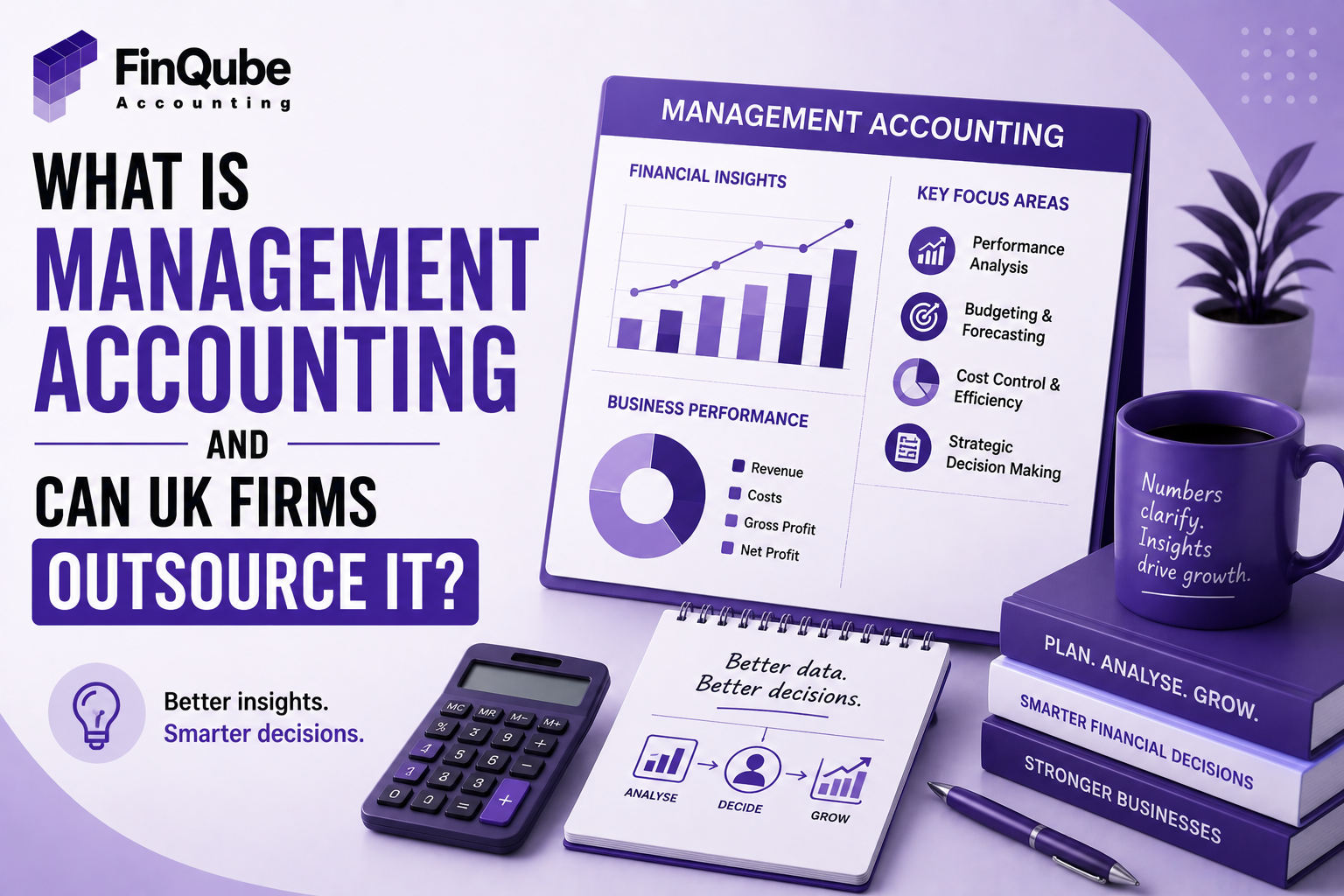
Management accounting means preparing financial reports for people inside the business. It is not for HMRC or Companies House. It helps leaders plan, cut costs, and make choices.
Statutory accounts go to Companies House. Management accounts do not. Nobody outside the business needs to see them.
They exist for one reason. They help the people who run the company.
BPP says management accountants work by "collecting, analysing, and reporting financial information that is used by company leaders to make informed business decisions." That is the key point.
Financial accounting looks back. Management accounting looks forward.
A typical pack includes a profit and loss report, a balance sheet snapshot, and a cash flow forecast. Many firms add a KPI dashboard too.
Some also compare budget against actual results. Some break results down by department.
This work sits close to financial vs management accounting. Financial accounting follows a strict format. Management accounting does not.
You build each report around what the client needs to know.
Financial Accounting vs Management Accounting
This table helps you explain the service to clients in plain terms. It also links to a wider topic: types of accounting. Clients often ask about this before they sign up for monthly reports.
Why Does Management Accounting Matter for UK Firms?
Management accounting matters because it changes your role. You stop being just a compliance provider. You become a partner in the business.
That shift changes two things. It raises what clients pay. It also keeps clients loyal for longer.
Clients who only get year-end accounts see you once a year. Clients who get monthly accounts talk to you often. A rival firm finds it harder to win them over.
There is a revenue case too. Monthly management accounts work brings steady income. It does not rely on one busy season each year.
Business owners now expect this kind of insight. A director running a £2 million business cannot wait a year to learn their margins have slipped. They need the numbers now.
AICPA and CIMA run a joint qualification called CGMA. They say it helps professionals "make sense of the past, navigate the present and model the future." Read more from AICPA and CIMA on this. That is the exact value you can offer clients.
Firms that skip this service risk losing ground. Rivals who offer it will pull clients away. Advisory work is where the profession is heading.
There is also a pricing reason. Compliance-only work gets compared on price. Clients switch firms easily when the service looks the same everywhere.
Advisory work built on management accounts is harder to compare this way. Clients pay for insight, not just a filed form.
There is a risk side too. A client who checks numbers once a year can make a costly mistake and not know it for months. Monthly accounts catch problems early. They protect the client and your firm's name.
Who Prepares Management Accounts?
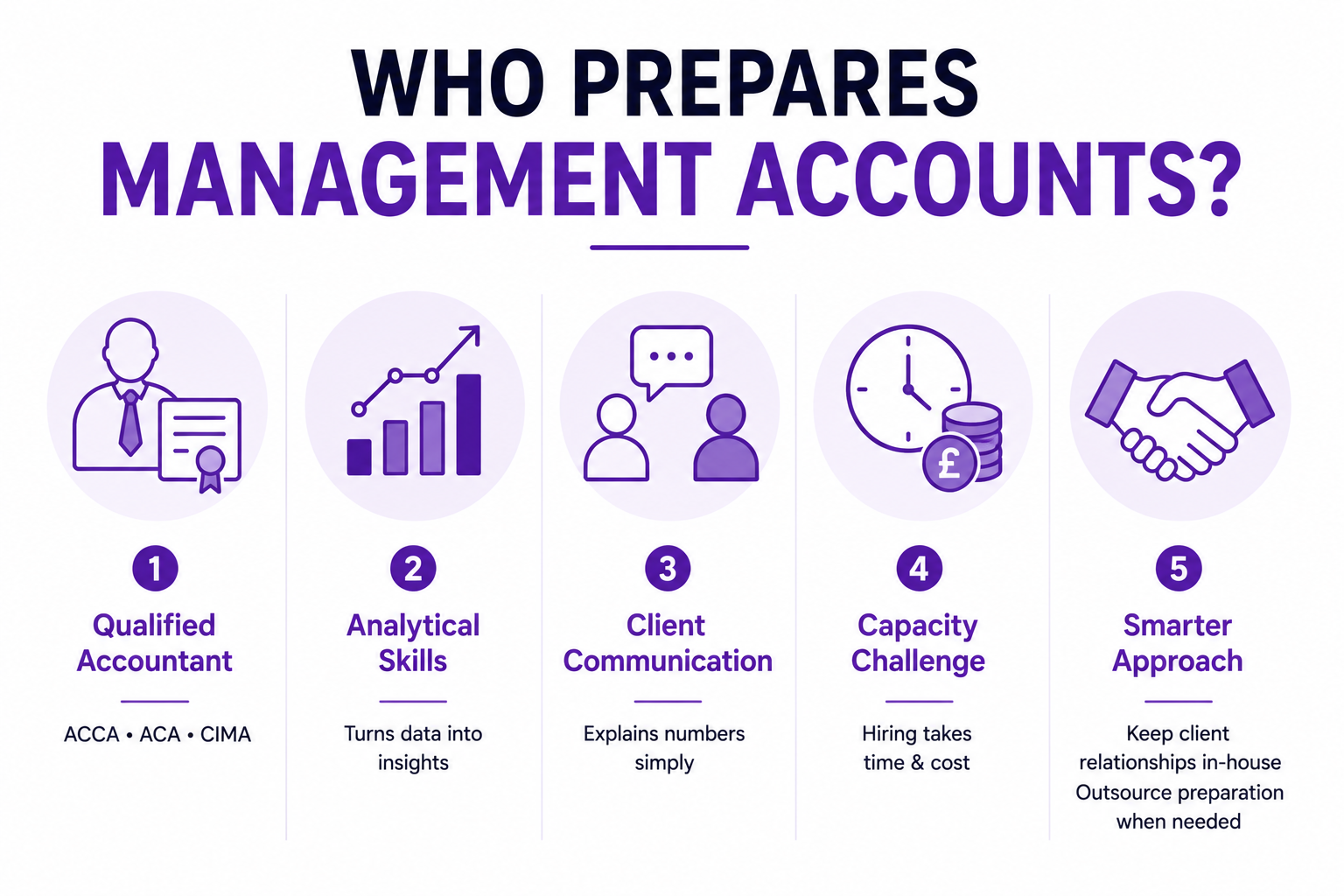
A qualified or part-qualified accountant usually prepares management accounts. Many hold a CIMA, ACCA, or ACA qualification.
ICAEW says the role mixes technical accuracy with business judgement. A good management accountant does more than record numbers. They explain what the numbers mean.
Inside a practice, this work can sit with a senior bookkeeper, a management accountant, or a client manager. The right person needs three things. They need technical skill. They need to know the software. They need to explain numbers in plain English.
That last skill is often the hardest to find. Many strong accountants struggle to explain a variance to a busy client in thirty seconds.
This is where firms hit a wall. Building this skill in-house takes time. You must find, train, and keep the right person. That is costly, especially during busy season.
Hiring adds more delay. A good management accountant can take months to find in a tight market. Many firms give up and stay compliance-only.
Keeping staff is a second risk. Train someone well, and a bigger firm may poach them within a year. You lose the investment and start again.
This is why some firms split the skill from the seat. They keep the client relationship in-house. They let a specialist partner supply the preparation work.
When Should a Practice Start Producing Management Accounts?
A practice should start as soon as a client outgrows year-end reporting. Common signs include fast growth, cash flow strain, or a new investor asking for regular numbers.
Clients turning over more than £500,000 tend to benefit most. At that size, gut-feel decisions start to cost real money.
Seasonal businesses need this even earlier. A shop with a strong Christmas period needs monthly numbers to plan stock and cash through quieter months.
New directors are another trigger. A first-time owner often does not know what "good" looks like. Monthly accounts give them a clear benchmark. They build a habit of checking performance often.
Waiting until year-end is too late. By the time statutory accounts are filed, the business has already lived through the problem. Monthly reports catch issues while there is still time to fix them.
Funding applications are another common trigger. Lenders and investors almost always ask for recent management accounts, not last year's filed statement.
A firm that turns these around fast wins client trust. A firm that cannot may lose that client to a rival who already offers the service.
Where Does Management Accounting Fit Inside Your Practice?
Management accounting sits between compliance and advisory work. It uses the same data as your bookkeeping. But it feeds straight into advisory conversations.
Most firms build this inside their current software. Data flows from Xero, QuickBooks, Sage, or any other software the client already uses. It lands in a monthly reporting pack.
This is why the work fits best inside your bookkeeping team. It should not sit apart on its own. The person preparing the numbers needs to know the client's accounts well.
Firms that treat this as a bolt-on often produce reports that look correct but say little. Numbers need context. That context comes from someone who knows the business.
For growing practices, this is also where outsourcing decisions get made. Read our guide to management accounts outsourcing for more on what to keep in-house and what to hand off.
Practice management software plays a role here too. Whatever system you use to track jobs, give management accounts their own deadline and owner. Treat it like VAT or payroll.
Without that structure, the work slips. Client deadlines like VAT returns take priority. The monthly report gets pushed back, week after week.
How Do You Outsource Management Accounting?
You outsource management accounting by handing over the preparation work. You keep the client relationship. A specialist partner works inside your existing systems and produces the reports. You add the insight on top.
Here is how the process works, step by step.
Step one: Share access to your systems. The outsourced team connects into Xero, QuickBooks, Sage, or any other software your client already uses. Nothing changes for the client.
Step two: Agree the reporting pack. You decide together what the client needs. That might be a P&L, a cash flow forecast, a KPI dashboard, or all three.
Step three: The outsourced accountant prepares draft accounts. This happens on a fixed monthly schedule. You always know when the numbers will land.
Step four: A review layer checks the file. A strong partner runs an automated check first. It catches reconciliation errors and odd variances before a human even opens the file.
Step five: You review and present. The final numbers come back to you. You present them to the client as your own work, under your firm's name.
In-House vs Outsourced Management Accounting
This table shows why outsourcing has become the default choice for growing UK practices. You get expert help without the hiring risk or the long contract.
Real Scenario: A Manchester Practice Turns Its Numbers Around
Ashworth & Pryce is a nine-partner practice in Manchester. In 2024, it offered management accounts to only three clients. Every other client got compliance work only.
The partners knew there was demand. Clients kept asking for monthly numbers. But the practice had no spare hours to deliver them without hiring.
They tried to hire a management accountant twice. Both searches ran over four months and found nobody. Meanwhile, two clients left for a rival firm that offered monthly reporting.
In early 2025, the practice outsourced its management accounts work. A dedicated partner worked inside its existing Xero and QuickBooks, or any other software setup. One named accountant learned the client base and the firm's style.
Within six months, the practice offered management accounts to 22 clients. Retention on that group rose. Clients now spoke to the firm every month, not once a year. Partners spent their time on advice, not data entry.
The team tracked the results closely. Average fees per client on this service rose 18% against compliance-only clients.
Staff turnover fell too. The team no longer felt stretched trying to cover a gap they had failed to hire for twice.
One partner put it simply. The practice finally offered the service clients wanted, without adding headcount or risk.
How FinQube Can Help
FinQube prepares your clients' management accounts. That frees your team to focus on the client conversation, not the spreadsheet.
You get one dedicated, named accountant. They learn your clients and your style. Not a shared pool. Not a rotating queue of new faces.
We work inside the systems you already use. Xero, QuickBooks, Sage, FreeAgent, or any other software — nothing changes for your clients. Nothing needs moving.
Our AI review checks every file first. It flags reconciliation issues, odd variances, and common errors before your partner opens it. You review a file that is already close to right.
Pricing is fixed and paid monthly. You know your cost before the month starts. You can price the service to your clients with confidence.
There is no minimum commitment. You start, you see the quality of the work, and you decide each month whether to continue.
Your firm keeps the client relationship at every step. FinQube supplies the preparation work and the review layer behind the scenes, under your brand.
If IR35 is a concern for your practice, our contracts are set up as a services agreement. They are not a labour supply arrangement. That keeps the relationship clean and compliant.
Ready to see it work on a real client file? Book a free consultation with a named FinQube management accountant today.
One month. No contract.
See how a dedicated Finqube accountant fits into your MTD workflow before you decide.
Start your free pilotConclusion
UK firms once saw management accounting as optional. Growing businesses now expect it. Clients want monthly numbers, not annual surprises.
Building this skill in-house is slow and costly. It is also hard to staff well. Outsourcing gives you the skill without the hiring risk.
FinQube gives you one named accountant. They work inside your existing systems. AI review backs every file. Pricing is fixed and monthly, with no minimum commitment.
Talk to us before your next busy season starts. Book your free consultation today.
FAQ
What is management accounting in simple terms?
Management accounting means preparing financial reports for people inside the business. These reports are not filed with HMRC or Companies House.
What is the difference between financial accounting and management accounting?
Financial accounting reports past results to people outside the business, in a fixed format. Management accounting gives inside, forward-looking insight, in whatever format the business needs.
Why do businesses need management accounts?
Businesses need management accounts to track performance each month. They help owners spot problems early and act on fresh data, not last year's results.
Who prepares management accounts for a business?
A qualified or part-qualified accountant prepares them, often trained through CIMA or ACCA. Many practices now outsource this work to a specialist partner.
Can UK accounting firms outsource management accounting?
Yes. UK firms can outsource this work to a specialist partner. The partner works inside your existing software and delivers reports on a fixed monthly schedule. Your firm keeps the client relationship throughout.
How often should management accounts be prepared?
Most businesses do well with monthly accounts. Fast-growing or seasonal businesses sometimes need weekly reports.
How much does it cost to outsource management accounting?
Cost depends on the client's size and the depth of reporting needed. FinQube agrees a fixed monthly price upfront, so you know your cost before work starts.