.avif)

Blog Summary
- The real difference between financial accounting and management accounting, not just the textbook definition
- Which rules apply to each, and why one is regulated and the other is not
- How a UK practice with 2 to 20 staff typically splits this work between statutory compliance and client advisory
- How a dedicated remote accountant with proprietary AI review can run both without adding headcount
Introduction
A client asks for two things. Their year end accounts. And a live view of cash flow.
Your team nails the first one. The second one gets ignored. Then the client complains.
That gap has a name. Financial accounting versus management accounting. Most practice owners feel this gap. Few can explain it in plain words.
This guide breaks it down simply. You will see what each report covers. You will see who reads each one. You will see how UK practices deliver both, without burning out the team.
If you want the wider picture first, our guide to the types of accounting is a good starting point.
What Is the Difference Between Financial Accounting and Management Accounting
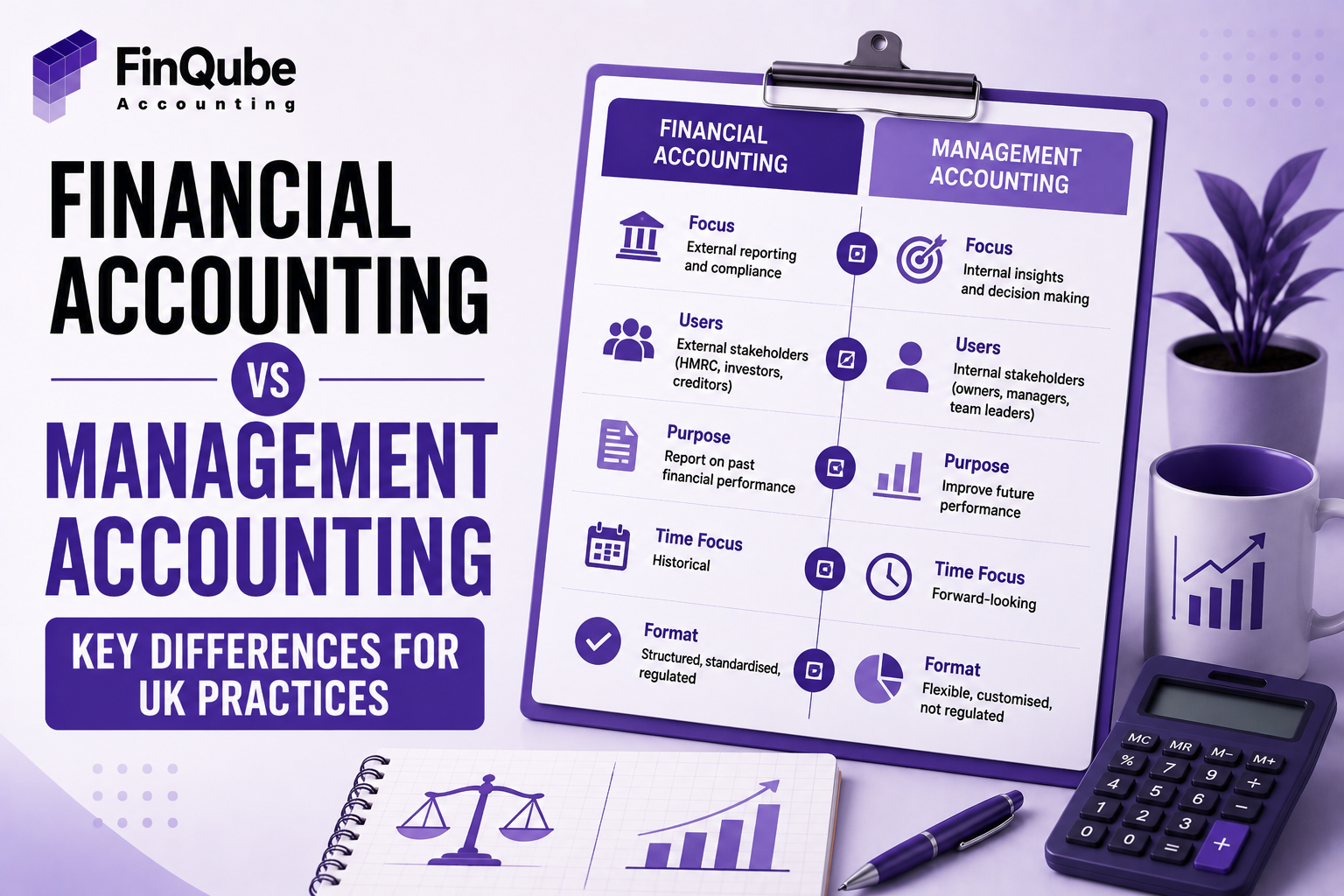
Financial accounting is for outsiders. Management accounting is for insiders.
Financial accounting means the profit and loss account. It means the balance sheet. It means the cash flow statement. These follow a fixed format. They go to HMRC, Companies House, shareholders, and lenders.
Management accounting means internal reports. They support decisions, not compliance. There is no fixed format. A practice builds each report around what the client needs.
ICAEW puts it simply. Financial accounting shows a true view of performance to outsiders. Management accounting helps insiders plan and decide.
The table below sets out the core differences, side by side.
Financial accounting proves what happened. Management accounting helps decide what happens next.
Why Do UK Practices Need Both
UK practices need financial accounting to stay legal. They need management accounting to stay useful.
The law demands financial accounting. Every UK limited company must file annual accounts. According to Companies House, private companies must file within 9 months of their year end. Turnover does not matter.
Corporation tax adds another rule. HMRC wants a return within 12 months. Payment is due sooner still, 9 months and 1 day after the period ends. Miss either date. The client pays a fine.
Management accounting exists for a different reason. Clients do not run a business on old numbers. They run it on this month's numbers.
A client watching cash tighten in March cannot wait until December. They need a pack now. It must show where the cash goes, in plain words.
This is why strong practices treat management accounting as its own service. It is not an afterthought. ACCA notes it has no fixed format. That gives firms room to build reports that actually help. Our guide on management accounting UK covers this in more depth.
Who Uses Financial Accounts Versus Management Accounts
Outsiders read financial accounts. Insiders read management accounts.
A bank manager reads the balance sheet. A shareholder reads the profit and loss account. HMRC reads the tax computation.
None of them see the monthly cash flow forecast. None see the cost breakdown by team. None see the KPI dashboard. Those live for the client alone.
The table below shows who reads what, and why.
A director wants one thing fast. Which product line is losing money this quarter? Yearly accounts cannot answer that fast enough. A monthly pack can.
This is where trust gets built or lost. A client who sees you once a year treats you as a cost. A client who gets a monthly pack treats you as part of the team.
When Should a Business Start Producing Management Accounts
Start as soon as a decision needs fresh numbers. Numbers less than a year old.
That point comes early. Sooner than most owners think. One extra employee. One new revenue stream. Any outside funding. All of these mean monthly figures within year one.
Seasonal firms need it sooner still. A shop or a restaurant without monthly cash visibility can hit a funding gap. Before the yearly accounts even flag it.
Growth is the other trigger. A client starts hiring. Or adds product lines. Or chases investment. Yearly accounts alone stop being enough. Lenders now ask for monthly figures too.
Practices that wait for the client to ask, wait too long. Raise it early. Raise it during onboarding. Set the tone from the first meeting.
Some clients push back at first. They see it as extra cost, not extra value. Show them one sample pack. Most change their mind fast, once they see what it actually tells them.
Where Do Financial Accounting and Management Accounting Overlap
Both jobs pull from one source. The outputs look different. The data underneath is the same.
Both draw on one general ledger. It might live in Xero, QuickBooks, Sage, FreeAgent, or any other software. A clean chart of accounts feeds both jobs. So does clean bookkeeping.
This is why messy bookkeeping hurts twice. Bad data means late filings. It also means useless management reports.
The overlap shows again at year end. Good monthly management accounts make year end faster. Matching entries, accruals, and prepayments are reviewed each month already. Nothing piles up at once.
Practices that split the two jobs fully often double their work. Practices with one clean data flow save real time.
This overlap is also why many firms now run management accounts outsourcing as one clean workflow, rather than treating each output as a separate task.
How a UK Practice Delivers Both Without Hiring More Staff
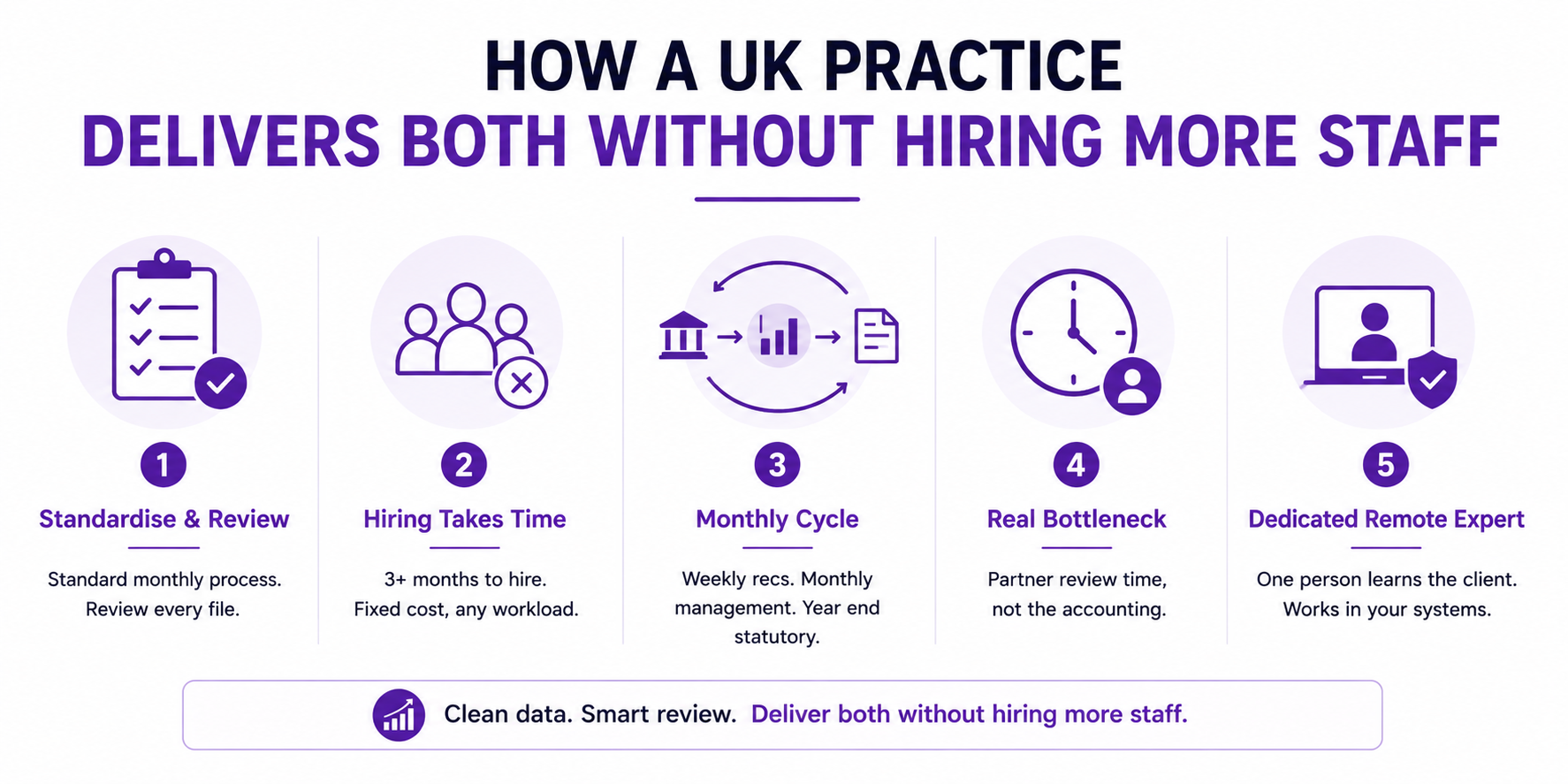
Standardise the monthly process. Review every file before the partner sees it. That is the fix.
Most practices try to hire their way out. A second qualified accountant takes 3 months to find. That adds a fixed salary too, busy month or quiet month.
There is another way. Build one monthly cycle for both jobs. Reconcile the books each week. Draft management accounts each month. Pull yearly accounts from those same figures at year end.
The real bottleneck is rarely the numbers. It is partner review time. Someone senior must check each file first.
One dedicated remote accountant changes this. They work inside the client's own system, Xero, QuickBooks, Sage, FreeAgent, or any other software. One person learns the business well. A rotating pool of juniors never does.
Review software helps too. It flags matching errors early. It flags open items before the partner opens the file. The partner then reviews clean work, not a pile of errors.
The table below compares three common routes for a growing practice.
Real Scenario: A UK Practice That Separated the Two Properly
Priya Nair runs a 9-person practice in Leeds. Her team was strong on yearly accounts. Management accounts were weak. Clients had started to notice.
One client, a growing logistics firm, asked for monthly figures. This came right after a cash scare. Priya's team was already stretched, doing yearly accounts for 40 other clients.
She tried a junior, part-time. The reports came out late. They were messy. The client threatened to leave for a rival with monthly reports as standard.
Priya brought in one dedicated remote accountant through Finqube. This accountant worked inside the firm's existing Xero setup. They took over the monthly work. Priya's own team stayed on yearly compliance.
Within two months, the client had a steady pack. It landed on the same date each month. It passed through Finqube's AI review first. Priya now offers this to every client above a certain size.
How Finqube Can Help
Splitting the two jobs takes the right structure. It does not take more staff. Finqube gives you that structure, without adding fixed salary costs.
You get one dedicated remote accountant. Not a rotating pool. They learn your clients well. They work inside your own systems, Xero, QuickBooks, Sage, FreeAgent, or any other software you already use.
Every file passes through our AI review software first. It flags matching errors. It flags open debtor and creditor items. It flags common mistakes. You review work that is already clean.
Pricing is fixed each month, agreed upfront. No hourly billing. No surprise invoice at year end. You know the cost before you commit.
The engagement runs as a services agreement, not a labour supply deal. This keeps IR35 risk off your desk. There is no minimum term beyond what you agree with us.
See how one dedicated accountant could run your management accounts. Book a call with Finqube. Find out what fits your practice.
Conclusion
Financial accounting and management accounting solve two problems. One keeps clients legal. The other helps them decide well.
Firms that treat both as real services win client trust. A once-a-year relationship never builds that trust. However, doing both well takes the right structure.
One dedicated accountant, working inside your own systems and backed by AI review, gives you both. Skip the 3-month hire. Skip the fixed cost of a full-time hire. Book a call with Finqube to see what that looks like.
One month. No contract.
See how a dedicated Finqube accountant fits into your MTD workflow before you decide.
Start your free pilotFAQ
What is the main difference between financial accounting and management accounting?
Financial accounting makes reports for HMRC and Companies House. Management accounting makes reports for your own team, for daily decisions.
Is management accounting a legal requirement in the UK?
No. Financial accounting is the legal one, under Companies House and HMRC rules. Management accounting has no set format or filing rule.
How often should a UK business produce management accounts?
Most growing firms do this every month. Fast-growing or seasonal firms often need figures every week.
Can one accountant handle both financial accounting and management accounting?
Yes. The bookkeeping just needs to stay clean. Many UK practices use one accountant for both jobs, from the same figures.
What accounting standards apply to financial accounting in the UK?
Most small and medium firms use FRS 102. Larger and listed firms use full IFRS. Management accounting follows neither rule.
Why do management accounts matter for small business owners?
They show current performance and cash right now. Owners can act fast, instead of waiting a year to find out.
Should accounting practices outsource management accounts preparation?
Many do. One dedicated remote accountant frees up partner time for advice work. No full-time hire needed.