.avif)

Blog Summary
- What outsourced accounting support looks like inside a UK practice
- Why most outsourcing deals fail to give partners real visibility
- How Finqube's dedicated accountant and AI review close that gap
- What one Leeds practice got back after switching to Finqube
Introduction
Hiring a second accountant takes three months. It often costs double what you budgeted. Outsourcing is meant to fix that.
But most practice owners we speak to have tried a remote provider before. They lost visibility the moment the contract started. Work went out, came back, and there was no way to know what had actually been checked.
This guide covers what outsourced accounting support should look like for a UK practice with two to twenty staff. It explains why most deals fall short. And it shows how a dedicated remote accountant, paired with AI review software, closes the gap between handing work off and losing control of it.
What Is Outsourced Accounting Support?
Outsourced accounting support means handing set tasks, such as bookkeeping, VAT returns, or management accounts, to a remote team. That team works inside your existing systems. Not a separate version of your workflow, built somewhere else.
For a UK practice, this usually covers bookkeeping and accounts finalisation, VAT return prep, management accounts, payroll support, and accounts payable or receivable work. The work stays inside your firm's own software, such as Xero, QuickBooks, Sage, or any other software. It does not move to a system the outsourced team controls.
The model only works if you keep the same oversight you would have with an in-house junior. This is where most outsourced accounting firms fall short. They deliver the labour. Not the visibility.
This gap matters more than most sales pitches let on. Labour is easy to find. Real visibility into that labour is what practice owners actually struggle to get.
Why UK Practices Outsource Accounting Work
Capacity is the reason practices look at outsourcing. Not cost.
A two to twenty person practice usually reaches a point where partners do review work that should sit with a senior accountant. There is no time left to take on new clients, without burning out the team.
Most practice owners we speak to are not chasing cheaper. They want reliable. Many tried a cheaper option before, and it cost them a client.
Common reasons UK practices look at outsourced accounting support:
- Bookkeeping and accounts finalisation work has backed up past what the team can clear
- VAT season consistently overruns, and amendments get filed late
- Hiring a qualified accountant locally takes three months or longer
- Partners spend time on review work instead of advisory work that grows the practice
- Month-end close regularly slips past the tenth working day
According to AccountingWeb, capacity pressure during compliance deadlines is a recurring problem for small and mid-sized UK practices. Especially around January Self Assessment and quarterly VAT filing.
This pressure rarely shows up all at once. It builds quietly over a few busy quarters. Then a partner realises they have not taken on a new advisory client in months, simply because there was no spare time to do the work properly.
Who Outsourced Accounting Support Is Built For
Outsourced accounting support fits practices with two to twenty staff. Practices that feel stretched, but are not ready to commit to a permanent in-house hire.
It is built for practice owners who have been let down by a remote provider before. They are not looking to be sold to. They are looking for a reason to trust the next one.
It suits these practices less well:
- Firms that need a single specialist for an unusual, one-off project
- Practices with no cloud accounting system, since the model depends on the team working inside your software, not around it
If your team already runs on Xero, QuickBooks, Sage, or any other software, and just needs more hands on that same workflow, the model fits naturally. If your firm is still paper-based, or split across disconnected spreadsheets, outsourcing may need to wait until your systems are ready.
When to Bring In an Extended Team
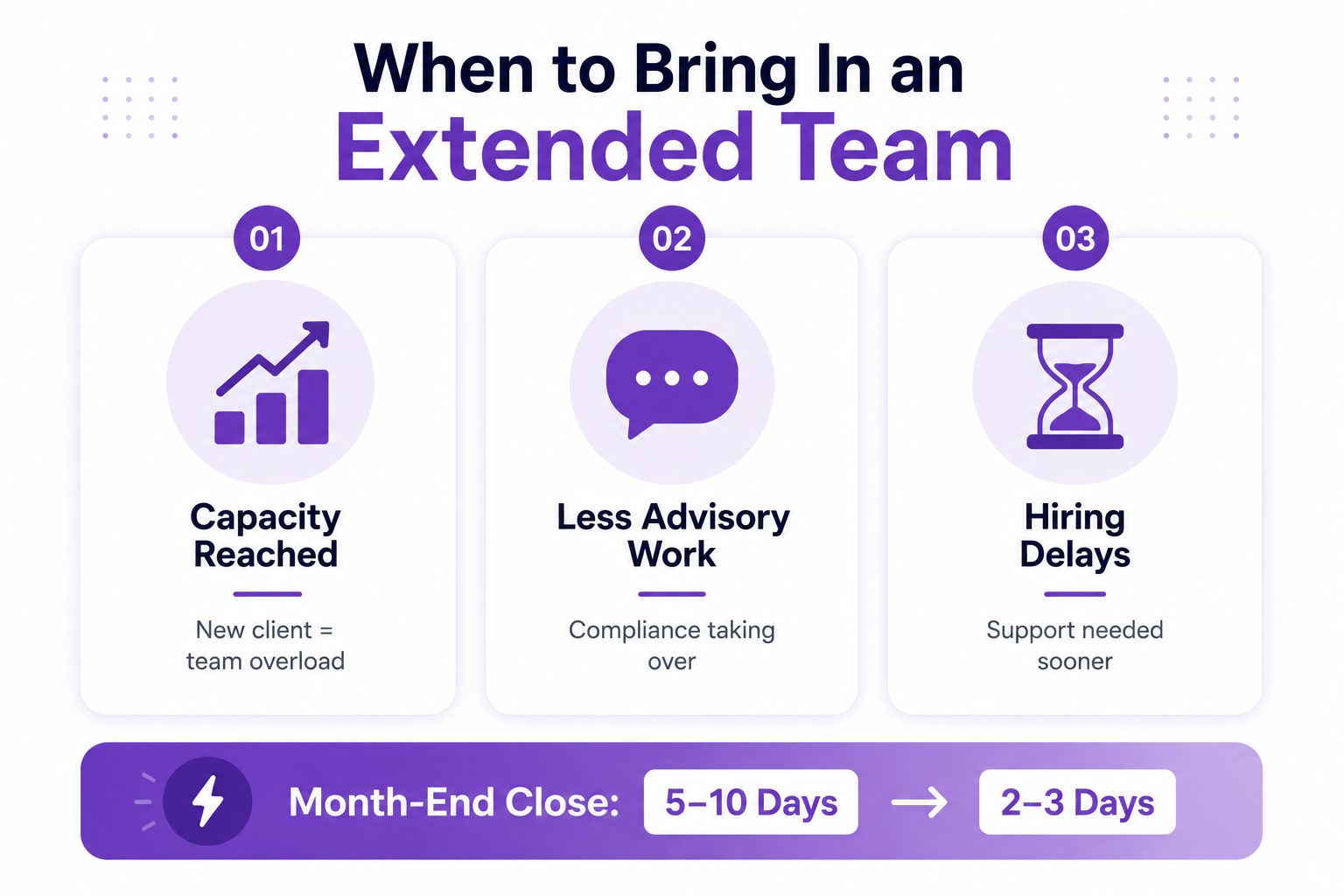
The right time to bring in outsourced accounting support is before a backlog becomes visible to clients. Not after.
If VAT returns get filed late, or management accounts arrive after the tenth working day, your practice is already past the point where outsourcing feels like a comfortable choice. It has become a reactive one.
Signals it is time to act:
- A new client win would push the team past capacity within the quarter
- Partners have not had an advisory conversation in the last month, because of compliance backlog
- A planned hire is more than six weeks away from being productive
Practices using a dedicated remote accountant alongside AI review software have reported cutting month-end close from five to ten working days down to two to three days per client.
Where Outsourcing Arrangements Usually Break Down
Most outsourcing deals fail at the same point. The practice owner loses sight of what has actually been reviewed before it reaches the client.
A freelance bookkeeper or an offshore team can finish the work fine. But without a shared review layer, the partner ends up checking everything by hand. That defeats the whole point of outsourcing.
The other common failure point is systems. If the outsourced team works on a separate platform and exports data into your system afterwards, errors pile up at the handoff. The work needs to happen inside your existing systems from the start. Not somewhere else first.
A third, quieter failure point is ownership. When work rotates between whoever is free on the provider's side, nobody actually owns your account. Small mistakes build up over time. Nobody notices until a client questions a figure.
A fourth failure point, less obvious than the rest, is slower response times over time. A provider might be fast and sharp in the first month, then slower once things settle into routine. Ask what happens after the honeymoon period ends. A provider's real service level shows up three or four months in. Not during the sales pitch.
How Finqube Delivers Outsourced Accounting Support
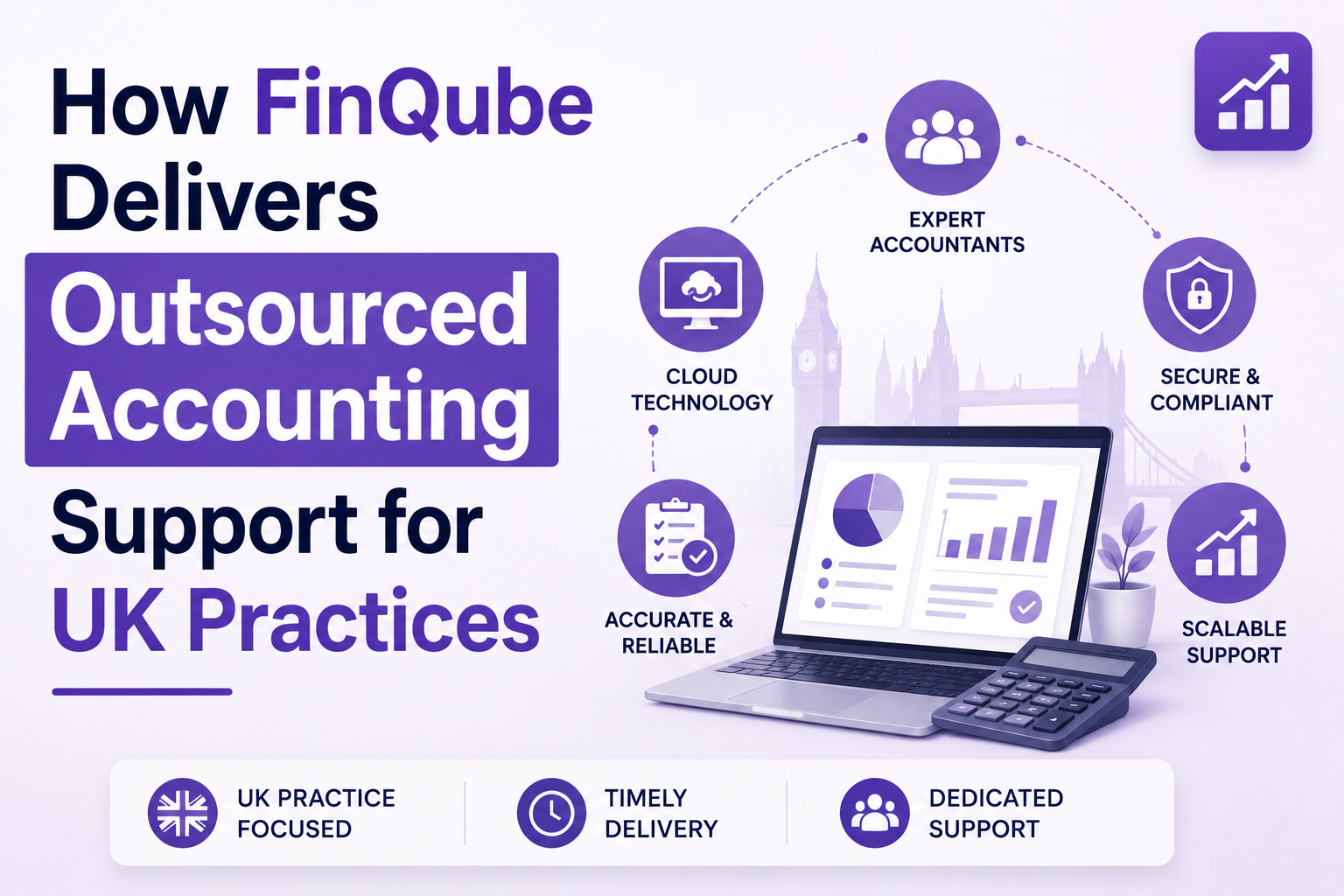
Finqube pairs one dedicated remote accountant with AI review software, included in every engagement. The accountant works inside your existing systems, Xero, QuickBooks, Sage, FreeAgent, or any other software, following your process. Not a separate workflow.
Before a file reaches your review, the AI review software has already flagged reconciliation mismatches, outstanding accounts payable and receivable items, and common preparation errors. You review work that is already clean. Not something you are starting from scratch.
Key features built into every engagement:
- One-Click Review, so partners can check a whole client file in minutes, not hours
- Reconciliation Health Check, which flags mismatches before a file goes out
- AP and AR Level Analysis, surfacing outstanding debtor and creditor issues on its own
- Practice Management visibility, giving the partner one clear view of work status across the team
A dedicated Finqube accountant usually starts within one to two weeks. Compare that to three or more months to hire and onboard an equivalent role in-house. See how the dedicated accountant model works on Finqube's engagement models page.
Finqube vs Hiring In-House vs a Traditional Remote Provider
Real Scenario
Priya Shah runs Shah & Co Accountants in Leeds. Before Finqube, she spent the last ten days of every month chasing her team for client file sign-offs. She had no way to see which files were reviewed, and which were still stuck.
She brought in a dedicated Finqube accountant, with AI review software built into the workflow. By month two, Priya had won back around twelve hours a week, and stopped chasing her team entirely. Three pending VAT quarters got filed clean within the first thirty days.
This is what outsourced accounting support is supposed to deliver. Not just finished work, but a partner who knows exactly where every file stands, without asking.
That kind of visibility is hard to build without it. Once a partner has it, going back to blind trust feels like a step backwards.
Her team felt the shift too. Junior staff stopped fielding last-minute questions about file status, since the answer already sat on the dashboard. The whole practice settled into a steadier rhythm. Not just Priya's own review time.
How Finqube Can Help
If your practice feels capacity pressure, but is not ready to commit to a permanent hire, a Finqube dedicated accountant can start working inside your systems within one to two weeks. Every engagement includes AI review software, so you see what has been checked before a file ever reaches your desk.
Whether you need ongoing fixed monthly support, or flexible overflow capacity during compliance peaks, the model scales with your workload. There is no minimum commitment. Start with a single dedicated hire, and expand once you have seen the work firsthand.
Explore Finqube's engagement models to see which structure fits your practice. Or look at bookkeeping and accounts finalisation, and accounts payable and receivable outsourcing, if those are your immediate pressure points.
Capacity problems rarely fix themselves. The sooner you address the gap, the less disruptive the fix tends to be.
Most practice owners who put this off are not unsure whether outsourcing helps. They are unsure whether it will work for their specific practice. A short, contained trial answers that question faster than another quarter of thinking about it.
One month. No contract.
See how a dedicated Finqube accountant fits into your MTD workflow before you decide.
Start your free pilotFrequently Asked Questions
What is outsourced accounting support?
Outsourced accounting support is when a UK practice hands set tasks, such as bookkeeping, VAT returns, or management accounts, to a remote team. That team works inside the practice's existing systems, not a separate platform.
How is Finqube different from hiring a freelance bookkeeper?
A freelance bookkeeper usually works alone, with little accountability to your review process. A Finqube accountant works inside your systems, follows your processes, and every piece of work goes through AI review software before it reaches the client.
How long does it take to deploy an outsourced accountant with Finqube?
A dedicated Finqube accountant typically starts within one to two weeks. Compare that to three months or more to hire and onboard an equivalent in-house role.
Will outsourcing accounting work mean losing visibility over client files?
No. Every Finqube engagement includes AI review software that flags reconciliation issues and outstanding items before a file reaches your review. You get a live view of what has already been checked.
How is the cost of outsourced accounting support worked out?
Cost depends on the scope and hours your practice needs. It is best discussed directly, since every engagement is shaped around what your team actually needs. Not a fixed package that might not fit.
Can outsourced accounting support scale up during busy periods like VAT season or January Self Assessment?
Yes. The model flexes with workload. Practices needing occasional overflow capacity, rather than a fixed monthly arrangement, can scale support up during compliance peaks and back down once they pass.
Is there a minimum contract length with Finqube?
No. Finqube's engagement models come with no minimum commitment, so you can test the workflow before deciding whether to scale it up.
What happens if my practice's workload changes significantly after signing up?
The engagement is built to flex. If your client base grows, or a busy season hits harder than expected, you can scale hours up. If things quiet down, you can scale back. Nothing locks you into a fixed level of support, regardless of what your practice actually needs that month.