.avif)

Blog Summary
- Why UK accounting practices are switching to outsourced accounting services in 2026, and what's driving it.
- How outsourced accounting works day to day, inside tools like Xero, QuickBooks, Sage, FreeAgent, or any other software you already run.
- What to ask before you choose a partner, plus a straight comparison of the options on the market.
- A real practice scenario, showing the before and after of switching to outsourced support.
INTRODUCTION
Your best senior accountant just handed in their notice. Again.
You have a stack of year-end files due. Three clients start Making Tax Digital for Income Tax this April. A recruitment agency just quoted six months to fill the role. This is the reality for most UK practice owners right now. It's why outsourced accounting services UK-wide have moved from a niche cost-cutting tactic to a mainstream way of running a practice.
This isn't about sending work overseas and hoping for the best. It's about finding a structured way to keep client work moving. No hiring. No training. No losing staff on repeat. This guide covers what's driving the switch, who it works for, and how to check a partner properly. We'll also show where FinQube fits into that decision.
WHAT IS OUTSOURCED ACCOUNTING?
Outsourced accounting means handing bookkeeping, VAT, payroll, or year-end work to an external team. That team works inside your own systems. They don't move you to a new one.
You keep the client relationship. You keep sign-off and final review. The outsourced team does the processing work that eats your week. Think reconciliations, journal entries, VAT prep, payroll runs, and first-draft accounts.
Most UK practices start with one function. Usually that's bookkeeping or VAT. They expand from there. The provider works inside Xero, QuickBooks, Sage, FreeAgent, or any other software your practice already uses. Clients never notice a change in how their books look.
Table 1: What Typically Gets Outsourced vs. Kept In-House
This split matters. Outsourcing removes the repetitive work. It doesn't touch the judgement calls. Those calls are what your client actually pays you for.
WHY ARE UK ACCOUNTING PRACTICES SWITCHING TO OUTSOURCING?
Three things are pushing practices toward outsourced accounting services UK-wide. A staffing crisis. A compliance deadline. Margin pressure.
The talent shortage is real. It isn't easing. Demand for accountants stays high even as firms bring in AI, per ICAEW. That means the staff you need are still hard to find. And expensive to keep once you find them.
Making Tax Digital for Income Tax has landed. From April 2026, sole traders and landlords above the income threshold must keep digital records. They must file every quarter, per GOV.UK and Deloitte. That multiplies your compliance workload. Practices with no spare capacity feel this now, not in theory.
Fixed salaries don't flex with seasonal workload. January and year-end create spikes. Permanent staff can't absorb those spikes without costly overtime or burnout. Outsourcing turns that fixed cost into a variable one. You scale it up and down as you need.
Industry data backs this up. The global finance and accounting outsourcing market grows close to 8% a year. Providers now handle complex work, not just simple data entry, per Acobloom's 2026 trends report.
WHO ACTUALLY BENEFITS FROM OUTSOURCED ACCOUNTING SERVICES?
Sole practitioners, small firms, and mid-sized practices all benefit. Each for a different reason.
A sole practitioner outsources to survive busy season. It saves them from hiring their first employee. A five-partner firm outsources to free senior staff from processing work. That frees them up to sell advisory services instead. A larger practice outsources to smooth capacity across offices. It avoids duplicating back-office teams.
Table 2: Who Outsources and Why
Does your team spend more time on data entry than client conversations? Then this shift is for you, whatever your firm size.
WHEN SHOULD A PRACTICE START OUTSOURCING?
Start before you're in crisis, not after. Wait until a resignation letter lands on your desk, and you'll outsource under pressure. That leaves less time to check a partner properly.
The clearest signal is repeated overtime at the same points each year. Do January, VAT quarter-ends, or year-end push your team past capacity every time? That's a structural problem. Outsourcing solves it.
A second signal is client growth that outpaces hiring. Are you turning down new clients because you lack staff? Outsourcing lets you say yes, with no six-month recruitment wait.
WHERE DO OUTSOURCED ACCOUNTING TEAMS WORK FROM?
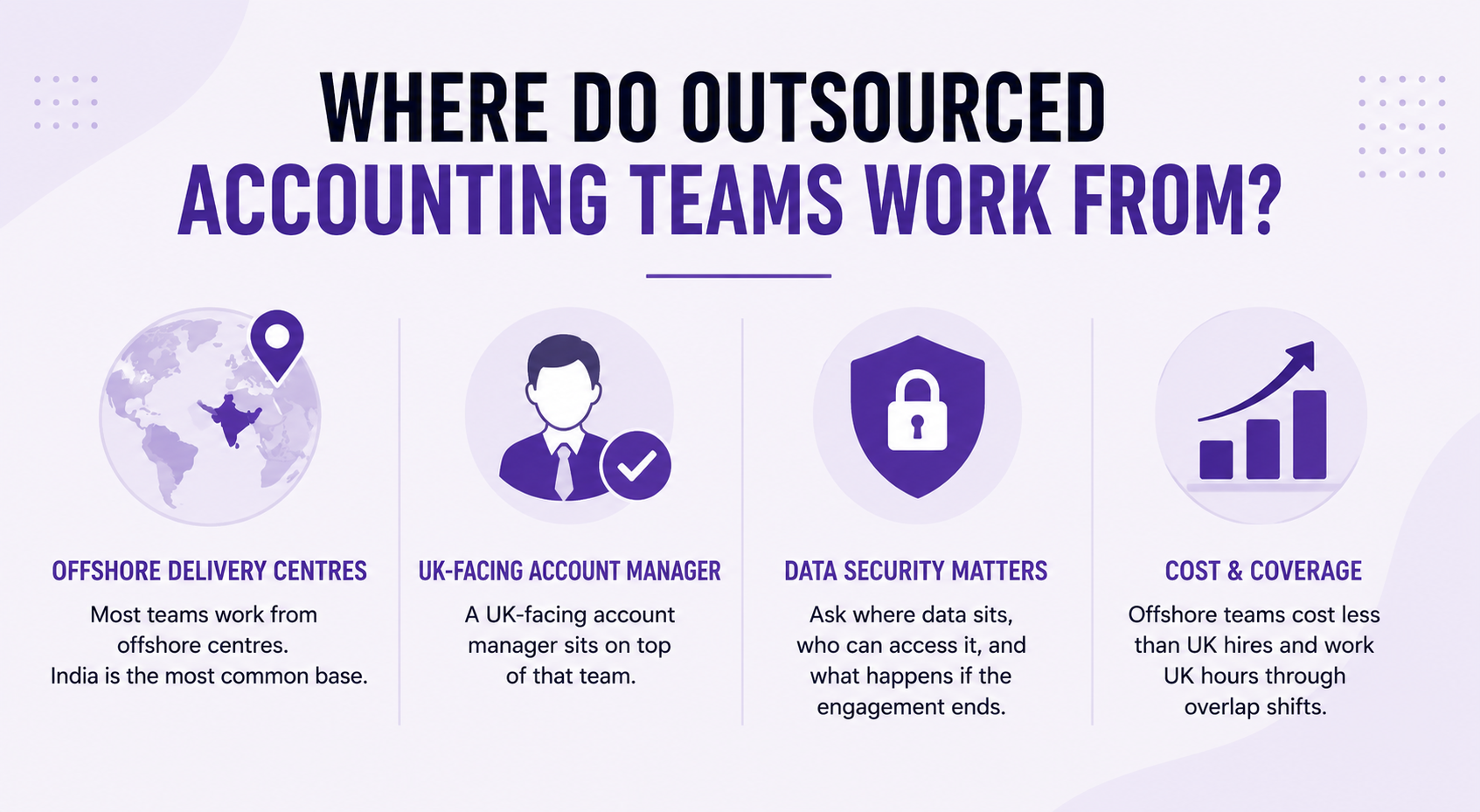
Most outsourced accounting teams serving UK practices work from offshore delivery centres. India is the most common base. A UK-facing account manager sits on top of that team.
This matters for two reasons: cost and coverage. Offshore teams cost less than UK-based hires. They still work UK hours through overlap shifts. The better providers now handle management accounts, payroll, and VAT work directly. Not just basic bookkeeping, per the Acobloom trends report.
Data security is a non-negotiable question here. Ask any provider where your client data sits. Ask who can access it. Ask what happens if the engagement ends. A serious partner gives clear answers, not vague reassurance.
HOW DOES OUTSOURCED ACCOUNTING WORK IN PRACTICE?
It starts with an onboarding review. Then it moves to a set monthly workflow. Your team reviews the work before it goes to any client.
Step one: system access. The provider gets access to your existing software. That could be Xero, QuickBooks, Sage, FreeAgent, or any other software your practice runs on. No client moves anywhere.
Step two: a set handover process. You send source documents and instructions through an agreed channel. Usually that's a shared portal or your practice management software.
Step three: processing and review. The outsourced team does the work. They flag anything unusual. They return it for your review before it goes to a client.
Step four: ongoing communication. You get one named point of contact, not a rotating queue. Questions get answered fast. You never re-explain the client each time.
Table 3: Outsourcing Options Compared
REAL SCENARIO SECTION
Ashworth & Co is a nine-partner practice in Leeds. Each senior accountant lost two to three days a week to bookkeeping catch-up and bank reconciliations for their larger clients.
The problem: Two bookkeepers left within four months of each other. Recruitment agencies quoted five to seven months to replace them at a salary the practice could afford. Client year-end deadlines slipped by two to three weeks.
What they tried first: Ashworth & Co hired a freelance bookkeeper by the hour to cover the gap. It helped short-term. But there was no backup cover. Any sick day or holiday created the same bottleneck all over again. Files sat untouched.
What changed: They moved bookkeeping and VAT prep for their 40 largest clients to an outsourced team. That team worked inside their existing Xero and QuickBooks setup. One named accountant handled the account. They learned each client's quirks instead of starting fresh every month.
The result: Within three months, year-end deadlines were back on track. The two remaining senior staff won back roughly a day a week each for advisory conversations instead of reconciliations. No client noticed a change in how their books were handled.
HOW FINQUBE CAN HELP
You get one named accountant on your account. Not a shared queue of whoever's free that week. They learn your clients and stay on your account long-term.
We work inside the systems you already run: Xero, QuickBooks, Sage, FreeAgent, or any other software your practice uses. Nothing migrates. Nothing changes for your clients.
Every file goes through our AI review before it reaches you. It catches errors and inconsistencies before they become a partner's problem. That means less time re-checking work. And more time on client-facing decisions.
Pricing is a fixed monthly fee, agreed with you upfront. No hourly billing surprises. There's no minimum contract term locking you in. The engagement is structured as a services agreement, not labour supply. That keeps it clean on IR35.
Ready to see if it fits your practice? Book a short call with FinQube. We'll look at your current workload, tell you honestly whether outsourcing makes sense for your practice right now, and quote a fixed monthly fee if it does.
One month. No contract.
See how a dedicated Finqube accountant fits into your MTD workflow before you decide.
Start your free pilotCONCLUSION
Outsourced accounting services UK-wide have shifted from a last resort to a normal business decision. Staffing gaps and rising compliance work made that shift happen. The practices getting the most from it treat outsourcing as part of their team. It's not a dumping ground for work nobody wants. Ask any provider about data security, named contacts, and pricing structure before you sign anything. Want a straight conversation about whether it fits your practice? Book a call with FinQube.
FAQ
What does outsourced accounting mean for an accounting practice?
An external team handles bookkeeping, VAT, payroll, or accounts prep inside your existing software. You keep client relationships and final sign-off.
Is outsourced accounting safe for client data?
It can be. The provider must be clear about where data sits, who accesses it, and what happens if the contract ends. Always ask before signing.
How much does outsourced accounting cost in the UK?
Pricing varies by provider and model. Some charge by the hour. Some charge per FTE. Some offer a fixed monthly fee. Ask for the pricing structure upfront, not just a headline rate.
Can I outsource just one part of my practice, like payroll or VAT?
Yes. Most practices start with one function, such as bookkeeping or VAT. They add payroll or year-end work later.
Will my clients know their accounts are outsourced?
No, if the provider works inside your existing systems and reports through you. Clients see your practice, not the outsourced team.
Does outsourcing accounting affect IR35 status?
It depends on how the contract is set up. A services agreement for defined deliverables sits differently to labour supply. Ask any provider how their contract is structured.
What's the difference between outsourcing and offshoring in accounting?
Offshoring means where the work gets done, usually overseas. Outsourcing means handing the work to an external provider. That provider may or may not be offshore.