.avif)

Blog Summary
- What counts as "messy books" before year-end
- Why messy books create risk at year-end
- Who should own the clean-up inside a practice
- When to start the clean-up before the filing deadline
- Where clean-up errors usually hide
- How a dedicated remote accountant runs the clean-up
What Counts as Messy Books Before Year-End
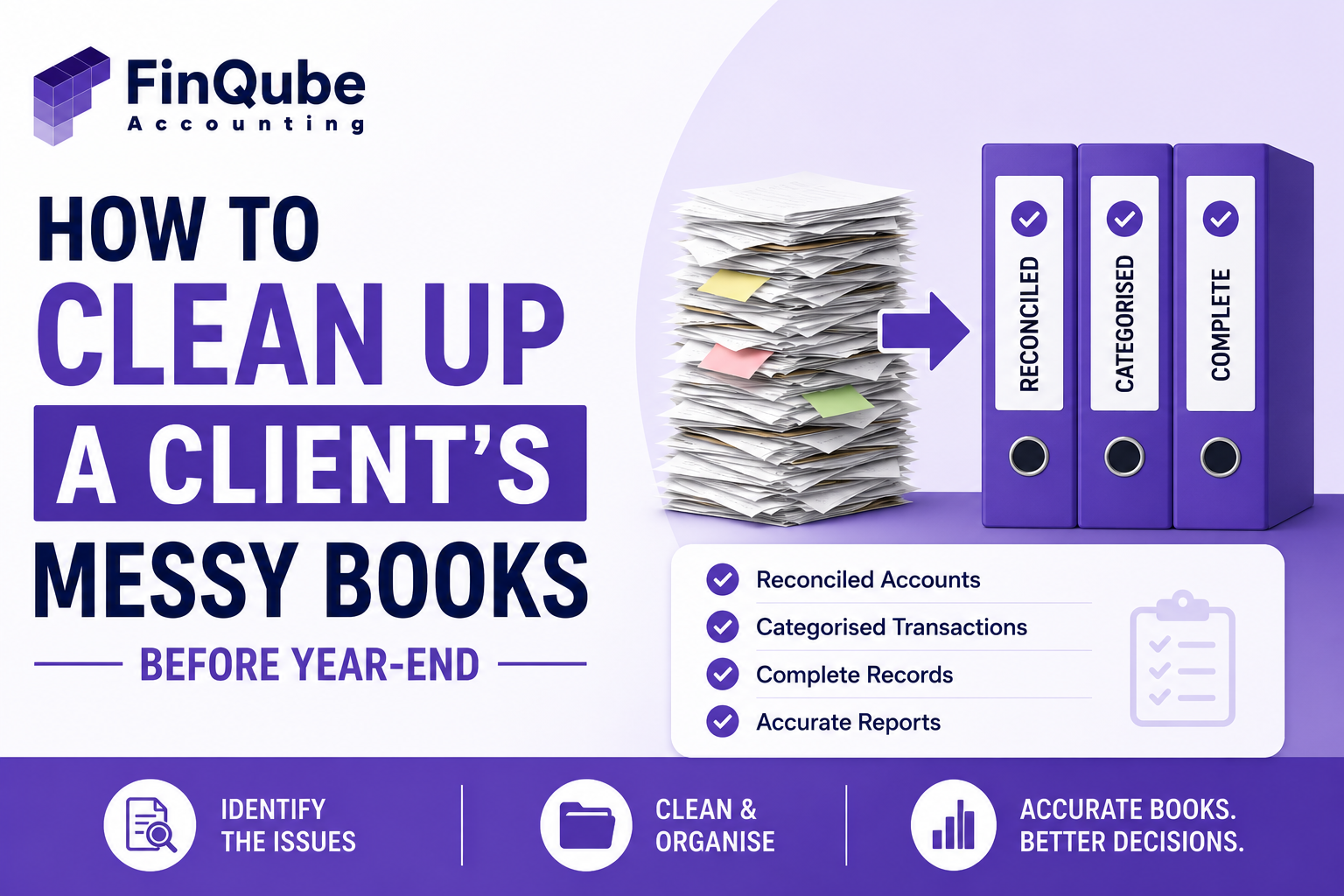
Messy books means the ledger does not match reality. Unreconciled bank accounts, miscoded transactions, unrecorded invoices, and a suspense account nobody has touched since March all count.
It is rarely one big error. It is usually 40 small ones that compound. A missed supplier invoice here, a personal expense coded to the business there, a bank feed that stopped syncing in October and nobody noticed until now.
For UK limited companies, this matters because year-end accounts feed directly into statutory filings. Annual accounts normally need to be filed with Companies House nine months after the financial year end, Corporation Tax is usually due nine months and one day after the end of the accounting period, and the Company Tax Return is due 12 months after that, according to GOV.UK. Three separate deadlines, all built on the same set of books. If the books are wrong, all three are at risk.
Why Messy Books Create Risk at Year-End
Messy books do not just slow down the finalisation process. They change the numbers your client relies on to make decisions, and they change what you are willing to sign off.
When the year end is rushed, it becomes easier to miss costs, overlook balance sheet issues, file late, or make decisions based on numbers that are not quite right. That risk sits with the practice, not just the client. A director relying on inaccurate management figures to plan a dividend, or a corporation tax return built on an unreconciled ledger, both trace back to the same root cause.
There is also a hard deadline risk. HMRC's joint filing service for company accounts and Company Tax Returns closed on 31 March 2026, and firms now need commercial software to file both HMRC and Companies House submissions on time. A messy ledger discovered two weeks before that deadline leaves no room to fix it properly.
Who Should Own the Clean-Up
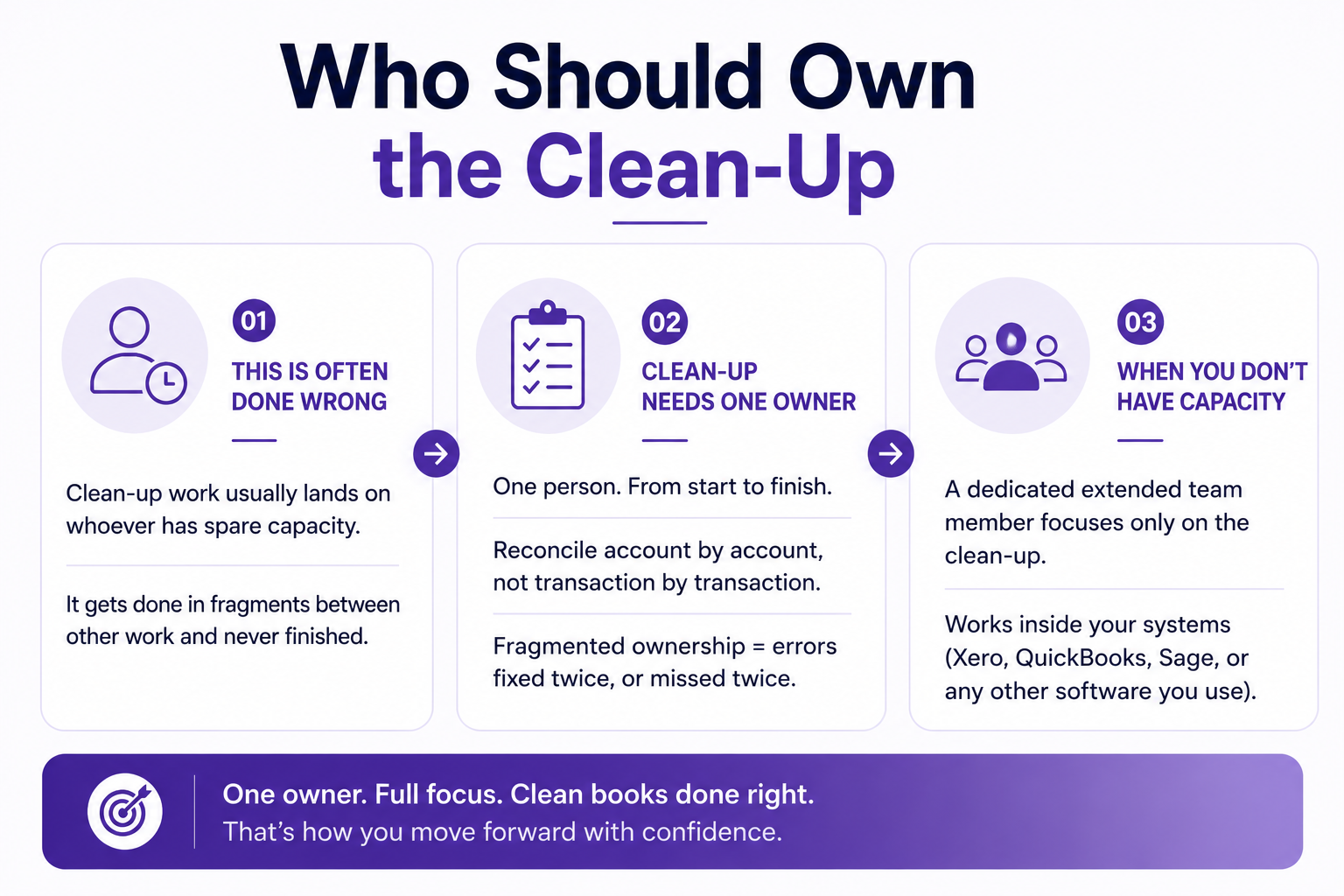
This is the question most practices get wrong. Clean-up work often lands on whichever junior has the most spare capacity that week, which means it gets picked up in fragments between other client work and never finished properly.
Clean-up needs one owner from start to finish, someone who reconciles account by account rather than transaction by transaction as they appear. Fragmented ownership is how the same error gets fixed twice, or missed twice.
For firms without spare senior capacity, this is exactly where a dedicated extended team member earns their place, someone whose only job that week is the clean-up, working inside your existing systems such as Xero, QuickBooks, Sage, or any other software your practice uses.
When to Start the Clean-Up
Start the clean-up as soon as the accounting period closes, not when the filing deadline is close enough to feel urgent. Sending initial requests to gather client information three months before year-end deadlines gives clients adequate time to provide documentation without rushing, and the same logic applies to your own clean-up timeline internally.
A practical rule: if the ledger has not been reconciled monthly throughout the year, budget for the clean-up to take as long as the number of unreconciled months, not a flat few days regardless of backlog size. A ledger that has drifted for six months takes meaningfully longer to untangle than one that slipped for six weeks.
Where Clean-Up Errors Usually Hide
Most clean-up checklists cover the obvious ground: bank reconciliation, VAT reconciliation, payroll ties. The errors that actually cause year-end problems tend to sit one layer deeper.
Suspense and clearing accounts. Balances get parked here "to deal with later" and never do. By year-end, a suspense account with six months of unresolved entries can hide anything from a duplicate payment to a missing invoice.
Director loan accounts. Personal and business transactions blur here more than anywhere else in the ledger, and an incorrect balance has direct tax consequences.
Accruals and prepayments. Expenses recorded in the wrong period distort both the profit and loss account and the corporation tax calculation.
Fixed asset registers. Assets bought mid-year sometimes never make it onto the register, which throws off depreciation and the balance sheet.
Duplicate or miscoded transactions from software migrations. If the client switched accounting software during the year, this is where the highest error concentration usually sits.
Balance Sheet Review Before Year-End
A clean-up that only checks transactions misses half the picture. The balance sheet tells you whether the ledger is structurally sound, not just whether individual entries are coded correctly.
Most first-pass clean-ups stop at the bank and the P&L. A proper year-end review works through every balance sheet line, because an error sitting quietly on the balance sheet can carry forward for years without anyone noticing.
Aged debtors. Review the debtor list by age, not just by total. Invoices sitting 90 days or more need a decision: chase, provide for, or write off. An aged debtor balance that never moves is usually a data problem, not a collections problem.
Aged creditors. The same logic applies in reverse. Old creditor balances that never clear often mean a supplier invoice was paid but never matched off, inflating what the business appears to owe.
VAT. The VAT control account should reconcile to the actual VAT return submitted for each quarter in the period. A mismatch here usually means a return was filed from different figures than what ended up in the ledger.
PAYE. Payroll liabilities on the balance sheet should tie to what was actually paid to HMRC. A running balance that grows quarter over quarter signals a payroll clearing account that is not being reconciled.
Director loan account (DLA). Confirm the closing balance against actual director drawings, dividends, and repayments for the period. This balance has direct tax consequences and needs to be right, not approximately right.
Fixed assets. Check that additions and disposals during the period match the fixed asset register, and that depreciation has been calculated on the correct opening balances.
Retained earnings. This should roll forward correctly from the prior year's closing position plus the current year's profit, less any dividends. If it does not tie, something upstream in the P&L or dividend record is wrong.
How a Dedicated Remote Accountant Runs the Clean-Up
A structured clean-up follows a fixed order, not a scramble through whatever looks wrong first.
Full bank and credit card reconciliation, every account, every month of the period. Transaction review and recategorisation, correcting miscoded entries and removing duplicates. Suspense and clearing account resolution, closing every balance sitting there without explanation. AP and AR reconciliation, matching outstanding invoices and bills against actual supporting documents. Accrual and prepayment adjustment, moving income and expenses into the correct period. Fixed asset register update, checking every asset purchase made it onto the register with the right depreciation treatment. Balance sheet review, working through debtors, creditors, VAT, PAYE, the director loan account, and retained earnings. Final trial balance review, checked against the prior year and against the client's own understanding of the numbers.
Every stage benefits from a second set of eyes before it moves to the next. Finqube's proprietary AI review software flags reconciliation mismatches and outstanding AP and AR items automatically, so by the time a file reaches partner review, the obvious errors have already been caught. You are reviewing a file that is already clean, not one you are checking from scratch.
Year-End Clean-Up Checklist
Use this as a working checklist alongside the process above, whether the work is done in-house or handed to a dedicated remote accountant.
- [ ] All bank and credit card accounts reconciled for every month in the period
- [ ] All transactions reviewed and recategorised where miscoded
- [ ] Duplicate transactions identified and removed
- [ ] Suspense and clearing accounts cleared to zero or explained
- [ ] Aged debtors reviewed and a decision made on anything 90+ days
- [ ] Aged creditors reviewed and old balances matched off
- [ ] AP and AR reconciled against supporting documents
- [ ] Accruals and prepayments adjusted into the correct period
- [ ] VAT control account tied to the returns actually filed
- [ ] PAYE liability tied to amounts actually paid to HMRC
- [ ] Director loan account confirmed against actual drawings and repayments
- [ ] Fixed asset register updated for additions and disposals
- [ ] Depreciation recalculated on correct opening balances
- [ ] Retained earnings rolled forward and checked against prior year
- [ ] Final trial balance compared against prior year for unexplained movement
- [ ] Numbers reviewed by a second person before sign-off
Finqube vs In-House vs Traditional Remote Provider
Cost is rarely the first question a practice owner asks about a clean-up, but avoiding it entirely in a comparison reads as evasive, and it is the first thing a partner will ask on a call anyway.
How Finqube Can Help
Finqube's Migration & Cleanup service is built specifically for this kind of work, whether the mess comes from a backlog, a mid-year software switch, or a client who has simply outgrown a spreadsheet. A dedicated Finqube accountant works the clean-up in the order above, inside your existing systems, whether that is Xero, QuickBooks, Sage, FreeAgent, or any other software.
Every file passes through Finqube's proprietary AI review software before it reaches your desk, flagging reconciliation mismatches, suspense account issues, and outstanding AP and AR items ahead of your review. Once the books are clean, the same team can carry the client through to year-end accounts finalisation and corporation tax filing, so the clean-up does not become a standalone project that gets handed off and starts again from zero.
There is no minimum commitment. You can bring Finqube in for a single clean-up project or as an ongoing extension of your team, and see how our models fit your practice before deciding on anything longer term.
Conclusion
Messy books at year-end are rarely one dramatic error. They are dozens of small ones that compound until the filing deadline forces the issue. A structured clean-up, run by one accountable owner in a fixed order, with a second layer of review before anything reaches the partner, is what keeps that deadline from becoming a crisis.
If your team does not have the spare senior capacity to run that process properly this year-end, book a call to see how a dedicated Finqube accountant can take on the clean-up directly, with full visibility into the work as it happens.
One month. No contract.
See how a dedicated Finqube accountant fits into your MTD workflow before you decide.
Start your free pilotFAQ
Q: How long does a bookkeeping clean-up take before year-end?
A: It depends on how long the books have gone unreconciled. A backlog of one or two months typically takes a few days to clear. Six months or more of unreconciled data can take several weeks, which is why starting early matters more than working faster later.
Q: What is the difference between catch-up bookkeeping and a clean-up?
A: Catch-up bookkeeping means entering transactions that were never recorded. A clean-up goes further, correcting miscoded entries, resolving suspense balances, and reconciling accounts that were entered but never checked against source documents.
Q: Can messy books delay a Companies House filing?
A: Annual accounts normally need to be filed with Companies House nine months after the financial year end, and unreconciled books discovered close to that deadline leave little room to fix errors properly before submission.
Q: Do director loan account errors matter if the amounts are small?
A: Yes. Even small misclassifications between personal and business spend affect the loan account balance, which has direct tax implications regardless of size.
Q: Should a clean-up happen before or after switching accounting software?
A: Ideally before. Migrating messy data into new software carries the same errors forward and adds duplicate entries on top. A clean-up before migration gives you an accurate opening balance in the new system.
Q: Who is responsible for catching clean-up errors before they reach the client?
A: The reviewing partner ultimately signs off, but structured tools that flag reconciliation mismatches and outstanding items before that review, such as Finqube's AI review software, reduce how much a partner has to catch manually.
Q: What does a bookkeeping clean-up typically cost compared to hiring in-house?
A: Outsourced clean-up support is generally around 60% lower in cost than adding a full-time in-house hire once salary, National Insurance, pension, and management overhead are factored in.