.avif)

Blog Summary
- What tax preparation outsourcing actually means and which tax jobs practices hand over first.
- Why UK firms are turning to outsourced tax preparation as staff shortages and deadline pressure both grow.
- How the process works day to day, from document handoff to final review.
- What to check before you pick a provider, so you do not trade one problem for another.
Introduction
It is October. Your best tax senior has just handed in her notice. January is thirteen weeks away, and you have 240 self assessment returns still sitting in the pile.
This is not a rare story. It is the normal shape of a UK accounting practice's year.
Tax preparation outsourcing is how a growing number of UK firms solve this problem. Instead of hiring a temp who leaves after busy season, or asking your team to work weekends again, you hand routine tax preparation to a dedicated external team. They prepare the computations. Your in-house accountant reviews and signs off.
This guide explains what tax preparation outsourcing means, why UK firms are adopting it faster than ever, and how the process actually works once you start.
You will also see where it goes wrong, what a good provider looks like, and how one Kent practice used it to clear a three-month backlog in six weeks.
What Is Tax Preparation Outsourcing?
Tax preparation outsourcing means handing the preparation of tax returns and computations to an external team, while your practice keeps final review and client sign-off in-house.
It covers self assessment (SA100), corporation tax (CT600), partnership returns (SA800), and the supporting schedules behind them. The outsourced team drafts the return. Your named accountant checks it, queries anything unusual, and files it under your practice's name.
This is different from full business process outsourcing, where an external firm runs an entire function end to end. Tax preparation outsourcing is narrower. You keep control of the client relationship and the final decision. You outsource the time-consuming preparation work sitting behind it.
Most UK practices start with one of three services:
The practice using an outsourced provider still owns every client conversation. The provider works inside your existing systems, whether that is Xero, QuickBooks, Sage, FreeAgent, or any other software your firm already runs.
Why Are UK Accounting Firms Outsourcing Tax Preparation?
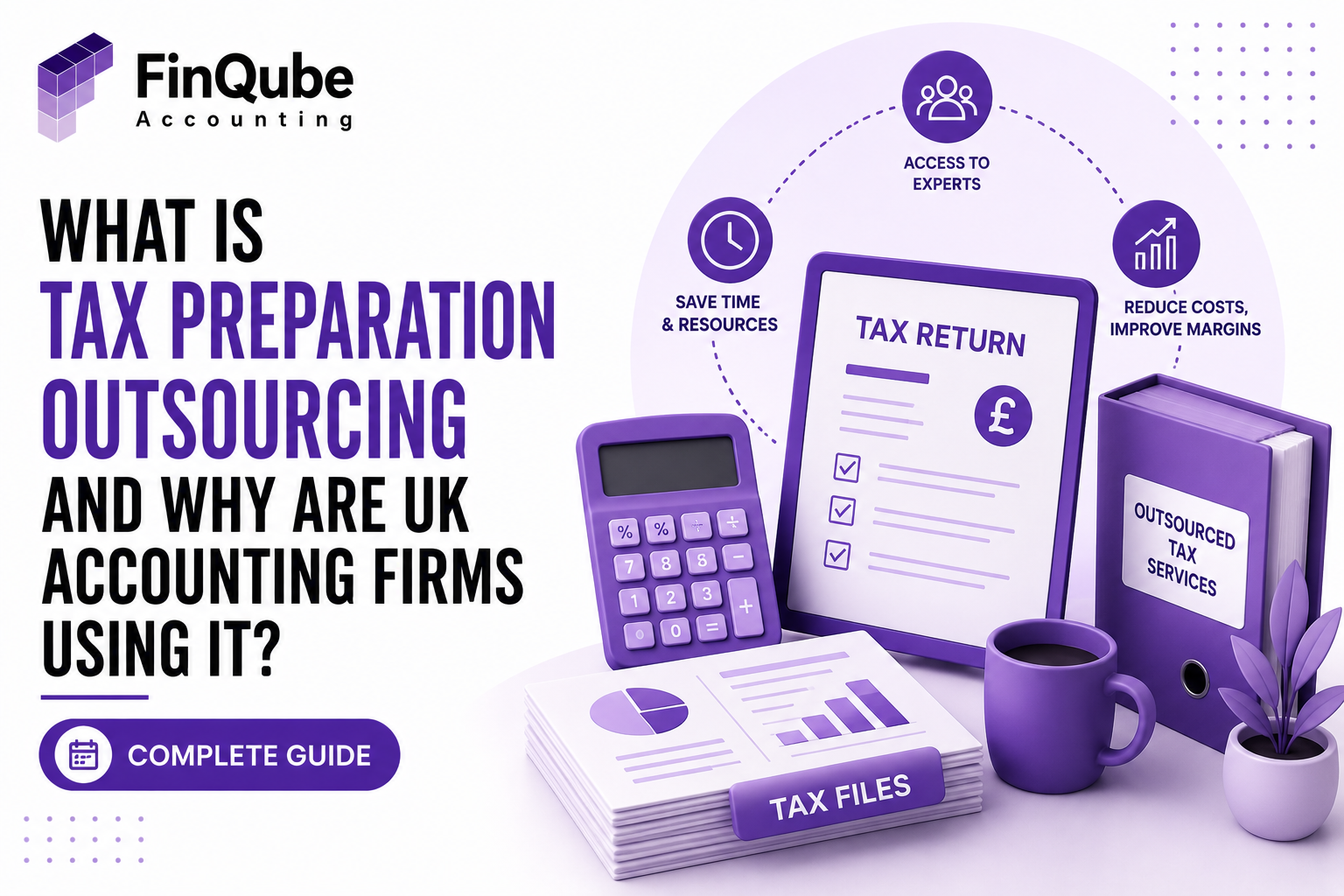
UK firms outsource tax preparation because the alternative, hiring and training seasonal staff, has become slower and more expensive than the outsourcing itself.
Three pressures are driving this shift at once.
Staff shortages have not eased. ICAEW's own research has flagged a persistent talent gap across UK practice, with firms struggling to fill technical roles even as demand for accountants stays high (ICAEW). A firm that cannot hire a qualified senior in October cannot magic one up by January.
Deadline volume keeps climbing. HMRC confirmed that more than 11.5 million taxpayers filed a Self Assessment return by the 31 January deadline for the 2023 to 2024 tax year, with over 730,000 filed on deadline day alone (GOV.UK). That volume does not spread evenly across the year. It lands on your desk in January.
Margins are tighter than they used to be. Recruiting, onboarding, and training a seasonal tax senior costs money whether or not they stay past April. Outsourcing converts that unpredictable cost into a fixed, monthly one. This is part of a wider shift toward outsourced accounting services uk, not just a tax season fix.
Here is how the two options compare on the factors that matter most to a practice owner.
None of this means outsourcing is free of risk. It means the risk profile is different, and for many practices, easier to manage.
Who Actually Does the Work?
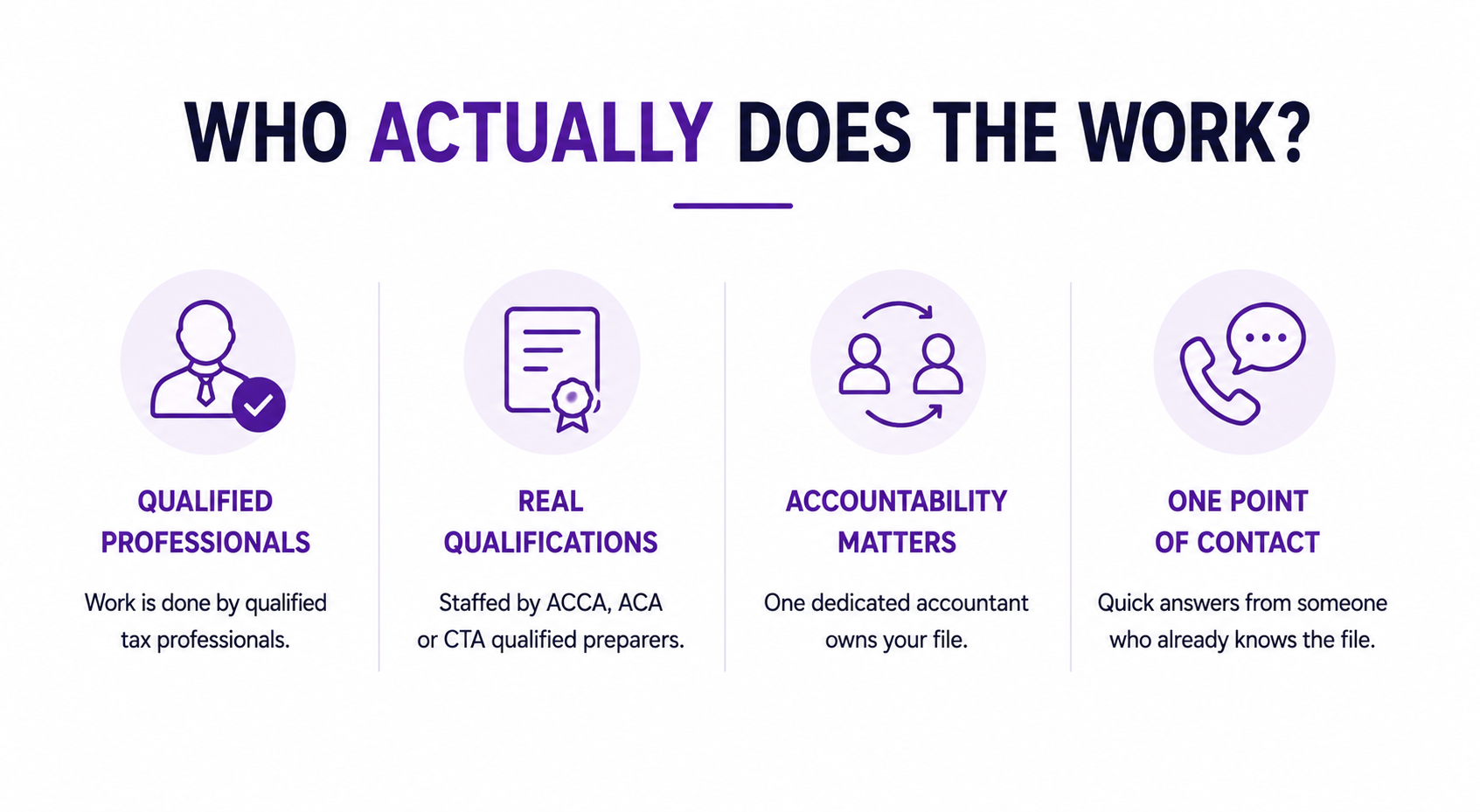
Outsourced tax preparation is done by qualified or part-qualified tax professionals employed by the outsourcing provider, working under the supervision of your practice's named accountant.
Reputable providers staff their tax teams with ACCA, ACA, or CTA qualified preparers, not generalist data-entry clerks. Ask any provider directly about staff qualifications before you sign anything.
The critical detail is accountability. In a weak outsourcing setup, you get handed to a different preparer every month, and nobody truly owns your file. In a strong one, you get one dedicated accountant who knows your practice, your clients, and your working style.
That single point of contact matters more than most firms expect. It is the difference between chasing a shared inbox for answers and picking up the phone to someone who already knows the file.
When Should a Practice Start Outsourcing Tax Work?
The right time to start outsourcing tax preparation is before your busy season begins, not during it.
Most firms make the mistake of waiting until they are already underwater in December. By then, onboarding a new provider competes with the work you are trying to clear.
Watch for these signals that it is time to start:
- Your team is regularly working weekends between November and January.
- You have turned away new client work because you lack capacity.
- A single staff departure would put your January deadline at risk.
- Review queues are backing up because juniors are drafting returns with errors.
If two or more of these sound familiar, outsourcing is worth testing well ahead of your next peak period, not during it. It is also worth reading how firms scale accounting firm UK capacity without adding headcount, since the same logic applies to tax season staffing.
Where Do Outsourced Tax Teams Operate From?
Outsourced tax preparation teams typically work remotely, connecting into your practice's own software rather than asking you to move data into theirs.
This matters for two reasons. First, your client data stays inside systems you already control and audit. Second, your team does not need to learn a second platform just to hand off a file.
A properly set up outsourcing relationship should work inside whatever your practice already runs, whether that is Xero, QuickBooks, Sage, FreeAgent, or any other software your clients use. If a provider insists you migrate everything to their platform first, treat that as a warning sign, not a feature.
Data protection matters just as much as software fit. Ask any provider how they handle GDPR compliance and client data security under UK law. The Information Commissioner's Office sets out clear expectations for any firm handling personal data on your behalf (ICO), and your outsourcing partner should meet them without you having to chase for evidence. If your practice is also navigating digital filing requirements, our guide to MTD for accountants covers the compliance side in full.
How Does Tax Preparation Outsourcing Work, Step by Step?
Tax preparation outsourcing works through a five-step cycle: onboarding, document handoff, preparation, internal review, and final sign-off.
Step 1: Onboarding. You share access to your practice management software and agree on file-naming conventions, deadlines, and communication cadence. This usually takes one to two weeks.
Step 2: Document handoff. Your team uploads client records, either through a secure portal or directly inside your existing software. No email attachments, no spreadsheets floating between inboxes.
Step 3: Preparation. The outsourced team drafts the computation, whether that is an SA100, a CT600, or the accounts feeding into either. They flag anything unusual, missing, or inconsistent as they go.
Step 4: Internal review. This is the step most providers skip, and the step that matters most. A second reviewer, ideally supported by software that flags anomalies automatically, checks the draft before it reaches your desk.
Step 5: Partner sign-off. Your named in-house accountant reviews the final file, resolves any queries, and files with HMRC under your practice's name.
The table below shows how long each step typically takes once a relationship is established.
Once this cycle is running smoothly, most practices see turnaround times shrink further as the outsourced team learns their client base.
Real Scenario: A Kent Practice Clears Its January Backlog
Ashford Grove Accountants, a nine-person practice in Kent, entered October with 210 self assessment returns still outstanding and one tax senior who had just resigned.
The problem: The practice's owner tried recruiting a temporary tax senior through two agencies. Neither candidate could start before December. Weekend work was already stretching the remaining team thin, and two clients had already complained about slow responses.
What they tried first: The owner asked the two remaining seniors to split the backlog and pushed non-urgent client meetings to February. It bought a few weeks but did not close the gap. By late November, the backlog had barely moved and staff morale was dropping.
What changed: Ashford Grove brought in an outsourced tax preparation team to handle the bulk of straightforward SA100 returns, working directly inside the practice's existing Xero and practice management setup. The practice kept every client conversation and final review in-house.
The result: The backlog of 210 returns dropped to zero by mid-January, three weeks ahead of the deadline. The two remaining in-house seniors spent their time on complex cases and client queries instead of routine data entry. No client missed a deadline, and the practice took on four new clients the following tax year because it finally had spare capacity.
How FinQube Can Help
FinQube gives you one dedicated, named accountant for your tax preparation work, not a rotating pool you have to re-explain your clients to every month.
Here is what that looks like in practice:
- One named accountant, always. You get the same person on every file, every season. No handoff, no repeat explanations.
- We work inside your systems. Xero, QuickBooks, Sage, FreeAgent, or any other software your practice already runs. Nothing to migrate.
- AI-assisted review before the partner sees it. Our proprietary review software flags inconsistencies and errors in every file before it reaches you, so what lands on your desk is closer to final.
- Fixed monthly pricing. You know your cost before the season starts. No hourly surprises when January gets busy.
- Structured as a services agreement, not labour supply. This is built to sit correctly outside IR35, not as a workaround bolted on afterwards.
- No minimum commitment. Start when your season demands it. There is no long-term contract locking you in.
Ready to clear your backlog before it becomes a crisis? Talk to FinQube about tax preparation outsourcing built around your existing systems, with one named accountant on every file. No minimum commitment, no contract lock-in.
One month. No contract.
See how a dedicated Finqube accountant fits into your MTD workflow before you decide.
Start your free pilotConclusion
Tax preparation outsourcing is not about replacing your team. It is about giving them room to do the work that actually needs a qualified accountant's judgement.
UK firms are adopting it because staff shortages and deadline pressure are not going away, and hiring seasonal cover has become slower and costlier than it used to be. The practices getting the most out of it are the ones that start before the season, not during it.
If your team is heading into another January underwater, this is worth testing now, while you still have the runway to do it properly. Talk to FinQube about a tax preparation partnership built around your existing systems and your existing clients.
FAQ
What is tax preparation outsourcing?
Tax preparation outsourcing means an external team prepares tax computations and returns, while your practice keeps final review and client sign-off in-house.
Is outsourcing tax preparation safe for client data?
Yes, provided your provider meets UK GDPR requirements and works inside your existing, audited systems rather than moving your data onto unfamiliar platforms.
How much does tax preparation outsourcing cost UK firms?
Costs vary by provider and volume, but most UK outsourcing partners offer fixed monthly pricing rather than hourly billing, making costs predictable across the year.
Can I outsource just self assessment and keep corporation tax in-house?
Yes. Most practices choose which tax services to outsource, and self assessment is the most common starting point because of its January deadline volume.
Will outsourcing tax preparation affect my IR35 position?
It should not, provided the arrangement is structured as a genuine services agreement with the outsourcing firm, not as disguised labour supply.
Do outsourced tax preparers work inside Xero, QuickBooks, or Sage?
Reputable providers work directly inside whichever software your practice already uses, including Xero, QuickBooks, Sage, FreeAgent, or any other platform your clients run on.
How long does it take to onboard an outsourced tax preparation provider?
Most practices complete onboarding in one to two weeks, covering system access, file conventions, and communication setup, well before peak season work needs to start.