.avif)

Blog Summary
- What outsourced bookkeeping actually costs across sole traders, small limited companies, and growing practices in 2026
- The seven factors that push your bookkeeping bill up or down, from transaction volume to VAT registration
- How hourly, monthly, and fixed-fee pricing models compare, and which one protects your budget
- How FinQube's fixed monthly pricing and dedicated accountant model compares to hiring in-house or using a traditional offshore provider
Introduction
Outsourced bookkeeping cost is the first question every UK practice owner asks. It is also the hardest to get a straight answer on. You see a "from £150 a month" headline. Then the quote arrives at three times that.
This guide gives you the real 2026 price bands. It shows the factors that move your number up or down. It also gives you a way to budget without guesswork.
Most practice owners we speak to get a quote range so wide it is useless. £50 to £3,500 a month tells you nothing about your actual bill. Therefore, this guide breaks the number down by business size, service scope, and pricing model. You can budget with confidence before you pick up the phone.
This matters more in 2026 than it did a few years ago. More clients are moving onto outsourced bookkeeping as Making Tax Digital reaches smaller incomes. Practice owners now need fixed, defensible prices, not vague ranges. Get the pricing logic right, and you can answer a client's cost question in one sentence.
What Does Outsourced Bookkeeping Cost in the UK?
Outsourced bookkeeping in the UK typically costs between £150 and £2,000 a month. The exact figure depends on your transaction volume, VAT status, and how many extra services you bundle in.
Sole traders and micro businesses with simple accounts usually sit at the bottom of that range. Larger SMEs with payroll, multiple bank accounts, and monthly management accounts sit near the top. For most small limited companies with 100 to 300 transactions a month, expect £250 to £800.
However, these are averages. Two businesses of the same size can pay very different amounts. Service scope decides the rest, and we cover that next.
It also helps to know what your money actually buys at each level. At the lower end, you typically get transaction categorisation and monthly reconciliation only. As the price climbs, you add VAT handling, payroll, and management reporting on top. Always ask a provider to itemise what sits inside their quoted number. "Bookkeeping" means different things to different firms.
Why Do Outsourced Bookkeeping Costs Vary So Much?
Outsourced bookkeeping costs vary because providers price on different factors: transaction volume, service complexity, and delivery model. No two quotes use the same formula.
Transaction volume is the single biggest driver. A business processing 50 transactions a month costs far less than one processing 500. For example, an ecommerce client with three sales channels creates far more reconciliation work than a single-site consultancy.
As a result, the only reliable way to compare quotes is to ask each provider one thing. What transaction volume and service scope does their price assume?
Provider type changes the number too. A freelance bookkeeper working alone often charges less per hour than an established firm. But you lose backup cover if they are ill or on holiday. An offshore or hybrid provider can bring the hourly rate down further. Quality control then becomes the deciding factor, not price. This is why bookkeeping outsourcing decisions should never rest on price alone. A cheap hourly rate with no review process can cost you more in corrections than it saves in fees.
Who Needs Outsourced Bookkeeping and What Do They Pay?
Outsourced bookkeeping serves three main groups in the UK. These are sole traders, small limited companies, and accounting practices supporting their own clients. Each pays a different rate because their needs differ.
Sole traders with straightforward income usually need basic reconciliation and simple record keeping. Small limited companies need VAT handling and more frequent reporting. Accounting practices often outsource bookkeeping capacity to a dedicated remote accountant. This frees their partners to focus on advisory work instead of data entry.
This means the "right" price depends entirely on who is asking. A practice owner outsourcing an entire client ledger has different needs than a sole trader outsourcing their own books.
For accounting practices, the question changes. It shifts from "what does bookkeeping cost per client" to "what does an extra pair of hands cost per month." Many practices now price this as a fixed block of hours each month. The fixed monthly hours model is easier to plan around during busy season. You know the number before the work starts.
When Should You Budget for Extra Bookkeeping Costs?
You should budget for extra bookkeeping costs whenever your VAT status, payroll headcount, or reporting frequency changes. These triggers move your price band without warning.
Making Tax Digital for Income Tax adds new compliance costs for many sole traders and landlords. According to GOV.UK, anyone with qualifying income above £50,000 must join from 6 April 2026. The threshold drops to £30,000 from 6 April 2027, then £20,000 from 6 April 2028. This means more clients will need MTD-ready bookkeeping sooner than they expect.
Pricing models also matter here. Some providers charge hourly. Some charge a flat monthly fee. Some charge per transaction. Each model behaves differently as your workload grows.
Therefore, a fixed monthly fee usually protects you best if your transaction volume is likely to grow. Your bill will not creep up every time you add an invoice.
Where Do Hidden Bookkeeping Costs Creep In?
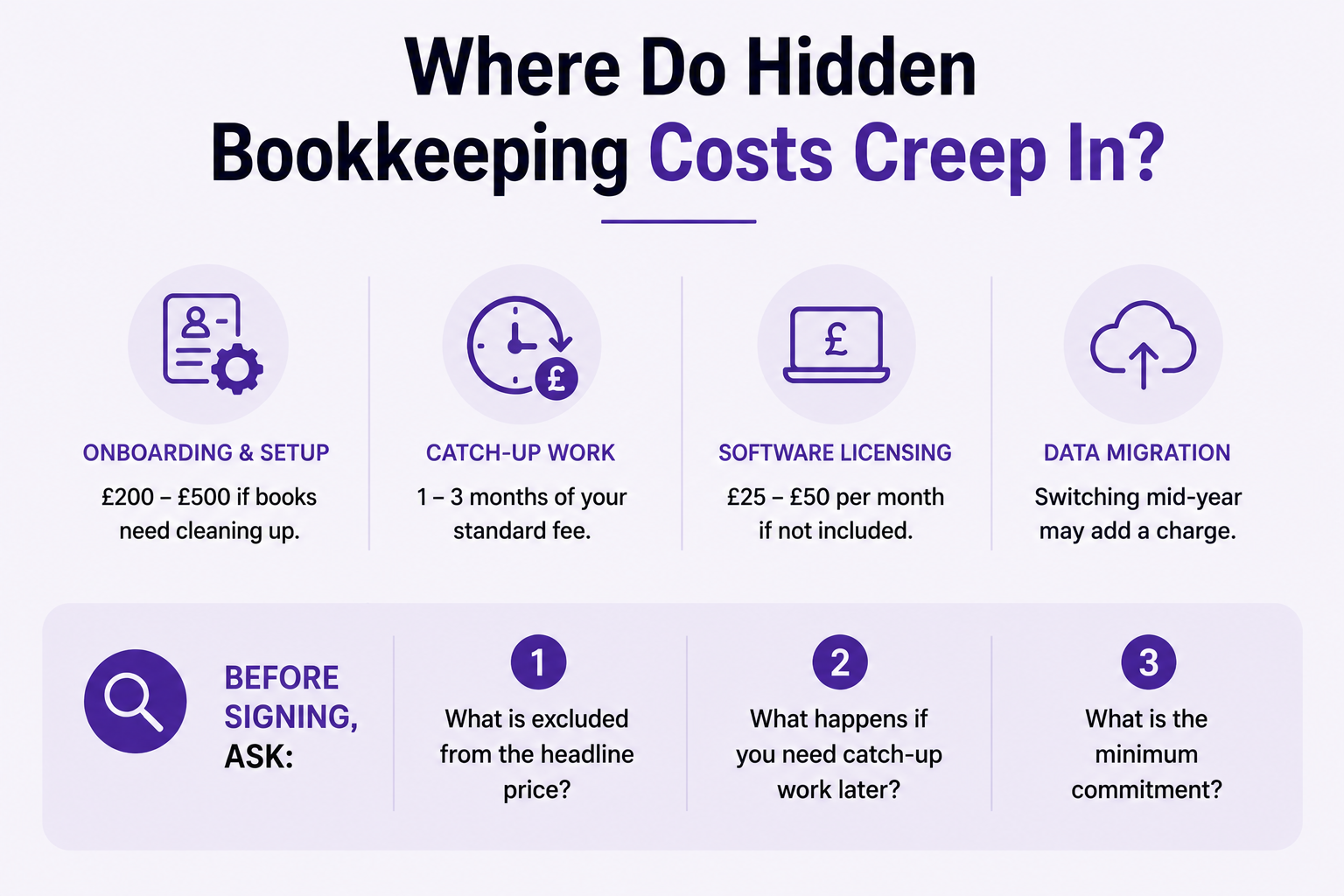
Hidden bookkeeping costs usually creep in through onboarding fees, catch-up work, and software licensing. The headline quote often leaves these out. Always ask what is excluded before you sign.
Onboarding and setup typically cost £200 to £500 if your books need cleaning up first. Catch-up work on months of unreconciled transactions can cost one to three months of your standard fee. Software licensing for Xero, QuickBooks, Sage, or any other software can add £25 to £50 a month if it is not already included.
For example, a business switching providers mid-year often finds a "data migration" charge on the first invoice. This means the cheapest quote on paper is not always the cheapest bill by month three.
Contract terms hide costs too. A provider that locks you into three or six months gives you little room to leave. This applies even if service quality drops. Before signing, ask three questions. What is excluded from the headline price? What happens if you need catch-up work later? What is the minimum commitment?
How Does Outsourced Bookkeeping Compare to Hiring In-House?
Outsourced bookkeeping usually costs 40% to 60% less than hiring an in-house bookkeeper. This is once you include salary, National Insurance, pension contributions, and overheads. A full-time UK bookkeeper typically costs £35,000 to £45,000 a year with these extras.
Cost is not the only difference. Hiring in-house gives you a dedicated person in the room. But it also brings recruitment risk, sickness cover, and management time. Outsourcing removes those burdens. It can introduce a different worry instead: visibility into whether the work is actually right.
This is why cost alone is the wrong first question. The right question is different. Does the price you pay buy you visibility, accountability, and a fixed number you can plan around?
According to the Office for National Statistics, median gross annual earnings for full-time UK employees reached £39,039 in April 2025. That is up 4.3% on the year before. Bookkeeping and finance salaries have followed a similar trend. This means the in-house cost gap is likely to widen in 2026, not narrow. Meanwhile, ICAEW reports that demand for accountants in the UK stays high, even as AI reshapes parts of the profession. The skills shortage pushing up in-house salaries is not going away soon.
Real Scenario: Hughes Accountancy
Daniel Hughes runs Hughes Accountancy, a UK practice with a growing client book and a small internal team. Before outsourcing, his bookkeeping costs were unpredictable. Some months, catch-up work on messy client files doubled his internal team's hours.
He tried a traditional remote provider first. The invoice varied every month. He had no visibility into which files were reviewed and which were still sitting untouched.
He then moved to a dedicated FinQube accountant with our proprietary AI review software built into the workflow. Daniel got a fixed monthly fee and a live view of every file in progress. He recovered 12 hours a week by month two. He finally knew what his bookkeeping cost would be before the month started, not after.
How FinQube Can Help
FinQube prices outsourced bookkeeping as a fixed monthly fee. It is scoped to your transaction volume and services, typically £300 to £1,200 a month. You get one number, agreed upfront. It is not a variable invoice that changes every quarter.
You also get one dedicated named accountant, not a shared pool that changes every few months. That accountant works inside your existing systems. This means Xero, QuickBooks, Sage, FreeAgent, or any other software your practice already runs on.
Every file passes through our proprietary AI review software before your partner ever sees it. It flags reconciliation mismatches, outstanding AP and AR items, and common preparation errors automatically. You review work that is already clean, not work you have to hope is clean.
For UK practices concerned about IR35, FinQube is structured as a services agreement, not a labour supply arrangement. There is no minimum commitment beyond your first month. You can test the fit before you decide anything long-term.
Ready to see your actual number instead of a range? Use our ROI calculator to estimate your fixed monthly cost. Or book a free consultation to get a scoped quote for your practice.
Conclusion
Outsourced bookkeeping cost in the UK sits between £150 and £2,000 a month for most businesses. But the number that matters is your number, not the average. Transaction volume, VAT status, and service scope decide where you land. A fixed monthly fee protects your budget better than an hourly rate that grows with your workload. Before you sign anything, ask what is excluded from the quote. Book a free consultation with FinQube to get a fixed, scoped price for your practice.
One month. No contract.
See how a dedicated Finqube accountant fits into your MTD workflow before you decide.
Start your free pilotFAQ
How much does outsourced bookkeeping cost per month in the UK?
Outsourced bookkeeping typically costs £150 to £2,000 a month in the UK. The price depends on transaction volume, VAT status, and whether payroll or management accounts are included.
Is outsourced bookkeeping cheaper than hiring an in-house bookkeeper?
Yes. Outsourced bookkeeping usually costs 40% to 60% less than a full-time in-house bookkeeper. This is once you include salary, National Insurance, pension, and overheads.
What is included in a typical outsourced bookkeeping package?
Most packages include bank reconciliation, transaction categorisation, and basic reporting. VAT returns, payroll, and management accounts are usually priced as add-ons.
Do outsourced bookkeepers charge hourly or a fixed monthly fee?
Both models exist. Hourly rates typically range from £16 to £60 an hour. Fixed monthly fees are more common for ongoing work and make budgeting easier.
Does outsourced bookkeeping cost more if my business is VAT registered?
Yes. VAT registration typically adds £70 to £300 a month to your bookkeeping cost. This covers quarterly returns and Making Tax Digital compliance.
What hidden costs should I ask about before hiring an outsourced bookkeeper?
Ask about onboarding fees, catch-up work on historical records, and software licensing. These can add £200 to £500 or more to your first invoice.
How is FinQube's pricing different from other outsourced bookkeeping providers?
FinQube charges a fixed monthly fee scoped to your transaction volume, typically £300 to £1,200. There is no minimum commitment beyond your first month and no hourly billing surprises.