.avif)

Blog Summary
- Every key self assessment deadline for the 2025/26 tax year, including payments on account
- Why January consistently breaks practice capacity, even for well-run firms
- What penalties clients face when a return is filed late, and who carries that risk
- How self assessment outsource support gives a practice a named accountant and full visibility before the deadline hits
Introduction
Self assessment outsource support exists for one reason: January does not forgive a practice that is short-staffed. Every accountant knows the 31 January deadline by heart. Knowing it and hitting it for 150 clients at once are different problems entirely.
Missing even a handful of returns costs clients an automatic £100 fine each, and it costs the practice something harder to recover: trust. This guide covers the real deadlines for the 2025/26 tax year, why practices fall behind, and how outsourcing the workload changes the outcome.
Why Do Accounting Firms Struggle to Hit Self Assessment Deadlines?
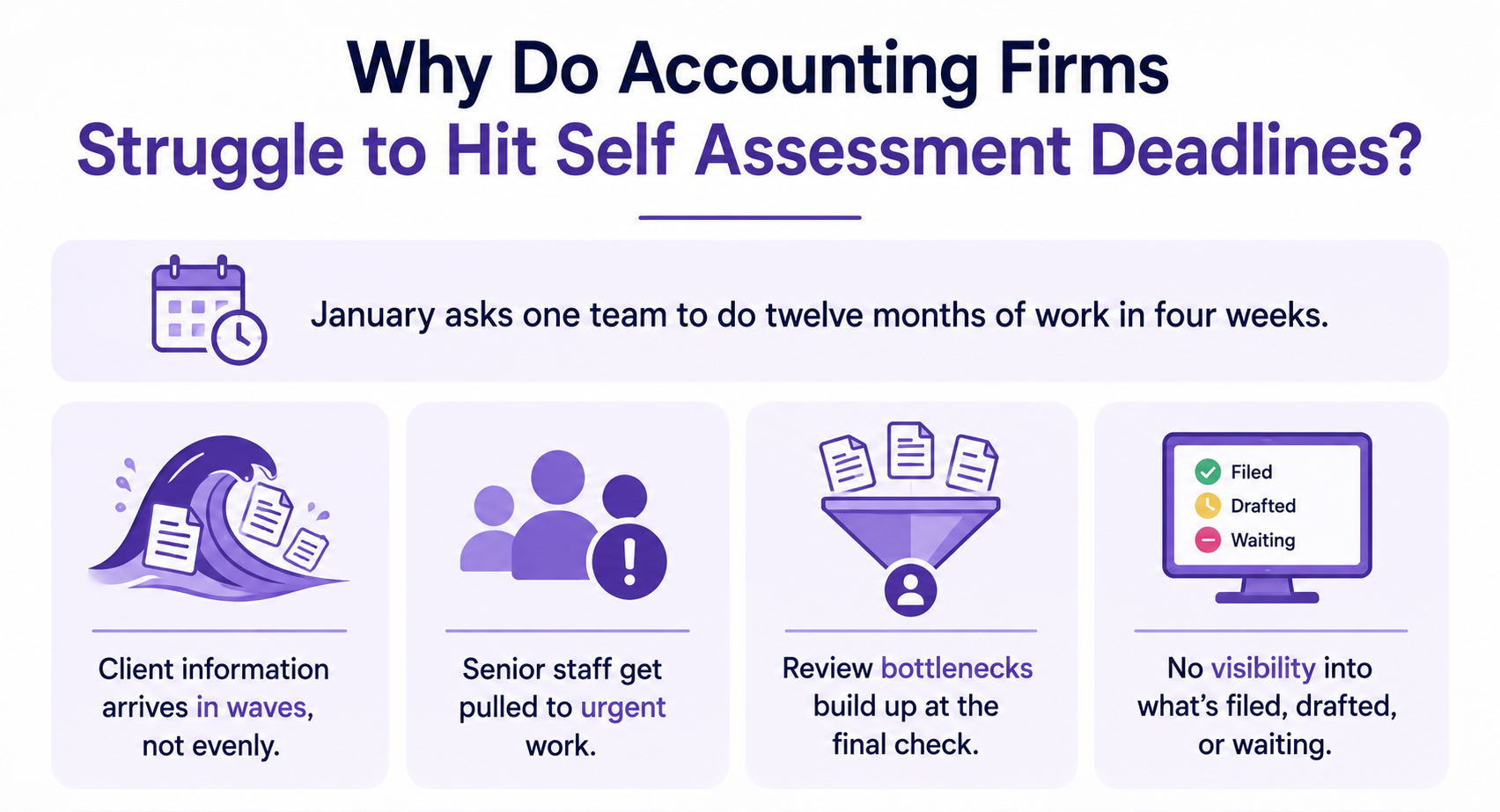
Most firms do not miss deadlines because they lack the knowledge. They miss them because January asks one team to do twelve months of work in four weeks.
Self assessment is the single most compressed period in the UK accounting calendar. A practice handling other compliance work, payroll runs, and management accounts at the same time has no spare capacity when client documents arrive late, which they always do.
- Client information arrives in waves through December and January, not evenly across the year
- Senior staff get pulled onto urgent corporation tax or VAT work, leaving self assessment to whoever has time
- Review bottlenecks build up because one partner has to check every return before submission
- There is no visibility into which returns are filed, drafted, or still waiting on the client
What Are the Self Assessment Deadlines for 2025/26?
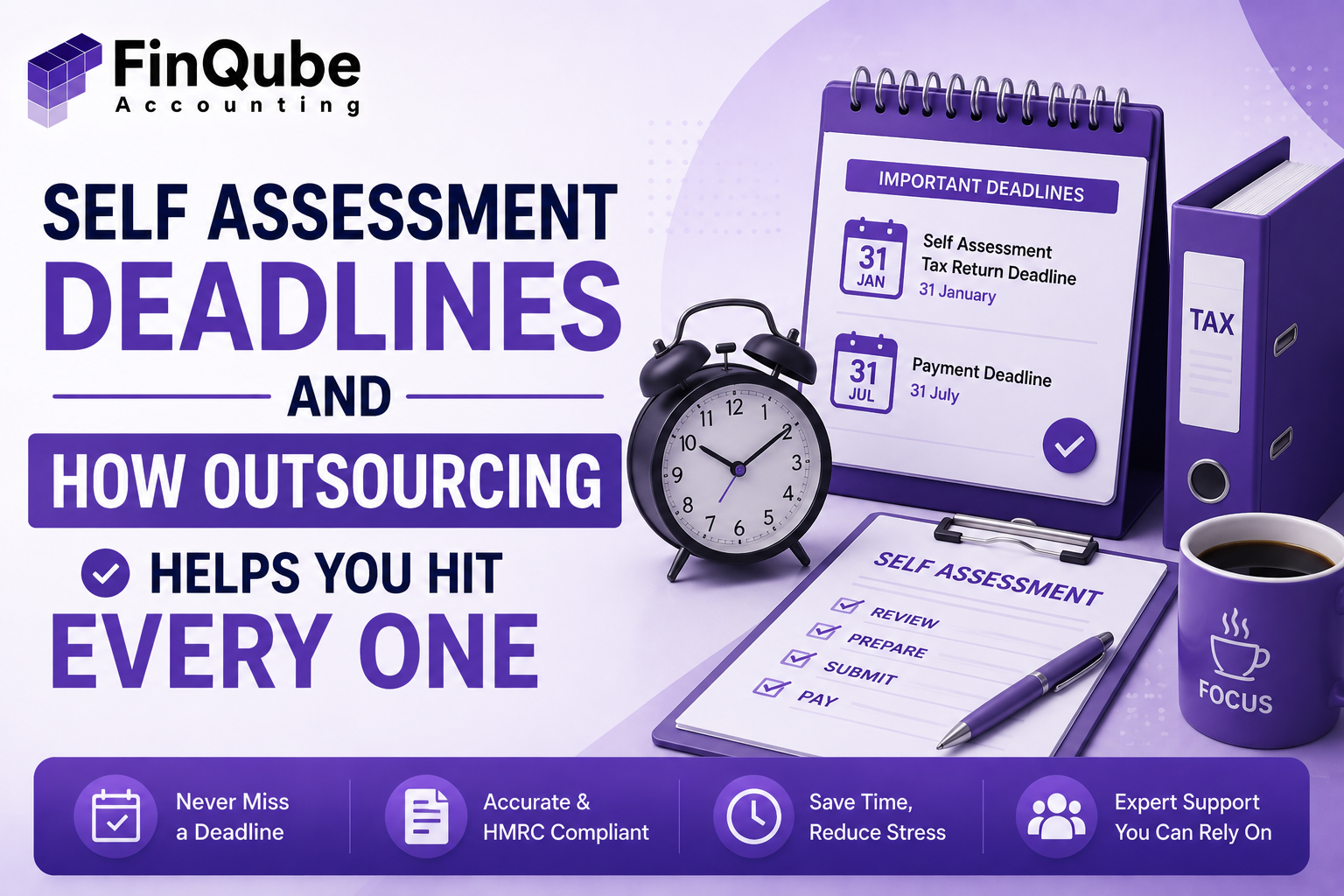
The 2025/26 tax year runs from 6 April 2025 to 5 April 2026. The online filing deadline is 31 January 2027, and paper returns are due three months earlier, on 31 October 2026.
According to Outbooks, the filing window for 2025/26 returns opens on 6 April 2026, with the online filing deadline falling on 31 January 2027 and paper returns due by 31 October 2026. Registration for anyone filing for the first time must happen by 5 October 2026.
According to British Tax Calculator, around 90% of taxpayers file online rather than by paper, which gives them roughly three extra months compared with the postal route. That gap matters for capacity planning, because it means the real crunch for most practices sits in the final weeks of January, not October.
Who Is Responsible When a Self Assessment Deadline Is Missed?
The client carries the penalty. The practice carries the reputational cost.
HMRC issues the fine directly to the taxpayer, not the accountant. But a client who receives a £100 penalty because their file sat in a queue rarely blames the process. They blame the firm they pay to prevent exactly that.
According to Double Point Accountancy, a £100 automatic fine applies from day one after the deadline regardless of whether tax is owed, daily penalties of £10 begin after three months and can add up to £900 over 90 days, a further charge of 5% of the tax due or £300 (whichever is greater) applies at six months, and another 5% or £300 charge applies at twelve months. Someone who files six months late while owing £5,000 in tax could face penalties exceeding £1,500 on top of the original bill.
Late payment penalties run separately from late filing penalties. According to Raisin UK, interest accrues daily from 31 January 2027 at the Bank of England base rate plus 2.5%, and a further penalty applies after 30 days of non-payment.
When Do Payments on Account and Registration Deadlines Fall?
Payments on account catch out more clients than the filing deadline itself, because they ask for money twice in one sitting.
According to Stewart Accounting, anyone with a tax bill above £1,000 for the previous year typically owes a first payment on account alongside their balancing payment on 31 January, effectively paying two tax bills at once. A second payment on account then falls on 31 July.
If a client's income has dropped, they can apply to reduce payments on account, but they must be able to justify the reduction or face interest charges on the shortfall. This is exactly the kind of proactive check that gets missed when a team is filing returns at speed with no spare capacity to review each client's wider position.
Where Do Most Self Assessment Delays Start Inside a Practice?
Delays rarely start with the accountant doing the work. They start upstream, in the systems that feed that work.
- Client onboarding: incomplete engagement letters or missing UTR numbers block a return before it starts
- Document collection: bank statements, dividend vouchers, and rental income records arrive piecemeal through January
- Software gaps: data sitting in Xero (or any other software) that has not been reconciled all year creates hours of clean-up work in week one
- Review queues: one partner reviewing every file creates a single point of failure at the busiest time of year
Firms using Xero, QuickBooks, Sage, or any other software still face the same bottleneck if reconciliation has not happened consistently across the year. The software is rarely the problem. Capacity is.
How Does Self Assessment Outsource Support Change January?
Self assessment outsource support adds a dedicated accountant who works inside the practice's existing systems, rather than adding another layer of admin the partner has to manage.
That accountant picks up return preparation, chases outstanding client information under the practice's own branding, and flags issues before a return reaches partner review. According to Frontedge Accountants, missed deadlines lead to penalties, interest charges, and unnecessary stress for the client, which is why catching problems early in the process matters more than catching them in the final week of January.
A named accountant, rather than a shared pool, means the same person is accountable for a client's file from intake to submission. Nothing gets picked up cold three days before the deadline.
Real Scenario: Shah & Co Accountants, Leeds
Priya Shah runs a nine-person practice in Leeds. Every January, her team filed self assessment returns for around 180 clients, alongside their normal VAT and bookkeeping workload.
Before outsourcing, Priya reviewed every return herself. By the third week of January, she was working past 9pm most nights, and two returns still slipped past 31 January the previous year, resulting in automatic £100 penalties for both clients.
Priya brought in a dedicated Finqube accountant three months ahead of the 2025/26 filing season. The Finqube accountant worked inside her firm's existing Xero and QuickBooks setup, prepared returns as client data arrived, and flagged incomplete files early rather than in the final week. Priya's team reviewed pre-checked returns instead of raw ones. Every client was filed by 20 January, with no penalties and no late nights in the final week.
How Finqube Can Help
Finqube gives your practice a dedicated remote accountant for self assessment, not a shared pool that picks up whichever file lands first.
- One named accountant works your self assessment client list from intake through to filing
- Our proprietary AI review software flags reconciliation gaps and missing information before your partner sees the file
- Your accountant works inside your existing Xero, QuickBooks, Sage, or any other software, so nothing needs migrating
- Fixed monthly pricing means your capacity cost does not spike every January
- There is no minimum commitment beyond the engagement itself
Ready to see January differently? Book a capacity review with Finqube and find out what a dedicated accountant would take off your plate before the next filing season.
Conclusion
Self assessment deadlines do not move, and neither does HMRC's penalty schedule. What can move is how much of that January workload sits on your existing team.
Self assessment outsource support gives practices a named accountant, visibility on every file's status, and review support before returns reach the partner. That is the difference between a January that ends in relief and one that ends in £100 penalty letters. If your practice is heading into another compressed filing season short on capacity, talk to Finqube about a dedicated accountant for self assessment.
One month. No contract.
See how a dedicated Finqube accountant fits into your MTD workflow before you decide.
Start your free pilotFAQ
When is the self assessment deadline for 2025/26?
The online filing deadline for the 2025/26 tax year is 31 January 2027, with paper returns due by 31 October 2026, according to Outbooks.
What happens if I miss the self assessment deadline?
An automatic £100 fine applies from day one, daily penalties of £10 begin after three months up to a maximum of £900, and further charges of 5% of the tax due or £300 apply at six and twelve months, per Double Point Accountancy.
Do I need to pay twice in January if I have payments on account?
Yes. Clients with a prior tax bill over £1,000 typically pay a balancing payment for the previous year plus a first payment on account for the current year on the same date, according to Stewart Accounting.
When do I need to register for self assessment for the first time?
First-time filers must register with HMRC by 5 October 2026 for the 2025/26 tax year to receive a UTR in time.
How does self assessment outsource support work with my existing software?
A dedicated accountant works inside your existing Xero, QuickBooks, Sage, or any other software setup. Nothing needs to be migrated or duplicated.
Does outsourcing self assessment mean losing control of client relationships?
No. Your practice stays client-facing throughout. The outsourced accountant works under your branding and processes, with your partner retaining final review and sign-off.
What is the minimum commitment for Finqube's self assessment support?
None. There is no minimum term beyond the engagement itself.