.avif)

Blog Summary
- What postponed VAT accounting is and why HMRC brought it in.
- Which clients can use it. The rules your firm needs to check first.
- How to pull the monthly statement. Where it goes on the VAT return.
- How a dedicated remote team keeps import VAT clean without adding to your review pile.
INTRODUCTION
A client calls. Goods are stuck at the border. They need an answer, fast.
Do they pay VAT now? Or does it wait for the VAT return?
If your team hesitates, postponed VAT accounting is probably the gap. It lets VAT-registered UK businesses declare import VAT and reclaim it on the same VAT return. No cash at the border. No wait to get it back.
That sounds simple. It isn't always.
Postponed VAT accounting touches customs declarations. It touches EORI numbers. It touches a statement that vanishes after six months. And it touches three separate boxes on the VAT return.
Get one part wrong and your client pays too much. Or they under-declare without knowing it.
This guide covers what postponed VAT accounting is. Who can use it. And how your firm gets it right, every time, for every importing client.
What Is Postponed VAT Accounting?
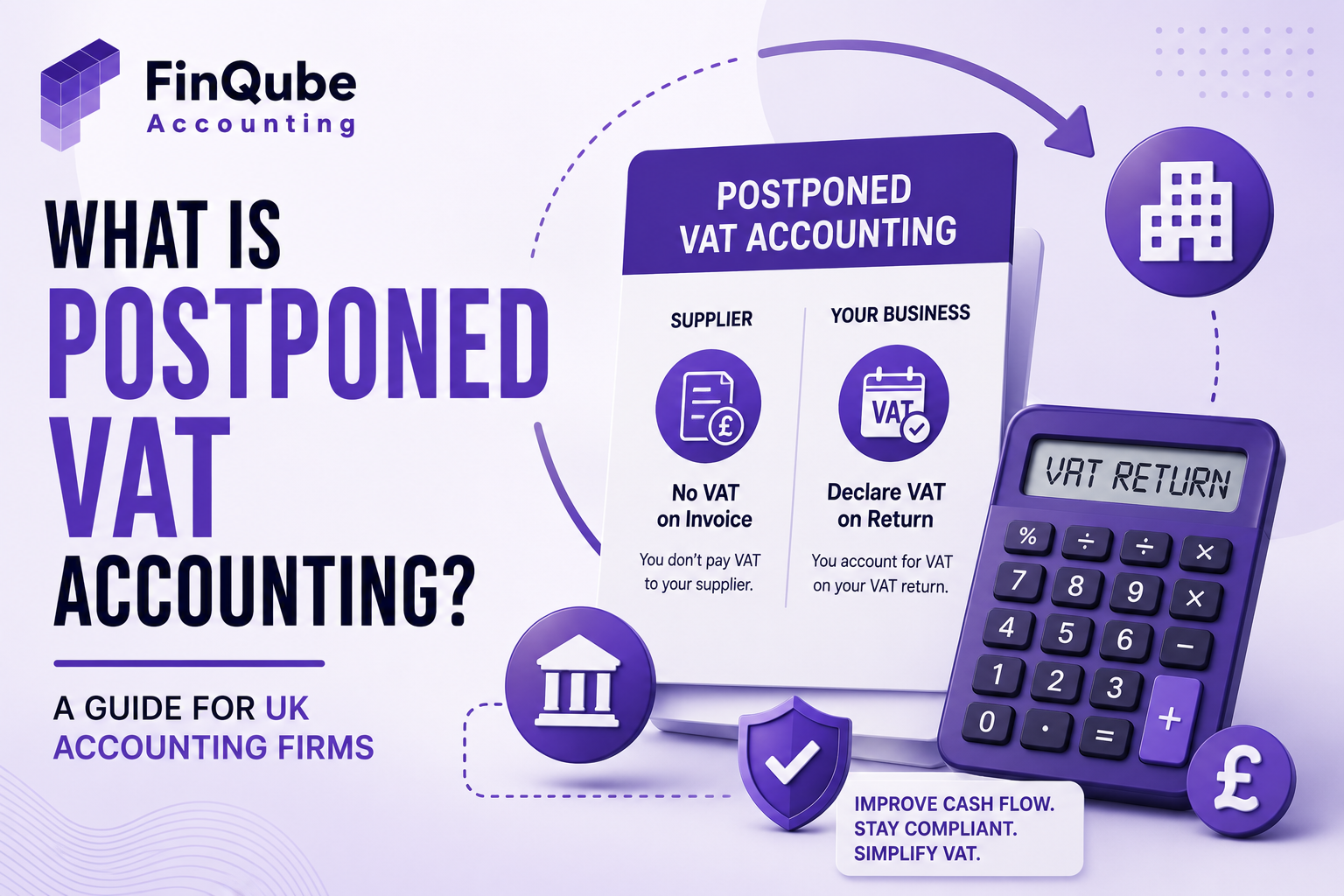
Postponed VAT accounting (PVA) lets a VAT-registered business declare import VAT and reclaim it on the same VAT return.
No cash changes hands at the border. The business records the VAT as due and reclaimable, both, on one return.
According to GOV.UK, businesses need no approval to do this.
HMRC brought PVA in during January 2021. That was just after the UK left the EU. Before that, most non-EU imports needed VAT paid at the border first. The business reclaimed it later.
That gap used to tie up client cash for weeks. PVA closes it.
Here's the shift in one table.
Why Postponed VAT Accounting Matters for UK Accounting Firms
PVA protects client cash flow. But it also hands your firm a new compliance step.
Any practice with importing clients needs a process. Someone has to pull the monthly statement. Someone has to check it. Someone has to reconcile it.
Miss this step and clients overpay HMRC. Or they misstate the VAT return.
This risk is real, not theoretical. HMRC's own statements have gone wrong before. AccountingWeb reported errors in the February, March, and June 2022 statements. Firms that filed on those figures had to go back and fix client returns.
So your firm can't treat the monthly statement as gospel. A second pair of eyes needs to check that number before it lands in Box 1. Human or AI, it needs a check.
Why does this land on the accountant, not the client? Most practice owners import goods. They don't track customs mechanics. Your firm is the checkpoint.
Who Can Use Postponed VAT Accounting?
Any VAT-registered UK business importing goods can use postponed VAT accounting. There is no application process.
The main conditions, from GOV.UK guidance:
- The business is VAT-registered in the UK.
- The goods are for business use.
- The business owns the goods, or holds disposal rights over them.
- The VAT registration number appears on the customs import declaration.
- If a freight forwarder or agent handles the import, they need written confirmation to declare PVA on the client's behalf.
A few clients sit outside the standard picture. Insurance firms, some financial services, and parts of real estate often can't recover VAT in full. Many still pay import VAT upfront, because they can't reclaim it either way.
Northern Ireland clients follow slightly different rules. NI still tracks parts of the EU VAT regime for goods movements.
When Does Postponed VAT Accounting Apply?
PVA applies the moment a business imports goods and picks the postponed VAT option on the customs declaration.
It isn't automatic. Someone has to select it. That could be the client, their freight forwarder, or their customs agent. They also need to enter the VAT registration number on the declaration.
There's one case where it's forced, not chosen. If a client defers their customs declarations, PVA becomes compulsory for that import.
Clients can also switch. One shipment can use PVA. The next can pay VAT upfront. As Xero notes, businesses "can alternate between using PVA and paying VAT upfront, depending on individual circumstances."
That flexibility helps clients. But it means your firm can't assume every import in a quarter used PVA. Check the statement against real import activity.
Where Do You Find the Postponed Import VAT Statement?
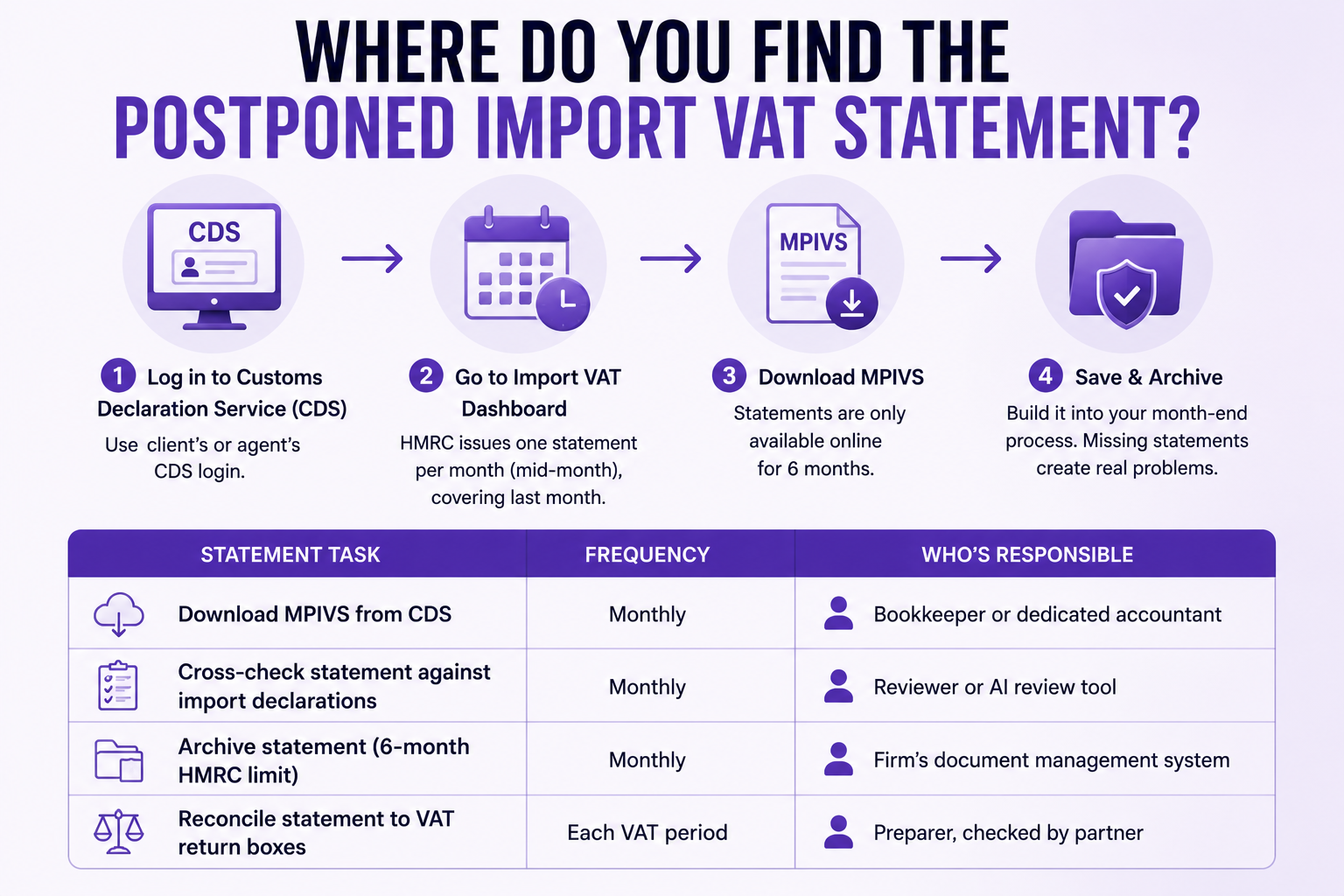
You find the monthly postponed import VAT statement (MPIVS) in the Customs Declaration Service. It sits under the client's import VAT dashboard.
HMRC issues one statement each month, usually mid-month. It covers the previous month's imports. Your firm needs the client's or agent's CDS login to see it.
Here's the part that catches firms out. Statements stay online for only six months. After that, they're gone. Unless someone already downloaded and saved a copy.
Build this into your month-end checklist. Not your year-end scramble. A missing March statement in October is a real problem.
How Do You Account for Postponed VAT on a VAT Return?
You take figures from the MPIVS and enter them in three boxes on the VAT return.
The mapping, confirmed by GOV.UK guidance and industry sources:
- Box 1 — VAT due on imports under postponed VAT accounting.
- Box 4 — VAT reclaimed on those same imports.
- Box 7 — Total value of imported goods, excluding VAT.
For a business with full VAT recovery, Box 1 and Box 4 usually cancel out. The net VAT impact is often zero. That's the whole point of PVA. No cash out. No cash back. Just a clean entry on both sides.
Flat Rate Scheme clients need extra care. PVA imports sit outside the flat rate turnover calculation. Firms often miss this step on a client's first import.
If MTD software is in use — Xero, QuickBooks, Sage, FreeAgent, or any other software — the MPIVS figures usually need a manual entry, or a bridging import. HMRC doesn't push the statement straight into most bookkeeping platforms.
That manual step is where mistakes creep in. Numbers get transposed. Statements get missed. A corrected HMRC statement, like the ones in 2022, gets overlooked. A review layer catches this before the return goes out. That saves an amendment later.
Real Scenario: A Kent Accounting Practice Fixes Its Import VAT Backlog
Ramsgate Trade Accountants is a nine-partner practice near the Port of Dover. After Brexit, they picked up a cluster of import-heavy clients. Mostly homeware and food distributors, bringing stock in from the EU and further afield.
The problem. Their bookkeeping team pulled MPIVS statements by hand each month. Then they re-keyed the figures into Xero. Two VAT returns needed correction in one year. A statement had been downloaded before HMRC fixed an error in it. Nobody caught the gap before filing.
What they tried first. They built a spreadsheet checklist. A junior team member owned the downloads. Missed downloads dropped. But the checklist only confirmed a statement existed. It didn't check whether the figures were right.
What changed. Ramsgate brought in a dedicated remote accountant through FinQube. The accountant works inside their existing Xero setup. Every MPIVS now runs through FinQube's AI review software before it reaches Box 1 and Box 4. The software flags any statement that doesn't match the client's real import activity.
The result. No corrected VAT returns since the change. The partner used to spend two hours a month cross-checking import VAT. Now it takes fifteen minutes to review the flagged exceptions.
How FinQube Can Help
Import VAT is a small, technical corner of compliance. But it eats partner time in small doses every month. Left alone, it becomes a real problem.
Here's what changes when FinQube handles it alongside your VAT compliance.
- One dedicated, named accountant. They work your import VAT clients every month. Not a rotating pool who relearns the client each time.
- Works inside your existing systems. Xero, QuickBooks, Sage, FreeAgent, or any other software you already use. No migration. No new login for your team.
- AI review flags issues before your partner sees the file. Mismatched MPIVS figures, missing statements, Flat Rate Scheme exceptions — caught before submission, not after.
- Fixed monthly pricing. You know the cost of getting import VAT right every month. No hourly surprises.
- No minimum commitment beyond the current month. You can outsource VAT returns UK support and step away any time it isn't working for your practice.
CONCLUSION
Postponed VAT accounting solved a real cash flow problem for UK importers. But it moved the risk from the border to the VAT return.
Your firm now owns the monthly statement check. The box-by-box reconciliation. The six-month archive deadline. Miss any of those and the VAT return is wrong, even if the import itself was fine.
Build a checklist. Assign an owner. Put a second review on every MPIVS before it hits the return.
Or hand the whole process to a dedicated accountant who already runs this for other import-heavy practices. Book a call with FinQube to see how it works inside your current systems.
One month. No contract.
See how a dedicated Finqube accountant fits into your MTD workflow before you decide.
Start your free pilotFAQ
What is postponed VAT accounting in simple terms?
Postponed VAT accounting lets a VAT-registered business declare and reclaim import VAT on the same VAT return. No payment at the border. No wait to get it back.
Do I need to apply for postponed VAT accounting?
No. Per GOV.UK, any VAT-registered business can use it. No approval needed. Just select it on the customs declaration.
How do I get my postponed import VAT statement?
Download the monthly postponed import VAT statement (MPIVS) from the Customs Declaration Service. Statements stay online for six months. Download and archive one every month.
Which VAT return boxes does postponed VAT go in?
Box 1 for VAT due on the import. Box 4 for VAT reclaimed. Box 7 for the total value of the goods, excluding VAT.
Can a business choose not to use postponed VAT accounting?
Yes, for most imports it's optional. A business can pay import VAT upfront instead. It only becomes compulsory if the business defers its customs declarations.
Does postponed VAT accounting work with Xero, QuickBooks, or Sage?
Yes. But most platforms — Xero, QuickBooks, Sage, FreeAgent, or any other software — don't pull the MPIVS in on their own. Figures usually need manual or bridging entry. That's where errors creep in.
What happens if HMRC's postponed VAT statement is wrong?
It has happened before. AccountingWeb documented statement errors in 2022. If a client already filed on wrong figures, HMRC allows an estimate. Base it on goods, shipping, and duty costs. Adjust once the correct data arrives.