.avif)

Blog Summary
- What proper bank reconciliation looks like for a UK practice running monthly bookkeeping for multiple clients
- The exact process we follow, from bank feed to signed-off file
- Where reconciliation errors actually happen, and how to catch them before a client sees them
- How a dedicated remote accountant with AI review software cuts reconciliation time without cutting corners
Introduction
Bank reconciliation should take an hour per client, not an afternoon. For most UK practices managing monthly bookkeeping across 20 or more clients, it takes far longer, and it is usually the first task to slip when month end gets busy. This guide walks through exactly how we handle reconciliation and monthly bookkeeping at scale, where the process breaks down for most firms, and how a dedicated remote accountant changes the maths.
What Is Bank Reconciliation, and Why Do So Many Practices Struggle With It
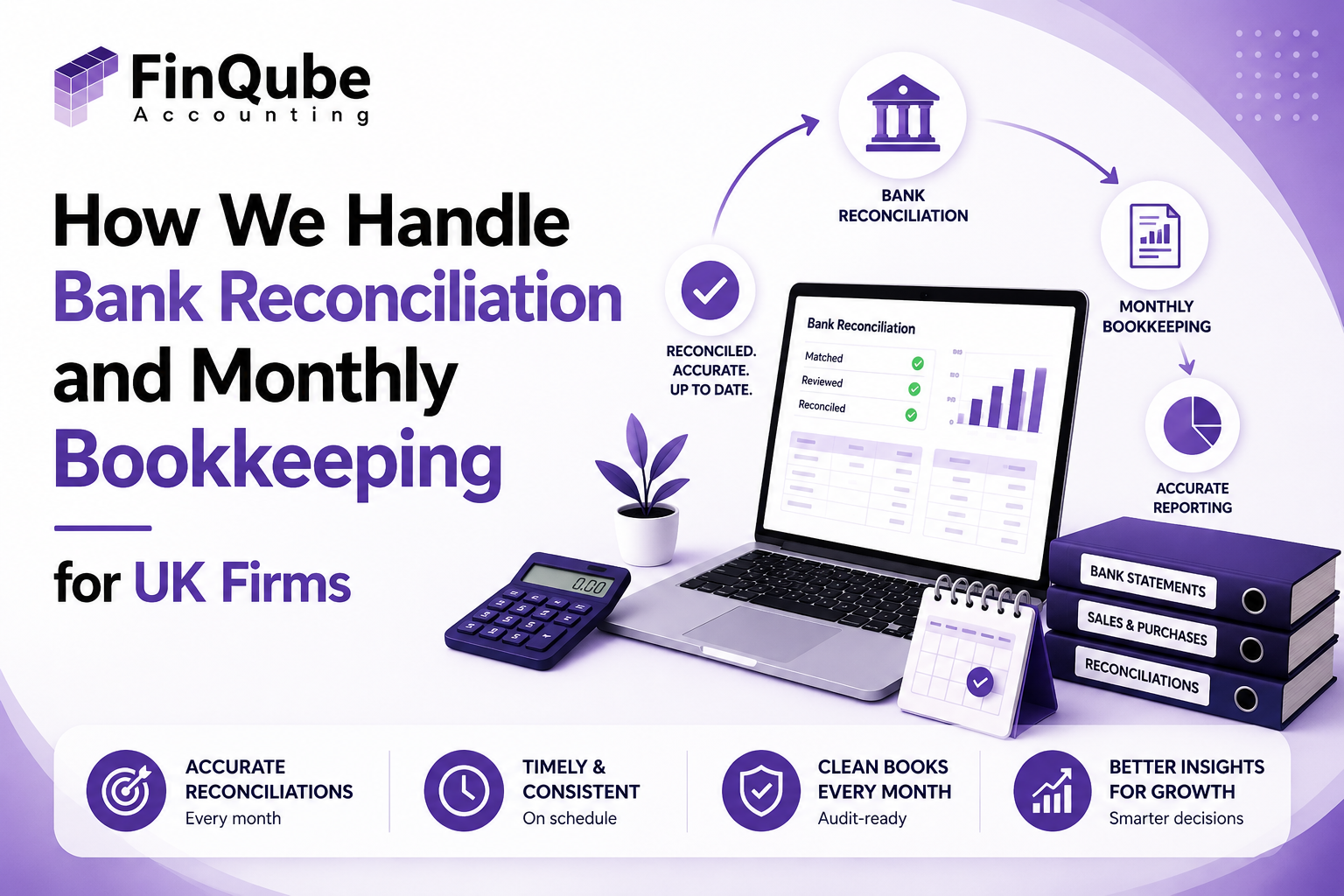
Bank reconciliation is the process of matching every transaction in a client's accounting software against their actual bank statement, so the two records agree exactly. It sounds simple. At volume, across multiple clients with messy bank feeds, it rarely is.
Most practices struggle with reconciliation not because the concept is hard, but because of timing. Bookkeeping gets done in batches, often days or weeks after transactions happen. By the time someone reconciles, the trail has gone cold. A duplicate payment, an unmatched supplier invoice, or a misclassified transfer becomes much harder to trace once three more weeks of activity have piled on top of it.
This is the gap between bookkeeping and reconciliation. Bookkeeping records what happened. Reconciliation confirms it actually happened the way the books say it did. Skip the second step, or rush it, and your client's numbers look complete while quietly being wrong.
Why Bank Reconciliation Matters More Than Most Practices Treat It
Reconciliation is the control point that catches errors before they reach a client's management accounts, VAT return, or year end figures. Treat it as a formality and those errors travel downstream.
An unreconciled bank account means you cannot trust the cash position you are reporting on. For a small business owner deciding whether they can afford to hire, or a director relying on management accounts to plan cash flow, that number matters. ICAEW sets the UK accounting standards and regulatory benchmarks practices are expected to meet, and accurate underlying records are the foundation those standards assume.
The risk is not abstract. Duplicate payments go unnoticed. Customer payments get applied to the wrong invoice. A standing order that stopped three months ago keeps appearing as a forecast outflow. Each of these is a small thing on its own. Across 30 clients a month, they add up to real client trust lost, usually discovered at the worst possible time, like during a bank loan application or an HMRC enquiry.
Practices that treat reconciliation as a proper control, not a box-ticking exercise, catch these issues before the client does. That is the difference between being reactive and being the accountant a client never has to double-check.
Who Should Actually Be Doing the Reconciliation
Reconciliation should be done by whoever is closest to the client's day-to-day transactions, then checked by someone who did not do the original entry. That second pair of eyes is not optional. It is the entire point of a review process.
In most small UK practices, the junior team member or bookkeeper handles the initial reconciliation. The problem is what happens next. In a 2 to 20 person practice, the partner is often the only review layer, and partners are already stretched across client work, business development, and managing the team. Review either does not happen properly, or it happens so late that errors have already reached the client.
This is where capacity, not skill, becomes the real constraint. The team usually knows how to reconcile correctly. They do not have the hours to do it and review it properly across every client, every month.
A dedicated remote accountant changes this equation by adding a full-time layer of capacity that follows your existing processes rather than replacing them. The work still happens inside your systems, under your name, with your review standards. It simply gets done by someone whose entire month is built around doing it properly.
When Should Reconciliation Happen in Your Monthly Bookkeeping Cycle
Reconciliation should happen weekly, not just at month end. Waiting until month close to reconcile an entire month of transactions in one sitting is where most of the time pressure, and most of the errors, come from.
A weekly reconciliation cadence means small discrepancies get caught while the transaction is still fresh and the explanation is still easy to find. By the time month end arrives, you are confirming a handful of outstanding items rather than untangling four weeks of unmatched entries against a looming deadline.
For VAT-registered clients, this cadence matters even more. Making Tax Digital for VAT requires digital record keeping and digital submission of VAT returns, which means your underlying bank data needs to be clean and current well before the quarterly deadline, not patched together the week it is due.
Month end should be reserved for final checks: confirming the bank reconciliation report ties out, reviewing any items still open, and signing off the file. If month end is when reconciliation actually starts, the cycle is already running too tight.
Where Most Reconciliation Errors Actually Happen

The same handful of failure points show up across almost every practice we have worked alongside. Knowing where to look cuts review time significantly.
Clearing accounts. Transactions get parked in a clearing or suspense account "to deal with later," and later never comes. Clearing accounts with a growing, unexplained balance are one of the most common signs that reconciliation has been deferred rather than completed.
Bank feed duplicates. When a bank feed reconnects after a gap, it can re-import transactions that were already manually entered, creating duplicates that inflate both income and expenses until someone spots the mismatch.
Unmatched customer payments. A payment arrives that does not match an open invoice exactly, often due to a discount, partial payment, or bank charge, and gets left sitting unallocated instead of being investigated and matched properly.
Timing differences mistaken for errors. A transaction recorded in the books on one date and clearing the bank a few days later is normal. Treating every timing gap as an error wastes review time that should go toward real discrepancies.
Foreign currency and rounding. For clients trading internationally, small exchange rate movements between invoice and payment date create rounding differences that, left unexplained, accumulate into a balance nobody can account for.
How We Handle Bank Reconciliation and Monthly Bookkeeping
Our process follows a fixed structure for every client, every month, so nothing depends on memory or whoever happens to be free that week.
Step 1: Daily bank feed monitoring. Transactions are categorised as they land, not in a batch days later. This keeps the trail warm for anything that looks unusual.
Step 2: Weekly reconciliation checkpoints. Every client account is reconciled against the bank statement weekly. Outstanding items are logged immediately, not left to accumulate.
Step 3: Clearing and suspense account review. Any balance sitting in a clearing account gets investigated that week. Nothing is allowed to age past one review cycle without an explanation attached.
Step 4: AI-assisted error flagging. Before a file reaches human review, it passes through our reconciliation health check, which flags mismatches, duplicate entries, and unusual variances automatically.
Step 5: Partner-visible sign-off. Your team can see exactly which files are reconciled, which are outstanding, and which have flagged items, without chasing anyone for an update.
Step 6: Month end confirmation. At month close, the reconciliation report is reviewed and signed off, ready to support management accounts, VAT submissions, or year end work without last-minute surprises.
A Real Scenario: What This Looks Like in Practice
Priya Mehta runs a 9-person practice in Leeds with a mix of contractor, retail, and small agency clients. Her bookkeeping team was reconciling once a month, right before VAT deadlines, because that was the only time anyone had a clear afternoon for it.
One client, a marketing agency with three overseas suppliers, had been building an unexplained balance in a clearing account for four months. Nobody had flagged it because nobody was looking at clearing accounts until VAT quarter end forced a full review. By the time it surfaced, untangling it meant going back through four months of FX-affected transactions to work out what belonged where.
After bringing in a dedicated Finqube accountant, the practice moved to weekly reconciliation across all 40 of their clients. The clearing account issue would have been caught in its first week rather than its seventeenth. Within the first full month, every client account was reconciled on a rolling weekly basis, and the partner could see reconciliation status for every file without asking the team for an update.
How Finqube Can Help
Every Finqube engagement pairs a dedicated remote accountant with our proprietary AI review software, included at no extra cost. The software's job is simple: catch what a human reviewer would otherwise have to find manually.
Before a reconciled file reaches your review, our reconciliation health check has already scanned it for mismatches, flagged any clearing account items still open, and surfaced anything that does not tie out. You are not reviewing raw work. You are reviewing work that has already been checked once.
Most practices already know how to reconcile correctly. What they lack is the hours to do it every week across every client. A dedicated Finqube accountant works full time inside your existing systems. The software behind them flags issues before they ever reach you. Together, they give you the visibility your team has been managing without.
One month. No contract.
See how a dedicated Finqube accountant fits into your MTD workflow before you decide.
Start your free pilotFAQs
Q: How often should bank reconciliation be done for monthly bookkeeping clients?
A: Weekly reconciliation is best practice, even for clients on a monthly bookkeeping cycle. It catches discrepancies while the transaction trail is still fresh, rather than leaving a full month of activity to untangle at once.
Q: What is the difference between bookkeeping and bank reconciliation?
A: Bookkeeping records transactions as they happen. Bank reconciliation confirms those records match what actually happened in the bank account. A practice can have complete bookkeeping that is still wrong if reconciliation has not caught the discrepancies.
Q: Why do clearing accounts build up unexplained balances?
A: Clearing accounts are meant to be temporary holding points for transactions awaiting further information. They build up balances when items get parked there during busy periods and are not reviewed and cleared on a regular schedule.
Q: Can outsourced bookkeeping services handle reconciliation as well as an in-house team?
A: A dedicated remote accountant working inside your existing systems and processes can reconcile to the same standard as an in-house hire, often with more consistent weekly cadence, since their capacity is not split across other unrelated tasks.
Q: What should a UK practice look for in a bank reconciliation service?
A: Look for a weekly reconciliation cadence rather than month-end-only checks, clear visibility into which files are reconciled and which are outstanding, and a review layer that catches errors before they reach the client.
Q: Does Making Tax Digital affect how often reconciliation needs to happen?
A: Making Tax Digital for VAT requires digital record keeping and digital submission of VAT returns, which means underlying bank records need to be accurate and current ahead of each quarterly deadline rather than reconciled in one sitting close to the due date.
Q: How long does bank reconciliation take for a practice managing multiple clients?
A: With a weekly cadence, reconciliation typically takes under an hour per client. Practices reconciling only at month end often find it takes several hours per client, since a full month of unmatched items has to be worked through at once.