.avif)

Blog Summary
- Why bookkeeping is a top capacity problem for growing UK accounting firms
- How outsourced bookkeeping cuts partner review time
- Which bookkeeping tasks you can hand off, without losing visibility
- How firms add capacity fast, without a new hire
The Real Problem With Bookkeeping Capacity
Most practice owners do not worry about bookkeeping itself. They worry about what it breaks downstream.
Late bookkeeping delays VAT returns. Delayed VAT returns hold up management accounts. That slows down advisory work. Partners end up checking messy files instead of growing the firm.
Many UK firms hit this wall. Client numbers grow. Demand goes up. The team gets busier. But bookkeeping capacity stays the same.
Most firms try to fix this by hiring first. But good bookkeeping staff are hard to find. ICAEW research on mid-tier firms names recruitment as one of the top challenges practices face. Staff retention is a close second.
A role can stay open for months. Even after a hire starts, training takes time. Client work keeps piling up in the meantime.
This is why more firms now turn to outsourced bookkeeping. Not to spend less. To free up time.
The pattern rarely feels urgent at first. A reconciliation that used to take an hour now takes two. A VAT return that used to close cleanly now needs a last-minute fix. None of it feels like a crisis in the moment. Added up over a few quarters, it becomes the reason growth stalls.
What Are Outsourced Bookkeeping Services?
Outsourced bookkeeping means you hand bookkeeping tasks to a dedicated professional. That person works inside your firm's own systems.
They join your team like an extra pair of hands. They use your software. They follow your workflow. They meet your standards.
This is not the old outsourcing model. It plugs straight into your daily work.
Typical tasks include:
Many firms run on cloud platforms such as Xero, QuickBooks, Sage, FreeAgent, or any other software. Bookkeeping work continues on the same platform, with no disruption.
Demand for bookkeeping services in the UK keeps growing. Xero's UK small business research shows cloud accounting adoption rising each year among UK SMEs. More firms want bookkeeping support that already knows cloud tools.
Why Are More UK Accounting Firms Outsourcing Bookkeeping?
The main driver is capacity. Most practice owners already understand bookkeeping well. What they lack is time.
As firms grow, bookkeeping work grows fast. Every new client adds monthly tasks. Demand often outpaces the team's ability to keep up.
Common pressure points:
- Recruitment delays
- Staff turnover
- Growing client lists
- VAT deadlines
- Month-end spikes
- More review work
Senior staff often spend big chunks of the week checking routine bookkeeping. That is a hidden cost. It pulls them away from advisory work, client calls, and growing the firm.
AccountingWeb has found the same pattern across UK practices. Capacity, not client demand, is usually the real limit on growth.
The result: slower growth, even when demand is strong.
Who Benefits Most From Bookkeeping Outsourcing?
Bookkeeping outsourcing helps most where teams feel stretched. A few groups stand out.
Growing Firms. New clients arrive faster than new staff can. Outsourcing absorbs that extra load.
Firms Facing Recruitment Challenges. The UK accounting job market stays tight. Hiring takes months. Outsourced bookkeeping fills the gap while recruitment carries on.
Firms Looking to Improve Margins. Partners often review work that could sit with someone else. Freeing them up puts senior time to better use.
Firms Expanding Advisory Services. Advisory work stalls when bookkeeping falls behind. Clean books are the base for management accounts and forecasting.
Firm size matters less than most people assume. A small two-person practice with a growing client list can gain just as much as a fifteen-person firm. What matters is the gap between what your team can handle, and what your clients actually need.
When Should a Firm Consider Outsourcing Bookkeeping?
The best time to outsource is before things break. Most firms see the warning signs first.
Sign 1: Month-End Feels Chaotic. Month-end should run smoothly. If it does not, bookkeeping needs support.
Sign 2: Partners Check Routine Work. Senior staff should handle exceptions and advice. Not line-by-line coding checks.
Sign 3: Recruitment Drags On. An empty seat costs more than people think. Every month without cover adds pressure on the rest of the team.
Sign 4: Client Onboarding Slows Down. If new clients wait because the team is full, growth stalls.
Sign 5: VAT Work Always Feels Rushed. Late bookkeeping causes last-minute VAT scrambles under Making Tax Digital rules. Better bookkeeping fixes this earlier.
Where Do Most Bookkeeping Bottlenecks Occur?
Bottlenecks tend to sit in repeat, high-volume tasks. Each one looks small alone. Together, they eat hours.
Bank Reconciliations. These cause the most trouble. Common issues:
- Unmatched transactions
- Duplicate entries
- Wrong coding
- Timing differences
When reconciliations slip, month-end gets harder.
Accounts Payable. Supplier invoices pile up during busy spells. Delays create reporting errors and extra review work.
Accounts Receivable. Debtor balances need watching. Without regular checks, debtor chasing turns reactive. This is why firms often pair bookkeeping with dedicated AP and AR management.
Data Cleanup. Many firms spend real time fixing bookkeeping errors before filing accounts or VAT returns. This is avoidable work. Often, a data cleanup project needs to happen first.
How Do Outsourced Bookkeeping Services Save Time?
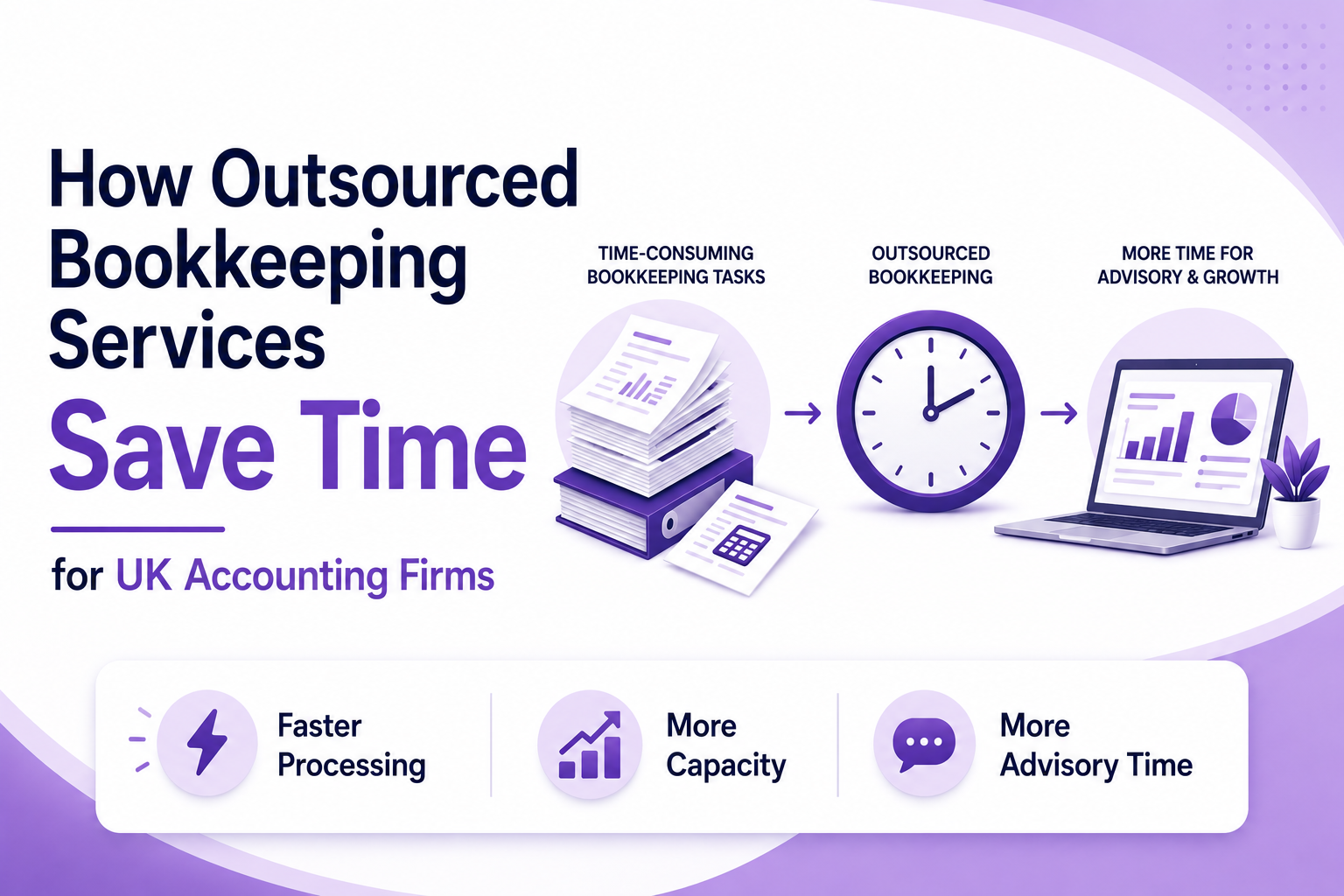
Outsourcing saves time by cutting manual work and shortening review cycles. The benefit reaches past bookkeeping itself.
Faster Bank Reconciliations. Daily or weekly checks stop big backlogs forming. Issues get caught early, not at month-end.
Less Partner Review Time. Partner review eats hours every week. Look at the usual pattern:
- Junior staff do the bookkeeping
- Errors slip through
- A partner checks the work
- Corrections get sent back
- Work comes back for fixes
- Review happens again
A dedicated bookkeeper improves the work earlier. That cuts the review cycle down.
Better VAT Preparation. Clean books make VAT easy. Good reconciliations and correct coding all quarter long mean less scramble at filing time.
More Predictable Workflows. Outsourcing brings routine. Tasks get done on schedule. Nothing piles up until the deadline hits.
More Capacity, No New Hire. Firms grow output fast, without months of recruitment or the extra management load of a new employee.
Comparison Tables
In-House vs Outsourced Bookkeeping
Hiring vs Dedicated Remote Bookkeeper
Impact on Practice Capacity
Real Scenario
Priya Shah runs Shah & Co Accountants in Leeds. She hit a problem many firm owners know well.
The last week of every month was a scramble. Files came in batches. Reconciliations sat unfinished. Staff waited for sign-off. Nobody could see the full picture.
The team was skilled. The workflow was not. As the firm grew, the bottleneck got worse.
Priya brought in a dedicated bookkeeper. Work now gets done all month, not just at the end. Review got faster. Visibility improved.
By month two, Priya had won back around 12 hours a week. She had spent that time chasing progress and fixing avoidable errors. The fix was not longer hours. It was a better process.
Her team felt the shift too. Nobody had to field last-minute questions about file status, since the answer already sat on the dashboard. The whole practice settled into a steadier rhythm, not just Priya's own workload.
How Finqube Can Help
Most practice owners do not doubt that bookkeeping can get done. They want to know it is right, and that they can see the work before it reaches a client.
Finqube gives you a dedicated remote accountant. The model flexes to fit your firm, not a single rigid contract. Your accountant works inside your systems, whether that is Xero, QuickBooks, Sage, FreeAgent, or any other software. They follow your process. You stay in control. You keep full visibility.
There is no minimum commitment. Scale up when it is busy. Scale down when it is quiet. No notice period gets in the way.
Every engagement also includes Finqube's AI review software, at no extra cost. Its job is to make work visible before it reaches you. It flags reconciliation issues, outstanding items, and common errors early. Partners spend less time hunting for problems, and more time deciding.
What you get:
- Faster bookkeeping
- Clear visibility
- Less review time
- More confidence in the work
- More capacity across the practice
Take a look at Finqube's engagement models to see which one fits your practice.
One month. No contract.
See how a dedicated Finqube accountant fits into your MTD workflow before you decide.
Start your free pilotConclusion
Bookkeeping rarely worries practice owners on its own. But it is often what holds a firm back.
When bookkeeping slips, everything else slips too. VAT gets harder. Management accounts arrive late. Partners spend more time checking, and less time advising.
Outsourced bookkeeping fixes this. It adds capacity exactly where firms need it, with no minimum commitment attached.
The real win is not a smaller bill. It is more time. Time for clients. Time for advisory work. Time to grow.
If bookkeeping is holding your firm back, a dedicated bookkeeper may be the fastest fix. Explore Finqube's engagement models, or get in touch to talk through your firm's specific bottlenecks.
FAQs
What are outsourced bookkeeping services?
You hand bookkeeping tasks to an outside accounting professional. They work inside your firm's own systems and follow your workflow.
Is bookkeeping outsourcing right for small accounting firms?
Yes. Small firms often gain the most, since bookkeeping takes up a bigger share of a small team's time.
Will I lose control if I outsource bookkeeping?
No. The best setups run inside your own systems. You keep full visibility over the work.
Is there a minimum commitment?
No. Support scales up or down with your workload. There is no fixed contract.
How fast can bookkeeping support start?
Timelines vary, but most dedicated support starts within one to two weeks.
Can outsourced bookkeeping help with VAT preparation?
Yes. Clean bookkeeping is the base for smooth VAT preparation and MTD compliance.
Is bookkeeping outsourcing mainly about cutting costs?
No. Most UK firms outsource bookkeeping to gain capacity and visibility first. Cost comes second.
What happens to my current software if I outsource bookkeeping?
Nothing changes. Your bookkeeper works inside Xero, QuickBooks, Sage, FreeAgent, or any other software your firm already uses. No migration needed.
How do I know if my practice actually needs this, or if it is just a busy month?
Look at the pattern over two or three cycles, not one. A single busy month happens to any practice. If month-end keeps slipping, or the same person keeps covering for gaps, that points to a real capacity problem. Not a one-off blip.

.png)