.avif)

Blog Summary
- The real accounting outsourcing cost range in the UK for 2026, broken down by service and firm size.
- Why per-hour pricing quietly costs practices more than fixed monthly fees.
- How outsourcing costs compare against hiring an in-house bookkeeper or accountant.
- What a transparent, fixed-fee pricing model actually looks like in practice.
META BLOCK
H1 Title: How Much Does Accounting Outsourcing Cost in the UK? (2026 Pricing Breakdown)
Meta Description: Accounting outsourcing cost in the UK ranges from £300 to £3,500+ a month. See real 2026 prices by service, firm size, and provider.
Primary Keyword: accounting outsourcing cost
Secondary Keywords: outsourced accounting services uk, accounting outsourcing uk, outsourced bookkeeping cost, payroll outsourcing cost, outsource accounting uk
Question Keywords (5W1H):
- What does accounting outsourcing cost in the UK?
- Why do outsourcing prices vary so much between providers?
- Who benefits most from outsourced accounting pricing models?
- When should a practice budget for accounting outsourcing?
- Where do UK firms find the most transparent outsourcing pricing?
- How do you compare outsourcing costs against an in-house hire?
LSI Keywords: outsourced accounting pricing, fixed fee accounting, per-employee bookkeeping cost, managed FTE pricing, accounting outsourcing companies UK, cost of hiring an accountant, offshore accounting costs
Intent: MOFU
Word Count Target: 2,500+
Internal Links: Outsourced Accounting Services in the UK: Everything Accounting Firms Need to Know (anchor: "outsourced accounting services uk"); The Complete Guide to Accounting Outsourcing for UK Firms (anchor: "accounting outsourcing"); Outsourced Accounting vs In-House: What's Cheaper for UK Firms? (anchor: "outsource accounting uk"); How Accounting Firms Are Using Offshore Teams to Cut Costs by 60% (anchor: "accounting outsourcing cost savings"); How Outsourced Bookkeeping Services Save UK Accounting Firms Time (anchor: "outsourced bookkeeping services"); Outsourced Payroll Providers in the UK: How to Choose the Right One (anchor: "outsourced payroll providers uk")
External Sources:
- ICAEW – The £100k Talent Gap in UK Accounting Firms (industry research referenced via ICAEW commentary)
- GOV.UK – Business Population Estimates for the UK 2025
- Qdos – Does IR35 Apply to Contracted-Out Services?
- Clutch – Small Business Outsourcing Report
- Wise – Cost of Outsourcing Accounting in the UK
CTA Type: Book a free scoping call / get a fixed monthly quote
SUMMARY BOX
Here's what you'll take away from this guide:
- The real accounting outsourcing cost range in the UK for 2026, broken down by service and firm size.
- Why per-hour pricing quietly costs practices more than fixed monthly fees.
- How outsourcing costs compare against hiring an in-house bookkeeper or accountant.
- What a transparent, fixed-fee pricing model actually looks like in practice.
TABLE OF CONTENTS
- What Does Accounting Outsourcing Cost in the UK?
- Why Do Outsourcing Costs Vary So Much?
- Who Should Budget for Accounting Outsourcing?
- When Does Outsourcing Start Paying for Itself?
- Where Do Practices Find Transparent Pricing?
- How to Compare Outsourcing Costs Against an In-House Hire
- Real Scenario: Harborne & Fields Accountants
- How FinQube Can Help
- Conclusion
- FAQ
- Internal Link Checklist
INTRODUCTION
You're staring at a stack of client files. Your best bookkeeper just handed in her notice.
Recruitment agencies want £8,000 just to shortlist candidates. And nobody has told you the real accounting outsourcing cost for the UK market in 2026.
That's the problem. Most pricing pages hide behind "contact us for a quote." You need real numbers before you pick up the phone.
This guide gives you the full breakdown. Bookkeeping, payroll, VAT, year-end accounts — the actual price ranges UK practices pay right now.
You'll also see how outsourcing stacks up against hiring in-house. For most practices, the maths is not close.
What Does Accounting Outsourcing Cost in the UK?
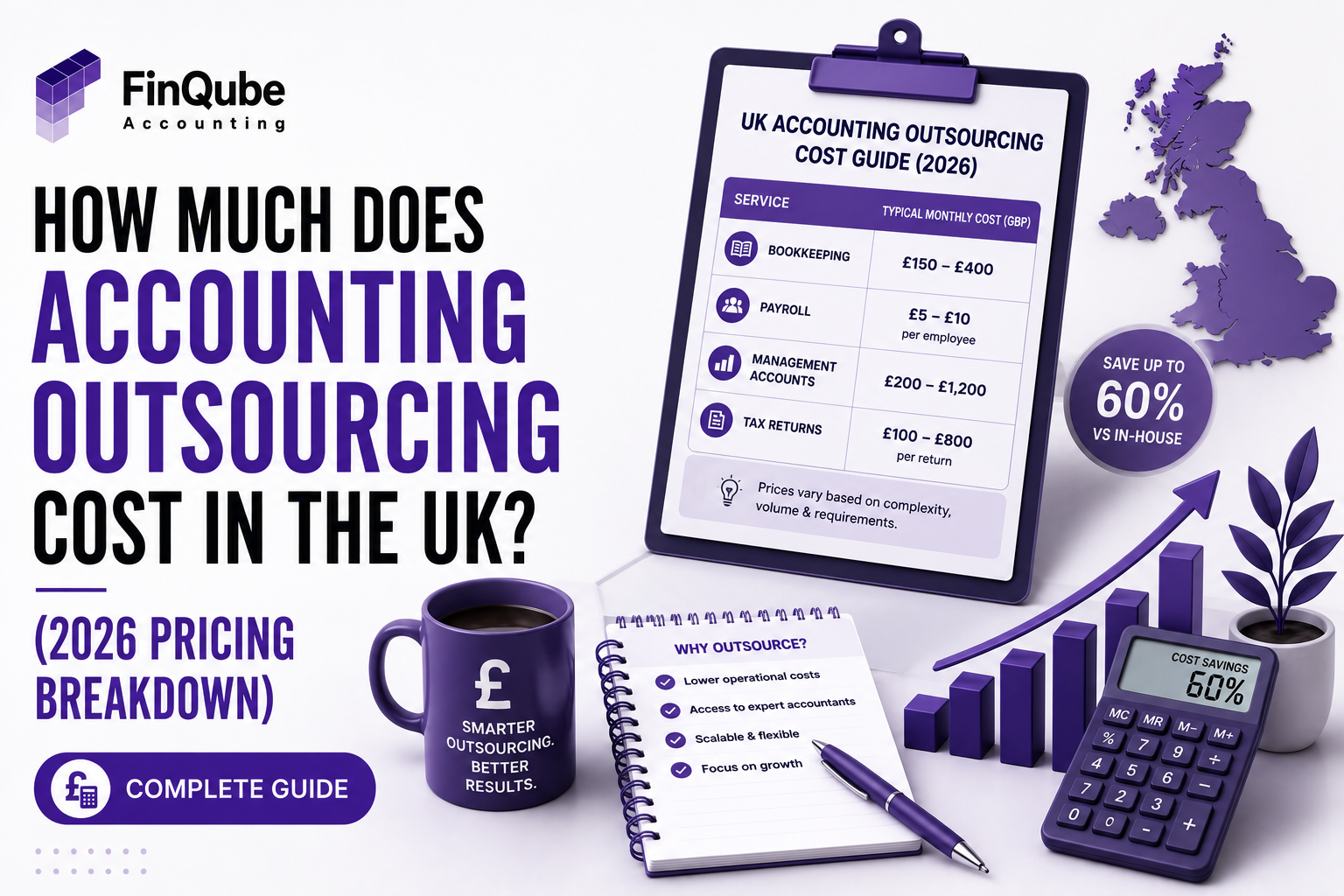
Accounting outsourcing costs UK practices between £300 and £3,500 a month, depending on service scope and firm size.
Small practices pay less. Larger practices with dedicated offshore teams pay more, but per-client cost usually drops.
Here's how the market breaks down by service and pricing model.
Providers price this work three ways: hourly, per job, or as a managed monthly retainer. Fixed monthly retainers give you the most predictable budget line.
Hourly rates for UK-based staff run £30–£90. Offshore hourly rates sit lower, typically £8–£25.
That gap explains why offshore-supported models can offer fixed monthly pricing that UK-only agencies struggle to match.
Why Do Outsourcing Costs Vary So Much?
Costs vary because providers price on different models — hourly, per job, or fixed monthly fee — and each carries a different risk for you.
Hourly billing punishes you for complexity. A messy set of books takes longer, and the invoice grows with it.
Per-job pricing works for one-off tasks. But it doesn't scale well once you need ongoing monthly support across bookkeeping, VAT, and payroll together.
Fixed monthly pricing removes the guesswork. You know the cost in January and you know it in December.
Location also drives price. A managed offshore team costs less to run than an equivalent UK-based team, and that saving should show up in your invoice.
Software compatibility matters too. Providers who rebuild your data in their own system charge more than those who work inside Xero, QuickBooks, Sage, FreeAgent, or any other software you already use.
Every rebuild adds hours. Every hour adds cost. Ask this question before you sign anything.
Who Should Budget for Accounting Outsourcing?
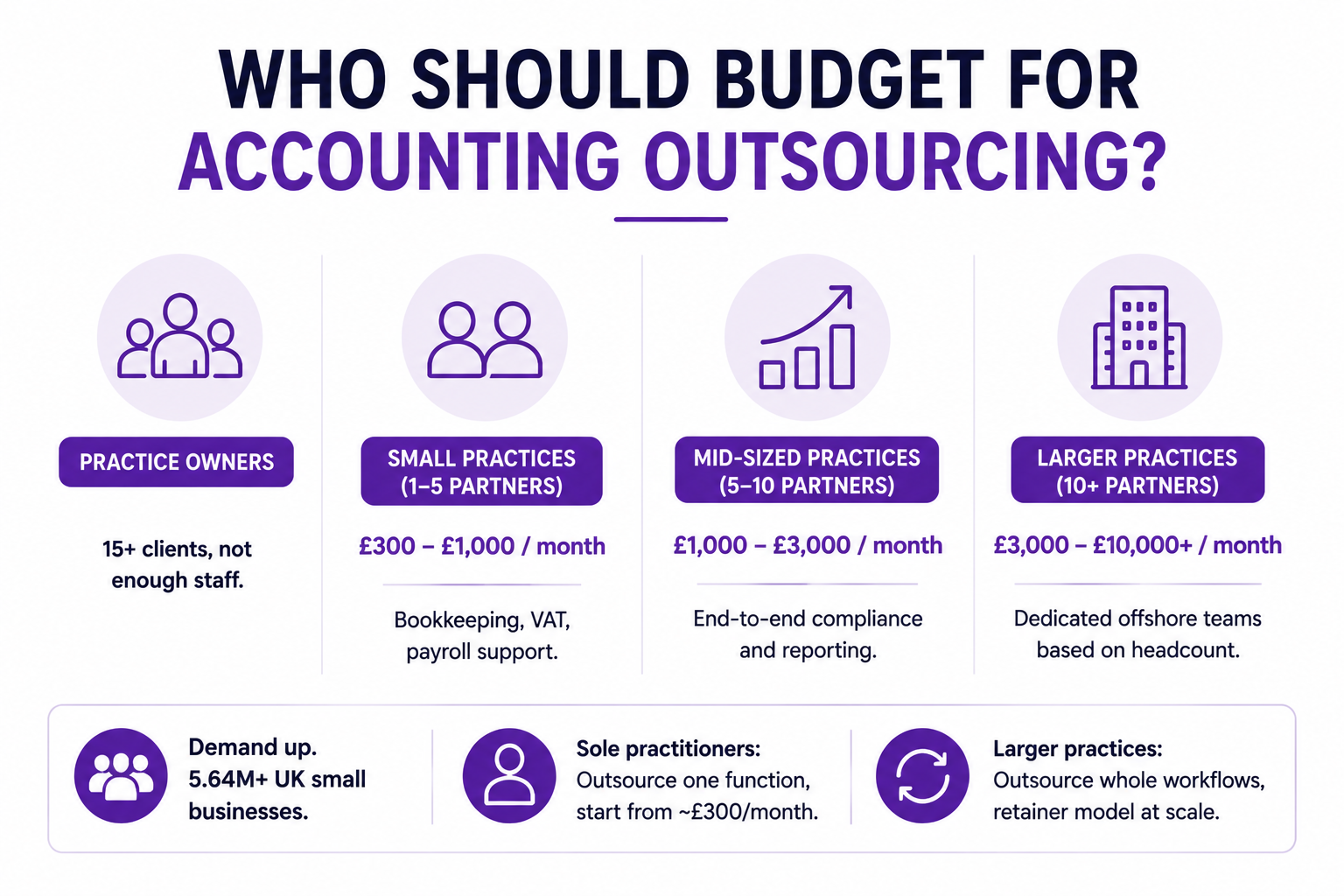
Practice owners managing 15 or more clients without enough qualified staff should budget for accounting outsourcing.
Small practices (1–5 partners) typically spend £300–£1,000 a month on outsourced bookkeeping, VAT, and payroll support.
Mid-sized practices spend £1,000–£3,000 a month for end-to-end compliance and reporting across a bigger client book.
Larger practices with 10+ partners often move to dedicated offshore teams, spending £3,000–£10,000+ a month depending on headcount.
The common thread across all three: practices that can't hire fast enough turn to outsourcing first. The ICAEW-referenced talent gap shows mid-tier firms are struggling to fill qualified roles locally, which pushes many toward outsourced or offshore models instead.
With 5.64 million small businesses making up over 99% of the UK's private sector, according to GOV.UK's Business Population Estimates, the client pool keeps growing. Staff supply hasn't kept pace.
Sole practitioners feel this pressure differently. One person can't cover bookkeeping, payroll, VAT, and client meetings alone during peak season.
Outsourcing a single function, such as bookkeeping or payroll, lets a sole practitioner keep the client relationship while offloading the repetitive work. That's often the cheapest entry point, starting around £300 a month.
Larger practices tend to outsource whole workflows instead of single tasks. The pricing shifts from per-task fees to a managed monthly retainer once volume passes a certain threshold, usually around 15–20 active clients.
When Does Outsourcing Start Paying for Itself?
Outsourcing starts paying for itself the moment it replaces a hire you'd otherwise have to make.
A UK junior accountant costs £33,000–£42,000 a year in salary alone. Add employer National Insurance, pension contributions, and office overhead, and that figure climbs past £45,000.
Compare that to a managed outsourced arrangement, which typically runs £14,400–£28,800 a year for an equivalent workload.
Firms replacing five in-house roles with outsourced support can save £150,000–£180,000 a year.
You feel the payoff fastest during peak season, when overtime and temp staff costs would otherwise spike.
Where Do Practices Find Transparent Pricing?
Practices find transparent pricing from providers who publish real ranges, not just "request a quote" forms.
Look for three things on a provider's pricing page: named services, a monthly range, and a clear statement of what's included.
Vague pricing usually means one of two things. Either the provider adjusts fees per client with no fixed structure, or the real number is higher than they want to advertise.
Ask for a written breakdown before any call. A provider confident in their pricing will hand it over without pushing you toward a sales meeting first.
Also check whether the quote includes onboarding and data migration. Some providers quote a low monthly fee, then bill separately to move your data from Sage, QuickBooks, FreeAgent, or any other software into their system.
Read the Clutch small business outsourcing report — most small businesses that outsource cite cost savings as the top driver, but only when pricing stays predictable month to month.
Watch for tiered pricing that jumps sharply at arbitrary client counts. A fair provider scales cost with actual workload, not with round numbers designed to push you into the next bracket.
Reference checks help too. Ask a provider for one practice of similar size you can speak to directly, without a sales rep on the call.
How to Compare Outsourcing Costs Against an In-House Hire
You compare outsourcing costs against an in-house hire by adding up the full employment cost, not just the advertised salary.
Start with base salary. Then add employer National Insurance at roughly 13.8% above the threshold. Add pension auto-enrolment contributions. Add recruitment fees if you use an agency.
Then add the soft costs: management time, desk space, software licences, and the weeks of reduced output while someone new gets up to speed.
Outsourced providers fold all of this into one fixed monthly fee. You know the number. There's no per-employee overhead calculation to run every quarter.
Here's a side-by-side most practice owners find useful.
If you want the full breakdown, read our guide on outsource accounting uk — it walks through exactly where the savings show up on your P&L, line by line.
Real Scenario: Harborne & Fields Accountants
Harborne & Fields is a fictional five-partner practice in the West Midlands, used here to illustrate a typical cost journey.
The problem: Harborne & Fields had 210 clients and two bookkeepers. One resigned in March, right before self-assessment deadline season.
What they tried first: They hired a recruitment agency. Three months, £6,500 in fees, and one candidate who left after six weeks.
What changed: They moved bookkeeping and VAT support to an outsourced provider on a fixed monthly fee of £1,400, working inside their existing Xero setup.
The result: No recruitment costs for 14 months. Turnaround on VAT returns dropped from nine days to three. The named accountant assigned to their account caught two VAT coding errors before submission, both of which would have triggered HMRC queries.
Their annual accounting cost dropped by roughly £11,000 compared to the in-house hire they'd budgeted for. The client relationship stayed with the same two people throughout.
How FinQube Can Help
You don't need another shared inbox and a rotating cast of juniors. You need one accountant who knows your clients.
FinQube assigns one dedicated, named accountant to your practice — never a shared pool, never a different face every month.
We work inside the systems you already use: Xero, QuickBooks, Sage, FreeAgent, or any other software your practice runs on. No data migration. No rebuild fees.
Every file goes through our proprietary AI review before your partner ever sees it. Errors get flagged early, not after HMRC does.
Pricing is fixed and monthly. You get one number, agreed upfront, based on your actual client volume and service scope — not an hourly meter that runs the moment work gets complicated.
There's no minimum commitment. Start with one pilot month, see the standard of work, and continue only if it's right for your practice.
Our structure runs as a services agreement, not a labour supply arrangement, which keeps IR35 exposure off your desk. You can read more on how Qdos explains contracted-out services under IR35 if you want the technical detail.
Ready to see your actual number? Book a scoping call and get a fixed monthly quote for your practice — no minimum term, no obligation beyond the work itself.
CONCLUSION
Accounting outsourcing cost in the UK ranges from £300 a month for basic bookkeeping to £3,500+ for full-service support. The real question isn't the headline number — it's whether the price stays fixed once the work gets complicated.
Compare that against the true cost of an in-house hire, and outsourcing usually wins on both price and speed. Practices that make the switch report savings of 40–60% against equivalent in-house staffing costs.
Ask any provider for a written breakdown before you commit to a call. If they can't give you one, that tells you something too.
Want a real number for your practice, with no minimum term attached? Book a scoping call with FinQube and get a fixed monthly quote this week.
One month. No contract.
See how a dedicated Finqube accountant fits into your MTD workflow before you decide.
Start your free pilotFAQ
How much does it cost to outsource accounting in the UK?
Basic bookkeeping outsourcing costs £300–£1,100 a month. Full-service outsourcing, covering VAT, payroll, and reporting, runs £1,000–£3,500 a month.
Is outsourced accounting cheaper than hiring an in-house accountant?
Yes. A UK junior accountant costs £45,000–£84,000 a year fully loaded. An equivalent outsourced arrangement typically costs £14,000–£30,000 a year.
What's included in a typical accounting outsourcing fee?
Most fixed monthly fees include bookkeeping, VAT preparation, payroll processing, and management reporting. Confirm inclusions in writing before signing.
Do outsourced accounting providers charge extra for software migration?
Some do. Ask upfront whether the quoted fee includes working inside your existing software, such as Xero, QuickBooks, Sage, or FreeAgent, with no rebuild cost.
How long does it take to set up outsourced accounting support?
Most providers onboard a practice within one to two weeks. In-house hiring typically takes six to twelve weeks from job posting to a productive employee.
Does outsourcing accounting work trigger IR35 rules?
Properly structured outsourcing runs as a services agreement, not a labour supply contract, which keeps it outside IR35's off-payroll working rules. Confirm the contract structure with your provider.
What's the minimum commitment for outsourced accounting services?
This varies by provider. FinQube requires no minimum commitment — you can start with a single month and continue only if the service fits your practice.