.avif)

Blog Summary
- Why offshore delivery has moved from a niche tactic to a mainstream capacity option for UK practices
- Where the cost saving actually comes from, and which costs disappear when you stop hiring in-house
- What to keep in-house and what to hand to an offshore team, without losing review control
- How a dedicated extended team, working inside Xero, QuickBooks, Sage, FreeAgent, or any other software, fits into your existing workflow
The Capacity Problem UK Firms Are Facing
Recruitment for bookkeepers and accountants now takes two to four months on average. The roles you do fill often leave within two years. That is a hard cycle to plan around.
At the same time, compliance work keeps growing. MTD for VAT is now standard. MTD for Income Tax lands for sole traders and landlords from April 2026. ISQM1 has added a layer of quality management documentation most small practices were never built to carry.
Most partners land on the same question eventually. Hire again and hope this one stays, or find a way to add capacity without adding headcount. That second question is what has pushed offshore delivery from a tactic used mainly by large firms into a standard option for practices of every size.
The shift is also generational. Firms that resisted remote and offshore delivery a decade ago are now the ones under the most pressure, because the talent pool they used to rely on locally has shrunk faster than they expected.
What Is an Offshore Accounting Team?
An offshore accounting team is a group of qualified accounting professionals, based outside the UK, who work as an extended part of your practice. They work inside your systems. They follow your processes. They produce work for your UK-based partners to review and sign off.
This differs from a general "outsourced" arrangement in one important way. Outsourcing can mean handing a task to any third party, UK or overseas. Offshoring specifically means the delivery work happens overseas. This usually comes with UK-based account management and compliance oversight layered on top. Most mature providers now run this as a hybrid model: offshore processing, UK-based client relationship and review control.
The distinction matters. It is exactly what the ICAEW and other professional bodies expect firms to be able to explain to their own clients: who did the work, and who is accountable for it.
Why Are UK Firms Moving Work Offshore Now?
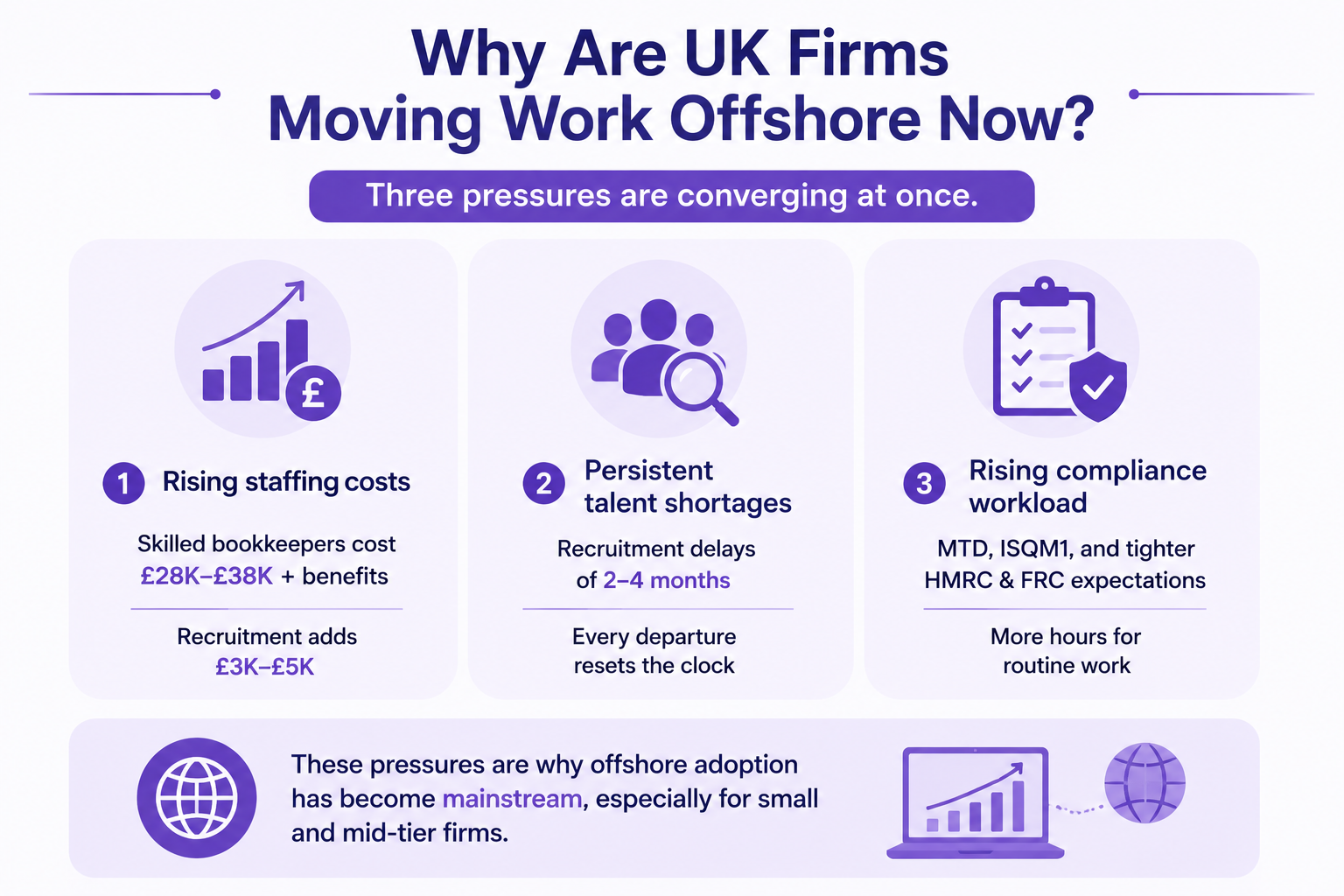
Three pressures are converging at once. None of them are going away on their own.
Rising staffing costs. A skilled UK bookkeeper now commands a substantial salary once pension, National Insurance, and benefits are included, before recruitment fees add further cost on top.
Persistent talent shortages. Recruitment delays of two to four months are now common, even for entry-level roles. Every departure resets the clock.
Rising compliance workload. MTD, ISQM1, and tightening HMRC and Financial Reporting Council expectations around accuracy are adding hours to routine work that used to take far less time.
Put together, these pressures explain why offshore adoption has shifted from an early-adopter tactic to a mainstream one. This is especially true among small and mid-tier firms that cannot absorb rising salary costs the way larger firms can.
Who Should Own Review and Client Contact?
This is the question every partner asks before they will consider offshore delivery. It deserves a direct answer.
Client relationships and final review sign-off should stay with your UK partners and managers. Always. What moves offshore is the production work underneath that layer: transaction processing, reconciliations, VAT preparation, payroll runs, and management accounts drafting.
Firms whose previous outsourcing experience went badly usually blame the wrong thing. The problem was rarely that the work moved offshore. It was that review visibility moved with it. If you cannot see what stage a file is at, who touched it, and what was flagged before it reached you, you have lost control of quality. It does not matter where the work physically happened. That visibility gap, not the offshore element itself, is what damages client trust.
When Does Offshore Make Sense for a Practice?
Offshore delivery tends to make sense in three situations.
You are structurally short of capacity, and recruitment has already failed once or twice. You are growing, and do not want a three-month hiring cycle to be the reason you turn away new clients. Or you are absorbing a seasonal spike, such as VAT season or the January Self Assessment rush, and do not want to carry that headcount year round.
It tends to make less sense in two situations. If your practice has highly bespoke, judgement-heavy work with almost no repeatable process behind it. Or if you are not yet ready to invest a few weeks building clear workflows and access controls before onboarding a team. Offshore delivery works best on top of process. It does not create process for you.
Where Does the Cost Saving Actually Come From?
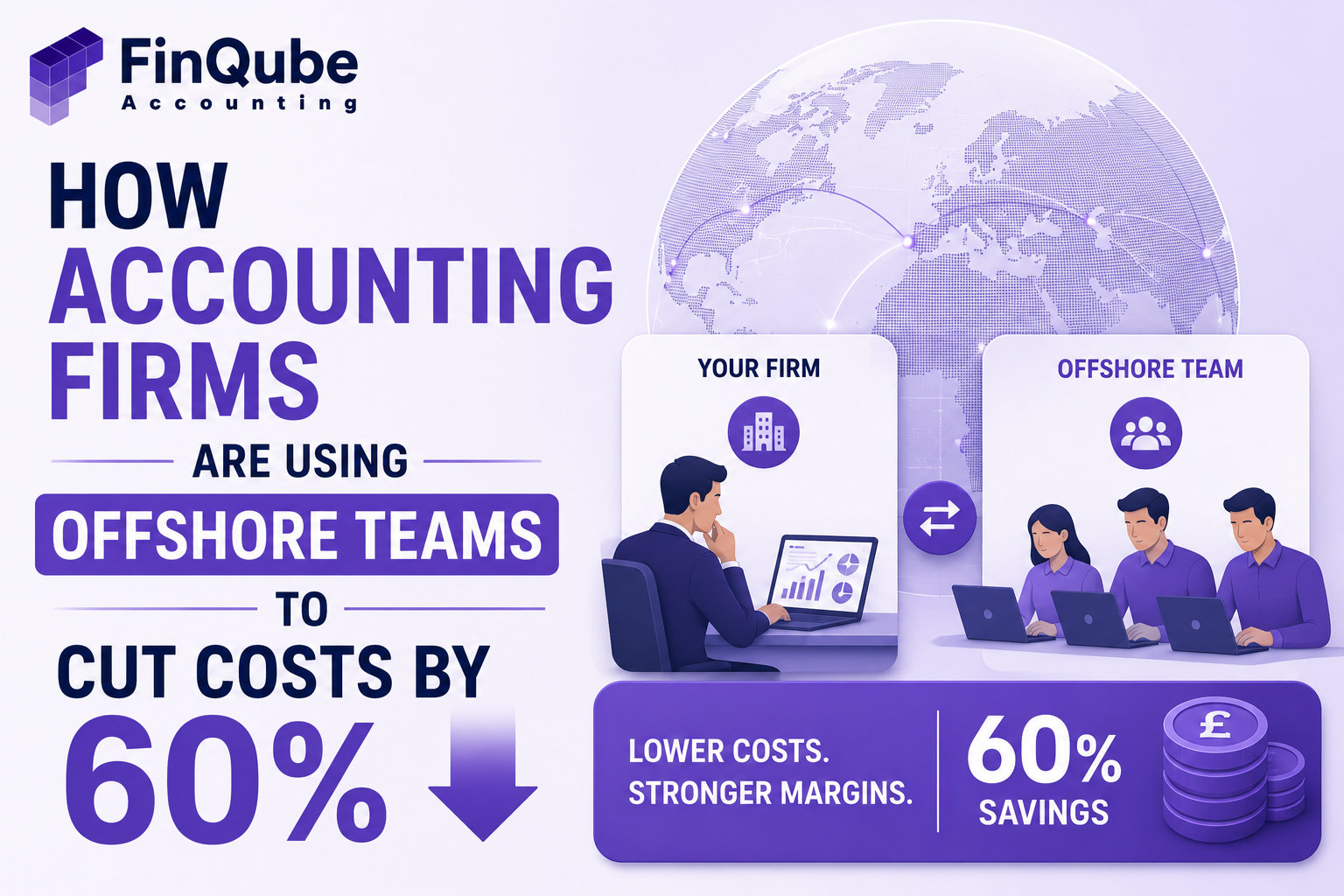
Cost savings from offshore delivery get quoted loosely across the industry, so it is worth breaking down where the saving typically comes from, rather than treating a single headline figure as settled fact.
A full-time in-house hire in a UK practice typically costs a substantial sum each year once you include base salary, employer National Insurance, pension contributions, software licences, training, holiday and sick cover, recruitment fees, and the management time spent supervising a junior hire. A dedicated offshore team member delivering comparable output often costs significantly less on a like-for-like engagement. The exact percentage varies by role, complexity, and provider, and any specific figure should be checked directly against your own numbers rather than assumed from an industry average.
That saving typically holds up even after you account for the cost of oversight. Offshore and hybrid delivery models tend to reduce the cost per full-time equivalent. Standardised processes and time zone coverage can also speed up turnaround on bookkeeping and tax preparation work.
The saving is not just the wage gap. It is the wage gap plus the recruitment cost you no longer pay, the training time you no longer absorb, and the two to four months of lost capacity you no longer wait out every time a role needs filling. Taken together, these add up to more than the salary difference alone suggests.
How Does a Dedicated Offshore Team Work Inside Your Systems?
A properly run offshore engagement should be close to invisible to your clients and fully visible to you. In practice, that means a few things need to be true.
The team works inside your existing software stack. That includes Xero, QuickBooks, Sage, FreeAgent, or any other software you already run, rather than asking you to adopt new tools. Work follows your existing processes and checklists, rather than the provider's generic template. You retain a live view of what stage every file is at, not a weekly summary email. And every piece of work passes through a review layer before it reaches your desk, so what lands in your inbox is close to client-ready, rather than a first draft.
What Onboarding Actually Looks Like
Onboarding for a well-run engagement typically takes one to two weeks from first call to a fully briefed team working inside your systems. Compare that with three or more months to source, interview, and train a new in-house hire.
The first week usually covers access setup, a walkthrough of your existing processes, and a review of a handful of sample files so the team understands your firm's standards before live client work begins. The second week is where most firms see the first real files move through the workflow, still under closer partner review than usual while trust builds.
This gradual handover matters more than it might seem. Firms that try to move an entire client book across in one go tend to create the exact review bottleneck they were trying to avoid. A phased start, client by client, gives both sides time to catch and fix small process mismatches before they become client-facing errors.
Finqube vs In-House vs Traditional Remote Provider
The cost gap is often the headline, but the row worth reading twice is minimum commitment. A permanent in-house hire, and a multi-month or annually licensed remote contract, both lock you in before you know if the fit is right. A model with no minimum commitment lets you test the working relationship first.
For an exact cost comparison against your own client book, book a discovery call rather than relying on an industry-wide average.
Real Scenario: Priya Shah at Shah & Co Accountants
Priya Shah, who runs Shah & Co Accountants in Leeds, was spending the last ten days of every month chasing her team for client file sign-offs. She had no clear view of which files were reviewed and which were still waiting. She had tried a remote provider before and found it created more coordination work than it solved.
After bringing in a dedicated Finqube accountant, with structured review built into the workflow, Priya recovered around 12 hours a week by month two. She describes the shift as moving her practice from reactive to structured, without the chaos she associated with her earlier attempt at outsourcing.
What made the difference was not the offshore element on its own. It was the visibility that came with it. Priya could finally see where every file sat, at any point in the month, without having to ask.
How Finqube Can Help
Finqube builds dedicated extended teams for UK accounting practices, structured around your firm's specific capacity needs, whether that is a single full-time accountant or a small group covering broader work.
Every engagement includes structured review support at no extra cost. It scans files for reconciliation mismatches, outstanding AP and AR items, and common preparation errors before a file ever reaches your review. What you sign off is already clean, rather than a first pass. This is what closes the gap that damaged trust in previous outsourcing attempts. You get full visibility into what your team is working on and where it stands, not a black box.
There is no minimum commitment attached. Explore Finqube's engagement models to see how the pricing and structure would work for a firm your size.
Conclusion
Offshore delivery is not about handing over control of your practice. It is about separating production work from review work, and giving the review layer the visibility it needs to actually catch mistakes before a client does.
The firms getting the most value from this model are not the ones chasing the lowest possible cost. They are the ones who kept review and client relationships firmly in-house, and used offshore capacity to remove the bottleneck underneath it.
If you want to see what this would look like for your own client book, book a discovery call. There is no minimum commitment, so you can see the model working with your own files before deciding anything longer term.
One month. No contract.
See how a dedicated Finqube accountant fits into your MTD workflow before you decide.
Start your free pilotFAQ
Is offshore accounting legal and compliant for UK practices?
Yes. Offshore delivery is standard practice across the UK accounting sector, provided the provider follows GDPR and UK data protection requirements, and your firm retains clear accountability for client work and final sign-off.
Will my clients know their work is being done offshore?
Not unless you choose to tell them. A well-run engagement operates as an extension of your firm. Client relationships and communication stay with your UK team throughout.
How is offshoring different from outsourcing to a UK-based provider?
Outsourcing is the broader term for handing work to any external party. Offshoring specifically means the delivery work happens overseas, usually paired with UK-based account management and review, which is where most of the cost saving comes from.
Does offshore work fit inside our existing software?
Yes. A dedicated team should work inside your existing systems, including Xero, QuickBooks, Sage, FreeAgent, or any other software you already run, rather than requiring you to switch tools.
How much does an offshore accounting team actually cost compared to hiring in-house?
Cost varies by role, complexity, and provider. A full-time in-house hire typically costs more once salary, National Insurance, pension, training, and recruitment costs are included. Ask any provider to scope pricing against your own client list rather than relying on a generic industry figure.
What is the minimum commitment for an offshore engagement?
With Finqube, there is none. You can book a discovery call to see the model working before deciding whether to continue, rather than signing a contract or annual licence upfront.
How quickly can an offshore team start?
Typically within one to two weeks from first call to a fully briefed team working inside your systems, compared with three or more months to hire, onboard, and train an in-house employee.
What work should stay in-house even with an offshore team in place?
Client relationships, final review, and sign-off should always stay with your UK-based partners and managers. Offshore teams handle the production work underneath that layer, not the accountability for it.