.avif)

Blog Summary
- What counts as qualifying R&D under the merged scheme that started on 1 April 2024
- Why R&D tax credit claims cause more HMRC compliance checks than almost any other relief
- Which parts of an R&D claim a generalist accountant should keep, and which parts to outsource
- How a dedicated remote accountant with AI-flagged review reduces claim risk for your practice
INTRODUCTION
R&D tax credits UK claims used to be a quiet add-on service. Not anymore.
HMRC now checks a large share of claims before it pays out. One weak write-up. One missed form. Your client waits months for money they already budgeted for.
Most practice owners did not train to write R&D claim reports. You trained to keep clients compliant. Not to argue software rules with an HMRC caseworker.
This guide covers three things. What changed under the new merged R&D scheme. Why claims now draw so much scrutiny. And which parts of the work you should keep in-house, and which parts to hand off.
What Are R&D Tax Credits and Who Can Claim Them?
R&D tax credits are a Corporation Tax relief. Companies claim them when they spend money solving a real scientific or technical problem. The relief cuts the company's tax bill. Or it pays out as cash.
Since 1 April 2024, most companies claim through one merged R&D scheme. This new scheme replaced the old SME scheme and the R&D Expenditure Credit (RDEC) scheme. It applies to accounting periods starting on or after that date.
Under the merged scheme, companies get a credit worth up to 16.2% of qualifying spend. This comes straight off their tax bill, according to ForrestBrown. Loss-making SMEs that spend 30% or more of their budget on R&D can claim more. This route is called Enhanced R&D Intensive Support, or ERIS. It is worth up to 27%.
Table 1: Merged R&D Scheme at a Glance
Qualifying costs cover several things. Staff costs. Subcontracted R&D. Externally provided workers. Consumables. Software licences used directly in the R&D. Most of the claims your practice sees will come from software, manufacturing, engineering, and life sciences clients.
Why R&D Tax Credit Claims Are Getting Harder for UK Practices
R&D claims got harder for one simple reason. HMRC tightened the rules and stepped up checks at the same time. This is not a short-term spike. It is the new normal.
HMRC once put error and fraud in the SME R&D scheme at 16.7%. That is roughly £1.13 billion, for the 2020 to 2021 tax year, according to ForrestBrown. That figure fell to around 7.8% by 2023/24 after HMRC's crackdown. But the extra scrutiny behind that drop has not gone away.
HMRC's Fraud Investigation Service sent 1,685 letters to claimants in November 2022. A further 650 went out in February 2023. That is according to Source Advisors. HMRC also wrote to around 1,000 first-time claimants directly. This was part of a wider check-up campaign.
This matters for your practice. Enquiries now demand real technical knowledge. A caseworker will ask why a piece of software work involved a genuine technical problem, not just normal business risk. Get that answer wrong and it can trigger a penalty review. HMRC also asks how the client chose their R&D adviser in the first place.
Most practices file only two or three R&D claims a year. Keeping deep R&D knowledge fresh for that few claims costs real money. You either build that skill in-house, or you find a partner who already has it.
Who Should Handle an R&D Tax Credit Claim?
The client relationship stays with you. The technical write-up goes to whoever knows that area best. So does the eligibility check.
Table 2: Who Handles What in an R&D Claim
A generalist accountant who preps a claim alone risks two things. Missing costs that genuinely qualify. Or over-claiming and pulling in an enquiry. Both cost the client money. Both cost you trust.
When to Claim R&D Tax Relief and What the Deadlines Are
Companies must claim R&D relief within two years of the end of the accounting period. Miss that window and the claim is gone for good.
First-time claimants must also file a claim notification form. So must anyone who has not claimed in the past three years. This form is due within six months of the period end. Skip it, and HMRC rejects the claim outright. It will not matter if the work qualifies.
Every claim also needs an Additional Information Form. It goes in before or with the Company Tax Return. This form asks for project details, cost breakdowns, and the name of any adviser who helped.
Some practices manage 10, 20, or more R&D-eligible clients. Tracking these deadlines by hand, across different year-ends, is where things slip. A missed notification is not a dispute with HMRC. It is a claim that never had a chance.
Where Most R&D Claims Run Into HMRC Trouble
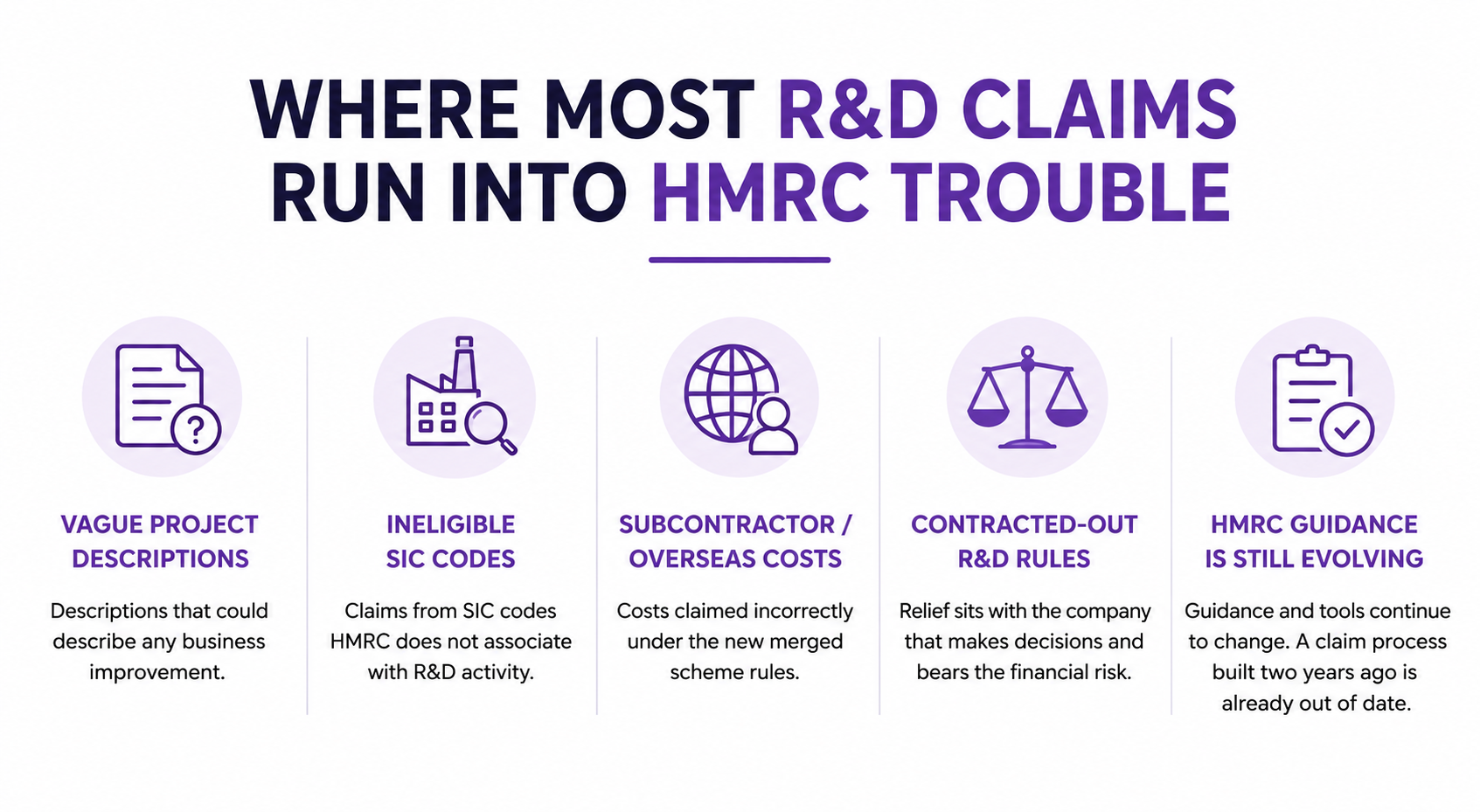
Most R&D claims run into trouble at the write-up stage, not the numbers stage. HMRC is far more likely to question whether the work qualifies than whether the sums add up.
A few things trigger scrutiny most often. Vague project write-ups that could describe any business upgrade. Claims from industry codes HMRC does not link to R&D work. Subcontractor or overseas costs claimed the wrong way under the new merged scheme rules.
The merged scheme also brought in tighter rules for contracted-out R&D. Relief now sits with the company that makes the decisions and carries the financial risk. Not the company doing the work under contract. Practices still using the old rules are putting clients at real risk.
HMRC keeps updating its guidance and tools for R&D claims, according to ICAEW. The rules are still moving. A claim process built two years ago is already out of date.
How a Dedicated Remote Team Handles R&D Claims for Your Clients
A dedicated remote accountant handles R&D claims in three steps. They work inside your systems. They flag problems early. They keep every piece of evidence in order before HMRC ever asks for it.
The work starts with the numbers. Your dedicated accountant pulls staff time, subcontractor invoices, and other costs straight from your client's books. This works the same in Xero, QuickBooks, Sage, FreeAgent, or any other software. Nothing moves outside your normal workflow.
Every file then goes through review before it reaches your partner's desk. Our AI review software checks for mismatched numbers, wrong cost categories, and missing evidence. It does this before a person even opens the file. You review a file that is already clean. You do not pick it apart yourself.
The accountant is named and dedicated, not part of a rotating pool. They stay on the file from the first draft through to any HMRC enquiry that follows. One person is accountable. You always know who that is.
Table 3: FinQube vs Alternatives for R&D Claim Support
REAL SCENARIO SECTION
Priya Shah runs Shah & Co, a seven-partner practice in Leeds. Many of her clients work in engineering and manufacturing. Several qualified for R&D relief. But her team built claims by hand, using a spreadsheet nobody had updated since before the merged scheme started.
Two clients got HMRC compliance check letters in the same quarter. Both enquiries came down to the same problem. The write-up described a general product upgrade. It did not show the real technical problem HMRC wanted to see.
Priya brought in a dedicated Finqube accountant. That accountant worked straight inside her clients' Xero files. They rebuilt the cost numbers from source data. They flagged which project write-ups needed more detail. They worked alongside Priya's team on the technical story, rather than taking it over.
By the next filing cycle, every notification and every form went in on time. Every cost breakdown matched the bookkeeping exactly. Priya stopped worrying about her R&D clients. They were no longer her biggest compliance risk.
HOW FINQUBE CAN HELP
Your R&D clients are often your hardest clients to serve well. FinQube gives you a dedicated remote accountant who works inside your existing systems. That means Xero, QuickBooks, Sage, FreeAgent, or any other software your practice already runs.
Every file passes through our AI review software before it reaches your desk. It flags reconciliation issues, missing evidence, and cost errors on its own. Your partner reviews a claim that is already clean.
Pricing is fixed and monthly, not hourly. You know your cost before the work starts. You work with one named accountant, not a rotating team. That person carries full context on every file, including through any HMRC enquiry that follows.
Is your practice IR35 sensitive? FinQube is structured as a services agreement, not a labour supply deal. Your engagement stays clean on that front too.
Ready to see how it works with your own client files? Start a one-month pilot with a dedicated Finqube accountant. There is no minimum commitment beyond that first month. You keep full visibility over every file, the whole way through.
CONCLUSION
R&D tax credits UK claims reward practices that treat them with real care. Not a spreadsheet template from three years ago. The merged scheme changed the rates, the rules, and the level of HMRC scrutiny, all at once.
Your client relationship should stay with your practice. But the technical depth behind the claim does not have to live entirely in-house. A dedicated remote accountant, working inside your existing systems with AI review built in, keeps your claims accurate. It frees your partners' time for the client work that needs them most.
Start a one-month pilot. See how a dedicated Finqube accountant handles your next R&D claim, from inside your own systems.
One month. No contract.
See how a dedicated Finqube accountant fits into your MTD workflow before you decide.
Start your free pilotFAQ
What are R&D tax credits in the UK?
R&D tax credits are a Corporation Tax relief. UK companies claim them when they spend money on real scientific or technical problems. The relief cuts the company's tax bill. Or it pays out as cash, depending on whether the company makes a profit.
How much can a company claim through the merged R&D scheme?
Most companies can claim up to 16.2% of qualifying R&D spend. This is under the merged scheme. Loss-making, R&D-heavy SMEs can claim up to 27%. This route is called Enhanced R&D Intensive Support, or ERIS, according to ForrestBrown.
Why is HMRC scrutinising R&D tax credit claims so closely?
HMRC once put error and fraud in the SME R&D scheme at 16.7%, for 2020 to 2021. This led to a sustained crackdown. That figure has since fallen. But enquiry numbers and technical checks remain high, according to ForrestBrown.
What is the deadline to claim R&D tax relief?
Companies must claim within two years of the end of the accounting period. First-time claimants must also file a claim notification form within six months of the period end. So must anyone who has not claimed in the past three years.
Can an accounting practice outsource R&D tax credit claims?
Yes. Many UK practices keep the client relationship in-house. They keep CT600 filing in-house too. They outsource the cost numbers and the technical write-up. This goes to a dedicated remote accountant or an R&D specialist with sharp, current knowledge.
What triggers an HMRC compliance check on an R&D claim?
A few things trigger checks most often. Vague project descriptions. Industry codes that do not match R&D work. Subcontractor or overseas costs claimed the wrong way. HMRC also runs targeted campaigns at sectors and claimant types it sees as higher risk.
Does FinQube replace our practice's R&D specialist?
No. FinQube works alongside your existing process. We handle the cost numbers. We handle bookkeeping accuracy. We handle AI-flagged review, inside your own systems. Your practice or specialist partner keeps the technical eligibility check. And the client relationship.