.avif)

Blog Summary
- FreeAgent works well for sole traders and contractors. It struggles once a client grows.
- You will learn where FreeAgent helps your practice. You will also see where it creates extra work.
- We cover pricing, MTD readiness and payroll limits. We compare FreeAgent with Xero, QuickBooks and any other software.
- You will see how a real UK practice managed a mixed portfolio of FreeAgent, Xero and Sage clients.
INTRODUCTION
A client asks you if FreeAgent is good enough for their business. You hesitate.
Many UK accounting firms recommend it. But it does not fit every client the same way.
Some of your clients love it. Others outgrow it within eighteen months. Then they come back needing help.
This creates a review problem. Your team spends time fixing data from a tool built for simple accounts, not complex portfolios.
You need a clear view of what FreeAgent does well. You also need to know where it stops being enough.
This guide breaks down FreeAgent for practice owners. It is written for firms managing real client portfolios, not single freelance accounts.
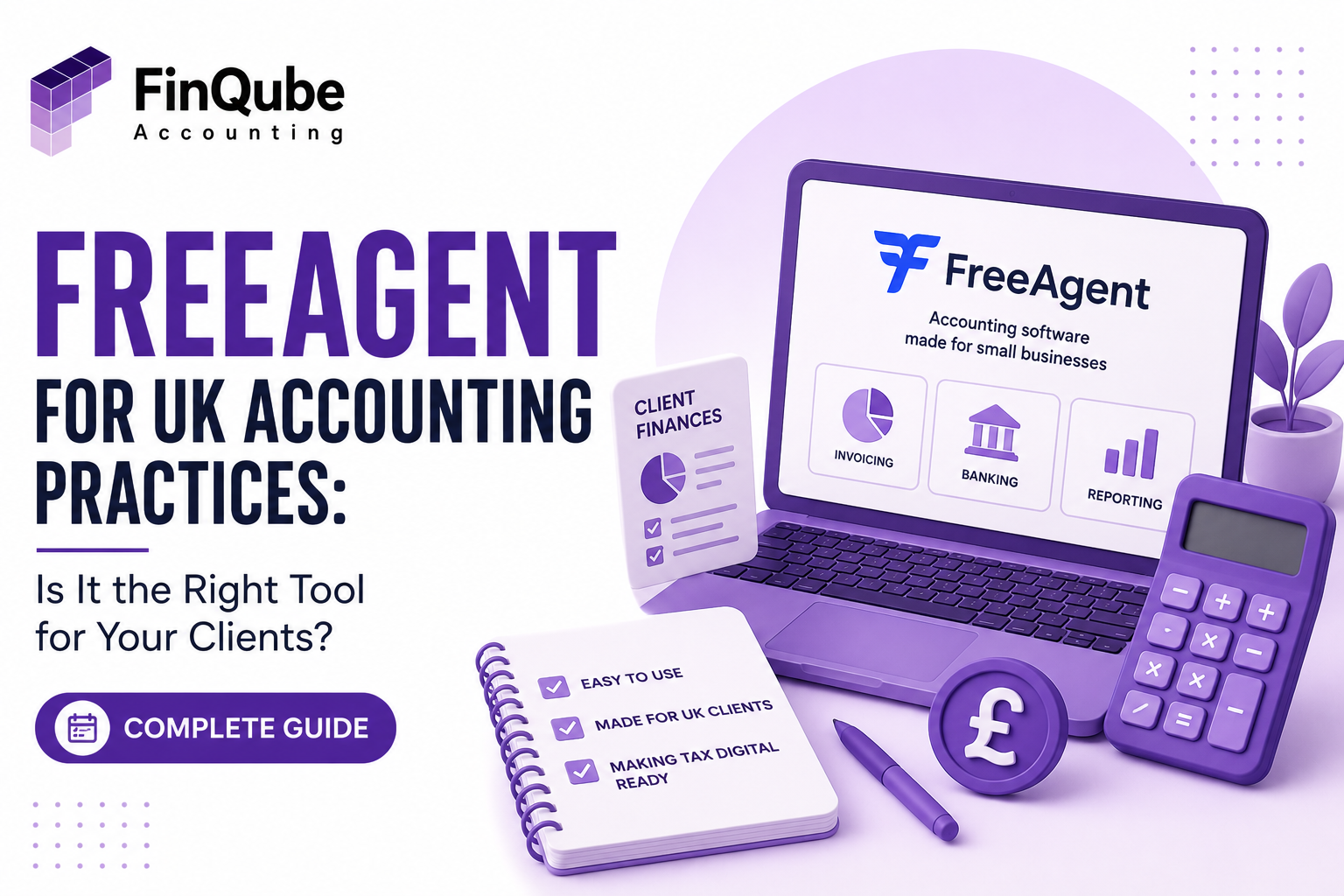
WHAT IS FREEAGENT AND WHY DO UK ACCOUNTING FIRMS USE IT?
FreeAgent is a cloud accounting platform. It is built for UK sole traders, freelancers, contractors and small limited companies.
It handles invoicing, expense tracking and bank feeds. It also handles VAT returns, payroll and Self Assessment filing, all in one place.
Accountants get their own practice login. This works much like Xero, QuickBooks, Sage, or any other software you already use.
FreeAgent is HMRC recognised for Making Tax Digital VAT submissions. It also supports MTD for Income Tax Self Assessment.
This became mandatory for many sole traders and landlords from April 2026.. See HMRC guidance for the full rollout timeline.
Firms use FreeAgent because the interface is simple. Clients with little bookkeeping experience can log expenses and send invoices without training.
This cuts the number of basic questions your junior staff field each week.
FreeAgent also files Corporation Tax CT600 returns straight to HMRC. Few platforms at this price include that feature, according to AccountingStack's 2026 review.
WHY DO PRACTICES RECOMMEND FREEAGENT TO CERTAIN CLIENTS?
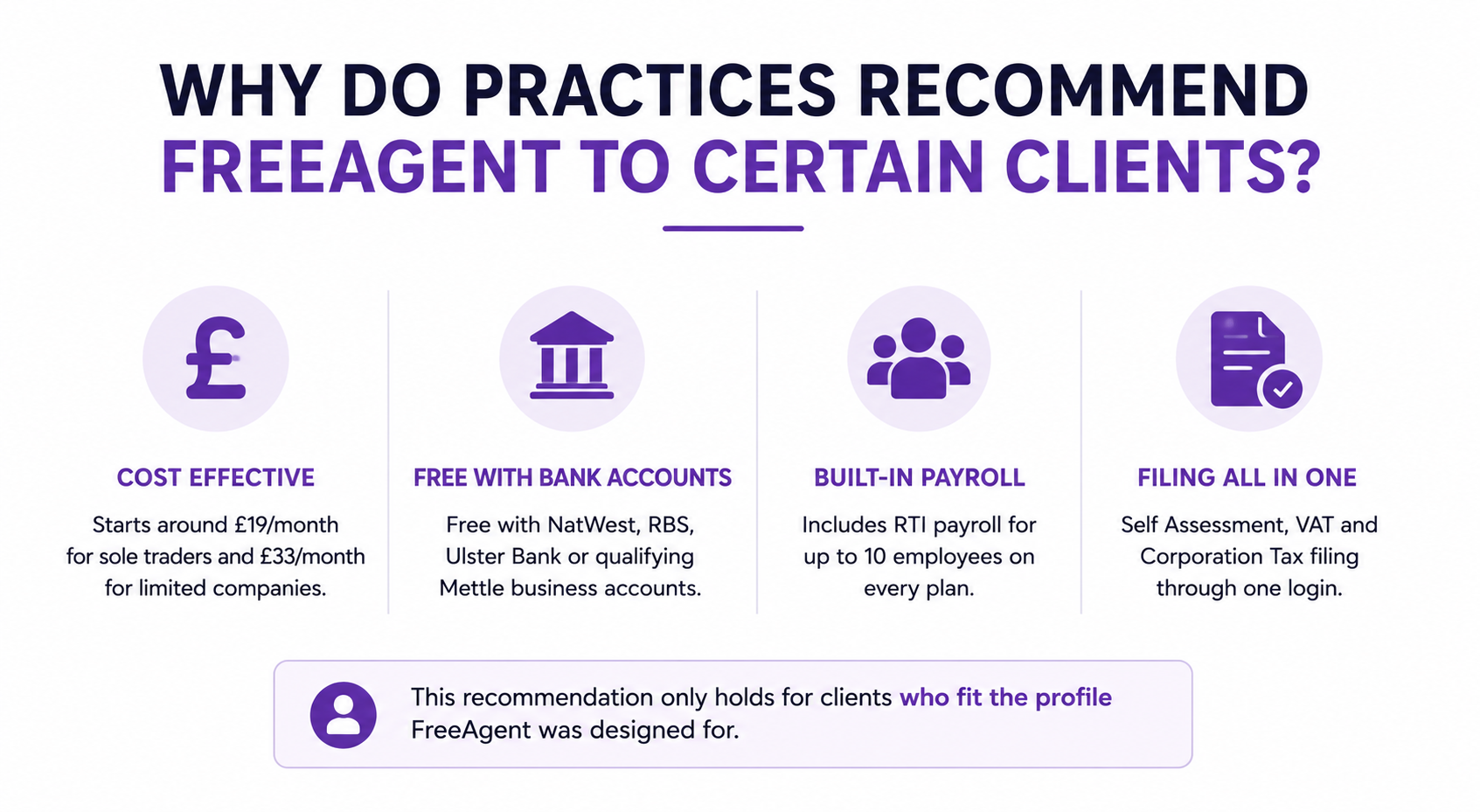
Practices recommend FreeAgent when it matches a client's complexity level. It is not a universal recommendation.
The main reasons firms recommend it:
Cost matters to sole traders. FreeAgent starts around £19 a month for sole traders. Limited companies pay around £33 a month, according to GoForma's pricing breakdown. Many clients pay nothing at all.
Clients with a NatWest, Royal Bank of Scotland, Ulster Bank or qualifying Mettle business account get FreeAgent for free. This removes the monthly cost objection completely.
Built-in payroll is rare at this price point. FreeAgent includes RTI payroll for up to 10 employees on every plan. There is no separate payroll fee.
Filing depth beats expectations. Self Assessment, VAT and Corporation Tax filing all run through one login. Your team does not need three separate systems for one small client.
This recommendation only holds for clients who fit the profile FreeAgent was built for.
WHO IS FREEAGENT ACTUALLY BUILT FOR?
FreeAgent is built for freelancers, contractors, sole traders, landlords and single director limited companies.
It is not built for growing practices with large teams or complex stock needs.
FreeAgent "automates many basic bookkeeping tasks," according to Fusion Accountants' review. This suits simple client profiles well.
However, its practice management depth stays lighter than enterprise solutions.
Client fit matters. It decides how much manual cleanup your team does later.
WHEN SHOULD YOU MOVE A CLIENT OFF FREEAGENT?
Move a client off FreeAgent when their business outgrows sole trader or single director complexity. Three signals tell you it is time.
Payroll requirements outgrow FreeAgent. As payroll becomes more complex with advanced reporting, employee benefits, or HR workflows, businesses may need a specialist payroll solution.
Stock or inventory management becomes central to the business. FreeAgent's inventory tools stay basic, according to AccountingStack. Retail and wholesale clients often need Xero, QuickBooks or any other software with stronger stock tracking.
For example, a landlord with three properties fits FreeAgent well. The same landlord buying a fourth property and starting short-term lets may need deeper reporting instead.
WHERE DOES FREEAGENT FALL SHORT FOR GROWING BUSINESSES?
FreeAgent falls short in three areas once a client scales past small business complexity: integration depth, multi entity support and advanced reporting.
The integration marketplace is smaller than Xero or QuickBooks. This limits how well FreeAgent connects to specialist tools, such as inventory systems or advanced CRM software.
There is no multi entity consolidation. Group structures with parent and subsidiary companies cannot report through one FreeAgent account.
Bank feed speed also causes friction. Fusion Accountants reports slow bank feeds as a recurring complaint. This sometimes forces manual reconciliation work.
Pricing packages are fixed, not modular. You cannot pick individual features to match a client's budget.
None of this makes FreeAgent a bad tool. It makes it the wrong tool past a certain complexity threshold. At that point, clients often move to Xero, QuickBooks, Sage, or any other software.
HOW DO ACCOUNTANTS MANAGE MULTIPLE FREEAGENT CLIENTS?
Accountants manage multiple FreeAgent clients through the practice dashboard. This gives one login across every client account.
Your team can file RTI, Self Assessment and VAT returns straight to HMRC. There is no need to switch logins for each file, according to Fusion Accountants.
Common friction points practices report:
Onboarding involves many question prompts. This can frustrate clients working without direct accountant guidance.
Reporting is straightforward but not enterprise grade. Firms managing large portfolios often export data into separate tools for partner review.
Review visibility varies by firm. Some practices build manual checklists to track which files are reviewed. The platform does not flag this automatically.
This last point costs practices real time. Without a system flagging incomplete reviews, partners chase status updates instead of reviewing actual numbers.
FREEAGENT PRICING: WHAT IT ACTUALLY COSTS
FreeAgent charges by business type. Sole trader plans start around £19 a month. Limited company plans start around £33 a month, both excluding VAT.
Source: GoForma and AccountingStack.
Compare this with QuickBooks. Plans range from £10 a month for Sole Trader Plus up to £123 a month for Advanced, according to Wise's comparison.
FreeAgent costs less at entry level. But it scales less flexibly than QuickBooks, Xero, or any other software with tiered plans.
Trustpilot rates FreeAgent 4.6 stars from over 2,900 reviews. QuickBooks sits at 3.9 stars, per the same Wise comparison.
REAL SCENARIO: BELLVIEW ACCOUNTANTS AND A MIXED SOFTWARE PORTFOLIO
Priya Shah runs Bellview Accountants, a nine person practice in Leeds. She serves around 140 clients.
About a third used FreeAgent. Most were sole traders and contractors who joined through NatWest business banking. The rest used Xero, Sage or QuickBooks.
Her team spent the last week of every month chasing file reviews. FreeAgent gave no partner level visibility across the portfolio. Staff relied on a shared spreadsheet that was always out of date.
Priya tried hiring a part time bookkeeper to manage the FreeAgent clients alone. It helped for a while. But the new hire needed months to learn every client's history. Review bottlenecks came back within a quarter.
She then brought in a dedicated FinQube accountant. This accountant worked inside her existing systems, including FreeAgent, Xero and Sage.
FinQube's proprietary AI review software flagged incomplete files automatically, before they reached her desk.
Within two months, Priya recovered close to 10 hours a week. She stopped tracking review progress by hand across three platforms.
HOW FINQUBE CAN HELP
Your practice does not need to force every client onto one platform. FinQube works inside the systems your clients already use.
What this means for your firm:
You get one dedicated, named accountant. Not a rotating pool of staff who need re-briefing every month.
Your FinQube accountant works directly inside FreeAgent, Xero, QuickBooks, Sage, or any other software your clients already run. There is no forced migration and no disruption to client relationships.
FinQube's proprietary AI review software flags issues before your partner opens the file. This cuts review time and catches errors your junior staff might miss.
Pricing is fixed and agreed upfront every month. There is no hourly billing, so you know your cost before the work starts.
There is no minimum commitment beyond the agreed monthly term. You are not locked into a multi year contract.
For IR35 purposes, FinQube is structured as a services agreement, not labour supply. This keeps the arrangement clean for your compliance records.
Ready to see how this works for your FreeAgent, Xero, Sage or QuickBooks clients?
Book a call with FinQube. We will walk through your current client mix. No commitment required.
CONCLUSION
FreeAgent suits a specific client type well. It is not a fit for every business on your books.
It works best for sole traders, contractors and single director companies. It starts to strain once payroll, stock or CIS complexity enters the picture.
Your job is knowing when to keep a client on FreeAgent and when to move them.
The real challenge is not the software itself. It is having review visibility across every platform your clients use, whether that is FreeAgent, Xero, Sage, QuickBooks or any other software.
FinQube gives your practice one dedicated accountant and AI backed review, inside whatever systems your clients already run. Book a call with FinQube to talk through your portfolio.
One month. No contract.
See how a dedicated Finqube accountant fits into your MTD workflow before you decide.
Start your free pilotFAQ
Is FreeAgent good for accountants?
FreeAgent works well for accountants managing sole traders, contractors and simple limited company clients. It gives one practice login across every client account. Reporting depth stays lighter than enterprise platforms.
How much does FreeAgent cost for accounting firms?
FreeAgent charges clients directly. Prices run from around £19 a month for sole traders up to £33 a month for limited companies. Clients with qualifying NatWest, RBS, Ulster Bank or Mettle accounts get it free.
Is FreeAgent free with NatWest?
Yes. NatWest, Royal Bank of Scotland, Ulster Bank and qualifying Mettle business account holders get FreeAgent at no extra cost. This lasts as long as the account stays open.
Does FreeAgent support Making Tax Digital?
Yes. FreeAgent is HMRC recognised for MTD VAT. It also supports Making Tax Digital for Income Tax Self Assessment, helping users comply with the requirements introduced from April 2026, according to HMRC.
What is the difference between FreeAgent and Xero for accounting firms?
FreeAgent suits simpler, UK focused clients with built in payroll and tax filing. Xero, or any other software with a larger integration marketplace, suits growing businesses that need deeper reporting.
Can FreeAgent handle payroll for accounting clients?
Yes, up to 10 employees on every plan through RTI payroll. Clients with larger teams need a different platform or a payroll add-on once they pass that limit.
When should a client move off FreeAgent to another accounting platform?
Move a client once payroll passes 10 staff. Move them if they need Construction Industry Scheme deductions or if stock management becomes central to the business. At that point, Xero, QuickBooks, Sage or any other software may fit better.