.avif)

Blog Summary
- The exact PAYE payment dates for the 2026/27 tax year, including monthly, quarterly and year-end deadlines.
- The difference between FPS and EPS submission deadlines, and why mixing them up costs firms money.
- What HMRC charges in penalties and interest when a PAYE payment lands late.
- How a dedicated outsourced payroll partner removes deadline risk from your practice, without adding headcount.
Introduction
Missing a PAYE deadline costs real money. HMRC charges interest from day one. Penalties stack up fast after that.
PAYE due dates for 2026/27 run on a strict monthly cycle. Every UK employer must pay HMRC by the 22nd if they pay electronically. Postal payments must land by the 19th.
For accounting firms managing payroll across dozens of clients, one missed date can mean one angry client. This guide sets out every PAYE due date for 2026/27. It also shows how firms protect themselves from the risk entirely.
What Are PAYE Due Dates in 2026/27
PAYE due dates are the fixed HMRC deadlines for paying tax and National Insurance collected from employees' pay. Miss one, and interest starts accruing immediately.
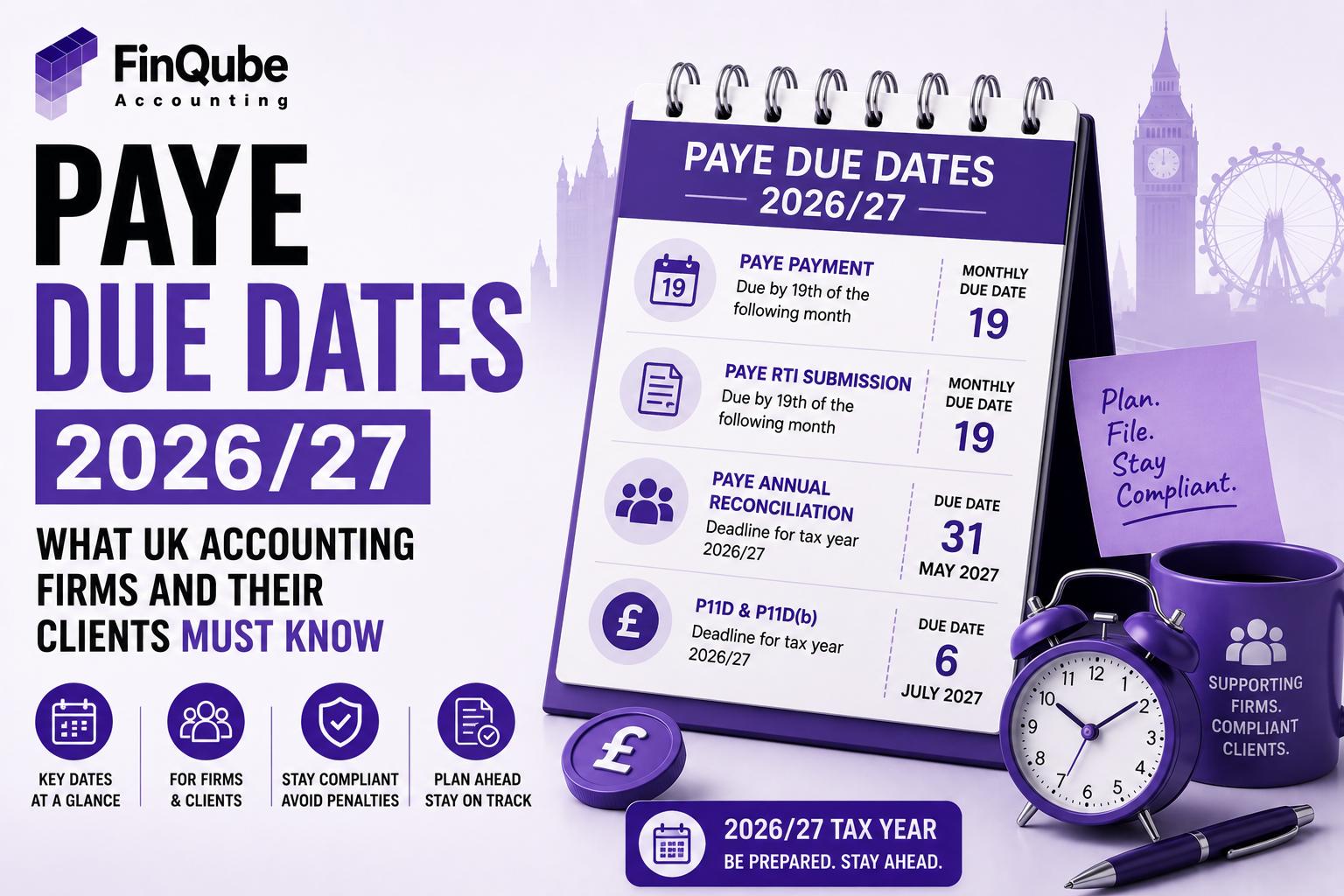
The 2026/27 tax year runs from 6 April 2026 to 5 April 2027. HMRC splits this into 12 tax months. Each tax month runs from the 6th of one calendar month to the 5th of the next.
Every employer must pay HMRC what they have deducted through payroll. This includes income tax, employee National Insurance, and employer National Insurance.
Two deadlines apply to every payment. Electronic payments are due by the 22nd of the following tax month. Cheque payments must reach HMRC by the 19th.
According to GOV.UK, if either date falls on a weekend or bank holiday, payment must arrive by the last working day before it. This single rule catches out more firms than any other.
Why PAYE Deadlines Matter for UK Accounting Firms
PAYE deadlines matter because HMRC treats late payment as a compliance failure, not an admin delay. Interest applies from the due date. Penalties follow after repeated defaults.
For a firm running payroll for multiple clients, one late payment rarely stays isolated. It usually signals a wider process gap.
That gap shows up again next month. And the month after. Clients notice. Trust erodes.
HMRC also uses PAYE payment history as a signal. A pattern of late payments increases the chance of a compliance check on other areas, including VAT and corporation tax.
For firms offering outsourced payroll providers uk services, a missed deadline is not just a fine. It is a reputational risk that follows the practice, not just the client.
Who Is Responsible for Meeting PAYE Deadlines
The employer is legally responsible for paying PAYE on time, even when an accounting firm or bureau runs the payroll on their behalf.
This matters because many practice owners assume liability shifts once payroll is outsourced. It does not, unless the engagement letter says otherwise.
For accounting firms, this creates a duty of care. Clients expect the firm to catch errors before HMRC does.
That responsibility falls hardest on smaller practices. A partner running payroll for 40 clients through a single junior team member has almost no room for error. One holiday, one sick day, and a deadline slips.
This is precisely why so many UK firms now use outsourced payroll uk partners: to separate deadline risk from staffing risk.
When Are the Key PAYE Payment Dates
Key PAYE payment dates for 2026/27 fall on the 22nd of each month for electronic payment, and the 19th for cheque. Quarterly payment is available for small employers.
Monthly PAYE Payment Deadlines
Small employers who expect to pay less than £1,500 a month can arrange quarterly payments instead. This reduces the number of payment runs from 12 a year to four.
Quarterly PAYE Payment Deadlines 2026/27
Firms must still file a Full Payment Submission (FPS) on or before every payday, even when the client pays quarterly. Quarterly payment changes when HMRC gets paid. It does not change when HMRC gets told.
Year-End PAYE Deadlines
These year-end dates cause the most disruption. They land on top of self assessment season and, for many firms, self assessment outsource workloads already stretching the team thin.
Where Firms Get PAYE Deadlines Wrong
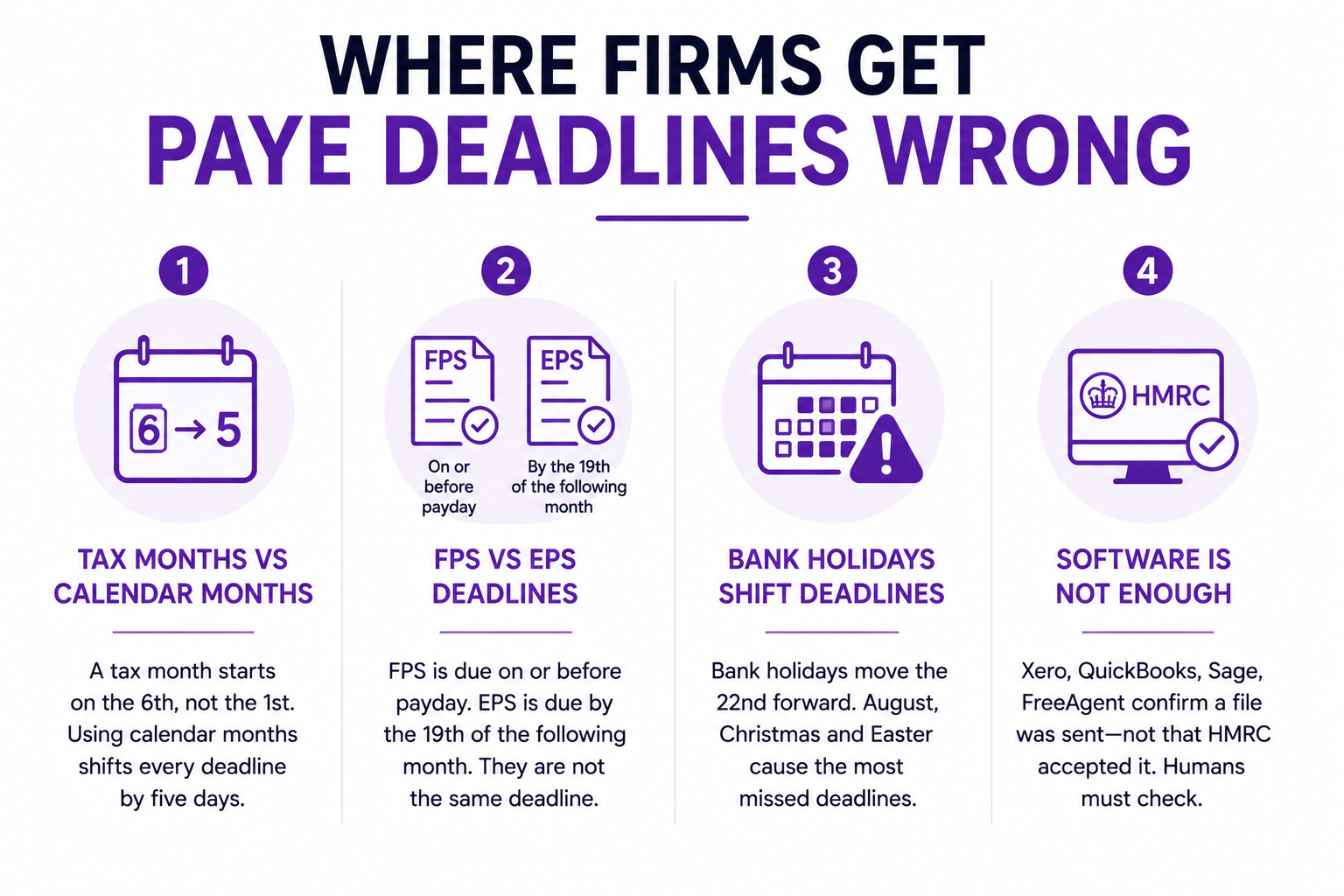
Firms most often get PAYE deadlines wrong by confusing tax months with calendar months, and by mixing up FPS deadlines with EPS deadlines.
A tax month does not start on the 1st. It starts on the 6th. Teams working from calendar-month spreadsheets often shift every deadline by five days without realising it.
The FPS is due on or before payday. The EPS, used to report statutory pay recovered or no payment due, is due by the 19th of the following month. Treating them as one deadline causes late submissions.
Bank holidays cause a third common error. The August bank holiday, Christmas, and Easter all shift the 22nd forward. Firms using a fixed calendar reminder, rather than a live one, miss this every time.
Software also plays a role. Payroll built on Xero, QuickBooks, Sage, FreeAgent, or any other software still requires a human to check the submission actually reached HMRC. Software confirms a file was sent. It does not confirm HMRC accepted it.
How to Stay on Top of PAYE Deadlines All Year
Firms stay on top of PAYE deadlines by building a live payroll calendar, assigning clear ownership per client, and reviewing every submission before it reaches HMRC.
A static spreadsheet drifts out of date within a few months. New clients join. Pay frequencies change. Someone leaves the team.
A live calendar, tied directly to each client's payroll software, updates automatically. It flags the tax month, not the calendar month, and adjusts for bank holidays without manual input.
Ownership matters just as much as the calendar. Every client needs one named person accountable for their PAYE submission, not a shared inbox that three people assume someone else is watching.
Review is the final safeguard. Before any FPS or EPS goes to HMRC, a second set of eyes should check the figures against payroll reports. This is where a proprietary AI review layer catches errors a tired reviewer might miss, flagging discrepancies before a partner ever opens the file.
Firms running this process well typically outsource the execution and keep the oversight in-house. This gives the practice a RTI payroll UK specialist handling submissions, while the partner retains full visibility.
Real Scenario: Hughes Accountancy
Daniel Hughes runs Hughes Accountancy, a mid-sized UK practice managing payroll for around 60 clients. Before working with FinQube, his team missed two PAYE deadlines in a single quarter.
Both misses came from the same root cause. His payroll assistant tracked deadlines on a personal calendar, using calendar months instead of tax months. A bank holiday shift caught them out on the second occasion.
Both clients received HMRC interest notices. One called Daniel directly, asking why his own accountant had let this happen.
After bringing in a dedicated FinQube accountant, with our proprietary AI review software built into the payroll workflow, Daniel's practice moved every client onto a live payroll calendar linked to their existing systems. The AI review flags submission risk before any file reaches HMRC.
Since then, Hughes Accountancy has not missed a single PAYE deadline. Daniel also recovered roughly 12 hours a week previously spent chasing sign-offs and checking submission dates manually.
How FinQube Can Help
FinQube removes PAYE deadline risk from your practice without adding headcount or changing your systems.
- One dedicated accountant. Not a shared pool. The same person learns your clients, your systems, and your deadlines.
- Works inside your existing software. Xero, QuickBooks, Sage, FreeAgent, or any other software. No migration, no disruption.
- Proprietary AI review. Every submission gets flagged for errors before your partner signs off, catching issues a manual review might miss.
- Fixed monthly fee. Priced against your workload, agreed upfront. No hourly billing, no surprise invoices at year-end.
- No minimum contract. Start with one client's payroll or your whole book. Scale up or down as your practice changes.
- IR35-structured engagement. Set up as a services agreement, not labour supply, so your compliance position stays clear.
FinQube vs. Other Payroll Support Options
Ready to stop tracking PAYE deadlines manually? Talk to FinQube about a dedicated payroll accountant for your practice. No long-term contract required.
Conclusion
PAYE due dates for 2026/27 follow the same shape every year: the 22nd for electronic payment, the 19th for post, and a run of year-end dates that land right in the middle of self assessment season. Missing any of them costs interest from day one and penalties after repeat defaults.
Firms that stay on top of these dates build a live calendar, assign clear ownership, and add a second review before anything reaches HMRC. Firms that do not usually find out the hard way, through an HMRC notice their client sees before they do.
FinQube gives your practice a dedicated payroll accountant and an AI-backed review layer, so deadlines stop depending on one person's memory. Book a call to see how it works with your systems.
One month. No contract.
See how a dedicated Finqube accountant fits into your MTD workflow before you decide.
Start your free pilotFAQ
What is the PAYE payment deadline for 2026/27?
The deadline is the 22nd of the following tax month for electronic payments, and the 19th for payments made by cheque through the post.
When do PAYE tax months start and end?
A PAYE tax month runs from the 6th of one calendar month to the 5th of the next, not from the 1st to the end of the month.
What happens if I pay PAYE late?
HMRC charges interest from the due date. Repeated late payments in a tax year trigger escalating penalties, starting at 1% and rising with each further default.
Can small employers pay PAYE quarterly instead of monthly?
Yes. Employers expecting to pay less than £1,500 a month on average can arrange quarterly payments with HMRC instead of monthly.
What is the difference between an FPS and an EPS deadline?
The FPS reports pay and deductions and is due on or before each payday. The EPS reports statutory pay recovered or confirms no payment is due, and is due by the 19th of the following month.
What are the year-end PAYE deadlines for 2026/27?
Final FPS or EPS submissions are due by 19 April 2027, P60s by 31 May 2027, and P11D forms by 6 July 2027.
How can an accounting firm avoid missing PAYE deadlines for clients?
Firms reduce risk by using a live payroll calendar tied to tax months, assigning one named owner per client, and reviewing every submission before it reaches HMRC.