.avif)

Blog Summary
- What payroll outsourcing companies actually do for accounting firms, not single businesses
- How the top payroll outsourcing companies in the UK compare on model, tech, and price
- Why white-label payroll is the angle most guides miss
- How a dedicated remote accountant with AI-backed review changes payroll accuracy
INTRODUCTION
Payroll season used to run like clockwork. Now your team juggles 40 client payrolls. Three RTI deadlines land in one week. A pension query lands at 4pm on a Friday. Something slips. A client notices before you do.
Payroll outsourcing companies solve this problem. They take processing, RTI submissions, and pension admin off your desk. But not every provider understands accounting practices. Many were built for HR teams inside single businesses. They were not built for a firm running dozens of client payrolls at once.
This guide compares the payroll outsourcing companies UK accounting firms actually use. You will see what to look for. You will see where the real risks sit. You will see which providers fit a multi-client practice, not just a single in-house team.
WHAT IS PAYROLL OUTSOURCING FOR UK ACCOUNTING FIRMS?
Payroll outsourcing means handing payroll processing to an outside provider. For accounting firms, it means a partner who can run this across many clients. It happens under your brand, not the provider's.
This is different from payroll outsourcing for one business. A retailer outsources one payroll. Your firm needs a partner who can run 30, 60, or 200 client payrolls. Each has its own pay date, pension scheme, and reporting need.
Most payroll outsourcing companies fall into three groups. Full-service bureaux run everything for you. Software-only providers give you a tool and leave the work with your team. Extended-team providers give you one dedicated person. That person works inside your own systems, such as Xero, QuickBooks, Sage, or any other software.
For UK accounting firms, outsourced payroll providers uk that understand the multi-client model save the most time. Under HMRC's PAYE rules, every employer must report pay and deductions on or before each payday. This applies to every client your firm runs payroll for.
WHY ARE UK ACCOUNTING FIRMS OUTSOURCING PAYROLL IN 2026?
Firms outsource payroll because it is repetitive. It is also full of tight deadlines. One late RTI filing can cost your client an HMRC fine. That is not a small mistake to explain away.
Payroll is not where most firms stand out. It is where firms lose hours to processing instead of advice. More firms now move payroll to a dedicated outsourced payroll uk partner. This frees up the team for higher-value client work.
Three pressures drive this shift in 2026.
Staffing. Good payroll staff are hard to find. They are hard to keep too. Lose one, and you lose weeks of know-how.
Rules. Pension rules, RTI payroll UK deadlines, and tax rates change each year. Keeping one in-house team up to date is a full-time job on its own.
Client demands. Clients now want to see payroll status in real time. A spreadsheet sent once a month no longer works.
WHO SHOULD CONSIDER A PAYROLL OUTSOURCING COMPANY?
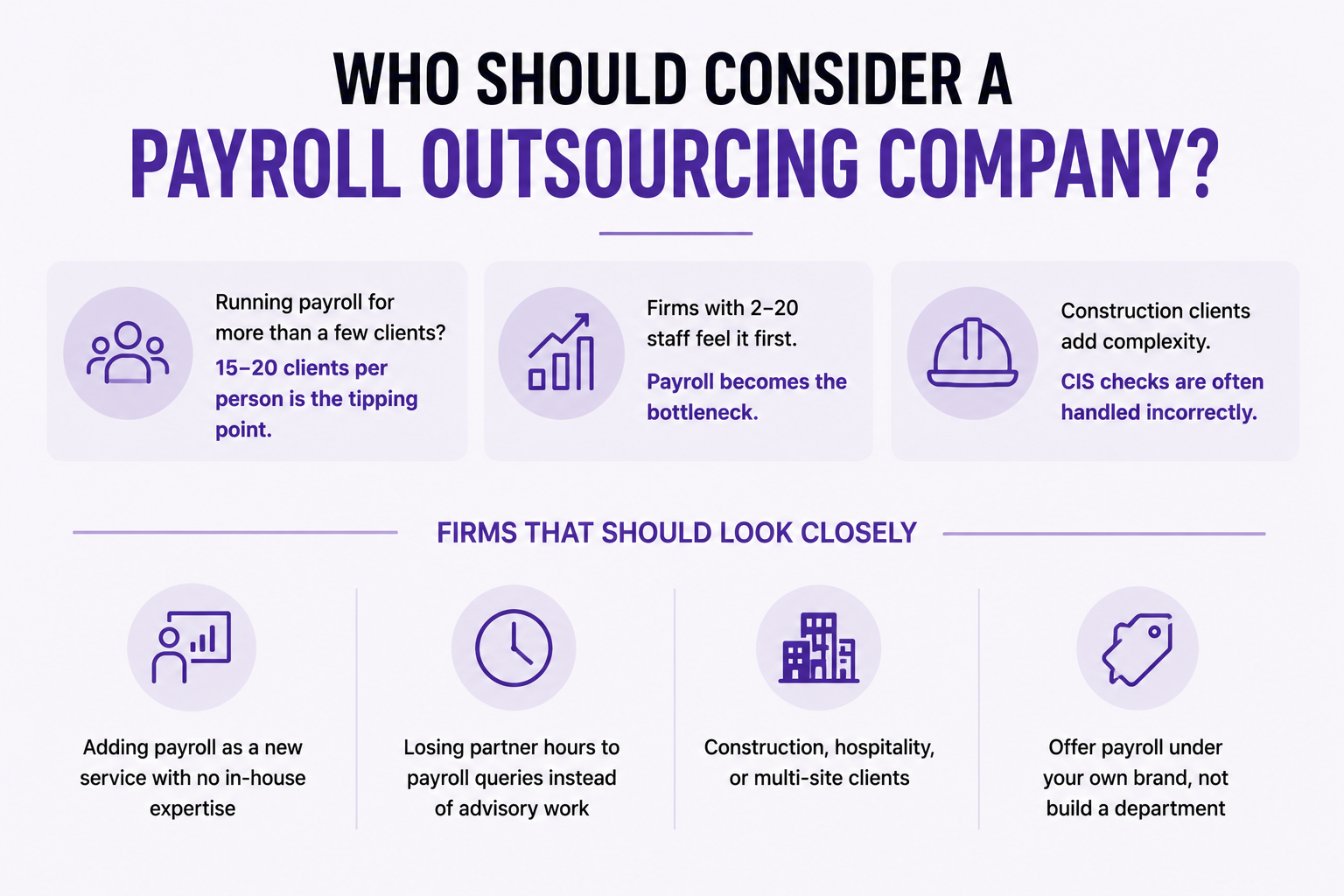
Any UK firm running payroll for more than a few clients should think about outsourcing. The tipping point usually hits once one person runs more than 15 to 20 client payrolls alone.
Firms with 2 to 20 staff feel this first. They do not have enough people for a full payroll team. Client demand for payroll keeps growing anyway. Payroll then becomes the bottleneck. It slows everything else down.
Construction clients add another layer too. Firms handling CIS payroll outsourcing face extra deduction checks. General payroll firms often get these wrong.
Firms that should look closely at outsourcing include:
- Practices adding payroll as a new service with no in-house expertise
- Firms losing partner hours to payroll queries instead of advisory work
- Practices with construction, hospitality, or multi-site clients
- Firms that want to offer payroll under their own brand, not build a department
THE BEST PAYROLL OUTSOURCING COMPANIES FOR UK ACCOUNTING FIRMS
The market splits into three groups. Managed bureaux. Software-only tools. Dedicated extended-team providers. Here is how the main options compare.
Software-only tools like IRIS and Sage Payroll suit firms with spare time to run payroll. They just need a better tool. But if the real problem is people, not software, a managed or extended-team provider fits better.
Full-service bureaux like Moorepay, PayEscape, and Cintra take the work off your desk. This suits firms happy to hand payroll over fully. You give up day-to-day visibility in return.
Extended-team models, including FinQube, sit in between. You keep control because the work happens inside your own systems. One dedicated person carries the load. This suits firms whose clients expect to see the practice's own name on every payslip query, not a stranger's.
WHEN IS THE RIGHT TIME TO SWITCH PAYROLL PROVIDERS?
The right time to switch falls outside your two busiest payroll windows. Avoid tax year-end in April. Avoid the run-up to Christmas payroll runs. Most switches take two to six weeks.
Waiting until a provider fails you is the most common mistake. By then, you switch mid-crisis. Clients are already asking questions. Review your provider every year instead. Q3 works best. Tax year-end pressure has passed, and the next one is still months away.
Watch for these signs. Repeated RTI filing errors. A provider that cannot scale as your client list grows. A support team that takes days, not hours, to reply. If you cannot name your one dedicated contact, that is a signal on its own.
WHERE DO MOST PAYROLL ERRORS HAPPEN DURING OUTSOURCING?
Most payroll errors happen at handover points. Think data transfer between systems. Think mid-month starter and leaver changes. Think pension checks. These are the moments where manual work breaks down fastest.
Data transfer is the biggest risk. Say a provider does not work inside your own software, such as Xero, QuickBooks, or Sage. Then every run means moving data out by hand. And typing it back in by hand too. Each move is a chance for a figure to go missing. Or for a deduction to hit twice.
Starter and leaver changes cause the next-largest share of errors. A new employee who joins mid-month needs a manual check. So does a leaver whose final pay includes unused holiday. Generic payroll software often misses both.
HOW TO CHOOSE THE RIGHT PAYROLL OUTSOURCING PARTNER
Start by matching the service model to how your firm works today. Do not chase the biggest feature list. Ask one simple question first. Does the provider work inside your systems? Or does it force you into theirs instead?
Ask these five questions before you sign anything:
- Does the provider work inside your own software, such as Xero, QuickBooks, Sage, or FreeAgent?
- Is there one named contact for your account? Or a shared support queue?
- How does the provider catch errors before your clients see them?
- What happens during your two busiest weeks of the tax year?
- What is the minimum commitment? What does it cost to leave?
The Chartered Institute of Payroll Professionals says accuracy and rule knowledge top the list of things UK payroll pros look for in a provider. Price comes after that, not before it. This matches what most practice owners tell us. Cost matters. It is rarely the first question they ask.
Pricing varies by service model. Expert Market's 2026 UK payroll pricing research shows outsourced payroll bureaux often charge £4 to £10 per employee per month. Large contracts get quoted one by one. FinQube works differently. Instead of a per-payslip fee that moves with staff numbers, FinQube runs on one fixed monthly fee agreed upfront. Your costs stay steady even when a client hires or lets someone go.
WHITE-LABEL PAYROLL: THE ANGLE MOST GUIDES MISS
Most payroll outsourcing guides write for HR teams inside single businesses. They skip what accounting firms actually need: a provider who works under the practice's own brand, not theirs.
White-label payroll means your clients see your firm's name on every payslip. They see it on every query reply. They see it on every RTI confirmation. The provider stays invisible to the end client. This protects the relationship you spent years building.
This matters more than most guides admit. Say a client emails "your payroll team" and gets a reply from a third-party bureau's branded support desk. That damages trust in your practice, not just in the payroll service. A dedicated accountant working inside your own systems avoids this. The work never leaves your name.
IR35 status is the second issue most guides skip. If your payroll partner is structured as labour supply, not a services agreement, your firm can carry unexpected IR35 risk. FinQube structures every engagement as a services agreement. This keeps that risk off your firm's books.
REAL SCENARIO: ASHWORTH PAYROLL SOLUTIONS
Priya Ashworth runs Ashworth Payroll Solutions, a 9-person practice in Leeds. Her firm handles payroll for 45 clients, including several construction businesses that need CIS payroll outsourcing.
Before she switched providers, her team ran payroll on a mix of spreadsheets and a generic bureau. That bureau worked outside her firm's own Xero and Sage set-up. Every month meant pulling client data out. Then typing it into the bureau's portal. Then checking every figure by hand.
Two RTI filings went out late in one tax year. Both led to HMRC fines. Priya had to explain both to her clients. She tried adding a second part-time payroll worker. Training took three months. The backlog barely moved.
She then brought in a dedicated FinQube accountant. That accountant works directly inside her existing Xero and Sage systems. AI review software flags reconciliation issues before submission. Her team stopped re-entering data entirely. RTI submissions now go out ahead of deadline. Priya reviews a summary instead of every single payslip.
HOW FINQUBE CAN HELP
Payroll outsourcing companies built for single businesses often create more admin, not less. FinQube was built for UK accounting practices running payroll across many clients.
You get one dedicated remote accountant. Not a shared support queue that changes every time you call. That person works directly inside your existing Xero, QuickBooks, Sage, FreeAgent, or any other software. No data re-entry. No second system to manage.
Every file passes through FinQube's own AI review software before it reaches you. Mismatched figures, missed starter or leaver updates, and RTI risks get flagged first. Your client never sees them. You review work that is already clean. You do not check it line by line.
Pricing is one fixed monthly fee, agreed upfront. Your costs stay steady even when a client's staff numbers shift. There is no minimum commitment. Every contract is set up as a services agreement, not labour supply. This keeps your firm's IR35 position clear.
Ready to see how a dedicated payroll accountant works inside your own systems? Book a call with FinQube. See exactly what your dedicated accountant would handle, with no minimum commitment attached.
One month. No contract.
See how a dedicated Finqube accountant fits into your MTD workflow before you decide.
Start your free pilotCONCLUSION
Payroll outsourcing companies are not all the same. General bureaux and software platforms solve payroll for one business. They were not built for a firm running dozens of client payrolls under one brand. The right partner works inside your own systems. It gives you one accountable person. It catches errors before your clients see them. FinQube was built for exactly this. Talk to FinQube about a dedicated payroll accountant with no minimum commitment.
FAQ
What is the best payroll outsourcing company for UK accounting firms?
It depends on your practice size and how much control you want to keep. Firms wanting full handover suit a managed bureau such as Moorepay or PayEscape. Firms wanting to keep visibility suit a dedicated extended-team model such as FinQube. FinQube works inside your existing systems.
How much does payroll outsourcing cost in the UK?
Outsourced payroll typically costs £4 to £10 per employee per month through a managed bureau. This is based on Expert Market's 2026 pricing research. FinQube uses one fixed monthly fee instead. Your cost does not shift when a client's headcount changes.
Is payroll outsourcing worth it for a small accounting practice?
Yes, once one payroll administrator manages more than 15 to 20 client payrolls alone. At that point, outsourcing frees up hours for advisory work. It also cuts the risk of missed RTI deadlines.
What is the difference between payroll software and payroll outsourcing?
Payroll software gives you a tool. Your team still does the processing. Payroll outsourcing hands the processing itself to a provider or dedicated accountant. Your team reviews the output instead of building it.
Can payroll outsourcing companies handle CIS payroll for construction clients?
Not all of them. CIS payroll needs extra deduction and check steps. Generic payroll firms often miss these. Look for a provider with real experience running CIS payroll for accounting firm clients.
How long does it take to switch payroll outsourcing providers?
Most switches take two to six weeks. This depends on client volume and data quality. Avoid switching during tax year-end in April or the December payroll rush.
Do payroll outsourcing companies work inside Xero, QuickBooks, or Sage?
Some do. Some do not. Software-only platforms like IRIS work inside these systems by design. Many managed bureaux run their own standalone portal instead. That means exporting and re-entering data every payroll cycle. FinQube works directly inside Xero, QuickBooks, Sage, FreeAgent, or any other software your firm already uses.