.avif)

Blog Summary
- What outsourcing Xero bookkeeping actually involves
- Why more UK practices are outsourcing Xero work now
- How to vet, onboard, and review an outsourced bookkeeper without losing control
- Where handovers break down, and how to avoid it
Introduction
Xero bookkeeping should take a fixed number of hours every month. No drama. For most UK practices, it does not work that way.
Reconciliations slip when a team member is off. Coding queries pile up in a shared inbox. Nobody owns that inbox. A partner ends up doing the review themselves at 9pm, because nobody else caught the error.
This guide covers how to outsource Xero bookkeeping properly. It covers how to vet a provider. It covers how to keep the review layer that protects your client relationships. It also shows you what a good handover looks like in practice, not just in theory.
What Does It Mean to Outsource Xero Bookkeeping?
Outsourcing Xero bookkeeping means handing routine work to someone else. That includes transaction coding, bank reconciliation, and month-end tidy-up. A bookkeeper or extended team does this work directly inside your Xero organisation, or any other software you run alongside it.
The work itself does not change. What changes is who does it. And how it gets checked before it reaches your client. A properly outsourced Xero function still follows your chart of accounts. It still follows your review checkpoints and your deadlines. It should feel like an extra pair of hands, not a separate process running outside your workflow.
Most practices start small. They outsource the repetitive layer first: bank feeds, supplier invoice coding, and reconciliation. Judgement-heavy work, like final review and client communication, usually stays in-house. At least at first. That staged approach gives you a low-risk way to test a provider before handing over anything more sensitive.
Why Are UK Practices Outsourcing Xero Work Now?
Three pressures are hitting UK practices at once. A shrinking bookkeeping talent pool. Rising compliance volume. Clients who expect faster turnaround than a stretched team can deliver.
Making Tax Digital for Income Tax became mandatory from April 2026. It applies to sole traders and landlords earning above £50,000. This brought a large number of taxpayers into digital record keeping and quarterly filing for the first time. That threshold drops again in April 2027. The pool of clients needing regular bookkeeping support keeps growing.
Firms that used to prepare one annual return per client now need four quarterly updates. Plus a final declaration. That multiplies the bookkeeping workload. It does not multiply headcount to match.
Recruitment has not kept pace either. Recent UK research found that most employers hit skills shortages over the past year. Those shortages held up project delivery at a large share of firms. A vacant bookkeeping seat is no longer a short-term gap. It is a structural capacity problem. Outsourcing has become one of the more practical ways to close it.
Industry commentary backs this up. Cloud accounting systems now make it realistic to outsource most bookkeeping, VAT returns, and year-end accounts to a trusted provider. With minimal disruption to how a practice already works.
Who Should Own the Xero Relationship Once You Outsource?
The partner or manager who signs off the client's accounts should still own final review. Even after bookkeeping gets outsourced. Ownership of the client relationship does not transfer. Only the transactional workload does.
In practice, this means someone stays accountable. They set the review checkpoints. They approve the chart of accounts structure. They are the person a client calls if something looks wrong. The outsourced bookkeeper reports into that structure.
Watch for a warning sign. If a provider suggests the client relationship or final sign-off should sit with them instead of you, that is a red flag. The engagement is not built the way it should be.
When Is the Right Time to Outsource Xero Bookkeeping?
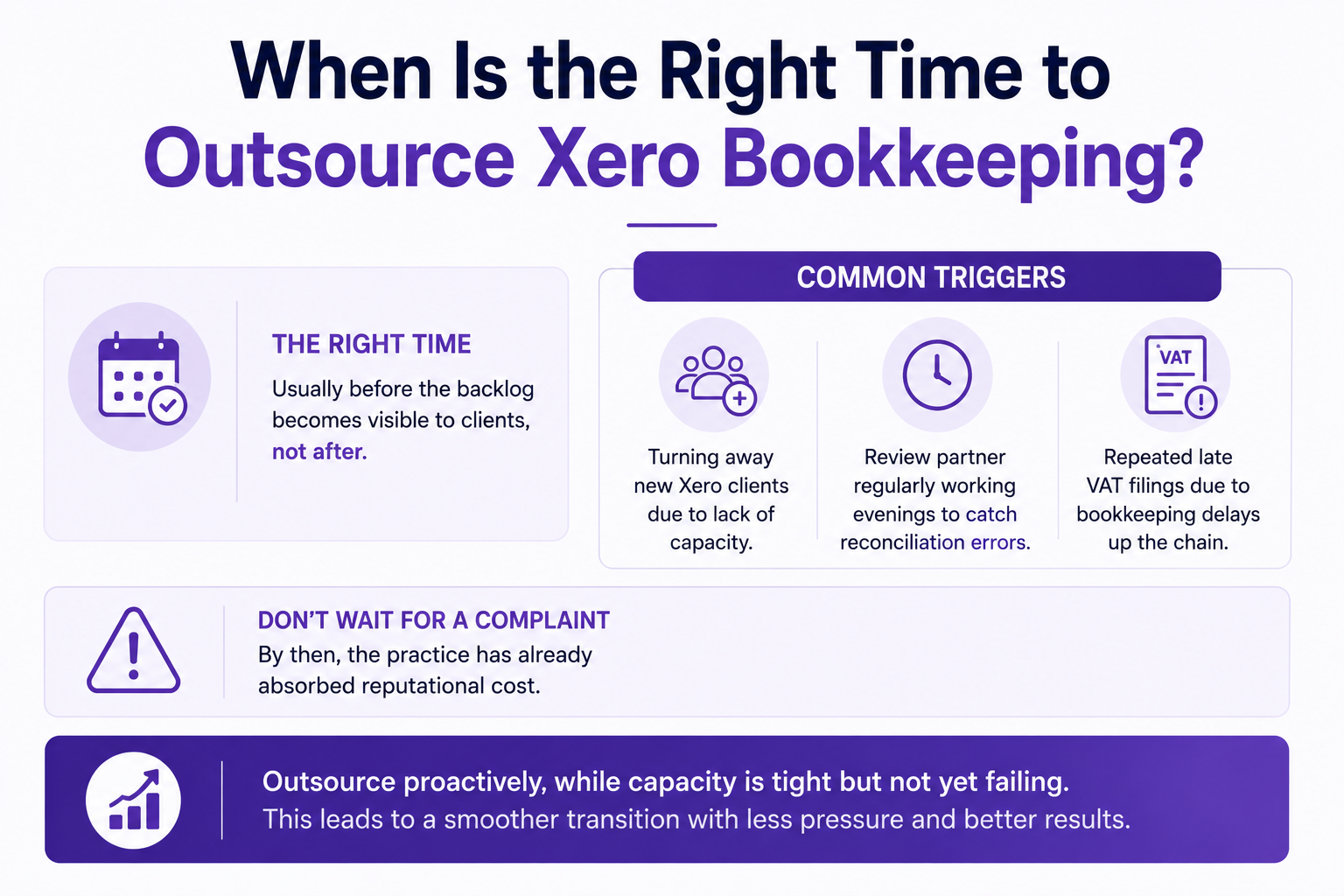
The right time is before the backlog becomes visible to clients. Not after. Common triggers: turning away new Xero clients due to lack of capacity. A review partner working evenings to catch reconciliation errors. Repeated late VAT filings caused by bookkeeping delays further up the chain.
Waiting until a client complains is the most expensive way to decide. By then, the practice has already absorbed reputational cost. Practices that outsource proactively, while capacity is tight but not yet failing, tend to have a smoother transition. There is less pressure to rush the handover.
Here is a useful early check. Look at how many hours per week your team spends on Xero queries unrelated to a specific error. If that number crept up over the last two or three months, without more clients to explain it, capacity has already started slipping. That signal beats waiting for a missed deadline.
Where Do Most Xero Handovers Go Wrong?
Most Xero handovers fail at the access and documentation stage. Not during the actual bookkeeping. A provider gets generic login access. No notes on client-specific coding rules. No notes on historical quirks or which accounts need extra scrutiny. Errors follow within the first month.
The second common failure is review. Some outsourcing arrangements skip human review entirely. The bookkeeper checks their own work. Without an independent review layer, errors that would have been caught internally reach the client's year-end accounts instead.
A structured handover needs three things. A documented client file. A defined reconciliation checklist. A review step that sits outside the person who did the original coding.
There is a third failure point too, and it is less obvious. Scope creep during onboarding. A provider given access for reconciliation work sometimes starts making judgement calls that were meant to stay in-house. This happens simply because nobody set the boundary clearly at the start. Write that boundary down before work begins.
How Do You Outsource Xero Bookkeeping Without Losing Visibility?
You keep visibility by insisting on a review layer. One that shows you the work before it reaches the client. Not after. Ask any provider what you can see, and when, before you sign anything.
A dedicated Xero bookkeeper should give you the same audit trail you would expect from an in-house hire. Reconciliation status per client. Flagged discrepancies. A clear log of what changed and who changed it. This applies whether they work in Xero or any other software you use alongside it.
If a provider cannot show you this in real time, you are trusting the work. Not reviewing it. That is the opposite of what outsourcing bookkeeping should achieve.
What a Good Handover Actually Looks Like
A well-structured handover follows a consistent shape. It does not matter which provider you use. It starts with access setup. Then a documented walkthrough of your coding rules, chart of accounts, and any client-specific quirks a generic template would miss.
From there, most providers run a short trial. Usually on a small number of clients. The more straightforward files go first. Every reconciliation gets flagged for your review during this trial. Not just the ones that raise an obvious query. This gives you a clear picture of accuracy before you expand the engagement.
The handover does not end when the trial does. A good provider keeps documenting client-specific rules as they come up. Practices that skip this ongoing documentation tend to see quality drift over time. This happens especially as staff on the provider's side change.
Comparing Your Options
Here is context on the cost gap. Skilled UK bookkeepers now command strong salaries, once you add pension, National Insurance, and benefits. Recruitment fees add further cost, before a new hire codes a single transaction. Outsourced arrangements usually price below that fully loaded figure. This is why cost saving shows up as a secondary benefit for most practices. Capacity is usually the real trigger. For an exact comparison, scope pricing directly with a provider. Do not rely on an industry average.
A Real Handover: Shah & Co Accountants
Priya Shah runs Shah & Co Accountants in Leeds. She was reconciling three Xero clients herself, every month. Her junior bookkeeper had left. Recruitment was taking longer than expected. VAT filings for two clients went in late, twice in a row.
Priya brought in a dedicated Finqube bookkeeper. That bookkeeper worked inside her existing Xero organisation from week one. They followed her chart of accounts and coding rules exactly as documented. Every reconciliation got flagged for review before it reached Priya, not after. Within the first month, both clients were back on schedule. Priya stopped doing hands-on reconciliation work entirely.
What made the transition smooth was not just the bookkeeper's skill. It was having a documented handover from the start. Nothing depended on the bookkeeper guessing how Priya's practice liked things done.
How Finqube Can Help
Every Finqube engagement includes a dedicated bookkeeper. They work inside your Xero organisation, or any other software your practice runs. They follow your existing coding rules and chart of accounts. Not a generic template.
Alongside that, structured review support gives you a live view of reconciliation status. Across every client file. Before it reaches your desk. It flags mismatches, unusual coding patterns, and outstanding items automatically. What lands in your review queue has already been checked once. You are not trusting that the work is right. You can see that it is.
Engagement starts with a scoped trial. Not a long-term contract. There is no minimum commitment, so you can test the fit on a handful of clients first. Explore Finqube's engagement models to see the structures available.
One month. No contract.
See how a dedicated Finqube accountant fits into your MTD workflow before you decide.
Start your free pilotConclusion
Outsourcing Xero bookkeeping only works if you keep the same visibility and control you would expect from an in-house hire. The practices that get this right treat it as adding a reviewed, accountable extension of their team. Not handing work over and hoping for the best.
Start small. Run a scoped trial on a handful of clients. Keep review ownership in-house. Expand once you have seen the process hold up under real deadlines. Book a discovery call to see how a scoped trial would work for your practice. There is no minimum commitment attached.
FAQ
Is it safe to outsource Xero bookkeeping for client accounts?
Yes, as long as the provider works inside your existing Xero access controls. They should follow a documented review process. Ask specifically how discrepancies are flagged, and who reviews the work before it reaches you.
Does outsourcing Xero bookkeeping mean giving up control of client relationships?
No. A properly structured engagement keeps the client relationship and final sign-off with your practice. The outsourced bookkeeper handles the transactional work inside your systems.
How much does it cost to outsource Xero bookkeeping compared to hiring in-house?
Outsourced arrangements typically cost less than the fully loaded cost of an in-house hire. That figure includes salary, National Insurance, pension, and recruitment fees. Exact costs depend on client volume and complexity. Ask any provider to scope pricing against your own client list.
Can an outsourced bookkeeper work with QuickBooks, Sage, or FreeAgent instead of Xero?
Yes. The same approach applies whether your practice runs Xero, QuickBooks, Sage, FreeAgent, or any other software. As long as the provider can work directly inside that system.
How long does it take to onboard an outsourced Xero bookkeeper?
A well-run onboarding usually takes one to two weeks. That includes access setup, documentation of coding rules, and a first reconciliation review cycle.
What happens if the outsourced bookkeeper makes an error?
With a proper review layer in place, errors get flagged before they reach the client. Not after. This is why an independent review step matters more than the absence of errors in the first place.
Do I need a long-term contract to outsource Xero bookkeeping?
Not necessarily. Providers with flexible engagement models can start with a scoped trial. On a small number of clients. With no minimum commitment. This lets you assess quality before committing further.