.avif)

Blog Summary
- What separates a genuine outsourced bookkeeping partner from a basic data-entry shop
- The criteria that actually predict whether a provider will work out for a UK practice
- How offshore, UK-based, and hybrid extended-team models compare in practice
- What to ask before signing, and the trial structure that protects you if it does not work
Why "Best" Depends on What You Are Actually Outsourcing
There is no single best outsourced bookkeeping service in the UK. There is a best fit for your practice, your client base, and the specific gap you are trying to close.
A 3-partner practice drowning in VAT season catch-up needs something different to a 15-person firm trying to free up a manager from reconciliation work so they can do advisory. Both will see the same shortlist of providers when they search. Both will get different results from the same provider, because the fit depends on volume, software stack, and how much oversight you want to keep.
This guide is not ranked top 10. It is the criteria experienced practice owners actually use to separate a partner from a risk, plus a fair look at how the main provider models differ.
What Outsourced Bookkeeping Actually Means
Outsourced bookkeeping is when a practice hands routine financial record-keeping, such as transaction coding, bank reconciliation, accounts payable and receivable, and management reporting, to an external team rather than an in-house hire.
The external team works inside your existing software, normally Xero, QuickBooks, Sage, or FreeAgent, and follows your processes rather than their own. The work still carries your firm's name and your sign-off. What changes is who is physically doing the data entry and first-pass review.
This is different from simply buying bookkeeping software. Software gives you tools. Outsourcing gives you people who use those tools to your standard, at a volume your in-house team cannot sustain alone.
Why UK Practices Are Outsourcing Bookkeeping Right Now
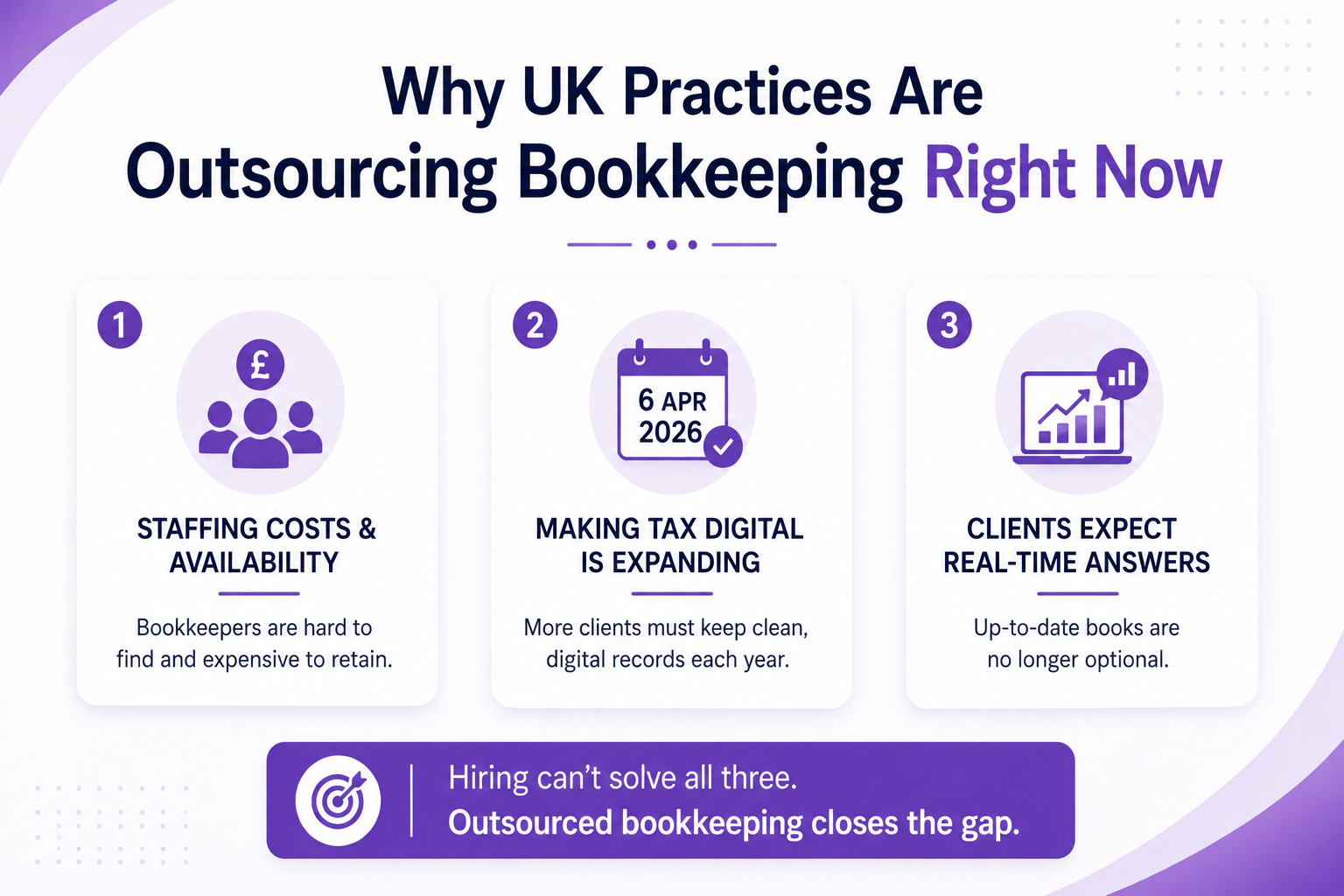
Three pressures are converging on UK practices at the same time, and none of them are going away.
Staffing costs and availability. Qualified bookkeepers are hard to find and expensive to retain in most UK regions. A salaried bookkeeper costs considerably more than the headline salary once you add employer National Insurance, pension contributions, software licences, training, and cover for holiday and sickness.
Making Tax Digital is no longer theoretical. From 6 April 2026, sole traders and landlords with combined income from self-employment and property over £50,000 must use Making Tax Digital for Income Tax, with quarterly digital submissions to HMRC replacing the old single annual return. The threshold then drops to £30,000 from April 2027 and £20,000 from April 2028. That means the pool of clients needing clean, continuously updated digital records is expanding every year, not shrinking.
Clients expect real-time answers. A client asking "what's my cash position right now" no longer accepts "let me check and call you back next week." Books that are weeks behind cannot answer that question.
Hiring your way out of all three at once is slow and expensive. That is the gap outsourced bookkeeping is built to close.
Who Should Outsource, and Who Should Not
Outsourcing tends to work well for:
- Practices with 30 or more bookkeeping clients where volume has outgrown one or two in-house staff
- Firms that want to move existing team members into advisory work but cannot afford to drop the compliance workload
- Practices facing a seasonal spike, such as VAT season or year-end, that does not justify a permanent hire
- Firms expanding into a new client niche (property, e-commerce, contractors) without in-house expertise in that area yet
Outsourcing is the wrong move for:
- A sole practitioner with five clients and spare capacity. The overhead of managing an external relationship will outweigh the benefit
- A practice with no documented process at all. Outsourcing amplifies whatever process you already have. If that process is chaotic, an external team will replicate the chaos faster
- A firm unwilling to give any access to systems or client data, for any reason. If you cannot grant secure access, the model cannot work
When to Bring in an Outsourced Bookkeeping Partner
The right time is before the breaking point, not after it.
Most practices wait until a partner is doing 60-hour weeks during VAT season, or until a client complains about a missed deadline, before they look at outsourcing. By then the decision is rushed and the onboarding happens under pressure, which is exactly when mistakes happen.
A better signal is tracking how many hours senior staff spend on routine reconciliation and data entry each month. If that number has been climbing for two consecutive quarters, it is time to start evaluating partners, not waiting for a crisis.
Where Most Outsourcing Relationships Go Wrong
This is the part most comparison articles skip, and it is the part that actually determines whether outsourcing works for you.
No named point of contact. Work gets shared across a rotating pool with no one accountable for a specific client's file. Errors get traced back too late, if at all.
Review happens after the fact, not during. The practice owner only finds out about a mistake when a client flags it, not before the file leaves the provider.
Software access is granted but never audited. Firms hand over Xero or QuickBooks logins and then have no visibility into who changed what, or when.
The contract has no easy exit. A 6 or 12-month minimum commitment with no trial period means a bad fit is locked in long before either side can prove it out.
Cost is the only thing discussed upfront. A provider that leads every conversation with price, rather than asking about your client base, your software stack, and your review process, is telling you what they will prioritise later.
How Outsourced Bookkeeping Actually Works, Step by Step
- Initial scoping. The provider reviews your client volume, software, and current process to size the right level of support
- Secure access setup. You grant access to your accounting platforms under your own permission controls, not theirs
- Trial period. A short pilot, ideally a single client file or a one-month window, before any wider rollout
- Live bookkeeping. Transaction coding, bank reconciliation, and AP/AR management happen on your timeline, inside your software
- Review and sign-off. Work is reviewed, ideally by a qualified accountant, before it reaches your desk for final approval
- Reporting. You get visibility into what was done and when, not just a finished file at month-end
The step most providers compress or skip is the trial period. If a provider pushes straight from scoping call to full rollout with no pilot, that is worth questioning.
Comparing the Provider Models on the Market
There are three broad models active in the UK market right now, and the differences matter more than any single provider's marketing.
None of these models is universally better. A practice that has been burned by an offshore provider with no named contact might do far better with a dedicated extended team model, even at a higher cost, because the accountability gap closes.
The Criteria That Actually Predict a Good Fit
Five questions matter more than any feature list a provider sends you.
Will I still know what is happening with client work? Ask exactly how visibility works. A provider should be able to show you, not just describe, how you would see file status without having to ask.
Will errors get caught before they reach my clients? Ask what review happens between the bookkeeper completing the work and you seeing it. "We're very thorough" is not an answer. A named review step is.
Is there a clear person responsible when something goes wrong? If the honest answer is "it depends who was working on it that week," that is a structural problem, not a one-off.
How quickly can this actually start? Three months to deploy defeats the purpose if your problem is this VAT season, not next year's.
Can I test this before I commit? A provider confident in their own quality will offer a genuine trial. A provider that insists on a long minimum term before you have seen a single file is asking you to trust them blind.
A Real Scenario: What Outsourcing Looks Like in Practice
Daniel Hughes at Hughes Accountancy was spending the last 10 days of every month chasing his team for client file sign-offs. He had no visibility into which files were reviewed and which were still sitting untouched. Some months, files reached him for final review with only a day or two left before deadline, which left no real room to catch errors.
After bringing in a dedicated Finqube accountant, with review visibility built into the day-to-day workflow, Daniel could see exactly which files were complete, which were flagged, and which were still in progress, at any point in the month. He recovered 12 hours per week by month two and stopped chasing his team entirely. The VAT quarters that had been running close to deadline started clearing a week early instead of a day late.
The change was not the software. It was having a named, accountable person inside his systems, with visibility he did not have to ask for.
How Finqube Can Help
Finqube builds dedicated extended teams for UK accounting practices, rather than routing work through a shared, rotating pool. Every engagement pairs you with a named accountant or small pod who works inside your existing systems, whether that is Xero, QuickBooks, Sage, or FreeAgent, and follows your processes from day one.
Every file your Finqube accountant works on is visible to you as it progresses, not only once it is finished. Before a file reaches your review, common reconciliation mismatches and outstanding AP or AR issues have already been flagged. You review what is already clean, rather than checking everything from scratch.
If capacity is the immediate problem, the FTE model gives you a full-time dedicated accountant without the UK employment overhead of hiring directly. If you are still working out whether outsourcing makes financial sense against an in-house hire, the ROI calculator lays out the real comparison, not just headline day rates.
The best way to know if a provider is the right fit is to see them work, not to read another comparison table. Finqube's one-month free pilot has no contract attached. You see exactly how the review process, visibility, and turnaround work on a real client file before you decide anything.
One month. No contract.
See how a dedicated Finqube accountant fits into your MTD workflow before you decide.
Start your free pilot
FAQ
Q: What is the difference between outsourced bookkeeping and hiring a freelance bookkeeper?
A: A freelance bookkeeper works independently with limited accountability to your internal review process. An extended team member from a provider like Finqube works inside your systems, follows your processes, and has their work reviewed before it reaches your client, rather than working in isolation.
Q: Is outsourced bookkeeping secure for client data?
A: Reputable providers grant access under your own permission controls rather than theirs, and should be able to show GDPR-compliant data handling. Ask specifically how access is logged and revoked, not just whether data is "encrypted."
Q: How much does outsourced bookkeeping cost compared to hiring in-house?
A: This varies by provider and volume, but the comparison should include the full cost of an in-house hire, not just salary. That means employer National Insurance, pension contributions, software licences, training, and cover for holidays and sickness, all of which add up to considerably more than the advertised salary alone.
Q: How quickly can an outsourced bookkeeping provider start working with my practice?
A: This depends heavily on the provider's model. Dedicated extended team models can typically deploy faster than building and training an in-house hire from scratch, which often takes three months or more once recruitment time is included.
Q: Does outsourced bookkeeping work with Xero, QuickBooks, and Sage?
A: Most established UK-focused providers work across all major cloud platforms, including Xero, QuickBooks, Sage, and FreeAgent. Confirm this specifically for your software during the scoping call, rather than assuming.
Q: Can I try an outsourced bookkeeping service before committing long-term?
A: Yes, and you should insist on it. A genuine trial period, ideally with no contract attached, is the clearest signal of a provider confident in their own quality. Finqube's free one-month pilot is structured for exactly this.