.avif)

Blog Summary
- Why UK accounting firms are outsourcing year-end accounts preparation instead of hiring seasonally.
- The real cost of missing a Companies House deadline, and how outsourcing cuts that risk.
- A simple, step-by-step look at how outsourced year-end accounts work actually gets done.
- How FinQube structures year-end accounts support with one named accountant and fixed monthly pricing.
Introduction
Every January, the same thing happens. Your best staff member disappears into a stack of client files. Your partners stop taking new client meetings.
Everyone talks about year end accounts outsourcing. But nobody has time to actually look into it. You're too busy finishing the accounts.
This is not a staffing problem. You can't hire your way out of it.
Firms across the UK ask the same question. Should we outsource year-end accounts preparation? Or keep grinding through it in-house every year?
The answer depends on three things. Your capacity. Your margins. And how much partner time you burn on compliance work a trained accountant could do off-site.
This guide walks through what year-end accounts outsourcing actually involves. You'll see who benefits most. You'll see how the process works day to day. And you'll see what one real UK practice changed when it made the switch.
What Is Year-End Accounts Outsourcing?
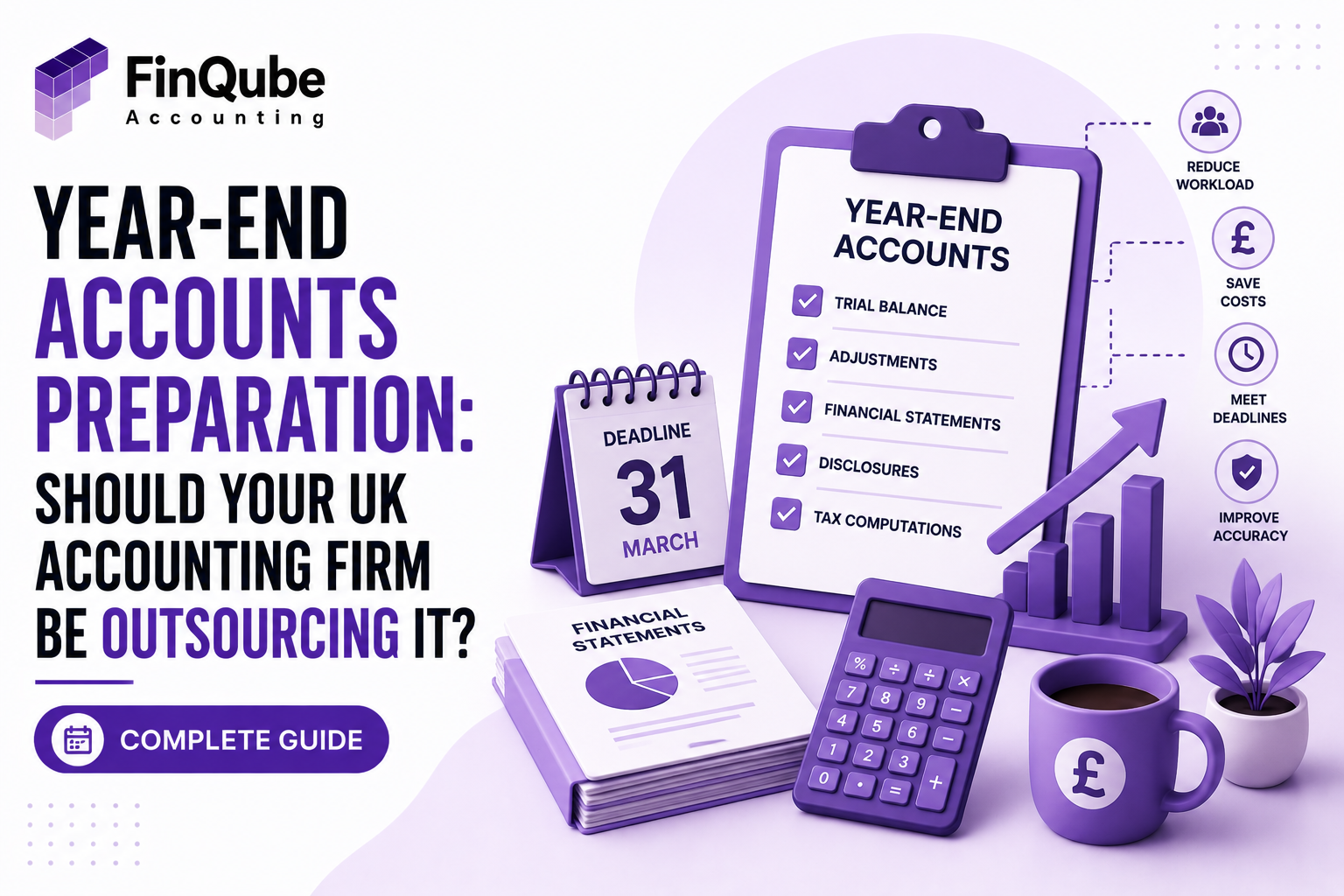
Year-end accounts outsourcing means one thing. An outside team does your accounts prep. They do the work your in-house staff would normally do.
That team takes the client's raw data. They finalise the ledgers. They prepare the statutory accounts. Then they hand back a review-ready file. Your partner checks it and signs it off.
This is not the same as buying software. You are not just buying automation. You are buying trained accountants.
They work inside your existing systems. That could be Xero, QuickBooks, Sage, FreeAgent, or any other software your practice already uses.
The output is a completed set of accounts under FRS 102 or FRS 105. It's ready for partner review. Nothing about the client relationship changes. The client still deals with you.
This fits inside a wider set of outsourced accounting services uk. Many firms already use these for bookkeeping and payroll. Year-end work is just one more piece of that same deal.
Why UK Accounting Firms Are Outsourcing Year-End Accounts
Firms outsource year-end accounts for two reasons. They can't recruit fast enough to match demand. And missed deadlines cost real money.
The UK's accounting talent shortage is real. The Accounting Talent Index 2026 found that 73% of UK firms say talent shortages are hurting their firm. The same report found that 73% of firms turn away work because they don't have enough staff.
A further 26% of accountants say they might quit the job. That shrinks the hiring pool even more. Yet ICAEW says demand for accountants stays high. This holds true even as firms start to use AI tools.
At the same time, the compliance stakes keep rising. Companies House late filing penalties start at £150 for accounts filed up to one month late. They rise to £375 for one to three months late. Then £750 for three to six months. Then £1,500 for anything over six months.
File late two years in a row, and the penalty doubles.
Private companies must file within nine months of their accounting reference date. That deadline doesn't move, even when a firm is short-staffed. This is why so many practices now see outsourcing as a release valve, not a last resort.
Do the maths, and the picture becomes clear. A firm with 40 year-end jobs stuck behind one overworked accountant isn't just slow. It carries real financial and reputational risk.
Here's what outsourcing actually changes.
So the case for outsourcing isn't really about cutting costs. It's about protecting deadlines. It's about protecting your best people's time.
Who Should Outsource Year-End Accounts Preparation?
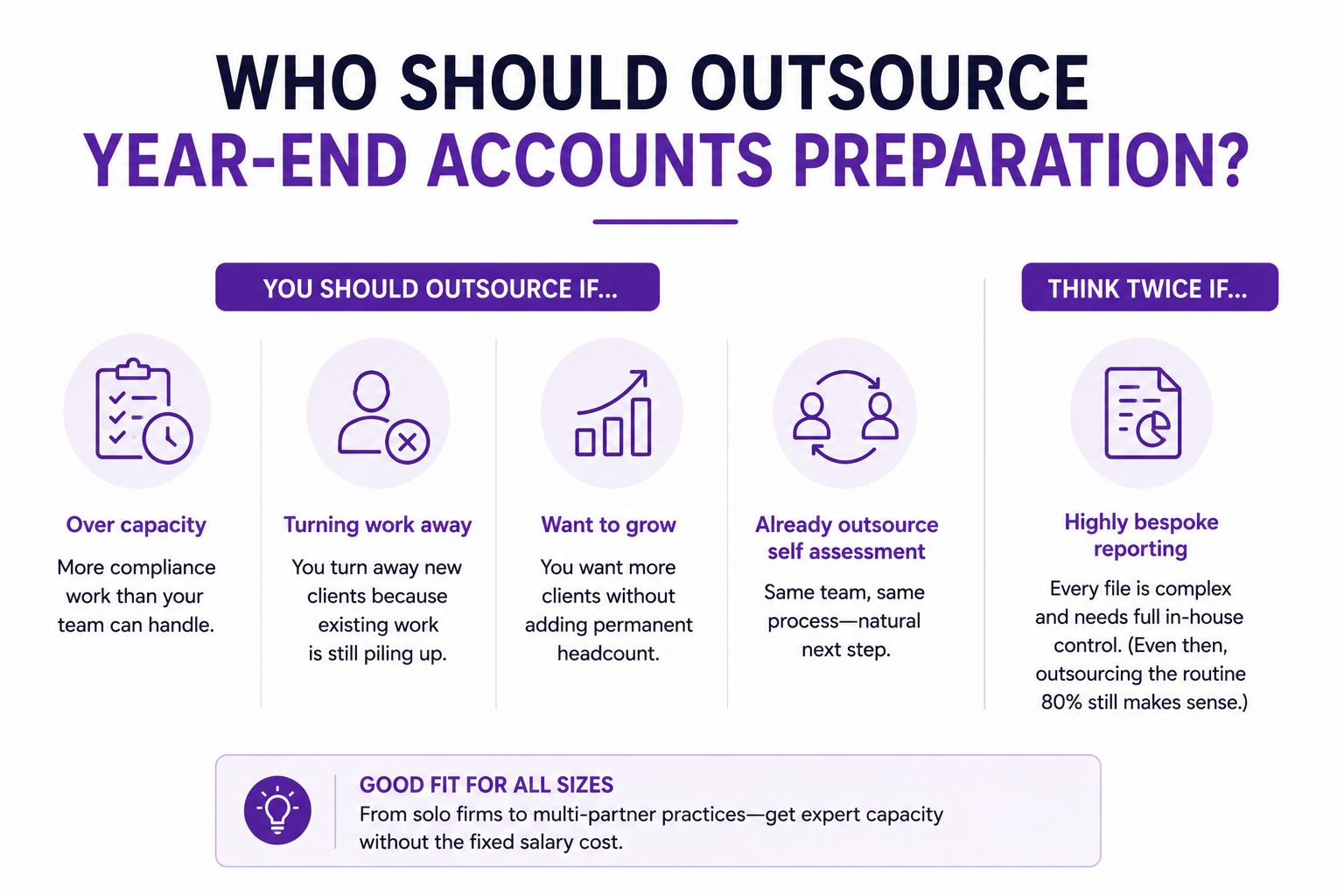
Some firms have too much compliance work. They don't have the staff to match it. These firms should outsource year-end accounts.
This includes practices that turn away new clients every January. Their current clients are still mid-process. It also includes firms where one accountant becomes the bottleneck for every file.
It includes growing practices too. They want more clients. But they don't want to add permanent staff. Growth without new hires only works if some work moves off-site.
Not sure if your firm fits this pattern? Check the signs your accounting firm is ready to outsource. Match them against your own numbers.
Some firms already outsource self assessment work. They often add year-end accounts next. The same team already knows the client's books.
Smaller practices benefit too. A two-partner firm doesn't need a full-time year-end specialist. Not when that person sits idle for ten months a year. Outsourcing gives that same skill set, without the fixed salary cost.
Some firms should think twice. Maybe every file needs odd, custom reporting. Maybe the client wants total in-house control. In those cases, outsourcing needs more care. Even then, most of these firms still outsource the routine work. They keep the tricky 20% in-house.
When Should You Start Outsourcing Before Busy Season?
Start the outsourcing relationship early. Aim for two to three months before your busiest filing period.
This gives the outsourced team time to learn your ways. They learn your working papers. They learn your review steps. They learn your file structure too. By the time January hits, the process is already tested.
Firms that wait too long run into trouble. They end up training a new team under deadline stress. That's the worst time to bring anyone new on board.
A better approach: send a small test batch of straightforward files during a quiet month. Review the quality. Then scale up before the deadline crunch begins.
Where Do Outsourced Year-End Accounts Teams Work From?
Most outsourced year-end teams work from home or an office abroad. But they work inside the same cloud software your practice already uses.
They don't need a new system. They log into your Xero, QuickBooks, Sage, or any other software account. You set the rules on access. Your files stay inside your own setup, unless you choose to share them another way.
This matters for data safety. The ICO wants firms to know where client data sits. They want you to know who can see it. A clear setup keeps this simple. The work happens inside your own systems, not somewhere else.
Before you hand over a file, check the books are clean first. Many firms run a quick accounts cleanup UK pass. Messy data slows down every step that comes after.
How Does Year-End Accounts Outsourcing Actually Work?
The process starts with a handover of the client's raw bookkeeping data. It ends with a partner-ready file.
Here's what that looks like, step by step.
- Your team shares access to the client's bookkeeping software and prior-year files.
- The outsourced accountant reconciles the ledgers. They flag any gaps or queries back to you.
- They prepare the statutory accounts. They draft disclosure notes under the relevant FRS standard.
- A review layer checks the file against a quality checklist before it reaches you.
- Your partner reviews the completed file, raises any final points, and signs off.
- You file with Companies House and HMRC. You talk to the client as usual.
Query turnaround matters here. Ask any provider how fast they answer when something doesn't add up. Slow answers are the top reason these deals fall apart.
It also helps to know how the books were kept before the accounts stage. Some firms use outsourced bookkeeping all year round. Their ledgers stay in order every month. So year-end work moves faster too.
Real Scenario: A Kent-Based Practice's Year-End Turnaround
Ashford Bridge Accountants is a five-partner practice in Kent. They used to run every year-end file through one senior accountant.
By December, that accountant was three weeks behind. Partners fielded client calls about delayed accounts. Two new client enquiries were turned away, because the firm had no visible capacity.
The firm tried hiring a temporary contractor for busy season. The contractor needed two weeks of training before doing useful work. Then they left once the peak ended, taking that knowledge with them.
Ashford Bridge then tried outsourcing its year-end accounts. They sent a batch of ten simple limited company files. The outsourced accountant used the firm's own working paper templates. They worked inside the firm's Xero setup, or any other software the firm might have used.
Turnaround on those ten files dropped from eighteen working days to six, on average. The firm's senior accountant moved from preparing files to reviewing them. The firm picked up two of the previously declined new clients the following quarter.
How FinQube Can Help
FinQube gives your practice a dedicated named accountant for year-end accounts work. Not a rotating pool of unfamiliar faces.
That accountant works inside your own systems. Maybe that's Xero. Maybe it's QuickBooks, Sage, FreeAgent, or any other software your practice runs on. Nothing new to install. Nothing new for your team to learn.
Before any file reaches your partner, FinQube's own AI review checks it first. It flags common errors. It flags gaps in the numbers. It flags missing notes too. Your partner reviews a file that's already passed this check, not a first draft.
Pricing is fixed and monthly. You know your cost each month. It stays the same no matter how many files land in a given week. A busy January won't turn into a surprise invoice.
FinQube works on a services agreement, not a labour supply deal. That keeps IR35 risk off your desk entirely.
There is no minimum commitment. Start with a small batch of files. See the quality for yourself. Check the turnaround too. Then scale up from there.
Ready to see how this works with your own files? Book a call with FinQube and send us a test batch this month. No minimum commitment required.
One month. No contract.
See how a dedicated Finqube accountant fits into your MTD workflow before you decide.
Start your free pilotConclusion
Year-end accounts outsourcing isn't about replacing your team. It's about protecting your deadlines, your margins, and your senior staff's time during the busiest months of the year.
UK firms that outsource this work report faster turnaround. They report fewer missed deadlines. Their partners get freed up for advisory conversations that actually grow the practice.
Is your firm turning away clients, or watching deadlines slip every January? It's worth testing outsourcing with a small batch of files before the next busy season hits.
FinQube offers a named accountant, fixed pricing, and no minimum commitment. That makes the test easy and low-risk to try.
FAQ
What does year-end accounts outsourcing include?
It covers the ledgers, the accounts, and the notes that go with them. It also covers a quality check. Everything comes back ready for partner sign-off.
Is outsourcing year-end accounts safe for client data?
Yes, as long as the outsourced team works inside your existing software. You control the permissions. Data doesn't move to a separate system.
How much does it cost to outsource year-end accounts in the UK?
Costs vary by provider. Fixed monthly pricing models are common. They let firms budget predictably, instead of paying by the hour.
Can outsourced accountants work in Xero or QuickBooks?
Yes. Most outsourced year-end teams work directly inside whatever software your practice already uses. That includes Xero, QuickBooks, Sage, or any other platform.
Why do UK accounting firms outsource year-end accounts instead of hiring?
Recruitment is slow. Good staff are hard to find, especially in the busy season. Outsourcing gives you trained accountants right away instead.
What happens if Companies House deadlines are missed?
Penalties start at £150 for filings up to one month late. They rise to £1,500 for filings over six months late. The penalty doubles if a firm files late two years in a row.
When should a practice start outsourcing before busy season?
Two to three months before peak filing periods. This gives the outsourced team time to learn your working papers and file structure before deadline pressure hits.