.avif)

Blog Summary
- What an outsourced accountant handles hour by hour, from daily reconciliations to year-end accounts.
- Why practice owners in the UK are turning to outsourced accountants amid a hiring crisis.
- A real hour-by-hour timeline showing how a dedicated accountant fits into your existing systems.
- How to tell if an outsourced accountant is right for your firm, and what to check before you sign up.
INTRODUCTION
Your best senior accountant just handed in her notice. Again.
You have four sets of year-end accounts due this month. Your team is stretched thin. And you still have to answer client emails by 6pm.
This is the reality for many UK practice owners right now. An outsourced accountant UK firms hire is not a mystery role. It is a real person doing real, structured work every day.
This guide shows you exactly what that work looks like. Hour by hour. Task by task. No vague promises. Just the actual job.
You will see what an outsourced accountant does each morning. You will see how they fit into your existing systems, whether that is Xero, QuickBooks, Sage, FreeAgent, or any other software. And you will see where the model breaks down, so you know what to check before you sign anything.
WHAT DOES AN OUTSOURCED ACCOUNTANT ACTUALLY DO?
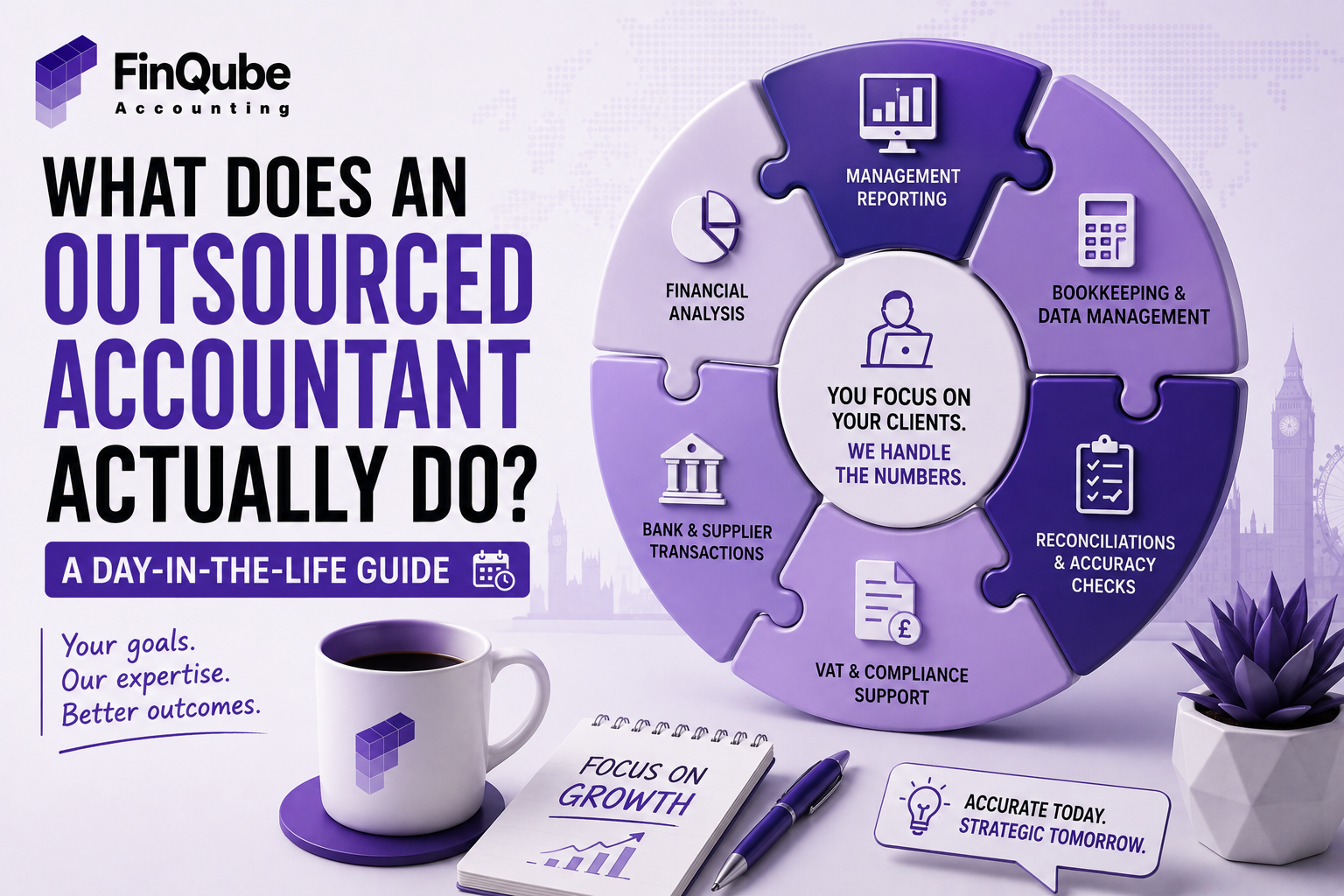
An outsourced accountant handles bookkeeping, reconciliations, VAT prep, management accounts, and year-end support. They work as an extension of your team.
They do not sit in your office. They work remotely, inside your existing software, on a fixed schedule you agree together.
Most outsourced accountants split their day across three types of work. First, transactional tasks like bank feeds and invoice coding. Second, review work like reconciliations and flagging errors. Third, reporting tasks like management accounts and VAT returns.
The exact mix depends on your practice. A firm that outsources only bookkeeping gets a narrower service. A firm that outsources full-cycle accounting gets a broader one.
Some practices also hand over payroll processing, accounts payable, and self assessment prep. Others keep those tasks in-house and outsource only the volume work that eats up junior staff time.
Either way, the outsourced accountant should slot into your existing workflow. They pick up where your internal process leaves off. They do not force you to redesign how your firm operates.
Here is a breakdown of the core tasks by how often they happen.
This is not a one-person show. A named accountant does the daily work. A partner or manager reviews and signs off the final output. That structure keeps quality high without slowing your firm down.
WHY UK ACCOUNTING FIRMS USE OUTSOURCED ACCOUNTANTS
Firms outsource because they cannot hire fast enough to keep up with client demand. The maths simply does not work otherwise.
Recent research backs this up. A 2026 survey found that 73% of UK accounting firms turned away new work. They lacked the staff to handle it, according to Accountancy Today's staffing crisis report. That is not a small gap. That is most of the profession.
Recruitment for qualified accountants in the UK takes months. Training a junior takes even longer. Meanwhile, client deadlines do not move.
Outsourcing solves the immediate problem. You get a trained accountant working inside your systems within weeks, not months.
There is also a compliance angle. Making Tax Digital for Income Tax rolls out in stages through 2026 and 2027, per GOV.UK's official guidance. Firms need more hands to manage quarterly digital submissions for clients. An outsourced accountant adds that capacity without adding a full-time salary and desk to your overheads.
ICAEW's own guidance on outsourcing makes a similar point. Firms use external support for cost reasons. But they also use it for skills and capacity they cannot build fast enough on their own. That matches what we see across UK practices today.
There is a seasonal pressure point too. Self assessment season, VAT quarter-ends, and year-end filing often land in the same few weeks. Firms without extra capacity either turn away clients or burn out their existing team.
Outsourcing spreads that load. A dedicated accountant absorbs the volume work during peak periods. Your qualified staff can then focus on advisory work and client relationships, not data entry.
WHO WORKS WITH YOUR OUTSOURCED ACCOUNTANT
Three people typically interact with an outsourced accountant on any given engagement. Your practice partner, your internal team, and the end client.
Your partner sets the standards and reviews the output before it goes to the client. They do not disappear from the process. They simply stop doing the manual entry work themselves.
Your internal team hands off specific clients or specific tasks. For example, a junior might keep client relationships while the outsourced accountant handles the bookkeeping behind the scenes.
The end client rarely interacts with the outsourced accountant directly. Your firm stays the face of the relationship. The client sees your brand, your email address, and your partner's sign-off.
This matters for trust. Clients hired your firm, not a subcontractor. A good outsourcing setup protects that relationship rather than diluting it.
Your outsourced accountant also works closely with whoever manages your practice's technology stack. That might be an office manager, a systems lead, or the partner themselves, depending on the size of your firm.
One structural point worth flagging here: IR35 and employment status. A properly structured outsourced accounting arrangement runs as a services agreement, not a labour supply contract. That distinction protects both firms from misclassification risk under UK tax rules.
WHEN AN OUTSOURCED ACCOUNTANT GETS INVOLVED
Timing depends on the task, not the calendar month. Some work happens daily. Some happens only once a year.
Daily work includes bank feed coding, invoice matching, and basic queries. This keeps the books current so nothing piles up.
Weekly work includes reconciliations and payroll checks. This catches errors before they become bigger problems.
Monthly work includes management accounts and board-ready reports. Practice owners use these to advise clients, not just file paperwork.
Quarterly work includes VAT returns, aligned to Making Tax Digital deadlines. Annual work includes year-end accounts, corporation tax computations, and self assessment support.
Firms that outsource well spread this work evenly across the year. Firms that outsource badly only bring in help during the busiest quarter, then lose that support the moment things calm down.
WHERE AN OUTSOURCED ACCOUNTANT FITS INTO YOUR PRACTICE
An outsourced accountant works inside your existing systems. They do not ask you to change software or move data to a new platform.
That means they log into Xero, QuickBooks, Sage, FreeAgent, or any other software your firm already uses. Your data stays where it is. Your client relationships stay intact.
This is different from switching to a full-service accounting firm that replaces your practice entirely. Outsourcing adds capacity underneath your brand. It does not replace your brand.
Data protection sits at the centre of this arrangement. Under UK GDPR, your firm remains the data controller. Your outsourcing partner acts as a processor, bound by a written contract, as outlined in the ICO's guidance on controllers and processors.
Ask your outsourcing partner directly how they handle client data, where their team is based, and what security measures protect that data. A firm with nothing to hide will answer clearly and quickly.
WHAT TO CHECK BEFORE YOU OUTSOURCE
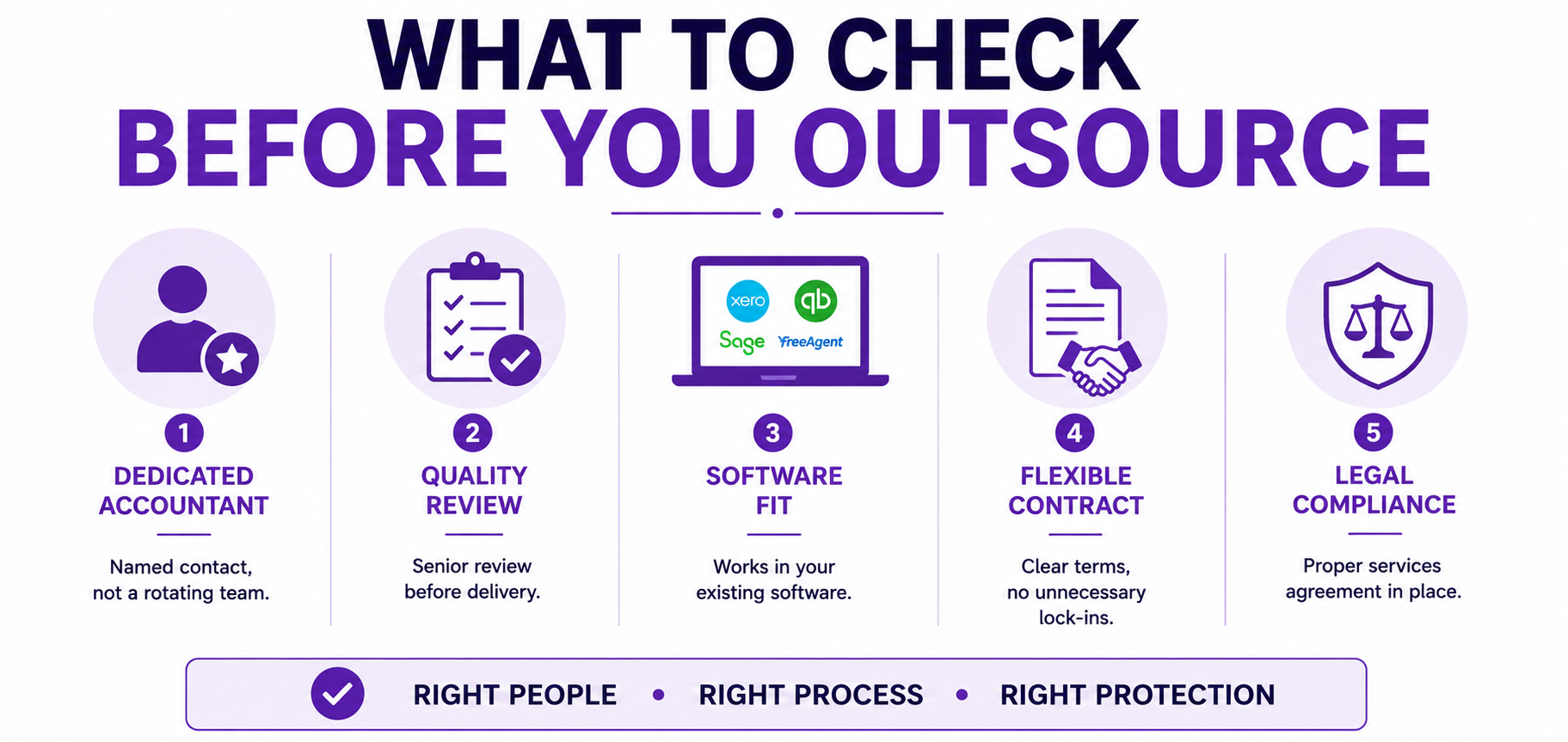
Not every outsourcing arrangement is built the same way. A few checks upfront save you a painful switch later.
First, ask who exactly will work on your files. A named, dedicated accountant beats a rotating pool every time. Pools lose context between handovers.
Second, ask how review and sign-off work. Someone senior should check the output before it reaches your partner or your client.
Third, ask about software compatibility. Your provider should work inside Xero, QuickBooks, Sage, FreeAgent, or any other software you already use, not force a migration.
Fourth, ask about contract terms. A provider confident in their service should not need to lock you into a long minimum term to keep your business.
Fifth, ask how they structure the engagement legally. A services agreement protects both sides from IR35 misclassification risk. A labour supply arrangement does not.
Run through these five checks with any provider before you sign. It takes one call, and it tells you almost everything you need to know.
This is the part most guides skip. Here is an actual hour-by-hour timeline for a dedicated outsourced accountant working with a mid-sized UK practice.
9:00am — Log into the practice's shared systems. Check overnight bank feeds across all assigned clients.
9:30am — Code and categorise new transactions in Xero, QuickBooks, or whichever platform each client uses.
10:30am — Flag unusual transactions to the practice partner. For example, a duplicate payment or a missing invoice.
11:00am — Work through the week's reconciliation queue. Match bank statements against ledger entries.
12:30pm — Respond to queries from the practice team about specific client accounts.
1:30pm — Prepare management accounts for a client with a month-end deadline. Build the P&L and balance sheet.
3:00pm — Join a short video call with the practice partner to review flagged issues from the morning.
3:30pm — Continue VAT return preparation for clients approaching their quarterly deadline.
4:30pm — Update task trackers so the practice has full visibility on what is done and what is outstanding.
5:00pm — Send end-of-day summary to the practice partner, highlighting anything that needs sign-off.
Notice what is missing from this list: guesswork. Every task ties to a specific client, a specific system, and a specific deadline. That structure is what separates a properly run outsourced accounting service from an ad hoc freelancer arrangement.
Communication holds this together. Most firms use a mix of email, a shared task tool, and a weekly video call. Nothing should feel like a black box. If you cannot see what your outsourced accountant did this week, that is a red flag.
REAL SCENARIO: A PRACTICE THAT CHANGED HOW IT WORKS
Sarah runs a nine-person accounting practice in Leeds. Her firm handles bookkeeping, VAT, and year-end work for around 140 small business clients.
The problem: Two senior bookkeepers left within three months of each other. Sarah could not recruit replacements fast enough. Client work backed up. Reconciliations fell three weeks behind.
What she tried first: Sarah hired a local freelance bookkeeper on an hourly basis. It helped briefly, but the freelancer worked across five other clients and could not commit consistent hours. Turnaround stayed unpredictable.
What changed: Sarah brought in a dedicated outsourced accountant. He worked only on her practice's clients, inside her firm's existing Xero and QuickBooks accounts. He followed a fixed daily schedule. He reported directly to Sarah's practice manager.
The result: Within six weeks, reconciliations were current again. Management accounts went out three days earlier than before. Sarah's team stopped firefighting and started advising clients proactively again.
The lesson here is not that outsourcing is magic. It is that a dedicated, structured arrangement beats an ad hoc one every time.
HOW FINQUBE CAN HELP
FinQube gives your practice one dedicated named accountant, not a rotating pool of unfamiliar faces. You always know exactly who is working on your files.
Your accountant works inside your existing systems, whether that is Xero, QuickBooks, Sage, FreeAgent, or any other software. Nothing changes on your end.
Every file goes through FinQube's proprietary AI review before it reaches your partner. Errors get flagged early, not discovered during a client meeting.
Pricing runs on a fixed monthly fee. You know your cost every month, with no hourly billing and no surprise invoices.
There is no minimum contract term. You can start, pause, or stop the arrangement whenever your practice needs change.
FinQube structures every engagement as a services agreement, not a labour supply arrangement. That keeps IR35 exposure off your desk.
Here is how that compares with the two most common alternatives UK practices consider.
Named accountant, then partner sign-off, backed by AI review
The pattern is simple. In-house hiring is slow and expensive to scale. Traditional outsourcing often locks you into a long contract before you know if the fit is right. FinQube removes that risk with fixed pricing and no minimum term.
Ready to see how this works for your practice? Book a short call with FinQube. We will walk through your current workload, show you exactly which tasks we would take on, and give you a clear view of monthly cost before you commit to anything.
CONCLUSION
An outsourced accountant handles real, structured daily work: reconciliations, bookkeeping, VAT prep, and management accounts. They do this inside your existing systems, under your brand.
The firms that get the most value treat outsourcing as a dedicated extension of their team, not a stopgap. Sarah's story shows what changes when that structure is right.
If staffing gaps are costing your practice client work, an outsourced accountant UK firms trust can close that gap quickly. FinQube can show you exactly how, with no minimum commitment and full visibility from day one.
One month. No contract.
See how a dedicated Finqube accountant fits into your MTD workflow before you decide.
Start your free pilotFAQ
What does an outsourced accountant do on a daily basis?
They code transactions, reconcile bank accounts, process invoices, and flag issues to your practice partner, all inside your existing accounting software.
Is an outsourced accountant the same as a bookkeeper?
Not always. Bookkeepers usually handle transactional entry. An outsourced accountant often covers bookkeeping plus VAT prep, management accounts, and year-end support.
How much does an outsourced accountant cost in the UK?
Costs vary by workload and scope. Most providers charge a fixed monthly fee rather than hourly billing, which makes budgeting easier for practices.
Can an outsourced accountant work with Xero, QuickBooks, or Sage?
Yes. A properly set up outsourced accountant works inside your existing software. That includes Xero, QuickBooks, Sage, FreeAgent, or any other software.
Is my client data safe with an outsourced accountant?
Your firm stays the data controller under UK GDPR. A compliant provider signs a data processing agreement and follows ICO guidance on handling client data securely.
How do I know if my practice needs an outsourced accountant?
Are you turning away work? Missing deadlines? Is your team doing unpaid overtime just to keep up? Any of these is a strong signal. You need extra capacity now.
Does outsourcing accounting work replace my accounting team?
No. It adds capacity underneath your existing team and brand. Your firm still owns the client relationship and the final sign-off.