.avif)

Blog Summary
- You will learn exactly which income tax band your salary falls into for 2026/27.
- You will see real take-home pay examples at £30,000, £60,000, and £120,000.
- You will understand why frozen thresholds mean you pay more tax even without a pay rise.
- You will find out how National Insurance and dividend tax change your final bill.
Introduction
You open your payslip and the number looks smaller than you expected. Again.
You are not imagining it. How much income tax you actually pay in the UK depends on far more than your headline salary. It depends on your tax code, your National Insurance band, and thresholds that have not moved since 2021.
This guide breaks down exactly what you owe in 2026/27. No jargon. No guesswork.
You will see the real bands, real examples, and the real reason your take-home pay feels tighter than it should.
What Is Income Tax and How Much Will You Actually Pay?
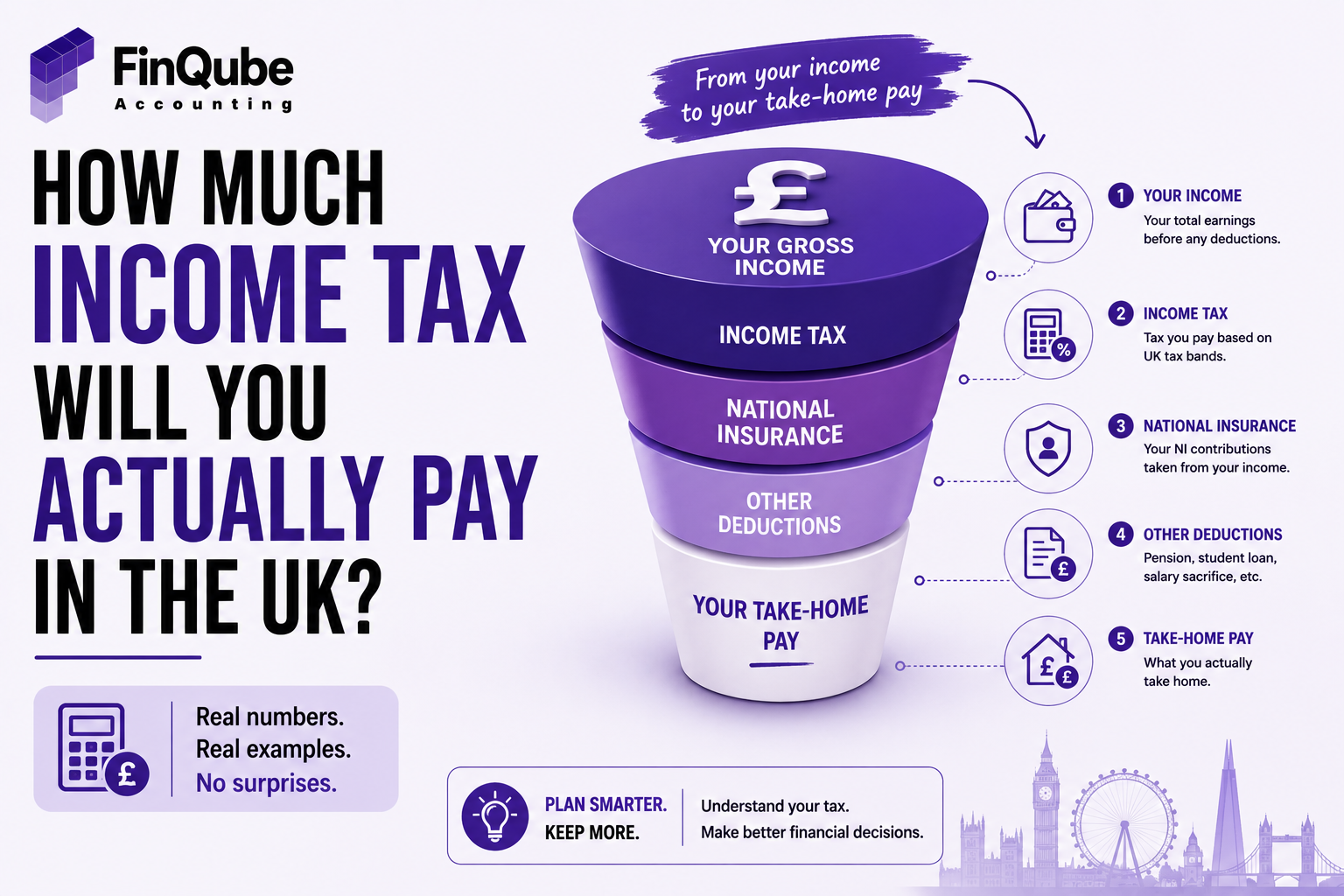
Income tax is the money HMRC takes from your earnings before you see them. It applies to your salary, self-employment profits, pensions, and rental income.
You pay it in bands, not as one flat rate. Each slice of your income gets taxed at a different rate.
For 2026/27, the personal allowance stays at £12,570. You pay no tax on the first £12,570 you earn.
Above that, you enter the basic rate band. This runs from £12,571 to £50,270, taxed at 20%.
Cross £50,270 and you hit the higher rate band, taxed at 40%, up to £125,140. Anything above £125,140 falls into the additional rate, taxed at 45% (GOV.UK, Income Tax rates and Personal Allowances).
Here is the part people miss. You do not pay 40% on your whole salary once you cross £50,270. You only pay 40% on the portion above that line.
Someone earning £60,000 pays 0% on the first £12,570. They pay 20% on the next £37,700. They pay 40% only on the remaining £9,730.
That distinction matters. It is the single most common misunderstanding about UK income tax.
Why Your Tax Bill Keeps Rising Even Without a Pay Rise
Your tax bill rises even when your salary stays flat. This happens because of fiscal drag.
The personal allowance has been frozen at £12,570 since April 2022. It stays frozen until April 2031 (House of Commons Library, Direct taxes: Rates and allowances 2026/27).
Wages rise with inflation. Thresholds do not. As a result, more of your income gets pulled into higher tax bands every year.
The Institute for Fiscal Studies found that extending these freezes pushes higher-rate taxpayer numbers to 10.1 million people by 2030. That is 4.8 million more than if thresholds had risen normally (IFS, How are frozen tax thresholds reshaping who pays personal taxes?).
Total income tax payers could reach 42.1 million, or 73% of UK adults, under the extended freeze.
Even minimum wage earners feel this. By 2029/30, someone on minimum wage will start paying tax after working just 18 hours a week. In 2015/16, that threshold sat at 31 hours.
This is why your payslip feels tighter even though your job title and salary look the same as last year.
Continued freeze, no inflation adjustment
Who Pays Each Rate of Income Tax?
Every UK taxpayer earning above £12,570 pays the basic rate. This covers most full-time workers.
Higher earners, typically senior employees, business owners, and landlords with strong rental income, cross into the 40% band once they pass £50,270.
Above £100,000, something else kicks in. Your personal allowance shrinks by £1 for every £2 you earn over that limit. It disappears completely at £125,140 (GOV.UK, Income Tax rates and Personal Allowances).
This creates an effective tax rate of 60% between £100,000 and £125,140. Accountants sometimes call this the "tax trap," because you lose your allowance and pay 40% at the same time.
Additional rate taxpayers, earning over £125,140, pay 45% on income above that threshold. This group includes company directors, senior partners, and high-earning contractors.
Scotland runs a separate system with more bands and different rates. If you or your clients live in Scotland, the England, Wales, and Northern Ireland bands above do not apply directly.
When Do Tax Thresholds Change?
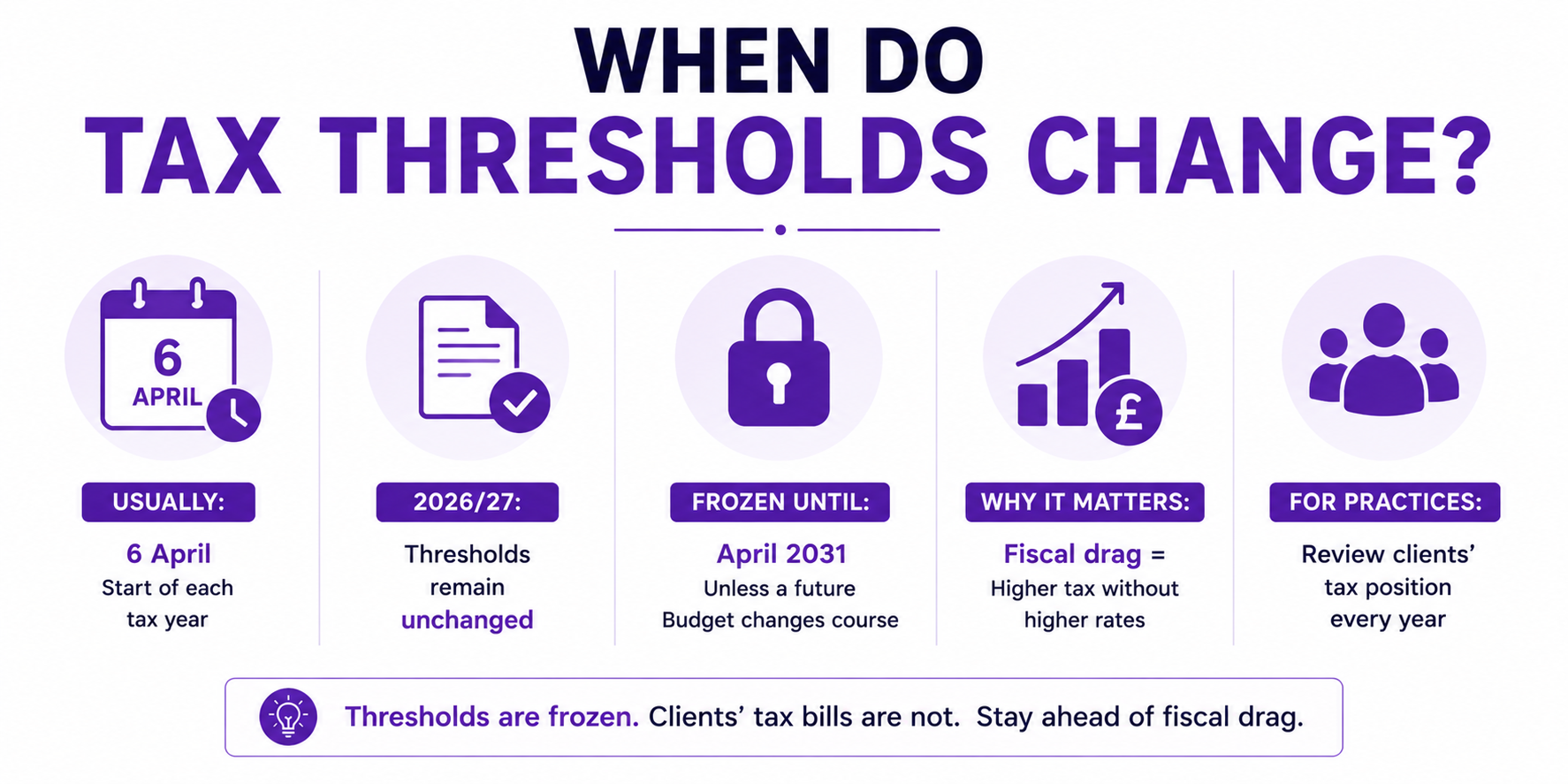
Thresholds normally change at the start of each tax year, on 6 April. For 2026/27, however, most figures stay exactly where they were in 2025/26.
The personal allowance, basic rate limit, and higher rate threshold are all frozen through to April 2031, unless a future Budget changes course (House of Commons Library, Direct taxes: Rates and allowances 2026/27).
This freeze was extended in recent Budgets specifically to raise revenue without raising headline tax rates. It is a quieter way to collect more tax.
For accounting practices, this timing matters. Clients often assume their tax position is unchanged year to year. It rarely is, once fiscal drag is factored in.
Where Your Income Tax Actually Goes
Income tax funds the NHS, education, welfare payments, defence, and public infrastructure. HMRC collects it, then it flows into general government spending.
Your income tax is separate from National Insurance, even though both come out of your payslip together.
National Insurance funds specific benefits, including the state pension. For 2026/27, employees pay 8% on earnings between £242 and £967 a week, and 2% above that (Low Incomes Tax Reform Group, National Insurance for employees).
If you receive dividends from a limited company, a different set of rates applies. Dividend tax rates sit outside the standard income tax bands, with their own allowance and rates set separately by HMRC (GOV.UK, Income Tax — Changes to Tax Rates for Property, Savings and Dividend Income).
This is exactly the kind of detail that trips up small business owners filing their own returns.
Real Scenario: A Manchester Accounting Practice Gets Its Tax Advice Right
Kirkham & Wren Accountants, a nine-person practice in Manchester, kept fielding the same client question every January: "why is my tax bill higher this year when my salary barely changed?"
The team knew the answer was fiscal drag. Explaining it clearly, for dozens of clients, at speed, was the problem.
Their existing process involved a shared inbox and a junior team member manually recalculating each client's band exposure in a spreadsheet. Errors crept in. Two clients received incorrect estimates during peak season.
The partners tried hiring a temporary contractor to handle the overflow. It helped for six weeks, then the contractor left, and the knowledge left with them.
They needed consistent, accurate support that did not disappear after tax season. So they brought in a dedicated outsourced accountant who worked inside their existing FreeAgent setup and reviewed every client tax calculation before it went out.
Within one quarter, Kirkham & Wren cut client query response time from four days to under 24 hours. Their error rate on tax estimates dropped to zero for the rest of the season.
The partners now spend January advising clients on planning, not firefighting spreadsheet errors.
How FinQube Can Help
Explaining income tax bands to clients, chasing self assessment deadlines, and catching threshold errors before they reach HMRC eats into hours your team does not have.
FinQube gives your practice a dedicated named accountant, not a shared pool that changes every month. You always know who is handling your clients' files.
We work inside your existing systems, Xero, QuickBooks, Sage, FreeAgent, or any other software you already use. No migration, no disruption.
Our proprietary AI review flags inconsistencies, like a client's tax band miscalculation, before your partner even opens the file.
You get fixed monthly pricing, not an hourly bill that grows every time a client asks a follow-up question. Your commitment to FinQube runs on a rolling monthly basis, with no minimum term locking you in.
Every engagement is structured as a services agreement, not labour supply, keeping your IR35 position clean.
Ready to stop firefighting tax season? Talk to FinQube about how a dedicated accountant can handle your clients' self assessment outsource workload before the next deadline crunch. Book a free consultation.
Conclusion
How much income tax you pay in the UK depends on your income band, your allowance, and thresholds that have not moved since 2022. Frozen bands mean your bill rises even without a pay rise, and the gap between what you expect and what you owe keeps growing.
Understanding your bands is the first step. Getting the calculation right, every time, for every client, is the harder part.
If your practice is spending January explaining fiscal drag instead of advising on it, FinQube can take that workload off your desk. Get in touch with FinQube to see how a dedicated accountant fits into your existing systems.
FAQ
How much income tax will I pay on £50,000 in the UK?
You will pay 0% on the first £12,570, then 20% on the remaining £37,430, giving a total income tax bill of roughly £7,486 for 2026/27.
What is the UK tax-free allowance for 2026/27?
The personal allowance is £12,570, frozen at this level until April 2031, meaning you pay no income tax on earnings up to that amount.
Why do I pay 60% tax between £100,000 and £125,140?
Your personal allowance reduces by £1 for every £2 earned above £100,000, so you lose the allowance and pay 40% tax at the same time, creating an effective 60% rate in that band.
Do I pay National Insurance and income tax separately?
Yes, National Insurance is a separate deduction from income tax, currently charged at 8% on earnings between £242 and £967 a week, with 2% above that threshold.
How is income tax different in Scotland?
Scotland uses its own income tax bands and rates, set separately from England, Wales, and Northern Ireland, so Scottish taxpayers should check the Scottish Government's rates directly.
Will UK income tax thresholds change in 2027?
Current policy freezes the personal allowance and rate thresholds until April 2031, though future Budgets could change this before then.
How do I know which tax band I am in?
Compare your total taxable income, after pension contributions and allowable deductions, against the current bands: £12,570 tax-free, 20% up to £50,270, 40% up to £125,140, and 45% above that.