.avif)

Blog Summary
- What corporation tax outsourcing covers, from CT600 preparation to iXBRL tagged accounts
- Why UK practices struggle with corporation tax capacity during peak filing periods
- Which parts of the CT600 workflow are safe to hand off and which need partner sign-off
- How a dedicated remote accountant with proprietary AI review reduces error risk before filing
Introduction
Corporation tax outsourcing helps UK practices clear CT600 backlogs. It means you do not need to hire another qualified accountant. Most firms understand corporation tax fine. The real problem is time. Practices cannot find the hours to do it properly. This is worst during the weeks when everything else is due too.
VAT returns land. Year-end accounts land. Client queries land. Then a CT600 needs a partner's full attention. It gets squeezed into whatever time is left. That is when mistakes creep in. The team has the skill. The team lacks the hours.
This guide covers what corporation tax outsourcing includes. It covers what stays with your practice. It shows how a dedicated remote accountant fits your review process. And it does this without adding risk.
Why Do Practices Struggle With Corporation Tax Capacity?

Most practices struggle for one clear reason. Corporation tax prep competes with accounts finalisation. It competes with VAT deadlines. It competes with client queries. All in the same weeks. ICAEW sets the standards practices must follow for statutory filings. Those standards leave little room to rush a CT600.
A 5 to 15 person practice usually has one or two people who can prepare a CT600 to review-ready standard. Both often cover accounts finalisation too. When that happens, the corporation tax queue backs up fast. This is worst around December and March. Most UK SMEs share these year-end dates.
The UK accounting sector is short on experienced corporation tax staff. Firms cannot always hire their way out of this. The work is seasonal. It spikes twice a year. Hiring a permanent person for that spike rarely makes sense.
Complexity is rising too. Marginal relief calculations need more care than before. R&D claims do too. So does group relief. The corporation tax main rate is 25% for profits above £250,000. Marginal relief applies between £50,000 and £250,000. Getting this banding right matters more than ever.
What Does Corporation Tax Outsourcing Actually Cover?
Corporation tax outsourcing covers the preparation work behind a CT600. It does not cover the legal responsibility for filing it. That responsibility always stays with your practice and your signing partner.
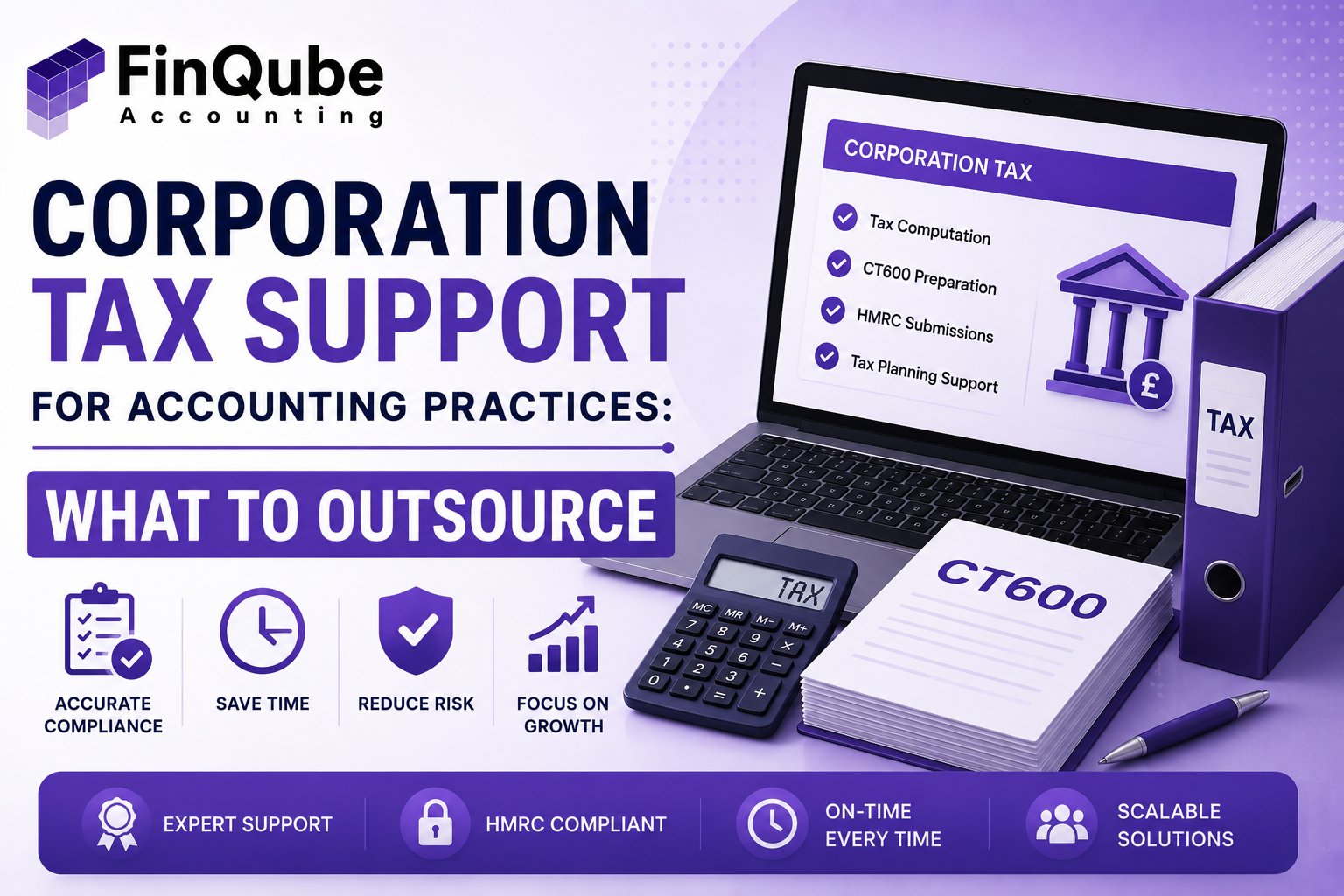
This usually includes tax computations. It includes capital allowances calculations. It includes iXBRL tagging of accounts. It includes the first draft of the CT600. A good partner delivers HMRC-ready working papers. Your partner review becomes a check, not a rebuild.
Most engagements also cover profit apportionment across periods. They cover loss carry-forward calculations too. They help spot reliefs like R&D credits or capital allowances. A stretched internal team can miss these under time pressure.
Who Should Review an Outsourced CT600?
Your signing partner or a senior team member should review every outsourced CT600. Do this before it goes anywhere near HMRC. Outsourcing removes the drafting burden. It does not remove the accountability.
HMRC is clear on this point. The legal responsibility for an accurate corporation tax return sits with the company. It also sits with the accountant who files it. This is true no matter who prepared the computation. That single fact should shape how you structure any outsourcing arrangement.
The review itself should be quick if the prep was done well. A good outsourcing partner hands over working papers, not just a finished form. Your partner can see how each figure was reached. No one has to take it on trust.
When Should a Practice Bring In Corporation Tax Support?
Bring in corporation tax support before the queue backs up. Do not wait until after. Watch for one clear signal. CT600 prep keeps getting pushed past its normal review window. That happens because senior staff are tied up elsewhere.
Filing deadlines do not move. Corporation tax must be paid within nine months and one day after the accounting period ends. The CT600 must be filed within twelve months. From April 2026, HMRC's new late filing penalty structure applies. It covers any return due on or after 1 April. This raises the cost of getting it wrong.
Some practices have clients with staggered year-ends. Others see clusters in December and March. Both groups benefit most from support arranged ahead of their busiest filing windows. Waiting until the backlog is visible costs more time.
Where Do Most CT600 Errors Happen?
Most CT600 errors happen at the reconciliation stage. This is where accounting profit becomes taxable profit. Disallowable expenses get missed here. So do capital allowances. So do timing differences. This happens most when the preparer is rushing.
The second common failure point is marginal relief. Since the 25% main rate returned, the banding got more technical. Errors here change the tax figure a client actually pays.
iXBRL tagging is the third risk area. HMRC rejects submissions with incorrect tagging outright. A rushed filing can bounce back close to the deadline. There is no time left to fix it properly.
A structured outsourcing process closes off all three risks. Proprietary review software checks reconciliation and tagging first. It does this before a human ever sees the file.
How Does a Dedicated Remote Accountant Handle Corporation Tax at Scale?
A dedicated remote accountant handles corporation tax at scale in one key way. They work as a named, consistent member of your team. They are not part of a rotating pool that changes each quarter. They learn your clients. They learn your review standards. They learn your systems.
This matters because corporation tax is not a one-off task. A client's group structure carries forward. So does their loss history. So do prior-year reliefs. A named accountant keeps this context. They do not start from zero each time.
They work inside your existing software. That might be Xero, QuickBooks, Sage, FreeAgent, or any other software your practice already runs. There is no separate portal to manage. There is no duplicate data entry to reconcile.
Before a file reaches partner review, proprietary AI review software checks it first. It flags reconciliation mismatches. It flags missing capital allowances. It flags tagging issues. You review a file that has already been checked. You are not looking at a first draft.
Real Life Scenario
Priya Shah runs Shah & Co Accountants, a 9-person practice in Leeds. Every December, her team's corporation tax queue collided with year-end accounts work. Both jobs hit the same clients at the same time.
Two senior staff could prepare a CT600 to review standard. Both were also finalising accounts for the same clients. Both jobs landed in the same three weeks. By mid-December, six CT600s sat untouched. Two more clients had queries with no answer.
Priya brought in a dedicated FinQube accountant. He handled tax computations and CT600 drafting for the December cluster. He worked inside her practice's existing Xero setup. He delivered HMRC-ready working papers. Proprietary AI review flagged a capital allowances discrepancy on one file. Priya had not even opened it yet.
By the following March cluster, her review time per CT600 had changed. It dropped from roughly ninety minutes to under thirty. Her senior staff spent December on client advisory calls instead. They were not chasing tax computations anymore.
How Finqube can Help
FinQube gives your practice a named, dedicated accountant for corporation tax prep. This is not a shared pool that changes each time. The same person learns your clients. The same person learns your systems. The same person learns your review standards. Over time, this gets faster.
Every file gets checked by our proprietary AI review software first. It flags reconciliation issues early. It flags missing reliefs early. It flags tagging errors early. You review work that is already clean. You are not looking at a first attempt.
Your dedicated accountant works inside your existing systems. That might be Xero, QuickBooks, Sage, FreeAgent, or any other software. There is no new portal to learn. There is no duplicate data entry. Pricing is fixed each month, not billed by the hour. A busy filing season will not bring a surprise invoice.
The engagement is a services agreement, not labour supply. There is no minimum commitment beyond the work you send us.
Ready to clear your corporation tax backlog before the next filing cluster hits? Book a discovery call or try the cost calculator to see how a dedicated accountant fits your practice.
Conclusion
Corporation tax outsourcing is not about handing off responsibility. It is about giving your senior staff back their hours. Those hours currently get eaten by CT600 prep during your busiest weeks. The filing and the accountability stay with your practice. That does not change.
What changes is who does the drafting. What changes is who does the reconciliation. What changes is who does the first-pass review. Proprietary AI review catches errors before your partner sees the file. That first pass gets faster. It also gets safer.
Your December or March corporation tax cluster may already be backing up. Waiting until the deadline gets closer only narrows your options. See how FinQube's outsourced accounting services uk model works for practices like yours.
FAQ
What does corporation tax outsourcing include?
Corporation tax outsourcing usually includes tax computations. It includes capital allowances calculations. It includes iXBRL tagging. It includes CT600 drafting. Filing responsibility always stays with the practice. So does client-facing advice.
Is outsourcing corporation tax preparation legal for UK accounting practices?
Yes, it is legal. The accountant and company stay legally responsible for filing accuracy. Preparation work can still go to a qualified outsourcing partner. This does not breach HMRC rules.
How much does corporation tax outsourcing cost?
Costs vary by provider and by volume. FinQube uses fixed monthly pricing, not hourly billing. This helps practices avoid surprise invoices during peak filing periods.
When is the corporation tax filing deadline?
Corporation tax must be paid within nine months and one day after the accounting period ends. The CT600 must be filed within twelve months of that same period end.
Can outsourcing help with R&D tax relief claims?
Yes, it can help. Most outsourcing partners spot eligible R&D reliefs. They calculate capital allowances too. They handle loss carry-forwards. This is all part of standard CT600 prep.
What happens if a CT600 is filed late?
HMRC applies penalties for late filing. These start at £100 and grow with repeated delays. A new penalty structure applies to returns due on or after 1 April 2026.
Does outsourcing work with our existing accounting software?
Yes, it should. A properly structured engagement works inside whatever software your practice already uses. That includes Xero, QuickBooks, Sage, FreeAgent, or any other software. No new portal is required.