.avif)

Blog Summary
- What outsourced tax return preparation UK actually means, and where the line sits between preparation and sign-off.
- Why January keeps breaking practices, backed by HMRC's own filing figures.
- A clear five-step process for outsourcing self assessment work without losing control of quality or client relationships.
- How one UK practice went from an all-hands January crisis to a calm, review-only season.
INTRODUCTION
Every January, the same thing happens. Your team drowns in Self Assessment returns.
Clients send you half-finished records at the worst time. Your best staff get stuck doing data entry, not advice work.
This is why more UK practices now use outsourced tax return preparation UK providers. They handle the bulk of Self Assessment work. Not to replace your team. To free it up.
HMRC says 11.5 million people filed a Self Assessment return by the 31 January deadline last season. Most of those returns land in the final six weeks.
You can't hire your way out of that. It's a workload problem built into the calendar, and outsourcing is the fix.
This guide shows you how to outsource self assessment tax return preparation. You'll learn who it suits and what to check before you sign anything.
WHAT IS OUTSOURCED TAX RETURN PREPARATION?
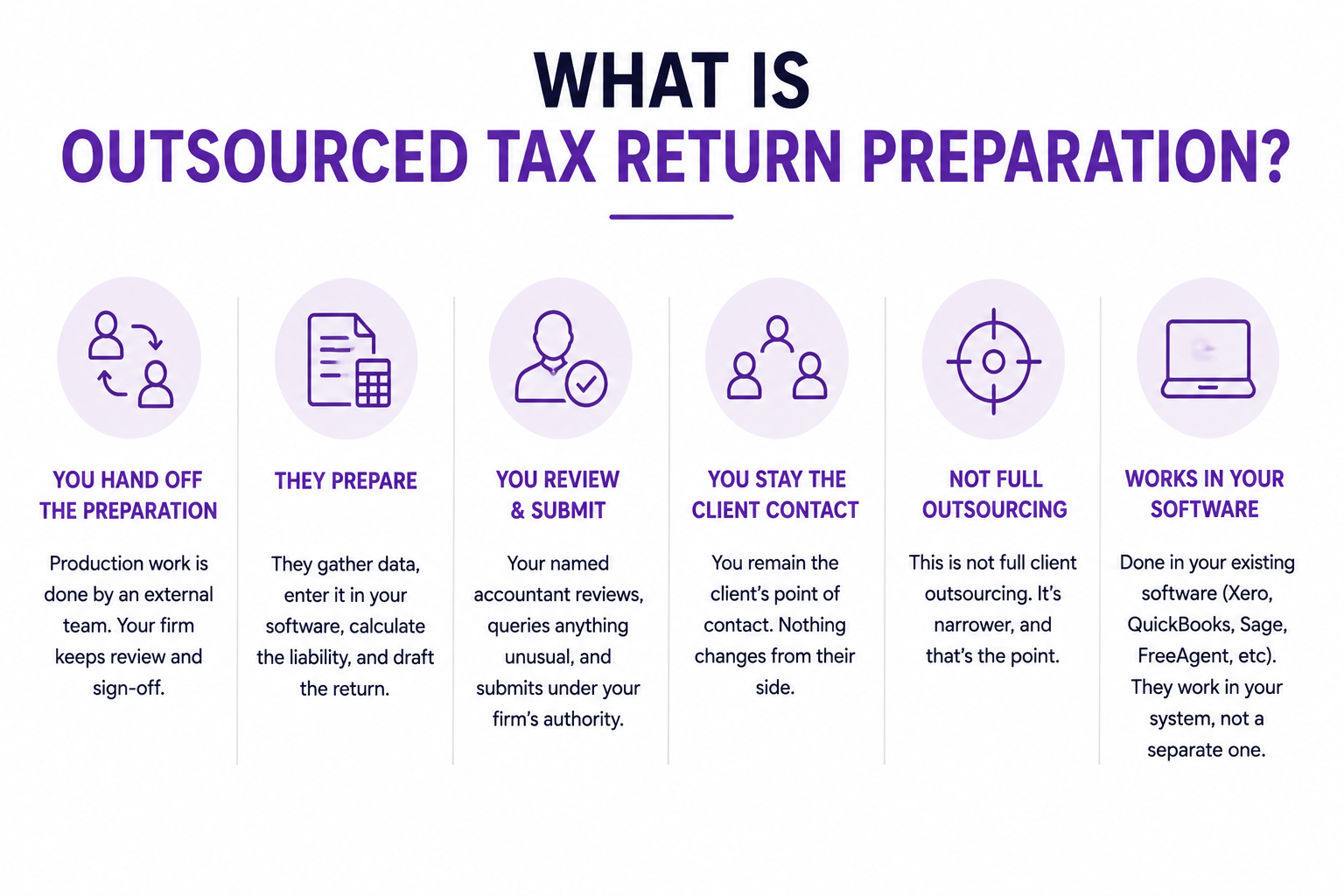
Outsourced tax return preparation UK means an external team does the groundwork on a tax return. Your firm still reviews it and signs it off.
The outsourced team collects client data. They enter it into your software, work out the tax due, and draft the return. Your named accountant checks it, asks about anything odd, and files it under your firm's name.
You stay the client's main contact the whole time. Nothing changes on the client's side.
This is not the same as handing over a whole client relationship. It's much narrower, and that's the point.
Preparing a return is repetitive work with clear rules. Reviewing it takes judgement. Splitting the two jobs lets each one go to whoever does it best.
Most practices outsource this work inside their own software. That might be Xero, QuickBooks, Sage, FreeAgent, or any other software your clients already use. The outsourced team works inside your system, not a separate one.
WHY UK ACCOUNTING PRACTICES ARE OUTSOURCING SELF ASSESSMENT WORK
Practices outsource self assessment work because January demand is too high for a normal staffing plan.
The spike is well known. HMRC's own figures show that most Self Assessment filing happens in the final weeks before 31 January.
At the same time, ICAEW reports that qualified accountants are still in high demand across the UK, even as firms use more AI tools. Good staff are hard to find, and harder to keep through another tough January.
Three problems show up again and again in UK practices.
Capacity mismatch. Firms staff for a normal month, then face two to three times that workload in January.
Recruitment problems. Qualified tax staff are hard to find, and seasonal hires rarely fix the gap.
More errors under pressure. Rushed returns lead to wrong figures, missed allowances, and gaps in the schedules. None of that is safe near HMRC.
Outsourcing fixes all three at once. It adds capacity without adding permanent staff, and it hands the busiest work to a team built for volume.
The result is a shift from a production crisis to something calmer: review and client care. Your partners check the work instead of racing to finish it.
WHO SHOULD OUTSOURCE SELF ASSESSMENT TAX RETURNS
Self assessment outsourcing UK suits practices that feel the January squeeze the most. That usually means a large personal tax book and a small permanent team.
Here's a quick way to check if outsourcing fits your practice right now.
If three or more rows point right, outsourcing is worth a serious look. It's not just for firms in crisis, though. Growing practices use it to take on new personal tax clients without hiring ahead of demand.
Sole practitioners benefit too. A one-partner firm can't add a January-only staff member. Outsourcing gives you that same flexible capacity, without the hiring hassle.
WHEN TO START OUTSOURCING BEFORE DEADLINE SEASON
Start your outsourcing relationship in September or October. That's well before the January rush hits.
This gives you time to test the process on a small batch of easy returns first. You want to find any gaps in October, not on 28 January.
Here are the key dates that shape when you need to act, based on current HMRC guidance.
Miss the 31 January online deadline, and the penalties grow fast. After six months, that's another 5% of the tax due or £300, whichever is more. The same happens again after twelve months.
If your firm is already outsourcing by autumn, you stay well clear of those numbers. Wait until December to start looking for help, and you've lost most of the benefit.
Firms that wait until the second week of January usually find it's too late for anything but firefighting.
WHERE UK PRACTICES OUTSOURCE TAX RETURN PREPARATION TO
UK practices usually pick one of three routes: UK-based seasonal staff, an onshore outsourcing partner, or an offshore team.
Seasonal UK hires cost more and are hard to find in a tight job market. You also have to train them from scratch every year.
Offshore teams cost less. But they often come with time zone gaps, staff shared across many clients, and patchy quality between reviewers.
Onshore and hybrid partners sit in the middle. You get one dedicated team that knows UK tax rules. They work inside your own software, whether that's Xero, QuickBooks, Sage, FreeAgent, or any other software. They report to your named contact directly.
The right choice depends on how much control you want to keep and how varied your client base is. Firms with complex, high-value personal tax clients tend to prefer one named accountant over a shared pool. That's because the same person handling a tricky return each year matters.
HOW TO OUTSOURCE SELF ASSESSMENT TAX RETURN PREPARATION, STEP BY STEP
Outsourcing self assessment tax returns works best as a clear process. Don't treat it as a last-minute handoff.
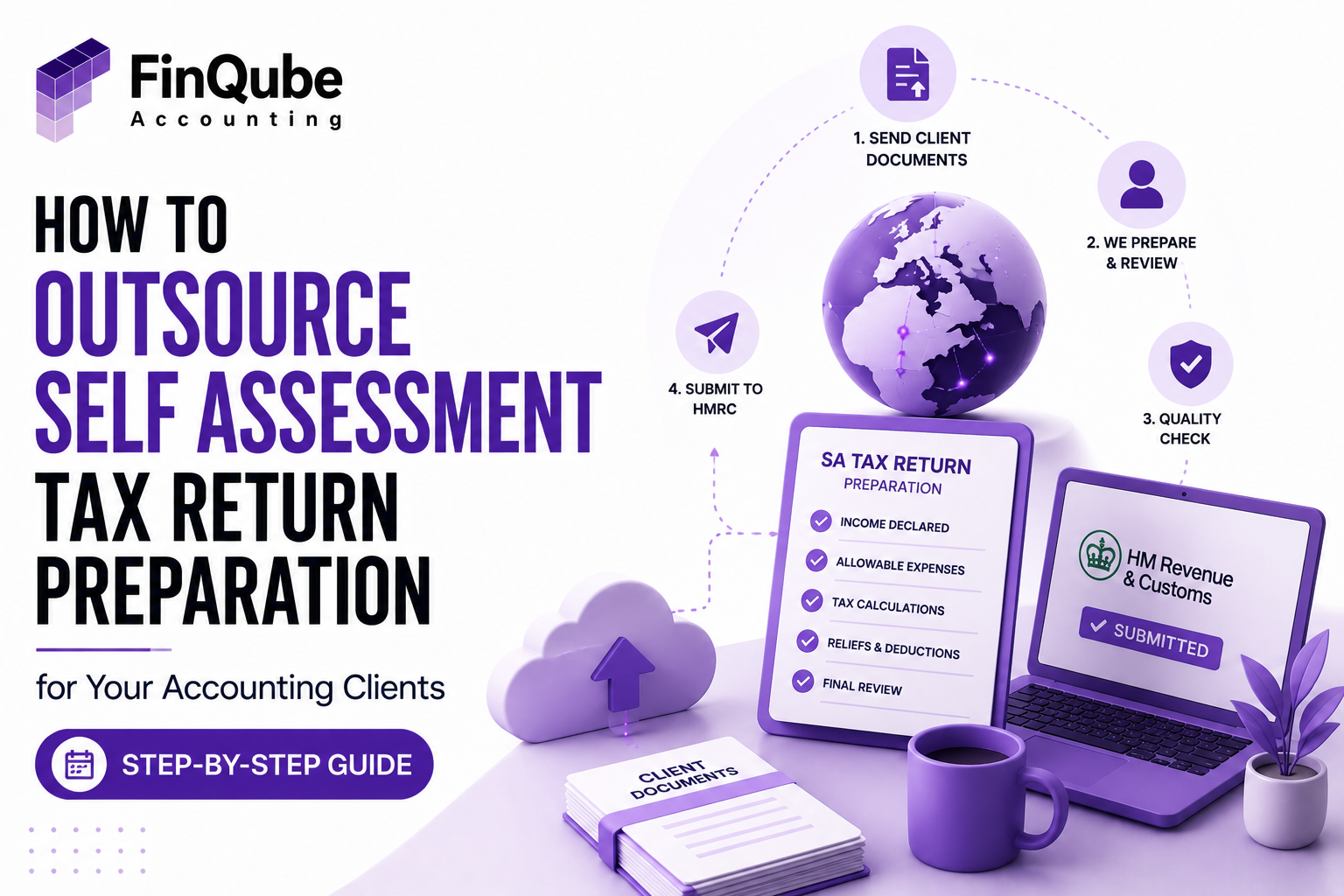
Step 1: Set the scope. Decide which returns go out first. Start with simple, low-risk clients before you add anything with CGT or foreign income.
Step 2: Pick a provider on quality, not price. Check how they review work, what software they use, and whether you get one dedicated contact or a rotating pool.
Step 3: Set up safe data transfer. Confirm GDPR-compliant file sharing and access controls before a single client file moves anywhere.
Step 4: Write down your workflow. Agree turnaround times both ways, steps for tricky queries, and what "ready for review" actually means.
Step 5: Run a small pilot. Test on 10 to 20 returns before you commit your full client book. Check accuracy, speed, and how well they communicate.
Step 6: Scale up with confidence. Once the pilot works, grow it steadily through October and November. Do this well ahead of the January peak.
Watch out for two mistakes that trip up most first-time outsourcers: skipping the pilot, and picking a provider on price alone. Both lead to rework, and rework in January is the worst thing that can happen.
REAL SCENARIO: A LEEDS PRACTICE BEFORE AND AFTER OUTSOURCING
Ashcombe Tait Accountants is a fictional example. It's built from patterns common among mid-sized UK practices, to show a typical before and after.
Before outsourcing, Ashcombe Tait had eight staff and around 900 Self Assessment clients. Every January, three staff worked evenings and weekends for the final two weeks.
The partners tried hiring a seasonal junior each year. It never worked well. Training took three weeks, and the junior left once the season ended.
By late January, mistakes crept in. Two returns in one season needed HMRC amendments after filing, both from wrong rental income figures.
The practice switched to an outsourced tax return preparation UK model. It sent its first batch of 40 simple returns in October as a pilot.
The outsourced team worked inside the practice's own Xero setup, so nothing changed for clients. A named accountant checked every file before it reached the partner's desk.
By January, Ashcombe Tait was sending 70% of its Self Assessment book through the same route. Partner time shifted from data entry to client calls and final sign-off.
No weekend work was needed that January. The two staff once buried in data entry spent the season talking to clients instead.
HOW FINQUBE CAN HELP
FinQube does the production work of Self Assessment prep. Your team gets to focus on review, queries, and client care.
One dedicated named accountant. You get the same person on every file. No rotating pool that makes you explain client history all over again each January.
We work inside your own systems. Xero, QuickBooks, Sage, FreeAgent, or any other software your practice already uses. We don't ask you to switch tools.
AI review before it reaches your partner. Our own AI checks every return for common errors, missing schedules, and odd figures, before your team ever sees it.
Fixed monthly pricing. You know your cost up front. No hourly billing, and no surprise invoices in the middle of tax season.
Set up as a services agreement, not labour supply. We deliver a finished outcome, which keeps your IR35 position clean.
No minimum contract. Start small, test the process on a few returns, and scale up only once you trust it.
Ready to see how it works with your own client files?
Book a capacity review call with FinQube. We'll look at your current Self Assessment workload and show you exactly where our corporation tax & self assessment services would take the pressure off, using our dedicated accountant model from day one.
13. CONCLUSION
January doesn't have to mean weekends in the office and more mistakes. Outsourced tax return preparation UK gives your practice a real fix, not a quick patch.
Start early. Pilot small. Keep review and sign-off in-house. That mix protects quality and frees up your best people.
Firms that treat self assessment outsourcing UK as a normal part of how they work, not just a January fix, see the biggest gains in staff retention and happy clients.
Talk to FinQube about your outsourced accounting services uk options. See what a calmer January could look like for your practice.
One month. No contract.
See how a dedicated Finqube accountant fits into your MTD workflow before you decide.
Start your free pilot14. FAQ
What does it mean to outsource self assessment tax returns?
An external team prepares the return. That means the data entry, the sums, and the draft. Your firm still checks it and files it.
Is it safe to outsource tax return preparation to an offshore team?
Yes, as long as the provider uses safe, GDPR-compliant data transfer, strong access controls, and a clear review step before anything reaches HMRC.
How much does it cost to outsource self assessment tax returns UK?
Costs vary by provider and volume. Ask for fixed monthly pricing instead of per-return billing. That keeps your costs steady through tax season.
Will my clients know their return was prepared by an outsourced team?
No. The outsourced team works inside your own systems, under your firm's name. Your client relationship stays exactly the same.
When should I start outsourcing before the January deadline?
Start in September or October. This gives you time to test the process on simple returns before your busiest weeks arrive.
What happens if HMRC penalises a return prepared by an outsourced provider?
Your firm stays responsible for the return you file. That's why review and sign-off should always stay with your named accountant, not the outsourced team.
Can I outsource just some of my self assessment clients, not all of them?
Yes. Most practices start with their simplest returns. They expand the scope once a pilot proves the quality and speed are right.