

Blog Summary
- What outsourcing VAT return filing actually involves, and what stays your job
- Why more UK practices moved VAT filing off their own desks in 2026
- Where most VAT errors happen when filing in-house
- How review transparency, not blind trust, makes outsourcing safe
Introduction
VAT return filing should take your team two days per client. For most practices juggling 30 to 50 returns a quarter, it takes a fortnight. It still ends with a last-minute fix before the deadline.
Every January, April, July, and October, the same partner checks the same reconciliations late at night.
This guide covers what it means to outsource VAT returns to a dedicated remote accountant. It covers what you keep control over. It shows how the right setup catches errors before HMRC ever sees them.
What Does It Mean to Outsource VAT Return Filing?
Outsourcing VAT return filing means a remote accountant does the work for you. They prepare, reconcile, and submit your clients' VAT returns. They work inside your systems. You review everything before it goes anywhere.
This is not the same as handing the client over. You keep the relationship. You keep sign-off. You keep the final say. What changes is who does the reconciliation and the checking. And who handles the digital submission.
A properly outsourced VAT service usually covers:
- Standard rate, flat rate, cash accounting, and annual accounting returns
- Partial exemption sums, for clients with mixed taxable and exempt supplies
- Digital submission through Xero, QuickBooks, Sage, FreeAgent, or any other software
- Checking the VAT return against the bookkeeping records
- Spotting reverse charge VAT and posting it correctly
- A log of anything unusual, flagged before submission
The work stays the same. What changes is who does it, and how much you can see before it reaches HMRC.
Why Are UK Practices Outsourcing VAT Filing Right Now?
Practices are outsourcing VAT filing for a simple reason. MTD compliance work has grown faster than most firms can hire for. Missed deadlines now carry a penalty that builds up quietly, until it does not.
Two pressures are hitting at once.
The first is capacity. Outsourcing adds capacity fast, without the cost of a new hire. According to AccountingWeb, Making Tax Digital for Income Tax has already rolled out. Many firms now manage new digital reporting cycles for clients who never had to file digitally before. Hiring a second VAT-competent bookkeeper can take months. A dedicated remote accountant can start within one to two weeks.
The second pressure is the cost of getting it wrong. Under HMRC's points-based system, a missed VAT deadline adds one penalty point. Cross the threshold for your filing frequency, and a fixed penalty follows. More penalties come after each further miss, according to GOV.UK. For a quarterly filer, that threshold is four points, according to ICAEW.
None of this is a disaster on its own. But across 30, 40, or 50 client returns a quarter, the odds of one slipping through rise every time your team is stretched thin.
Outsourcing does not remove the deadline pressure. It adds a second set of trained eyes. Someone whose only job that week is the VAT return. Not one of six tasks a generalist bookkeeper is racing through before Friday.
Who Should Be Responsible for an Outsourced VAT Return?
You stay responsible for the final review and sign-off. Every time. The dedicated remote accountant owns preparation, reconciliation, and the digital submission itself.
This is the part that makes practice owners nervous, and fairly so. The worry is not whether the work gets done. It is whether you will spot a problem before the client does. A well-built outsourcing setup answers that directly:
The accountability question is really a process question. Ask any provider exactly where your review sits in their workflow. Ask what you see, and when you see it.
When Does MTD Apply, and When Should You Start Outsourcing?
MTD for VAT has applied to every VAT-registered business since April 2022. MTD for Income Tax now applies to sole traders and landlords earning above £50,000, according to GOV.UK. Most practices already juggle this second wave of digital reporting, on top of their normal VAT deadlines.
This is not a future change to plan for. It is already here. Sole traders and landlords who once filed one annual return now file quarterly, digitally. These cycles run alongside the VAT quarters your team already handles. A practice with 30 to 50 VAT clients, plus a solid book of ITSA-mandated sole traders and landlords, now juggles two compliance calendars at once. Competing for the same reviewers. In the same weeks. Every quarter.
There is some breathing room. No penalty points apply for the first four quarterly submissions in the first year of MTD for Income Tax, running from April 2026 to March 2027, according to ICAEW. That softens the penalty risk. It does nothing to shrink the workload landing on your desk right now. The grace period ends on a fixed date. The work does not wait for it.
If your VAT client base is growing, or several clients are nearing the £90,000 VAT registration threshold, according to GOV.UK, that is your signal. Put outsourced capacity in place before the two compliance cycles pile up further. Not after.
Where Do Most VAT Errors Happen In-House?
Most VAT errors happen at the reconciliation stage. That is where return figures get checked against the bookkeeping records. Errors also cluster around reverse charge and partial exemption transactions. Generalist bookkeepers see these far less often than standard sales and purchase entries.
The recurring failure points:
Reconciliation mismatches. The VAT return total does not match the ledger. Usually a timing gap or a missed adjustment.
Reverse charge errors. Construction and cross-border services get posted as standard supplies. This gets the VAT position wrong.
Partial exemption mistakes. Clients with taxable and exempt income need a split calculation. It is easy to get wrong doing it once a quarter.
Odd input or output tax swings. A spike or drop against last period goes unexplained. Nobody had time to check it before the deadline.
Late adjustments. Credit notes, bad debt relief, or fix journals arrive after the return is already drafted.
A second set of eyes catches all of these. Someone whose only task that week is the VAT period. Not someone squeezing it in between bookkeeping, payroll, and a client call.
Handling High-Risk VAT Scenarios
Knowing VAT in general is not the same as handling the transaction types that actually cause errors. Two client types cause most of the mistakes: construction clients under Domestic Reverse Charge, and import-heavy clients using Postponed VAT Accounting. Both need someone who checks these every quarter. Not once a year by accident.
Domestic Reverse Charge for Construction Clients
Under DRC, a VAT-registered subcontractor does not charge VAT on their invoice to another VAT-registered contractor. Instead, the contractor accounts for both sides of the tax themselves, as long as they are not the end user of the building work.
The risk sits in three places:
- Spotting which supplies fall inside the Construction Industry Scheme. Mixed invoices need splitting, not one blanket rule.
- Confirming the customer's end-user status before the invoice goes out. Get this wrong, and you have to unpick the VAT treatment across a whole contract.
- Making sure the software applies the DRC VAT code, not the standard rate. A default setting left unchanged quietly produces the wrong return every time.
An accountant working construction clients every quarter learns to spot a wrong DRC code before it hits the return. Not during an HMRC check.
Postponed VAT Accounting for Import-Heavy Clients
PVA lets importers put import VAT on their VAT return, instead of paying it upfront at the border. This helps cash flow. But it puts more weight on careful record keeping.
The common failure point is the monthly postponed import VAT statement. This comes from HMRC's Customs Declaration Service. Either it does not show up on the VAT return at all, or it shows the wrong value. Gaps between the statement and what the freight forwarder declared are common, especially with several shipments in one period.
Someone working import clients regularly checks the monthly PVA statement against the return every time. Not as an afterthought once the return is already done.
Both cases teach the same lesson. Reverse charge and postponed accounting are exceptions to normal VAT rules. Exceptions are exactly where a generalist, juggling bookkeeping, payroll, and VAT in the same week, defaults to the standard rule instead of checking which rule actually fits.
How a Dedicated Remote Accountant Handles VAT at Scale
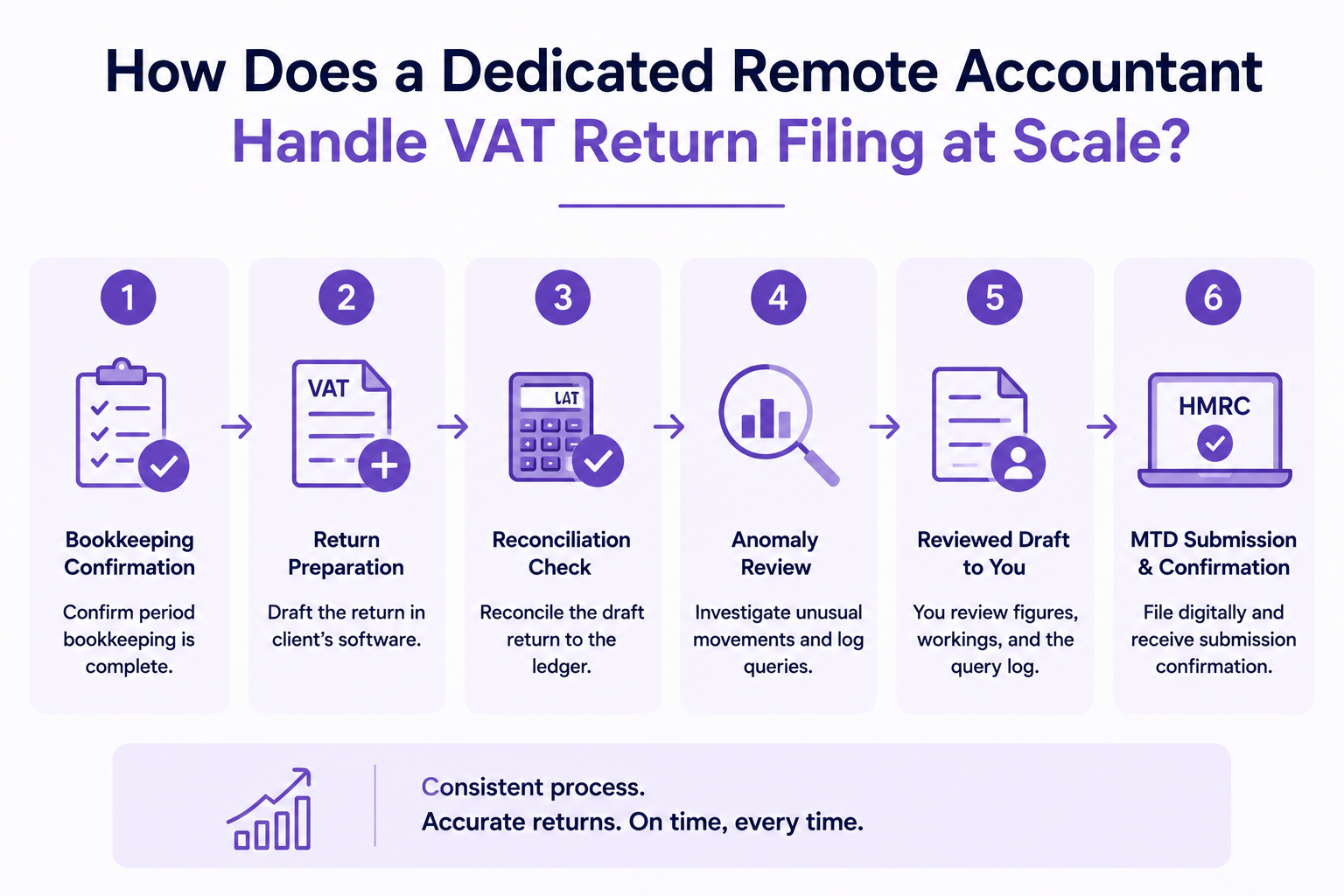
A dedicated remote accountant runs the same checks on every client file, every quarter, inside your existing software. A query log and a reviewed draft come back to you before anything reaches HMRC.
The workflow, step by step:
- Bookkeeping check. The accountant confirms the period's books are done, whether that sits with you or is also outsourced.
- Return preparation. Figures get pulled and the return gets drafted in Xero, QuickBooks, Sage, FreeAgent, or any other software the client uses. Nothing gets rebuilt from scratch.
- Reconciliation check. The draft return gets matched back to the ledger. Any gap gets flagged, not smoothed over.
- Anomaly review. Odd movements, including DRC and PVA transactions, get checked and explained in a log. Not just submitted and hoped for.
- Reviewed draft comes to you. You see the figures, the workings, and the query log before you approve anything.
- Submission and confirmation. Once approved, the return gets filed digitally. A submission reference confirms it reached HMRC on time.
This is where seeing the work matters more than raw speed. Every Finqube engagement includes AI review software. It gives you a live view of every file your accountant is working on. Before a file reaches you, the software has already flagged mismatches and odd movements. What lands on your desk is already clean.
Comparison: In-House vs Outsourced VAT Filing
How Finqube Can Help
Outsourcing VAT return filing only works if you can see the work before it reaches you. Not after. That is what Finqube's dedicated remote accountants and AI review software are built to solve together.
Every Finqube engagement pairs a dedicated remote accountant, trained on UK VAT and MTD rules including DRC and PVA, with review software that flags mismatches and odd movements before a return reaches your desk. You are not trusting a black box. You are reviewing a return that has already been checked twice. Once by a person, once by the software behind them.
The accountant works inside whatever software your practice already runs. Xero, QuickBooks, Sage, FreeAgent, or any other software your clients use. There is no software switch to plan before the support even starts.
There is no minimum commitment on any engagement. See the full scope of Finqube's VAT and MTD compliance service, or explore Finqube's engagement models to see which structure fits your practice.
One month. No contract.
See how a dedicated Finqube accountant fits into your MTD workflow before you decide.
Start your free pilotConclusion
VAT return filing does not have to be the thing your team dreads every quarter. Outsourcing it to a dedicated remote accountant turns a recurring deadline scramble into a process you can see and trust. You get full visibility over reconciliation, checks, and submission.
There is no minimum commitment to find out if it fits your practice. Explore Finqube's engagement models and start with a dedicated VAT accountant inside your systems.
FAQ
Can I outsource just VAT returns, or does it have to be the whole bookkeeping function?
You can outsource VAT return filing on its own. Many practices start there, since it is a set task with a clear deadline. They add bookkeeping or management accounts later, once they trust the process.
Will an outsourced accountant work with our existing software?
Yes. A properly set up VAT service works inside Xero, QuickBooks, Sage, FreeAgent, or any other software your practice and clients already use. No need to switch platforms first.
How do I know an outsourced VAT return is accurate before it is submitted?
You should get a reviewed draft with full workings and a check against the ledger before anything goes to HMRC. If a provider will not show you that step, ask why not.
Does outsourcing cover Domestic Reverse Charge and Postponed VAT Accounting clients?
It should. Construction clients under DRC and import-heavy clients using PVA need someone who checks these transaction types every period. Not a generalist defaulting to the standard rule.
What happens if HMRC queries a return that was outsourced?
The client relationship stays your responsibility. A good outsourcing partner backs you up with the workings and records you need to answer any HMRC query.
How quickly can a dedicated VAT accountant be up and running?
With Finqube, usually one to two weeks from your first call to working inside your systems. Compare that to three or more months for an equivalent in-house hire.
What is the penalty risk if a VAT return is filed late?
HMRC runs a points-based system. Cross the penalty threshold for your filing frequency, and a fixed penalty applies. More penalties follow for each further miss. The threshold for quarterly filers is four points.
Is there a minimum contract length with Finqube?
No. Finqube's engagement models come with no minimum commitment. Start with one VAT client, or your whole book.