.avif)

Blog Summary
- What UK payroll bureaux actually charge, from base fees to per-payslip add-ons
- Where the hidden costs sit, including setup, pension admin, and correction fees
- How payroll bureau pricing compares with fully outsourced payroll on a real cost basis
- How FinQube prices payroll support with one fixed monthly fee and no surprise invoices
Introduction
You signed up for a payroll bureau. The quote looked simple. Then the invoice arrived. It had a setup fee. It had a pension admin charge. It had a correction fee for a starter form nobody flagged.
This happens to UK accounting practices every payroll season. The headline price on a bureau's website rarely matches what lands on your bank statement three months later.
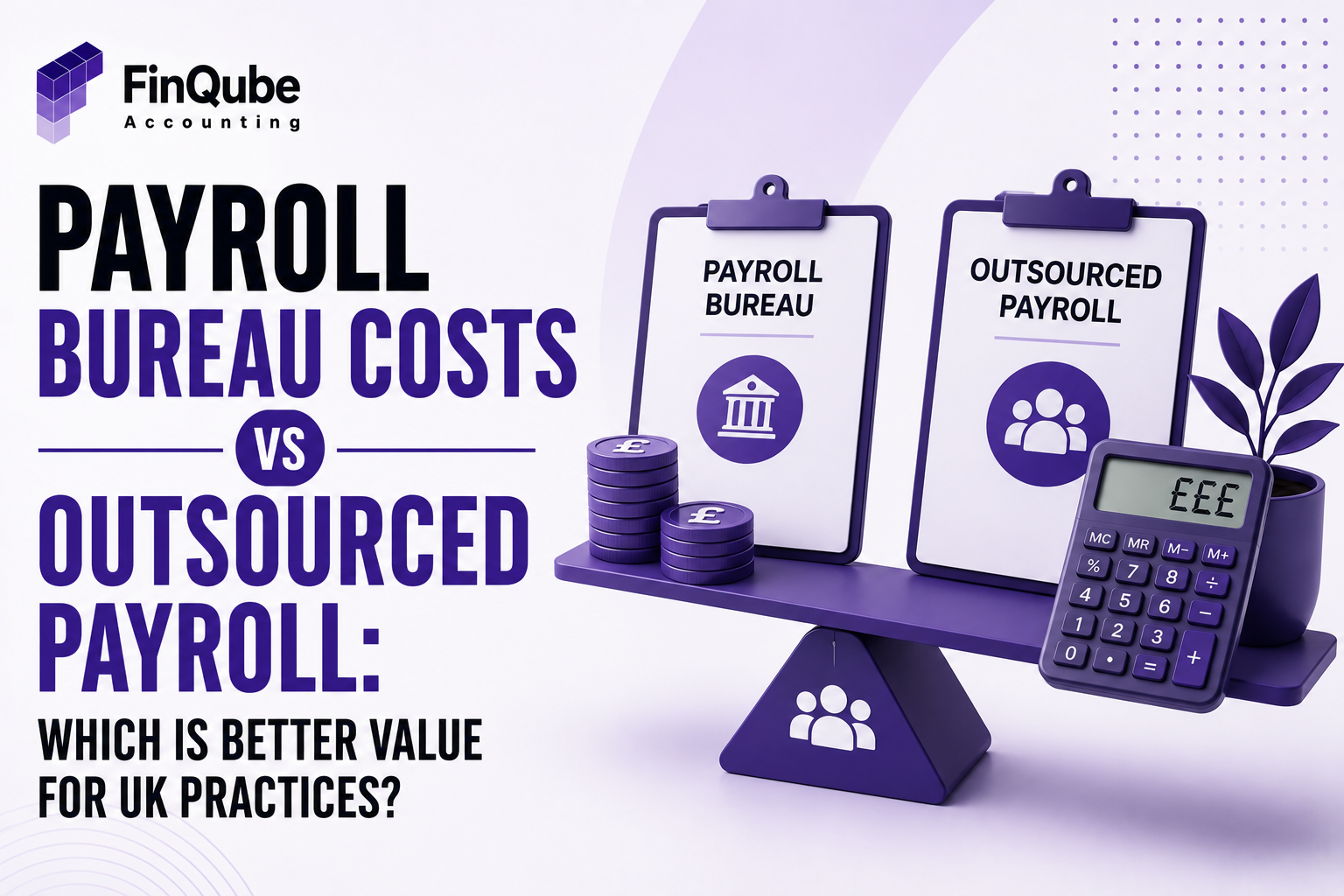
This guide breaks down real payroll bureau costs. It compares them against fully outsourced payroll. You will see exactly where the gap between quoted and actual pricing opens up. You will also see how a fixed monthly model removes that guesswork.
What Is a Payroll Bureau and What Does It Cost?
A payroll bureau is a service that supports your in-house payroll team. It handles specific tasks like RTI submissions and payslip generation. Your practice keeps some control in-house.
A bureau is different from full outsourced payroll UK support. With full outsourcing, a third party manages the entire cycle. It does not just support your team on specific tasks.
Bureau pricing usually runs on a per-payslip or per-employee basis. Most UK bureaux charge between £4 and £12 per employee per month. Smaller client accounts often face a minimum monthly fee too, typically £25 to £80 regardless of headcount.
Per-payslip pricing tends to sit between £2 and £8. Weekly payroll runs cost more than monthly ones. Fixed monthly packages exist too. They typically run £25 to £250, depending on client size. They rarely include everything.
According to Wise, published bureau rates often understate the real cost. The site notes that "the biggest payroll cost is often not what you pay your payroll provider. It is the time and effort spent around payroll." That gap between quoted and actual spend is why this comparison matters.
Why Do Payroll Bureau Costs Creep Up After Month One?
Bureau costs creep up because the base fee rarely covers every task your clients need. Add-ons stack quickly once you start using them.
Setup fees can run from £50 to £1,000. The exact cost depends on client size and data migration complexity. Pension auto enrolment administration typically adds £1.50 to £3.50 per enrolled employee, per month. P11D processing can cost £10 to £75 per employee at year end.
Then there are the fees nobody mentions upfront. Off-cycle amendments, BACS payment file generation, and CIS certificate processing for construction clients each carry their own charge. These often run £5 to £40 per instance. Picture a practice running payroll for 30 clients. These small charges add up fast. They add up to a real monthly cost that never appeared on the original quote.
This is the pattern practice owners describe most often. The bureau relationship starts affordable. It becomes expensive because nobody totalled the add-ons before signing.
Who Should Choose a Bureau Over Full Outsourcing?
A bureau suits practices that want to keep some payroll tasks in-house. It works when you have staff capacity but need help with RTI and HMRC filing.
According to PayFit, a bureau is "a hybrid payroll service that combines the efforts of your internal payroll team with an outsourced team of experts." That hybrid model means you keep oversight. But you still need staff hours dedicated to the process.
Say your practice has a payroll specialist already on the books. You just need help with RTI submissions and pension compliance. A bureau can work here. However, you pay twice. You pay for your internal team's time. Then you pay again for the bureau's fees.
If you are still weighing up providers, our guide to outsourced payroll providers UK walks through how to choose the right one for your practice.
Are you trying to reduce headcount pressure? Do you want to free up your team entirely? A bureau will not get you there. That is where full outsourcing changes the maths.
When Does Full Outsourcing Become Cheaper Than a Bureau?
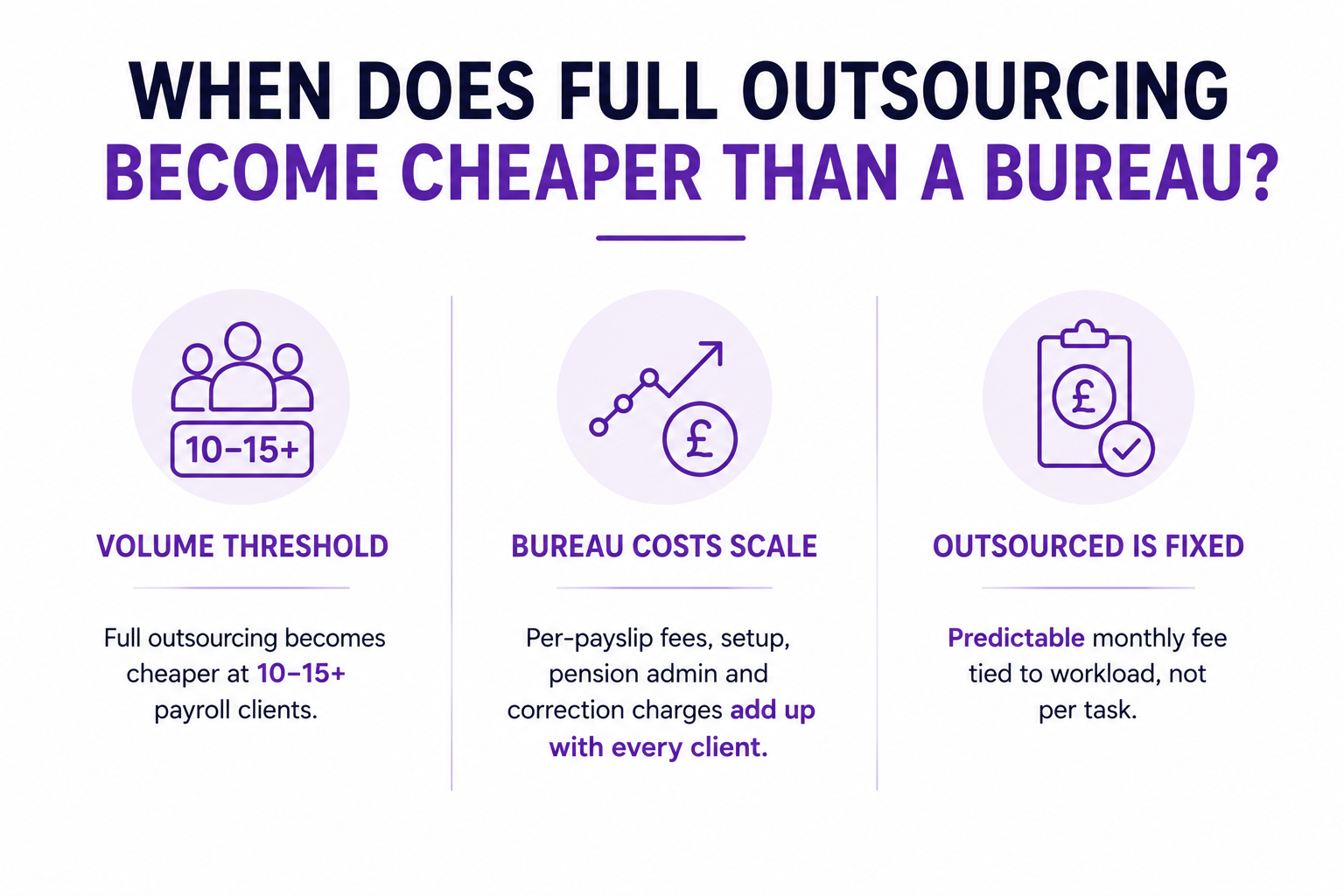
Full outsourcing tends to become cheaper once a practice runs payroll for more than 10 to 15 clients. Bureau per-payslip and add-on fees scale up with every client. Outsourced fixed pricing does not.
Picture a practice paying £6 per employee, plus a £40 setup fee, a £2 pension admin fee, and occasional £15 correction charges. Multiply that across dozens of clients. The total can easily beat a fixed-fee outsourced arrangement covering the same volume. The bureau model punishes growth. Every new client adds fresh per-employee charges and fresh admin fees.
Outsourced payroll works differently. It is usually priced as a predictable monthly fee tied to workload, not itemised per task. That predictability matters most when you quote your own clients a fixed retainer. You cannot price your services accurately if your own payroll costs move every month.
Where Do Most Hidden Payroll Fees Appear?
Most hidden fees appear in four places: setup, pension administration, corrections, and year-end filing. These rarely show up in the headline price you were quoted.
The table below shows where bureau pricing typically hides extra cost.
Practices that only budget for the base per-employee fee usually get a shock. They underestimate their true annual payroll cost by 20% to 40% once these extras are added across a full client book. For a closer look at RTI specific compliance costs, see our guide to RTI payroll UK requirements.
How Do You Compare Bureau Pricing Against Outsourced Payroll Fairly?
You compare them fairly by calculating total annual cost per client. Do not just look at the headline per-payslip rate. Add every fee a bureau charges across a full year. Then compare that total against a fixed outsourced fee for the same volume.
Start by listing every fee type your current bureau charges. Multiply per-employee and per-payslip rates by your actual client headcount and payroll frequency. Add setup, pension admin, correction, and year-end costs. Use last year's actual invoices for this, not the quoted rate card.
Then compare that total against a fully outsourced, fixed-fee arrangement for the same workload. Include every add-on and the fixed fee model usually comes out ahead. It also comes with one invoice instead of six.
Payroll Bureau vs Outsourced Payroll: Full Cost Comparison
The table below compares payroll bureau services, hiring in-house, and FinQube's fully outsourced model side by side.
FinQube prices payroll support as one fixed monthly fee. We agree this with you before work begins, based on client volume and payroll frequency. There is no per-payslip surcharge. There is no setup fee. There is no year-end surprise invoice. You know the number before the month starts. It does not change because a client added three new starters.
For a full breakdown of how outsourcing pricing works across accounting services more broadly, see our guide on accounting outsourcing cost. You can also run your own numbers through the FinQube ROI Calculator.
Real Scenario: Hughes Accountancy
Daniel Hughes runs Hughes Accountancy. He was managing payroll for 40 clients through a mix of an in-house junior and a regional payroll bureau. The bureau invoice looked reasonable on paper.
Then the extras added up. Pension admin, correction fees, and two P11D seasons pushed his actual annual spend nearly 35% above the original quote.
He also had no visibility into which files had been checked before submission. Two RTI errors reached HMRC in one quarter. Both traced back to starter details his junior had entered. Nobody had reviewed them first.
Daniel moved payroll to a dedicated Finqube accountant. Our proprietary AI review software now flags discrepancies before submission. He recovered 12 hours per week by month two. His payroll spend became one predictable monthly figure. The RTI errors stopped.
How Finqube Can Help
You should not have to choose between paying too much for a bureau or losing control by outsourcing blind. Finqube gives you a dedicated accountant and full visibility, at one fixed price.
Every client gets one named payroll accountant. This is not a shared inbox or a rotating contact. They work inside your existing systems, whether that is Xero, QuickBooks, Sage, FreeAgent, or any other software your clients already use. Nothing needs migrating.
Before any RTI submission reaches you for sign-off, our proprietary AI review software checks it first. It flags reconciliation mismatches, missing starter or leaver details, and pension enrolment errors. You review a file that has already been checked. You do not have to check it yourself.
Pricing is fixed and agreed upfront, based on your client volume and payroll frequency. No per-payslip charges. No setup fee. No surprise invoice at year end. Does your practice need IR35 structured correctly? Our engagements run as a services agreement, not labour supply. Your compliance position stays clean.
See how fixed-fee payroll support compares to your current bureau invoice. Book a call with FinQube and bring your last three months of payroll invoices. We will show you the real number, side by side. No minimum commitment.
One month. No contract.
See how a dedicated Finqube accountant fits into your MTD workflow before you decide.
Start your free pilotConclusion
Payroll bureau pricing looks affordable at first. Then the add-ons start stacking up. Setup fees, pension admin charges, and correction costs can push your real annual spend 20% to 40% above the quoted rate. Outsourced payroll with one fixed monthly fee removes that unpredictability. For UK practices managing payroll across a growing client book, the fixed-fee model is usually cheaper and easier to plan around. Talk to FinQube about what a fixed monthly payroll fee would look like for your practice.
FAQ
How much does a payroll bureau cost per employee in the UK?
Most UK payroll bureaux charge between £4 and £12 per employee per month. Smaller client accounts also face a minimum monthly fee of £25 to £80. Per-payslip pricing typically runs £2 to £8. Weekly runs cost more than monthly ones.
What is the difference between a payroll bureau and outsourced payroll?
A payroll bureau supports your existing in-house team with specific tasks like RTI filing. You keep internal staff and some control. Fully outsourced payroll hands the entire process to a third party. This includes a dedicated accountant managing the whole cycle.
Are there hidden fees with payroll bureaux?
Yes. Common hidden fees include setup charges, pension auto enrolment administration, P11D processing at year end, off-cycle amendment fees, and BACS payment file charges. These can add 20% to 40% on top of the quoted per-employee rate.
Is outsourced payroll cheaper than a payroll bureau?
For practices managing payroll across more than 10 to 15 clients, yes. Fully outsourced payroll with a fixed monthly fee is usually cheaper once bureau add-on fees are included. Bureau costs scale per client and per task. Fixed-fee outsourcing does not.
What does HMRC charge for late payroll submissions?
HMRC applies monthly penalties for late RTI filing based on employee count. There is also an additional penalty of 5% of unpaid tax and National Insurance if a submission stays outstanding beyond three months, according to GOV.UK.
Can a small accounting practice outsource payroll without losing control?
Yes. A dedicated payroll accountant working inside your existing systems gives you more oversight than a bureau relationship split across shared staff. You get review visibility before submission. You see the file before it goes anywhere near HMRC.
How quickly can a practice switch from a payroll bureau to outsourced payroll?
Most switches take 1 to 2 weeks with a dedicated outsourced provider. Compare that with recruiting and training an in-house payroll specialist, which typically takes 3 months or more.