.avif)

Blog Summary
- Every VAT, PAYE, Self Assessment and Corporation Tax deadline that falls in the 2026/27 tax year
- Why deadline dates shift depending on your client's accounting period, not the calendar year
- The three points in the filing process where UK practices most often lose a deadline
- How a dedicated remote accountant with proprietary AI review keeps your firm ahead of every date
Introduction
Miss one Self Assessment deadline. You cover the client's penalty. Miss three in one January. You start losing clients.
The 2026/27 tax year is busy. It has VAT quarters, PAYE months, a Self Assessment peak, and staggered Corporation Tax dates. Each one runs on its own clock. This tax calendar UK guide puts every date in one place. No guesswork.
The tax year 2026/27 runs from 6 April 2026 to 5 April 2027. It holds a Self Assessment deadline that hits millions of taxpayers. It holds twelve months of PAYE and VAT cycles. It is also the first full year of Making Tax Digital for Income Tax at scale. Get one date wrong and HMRC will not care that your firm was short-staffed that week.
What Is the UK Tax Calendar for 2026/27?
The UK tax calendar for 2026/27 is the full set of HMRC and Companies House deadlines. It covers 6 April 2026 to 5 April 2027.
It has four main obligation types. These are Self Assessment, VAT, PAYE and payroll, and Corporation Tax. Each one has its own rhythm. Self Assessment runs once a year. VAT runs quarterly, or monthly for some clients. PAYE runs every month. Corporation Tax runs on each client's own accounting period, not the UK tax year.
For a small practice, that means tracking dozens of deadlines at once. One spreadsheet per client does not scale past ten or fifteen clients. That is where most deadline tracking starts to break down.
Why Do UK Accounting Firms Miss Tax Deadlines?
UK accounting firms miss tax deadlines for two reasons. Client accounting periods do not match the tax year. And manual tracking cannot keep up with the volume.
Take a firm with 40 clients. Corporation Tax deadlines can fall in every month of the year, because each client's year end is different. Add VAT quarters that reset every three months per client. Add payroll deadlines that hit monthly across the whole book. Now you have hundreds of dates to track at once.
According to ICAEW, capacity pressure during peak filing periods is a common cause of late submissions and unhappy clients. One person often owns the deadline tracker. When that person is off sick or buried in review work, deadlines slip through.
The most common causes we see across UK practices:
- No single source of truth for client-specific deadlines
- Manual spreadsheets that fall out of date after a client changes their accounting period
- One overstretched team member responsible for chasing every filing
- No review step that flags a missed date before it becomes a missed deadline
Who Should Own Deadline Tracking in Your Practice?
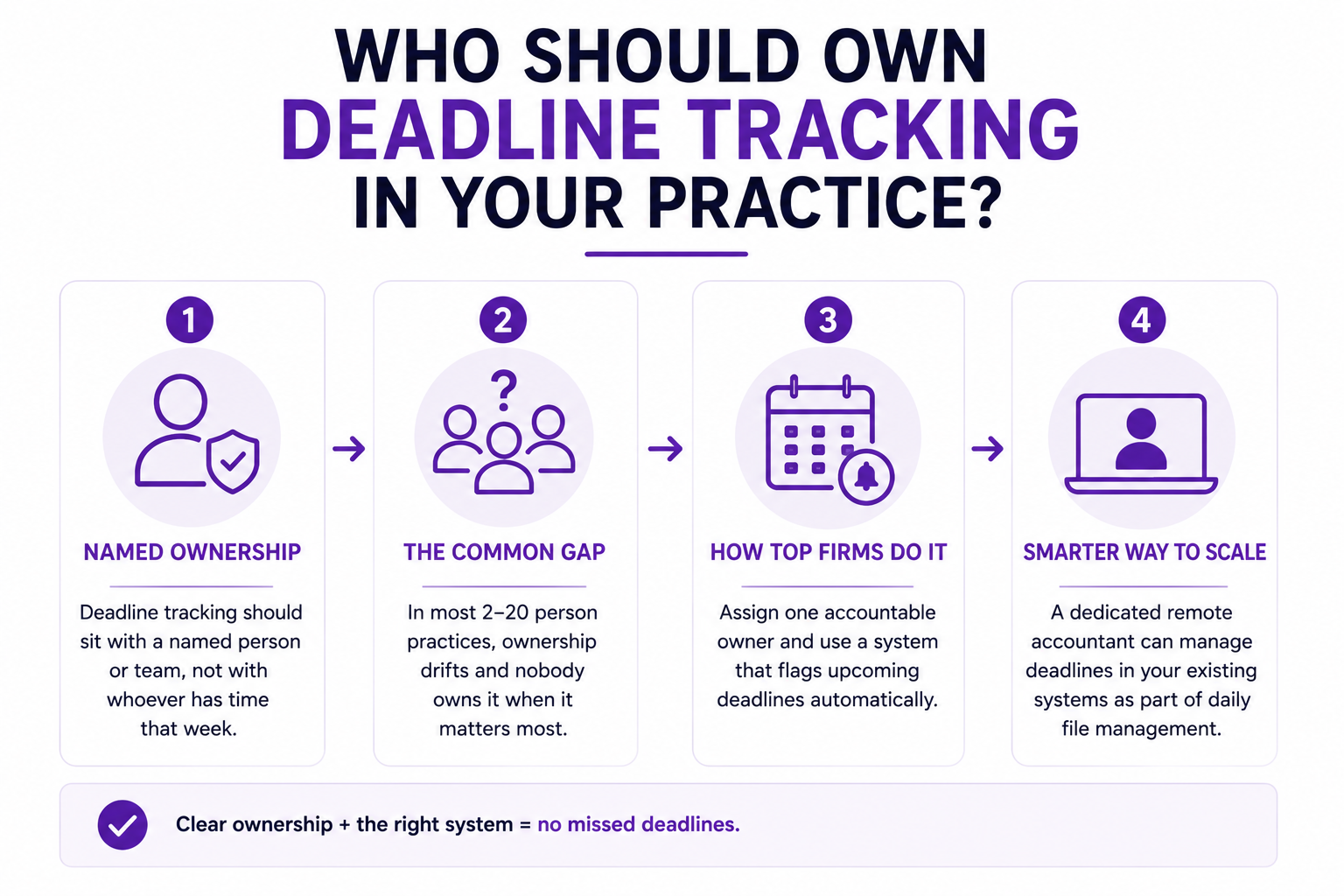
Deadline tracking should sit with a named person or team. It should not fall to whoever has time that week.
In most 2 to 20 person practices, this job drifts. A partner owns it on paper. A junior tracks it in practice. Nobody owns it when both are busy with client work at the same time. That gap is where deadlines get missed.
The firms that stay ahead assign deadline ownership the way they assign client files. One accountable person owns it. A system flags upcoming dates on its own, instead of relying on memory. A dedicated remote accountant can take this on as part of day-to-day file work, not as a separate admin task. This works whether your firm runs on Xero, QuickBooks, Sage, FreeAgent, or any other software.
When Do the Key 2026/27 Deadlines Fall?
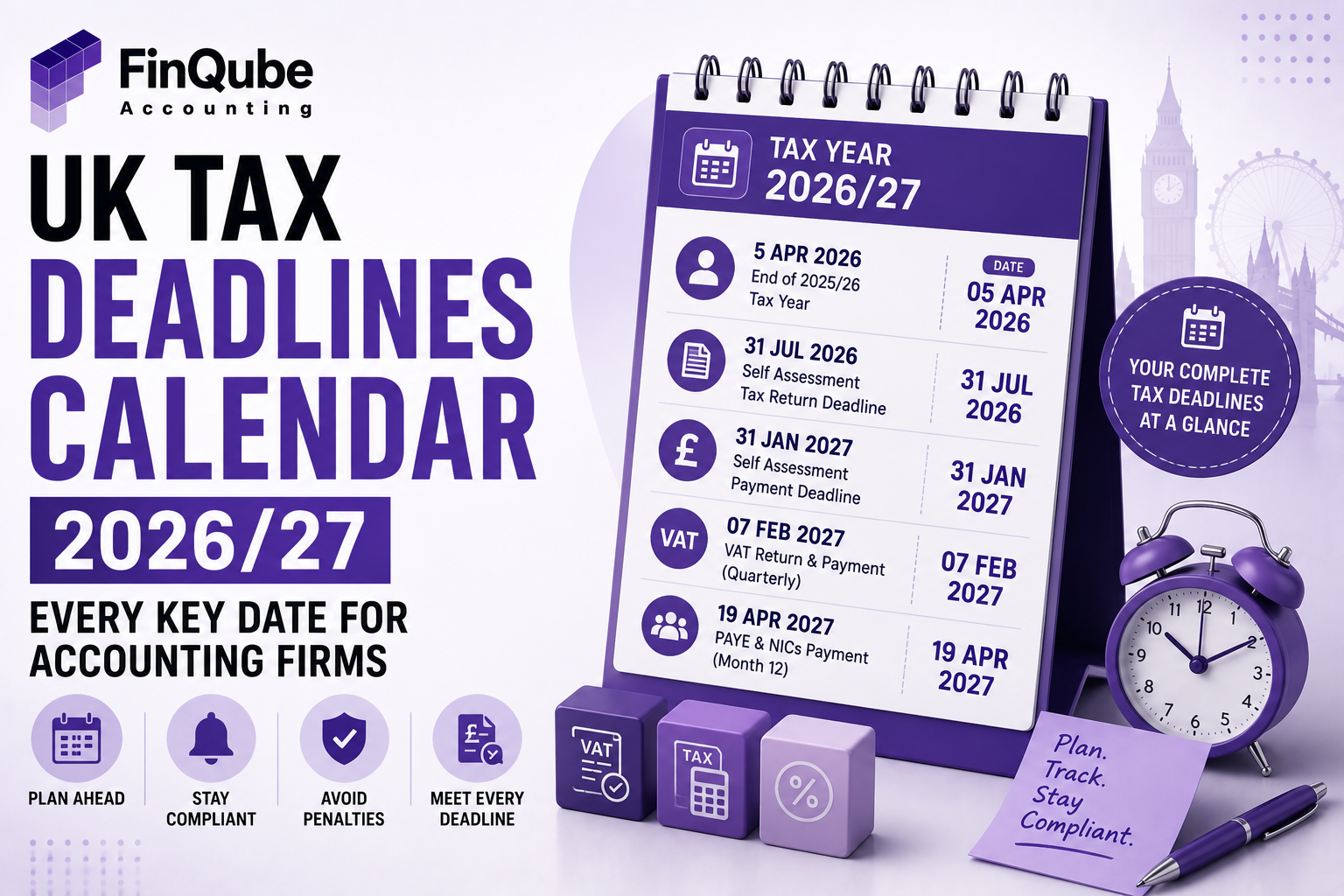
The 2026/27 deadlines span Self Assessment, VAT, PAYE and Corporation Tax. January and July carry the heaviest load.
Below is the full working calendar. Corporation Tax dates depend on each client's own accounting period end. So we have added the standard nine-month payment window and twelve-month filing window, with worked examples.
Self Assessment Deadlines 2026/27
According to GOV.UK, taxpayers who file online and owe less than £3,000 can ask HMRC to collect it through their tax code. They must file by 30 December 2026 to qualify.
VAT Return Deadlines 2026/27
Most VAT-registered businesses file quarterly. Payment is due one calendar month and seven days after the period ends.
Clients on the Annual Accounting Scheme file once a year. The return is due two months after the annual period ends.
PAYE and Payroll Deadlines 2026/27
Corporation Tax Deadlines 2026/27
Corporation Tax runs on each client's accounting period, not the tax year. Payment is due nine months and one day after the period end. The CT600 return is due twelve months after the period end.
Making Tax Digital for Income Tax
Making Tax Digital for Income Tax became compulsory from 6 April 2026. It applies to self-employed people and landlords with income above £50,000. The threshold drops to £30,000 from 6 April 2027. That pulls a much larger share of your client book into quarterly digital reporting. According to GOV.UK, affected clients must keep digital records and file quarterly updates instead of one annual return.
Where Do Most Deadline Errors Happen?
Most deadline errors happen at the handoff points. They rarely happen inside the filing itself.
The actual VAT return or Self Assessment submission is rarely the problem. The failure point comes earlier. A client's accounting period changes and nobody updates the tracker. A junior prepares a file correctly, but nobody confirms it reached the partner in time for sign-off. Or a payroll deadline gets buried under month-end work.
Three handoff points cause most missed deadlines in UK practices:
- Onboarding to logging: new clients are not added to the tracking system right away
- Preparation to partner review: a finished file sits waiting for sign-off, with no visibility into how long it has waited
- Filing to confirmation: nobody checks that a submission actually went through
A review system that flags where every file sits closes these gaps before they turn into a missed deadline.
How Does a Dedicated Remote Accountant Help You Hit Every Date?
A dedicated remote accountant takes deadline tracking and file prep off your team's desk. They stay inside your existing review process.
They do not add another spreadsheet. A dedicated accountant works inside the systems you already use, whether that is Xero, QuickBooks, Sage, FreeAgent or any other software. They build deadline tracking into the file itself. Each client record carries its own VAT quarter, Corporation Tax date and Self Assessment status. Your team can see it at any time.
This works best with a review layer that catches problems before a file reaches the partner. A named accountant plus a proprietary review step turns a deadline calendar from a document nobody checks into a system that runs itself.
Real Scenario: Bright Path Accountants
Priya Shah runs Bright Path Accountants, a nine-person practice in Leeds. Her team handles around 150 client files across VAT, payroll and Self Assessment. Before she worked with a dedicated remote team, her firm tracked deadlines on a shared spreadsheet. Two team members updated it, but not always.
In January 2025, three Self Assessment returns went in late. The spreadsheet had not been updated after a staff change. Nobody noticed the files were still sitting in draft. Two clients got HMRC penalties. Priya spent the next week on damage control calls instead of client work.
Then she brought in a dedicated FinQube accountant with our proprietary AI review software built into the workflow. Now every client record carries its own live deadline status. Files get flagged automatically if they sit unreviewed for more than 48 hours. Bright Path has not missed a filing deadline since. Priya now spends January reviewing clean files instead of chasing them.
How FinQube Can Help
Running an accurate tax calendar across dozens of files is a capacity problem, not a knowledge problem. You already know when VAT quarters end. What breaks down is having enough hands to prepare, review and file on time, every time.
FinQube gives your practice one dedicated named accountant, not a shared pool. They work inside your existing systems, whether that's Xero, QuickBooks, Sage, FreeAgent or any other software your clients use. Every file your accountant prepares passes through our proprietary AI review software before it reaches your partner. It flags reconciliation issues and missing information, so you review work that is already clean. Pricing is fixed monthly, so you know your cost before the year starts, not after a busy quarter runs up the hours. There is no minimum commitment. If your engagement involves IR35, it is structured as a services agreement, not labour supply.
Conclusion
The 2026/27 tax calendar is packed with dates. VAT quarters, PAYE months, Self Assessment peaks and staggered Corporation Tax deadlines all run on their own clocks. One missed handoff can cost a client a penalty. It can cost you their trust. The firms that stay ahead treat deadline tracking as a system, not a memory exercise. Build the tracker into your files. Assign clear ownership. Add a review layer that catches gaps early. Talk to FinQube about how a dedicated accountant and proprietary AI review can keep your practice ahead of every date this year.
One month. No contract.
See how a dedicated Finqube accountant fits into your MTD workflow before you decide.
Start your free pilotFAQ
When is the Self Assessment deadline for 2025/26?
The online Self Assessment deadline for the 2025/26 tax year is 31 January 2027. Paper returns are due earlier, on 31 October 2026. Both dates carry automatic penalties if you miss them.
What are the VAT return deadlines for 2026/27?
VAT returns are due one calendar month and seven days after each quarter ends. Take a standard quarter ending 31 March 2026. The filing and payment deadline is 7 May 2026.
When do I need to pay Corporation Tax?
Corporation Tax payment is due nine months and one day after your accounting period ends. The CT600 return itself is due twelve months after the period end. That gives you a longer window to file than to pay.
What is the deadline for P11D forms?
P11D and P11D(b) forms are due by 6 July, after the tax year they cover ends. Class 1A National Insurance on the benefits reported is due by 22 July if you pay electronically.
When does Making Tax Digital for Income Tax apply to my clients?
Making Tax Digital for Income Tax became compulsory from 6 April 2026. It applies to self-employed people and landlords with income above £50,000. The threshold drops to £30,000 from 6 April 2027.
How do I track tax deadlines across multiple clients?
Most practices use practice management software or a shared calendar. They log each client's VAT quarter, payroll dates and Corporation Tax period one by one. A dedicated remote accountant can build this tracking straight into your existing systems, instead of a separate spreadsheet.
What happens if my practice misses a client's tax deadline?
HMRC applies automatic penalties for late Self Assessment, VAT and Corporation Tax filings. The fine starts small and grows the longer the delay lasts. Beyond the penalty, a missed deadline hurts the trust a client places in your practice.