
.avif)

Blog Summary
- The seven operational signs that tell you your practice has outgrown its current capacity
- Why turning away work is a more urgent signal than most partners realise
- How a named client scenario (Hughes Accountancy) worked through this exact decision
- What outsourcing actually costs against hiring in-house, with a straight answer on Finqube pricing
- How to test the model with a one-month free pilot before committing to anything
What Does It Mean for a Firm to Be "Ready" to Outsource
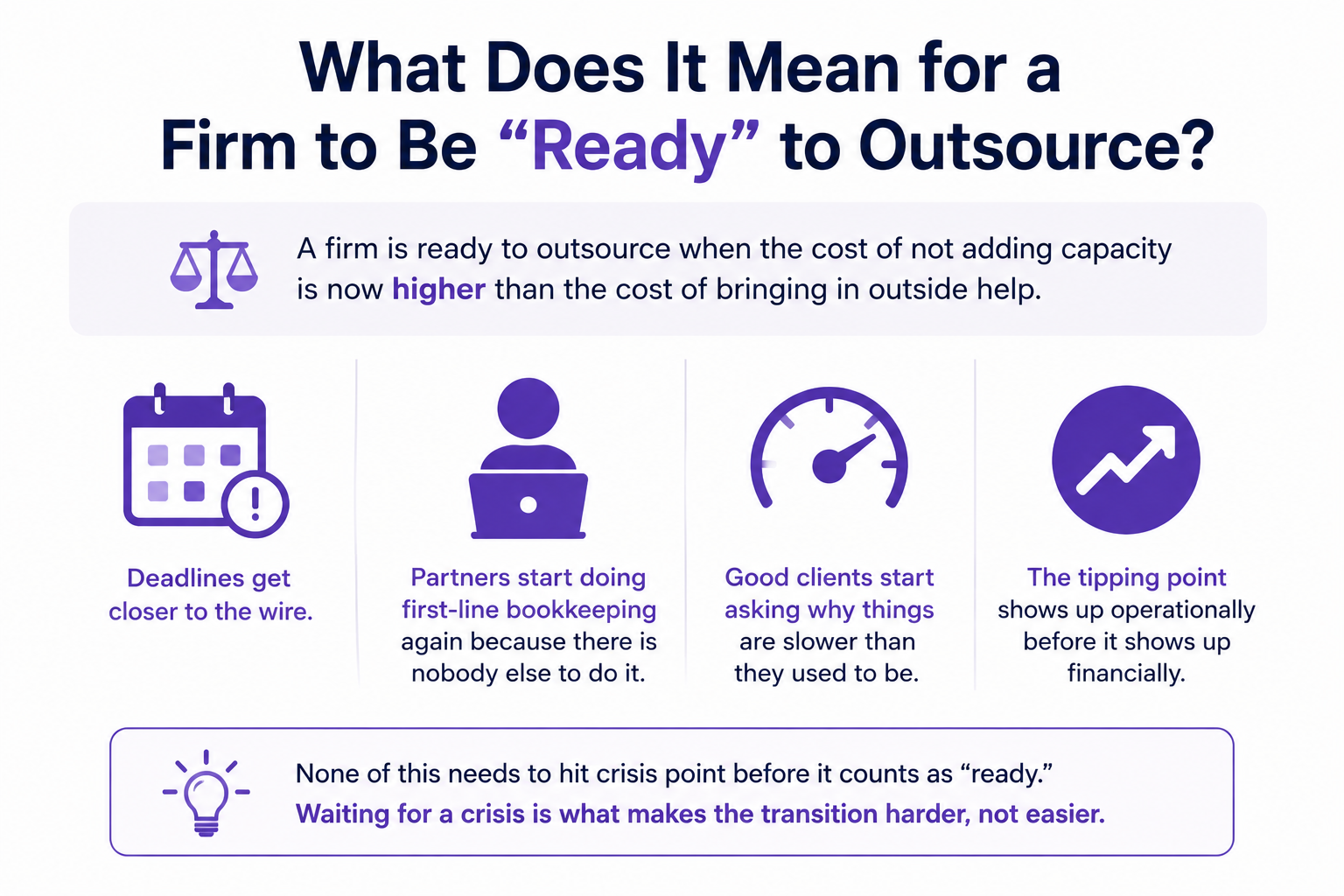
A firm is ready to outsource when the cost of not adding capacity is now higher than the cost of bringing in outside help. That tipping point usually shows up operationally before it shows up financially.
You will notice it in the diary before you notice it on the P&L. Deadlines get closer to the wire. Partners start doing first-line bookkeeping again because there is nobody else to do it. Good clients start asking why things are slower than they used to be. None of this needs to hit crisis point before it counts as "ready." Waiting for a crisis is what makes the eventual transition harder, not easier.
Why Practices Reach This Point
Most UK practices are not outgrowing their capacity because they are badly run. They are outgrowing it because the profession has a structural staffing problem that individual hiring cannot solve fast enough.Separately, AccountingWEB reports that 40% of practices describe the impact of the talent shortage on their business as very significant or severe, with the effects felt most in business services and tax divisions (https://www.accountingweb.co.uk/practice/general-practice/the-talent-shortage-is-stunting-firms-growth).
This matters because it reframes the decision. Outsourcing is not a sign your firm has failed to hire well. It is what a growing number of well-run UK practices are doing because the local talent pool cannot keep pace with client demand.
Who Should Be Making This Call
In practices of 2 to 20 staff, this decision usually sits with the managing partner or practice owner, but the signal often comes from further down the chain first. Senior staff feel the review backlog. Junior staff feel the onboarding gap when nobody has time to train them properly. If you are the partner and you are the last to notice capacity is stretched, that is worth sitting with. It usually means you are absorbing the overflow yourself, which is the most expensive place for it to land.
The decision works best when it includes whoever currently owns review and sign-off, since they are the one who will feel the difference first, for better or worse.
When Is the Right Time to Outsource
There is rarely one single moment. There is usually a pattern across a few consecutive months. Watch for these together, not in isolation:
- You have said no to a new client or new service line in the last two quarters because of capacity, not fit
- Month-end or VAT season now regularly runs past deadline, or only hits deadline because a partner works the weekend
- You have tried to hire and either could not find a qualified candidate or lost one to a higher offer within the first year
- Review has become a bottleneck that only one or two senior people can clear
If two or more of these are true right now, you are past the point where waiting helps. Both ICAEW (https://www.icaew.com) and ACCA (https://www.accaglobal.com) have flagged a widening qualification pipeline gap in the UK profession, which means the hiring route is getting slower, not faster, for firms your size.
Where Capacity Problems Show Up First
Capacity strain rarely shows up evenly. It concentrates in a few specific places, and recognising which one is straining tells you what kind of support actually fixes it.
Most firms assume the fix is "hire a junior." In practice, the fastest relief usually comes from adding capacity at the point that is actually straining, not from adding headcount generally.
How to Outsource Without Losing Control
The reason many practice owners hesitate is not the idea of outsourcing itself. It is a past experience, or a fear, of losing visibility into work quality once it leaves the building. That concern is fair. Most of the outsourcing horror stories UK practice owners tell each other come from exactly this: work went to an anonymous pool of staff with no clear ownership and no way to check it before it reached a client.
The model that actually works keeps three things intact:
- A named, accountable person or team, not a rotating pool of unknown staff
- Review transparency, so the partner can see the state of every file before it reaches their desk, rather than trusting a black box
- A low-commitment way to test it, so the practice is not signing a long contract on a provider it has never worked with
This is also where technology earns its place. A dedicated extended team member working inside your existing systems, with proprietary AI review software (https://finqubeaccounting.com) flagging reconciliation mismatches and preparation errors before a file reaches your desk, means you are reviewing work that is already clean rather than checking it from scratch. That is the difference between outsourcing that adds oversight burden and outsourcing that removes it.
Finqube vs In-House vs Traditional Remote Provider
Cost is rarely the first question a practice owner asks, but it is always the second, and avoiding it in a comparison only reads as evasive. Here is the straight comparison, model to model, including cost.
Finqube's pricing sits at roughly 60% below the fully loaded cost of a full-time in-house hire once salary, National Insurance, pension contributions, and recruitment fees are accounted for, and there is no fixed-term contract behind it. You can run your own numbers against your current headcount plans using the ROI calculator: https://finqubeaccounting.com/roi-calculator
How Finqube Can Help
If two or more of the signs above sound familiar, the next step is not a hiring plan. It is a capacity conversation. Finqube places a dedicated accountant or team inside your practice, working in Xero, QuickBooks, Sage, FreeAgent, or any other software you already use, with proprietary AI review software checking every file before it reaches your review. You choose the model that fits, whether that is a single dedicated hire through the FTE model or a full multi-skill team through The Squad: https://finqubeaccounting.com/our-models
If bookkeeping and accounts finalisation is where the strain is concentrated first, that is often the easiest place to start: https://finqubeaccounting.com/services/bookkeeping-accounts-finalisation
There is no long-term contract to test it. The minimum commitment is none, thanks to the one-month free pilot, which lets you see the review visibility and turnaround for yourself before you decide on anything further.
One month. No contract.
See how a dedicated Finqube accountant fits into your MTD workflow before you decide.
Start your free pilotConclusion
None of the seven signs above needs to hit crisis point to count. If you have turned away work, if review only clears because someone worked a weekend, or if your last hire was outbid before they started, your practice is already telling you it is ready. The question is not whether to add capacity. It is whether you add it through another slow, uncertain hire, or through a dedicated team that can be working inside your systems within 48 hours, with no minimum commitment.
Start with a one-month free pilot and see what a dedicated, reviewable extended team looks like inside your own practice before you commit to anything.
FAQ
Q: How do I know if my accounting firm is ready to outsource?
A: The clearest sign is turning away new work or new service lines because of capacity rather than fit. If that has happened more than once in the last two quarters, alongside a review bottleneck or a missed recruitment attempt, your practice is ready.
Q: Is outsourcing only for firms that are struggling?
A: No. Many practices outsource from a position of strength, to take on growth they could not otherwise service, rather than as a last resort when things go wrong.
Q: What is the difference between outsourcing and offshoring?
A: Outsourcing means handing work to an external provider, which can be based anywhere. Offshoring specifically refers to moving work to a lower-cost country. A dedicated extended team model, like Finqube's, is a form of outsourcing built around named, accountable staff rather than an anonymous offshore pool.
Q: How much does outsourced accounting support cost compared to hiring in-house?
A: Outsourced support through Finqube typically runs around 60% lower than the fully loaded cost of a full-time in-house hire, once salary, National Insurance, pension, and recruitment fees are included, and there is no permanent employment contract behind it.
Q: Will I lose visibility into the work if I outsource?
A: Not if the provider offers live review transparency. Finqube's proprietary AI review software flags reconciliation mismatches and preparation errors before a file reaches your desk, so you retain full visibility over work quality rather than trusting a black box.
Q: What is the minimum commitment to start with Finqube?
A: None. Finqube's engagement starts with a one-month free pilot with no long-term contract, so you can test the fit before committing to any ongoing model.
Q: What software does Finqube work with?
A: Finqube works inside your existing systems, including Xero, QuickBooks, Sage, FreeAgent, or any other software your practice already runs, so there is no migration required to get started.