.avif)

Blog Summary
- Why payroll eats more partner time than firms expect
- What outsourced payroll looks like when it works well
- Where payroll errors actually happen, and why
- How a dedicated remote accountant with AI review changes the workload
Why Payroll Eats More Time Than Firms Expect
Payroll should be simple. Same clients, same deadlines, same RTI submission every month. In practice, it is one of the most disruptive services a firm runs.
One missed RTI deadline brings an HMRC penalty and an angry client call, often on the same day. A new starter mid-month needs a pro-rated calculation, a P45 check, and a pension decision, all before the next pay run. None of this is hard on its own. It just takes time, and it lands on the same one or two people every cycle.
Payroll does not scale the way other services do. Ten more bookkeeping clients means more work. Ten more payroll clients means ten more deadlines, ten more pension checks, and ten more chances for something to slip before the same Friday cut-off.
This is why payroll so often becomes the service a firm quietly dreads, even when every other part of the practice runs smoothly. It is not a skill problem. It is a workload problem that compounds every time the client list grows.
There is also a quieter cost that rarely shows up on a time sheet: the cognitive load of holding every client's payroll quirks in one person's head. One client pays weekly. Another has three directors on different salary structures. A third has seasonal staff who move in and out of auto enrolment scope every few months. None of this is documented anywhere except in the memory of whoever has always handled it. When that person is stretched, distracted, or simply tired at the end of a long month, that is exactly when a detail gets missed.
What Is Payroll Outsourcing for an Accounting Firm?
Payroll outsourcing means handing the processing of client payroll runs to a dedicated remote accountant. The practice keeps the client relationship and final review.
This is not the same as referring clients to a separate payroll bureau. You keep the client and the fee. Only the processing work moves off the partner's desk.
A properly outsourced payroll setup covers the full cycle: data collection, gross-to-net calculations, RTI submission to HMRC, payslip generation, pension auto enrolment checks, and year-end reporting including P60s. The practice keeps visibility and sign-off at every stage.
This is different from software. Cloud payroll tools like Xero Payroll, BrightPay, or any other software still need someone to enter data, check it, and submit it. Outsourcing replaces that person. Not the software.
It is worth being precise about what "outsourcing" does and does not change. The client still deals with your firm. Your firm still sets the price, still signs off the work, and still carries the compliance responsibility to HMRC. What changes is who sits behind the screen each pay cycle, entering the data and running the checks. For the client, nothing looks different. For the partner, the workload behind the scenes looks very different.
Who Should Be Outsourcing Payroll?
Payroll outsourcing makes the most sense for firms in a specific position.
Practices running payroll for 20 or more clients. Below this, in-house processing is usually manageable. Above it, deadlines start to overlap.
Firms where one person owns all the payroll knowledge. If a single staff member's holiday creates a payroll crisis, that is a capacity risk. Not a personnel issue.
Practices wanting to grow payroll as a service line. Capacity, not demand, is usually what blocks growth here. Firms often turn down new payroll clients not because the fee is not worth it, but because there is nobody left to run the extra pay cycles properly.
Firms that have had a payroll error reach a client. A missed RTI deadline or an auto enrolment mistake often starts the search for a better way to run this service.
There is a fifth group worth naming directly: firms expanding into sectors with more complex payroll needs, such as construction clients requiring CIS deductions, or hospitality clients with high staff turnover and variable hours. These clients bring more admin per payslip than a standard salaried employee, and they are often the first clients to expose a strained in-house payroll process.
When Is the Right Time to Outsource?
The signal is rarely a single bad month. It is a pattern.
Watch for payroll consistently running into the evening before submission day. Watch for staff turnover in the payroll function. Watch for partners reviewing payslips themselves because they no longer trust the output. Many practices move to outsourcing once payroll review time regularly runs past four or five hours a week, the point where it starts pushing out higher-value advisory work.
The other clear trigger is auto enrolment complexity. Auto enrolment assessment has to happen correctly every pay run, for every employee, with no exceptions. Firms that have had even a minor query from the pension regulator tend to outsource within the following quarter.
A less obvious but equally reliable signal is client growth outpacing team growth. If your payroll client count has grown by a third over the last two years and your payroll headcount has stayed flat, the gap between demand and capacity is already there, whether or not it has caused a visible problem yet. Waiting for the visible problem is the expensive way to find out.
Where Payroll Errors Actually Happen
Most payroll mistakes cluster around a handful of predictable points.
New starters and leavers. Pro-rated pay, P45 handling, and final pay calculations are where most manual errors begin.
Auto enrolment assessment. Getting the qualifying earnings threshold wrong, or missing a worker who crosses it mid-year, is a common and costly mistake.
Statutory payments. Statutory sick pay and statutory maternity or paternity pay calculations are rules-heavy. They are easy to get wrong under time pressure.
RTI submission timing. Submitting on time but with incorrect figures still triggers HMRC queries and dents client trust.
Year-end reconciliation. P60s and final RTI submissions for the tax year expose any errors that built up quietly over the previous twelve months.
A dedicated remote accountant who runs payroll daily, rather than as one task among many, catches these patterns before they reach a client.
Familiarity matters here more than most firms expect. Someone processing payroll every day spots a mismatch instantly. Someone processing it once a month, between other work, is far more likely to miss the same warning sign.
There is also a compounding effect worth flagging. A single missed auto enrolment assessment rarely causes damage on its own. The risk builds when the same gap repeats silently across several pay cycles, because nobody re-checks the employee's status until a year-end review, or worse, until The Pensions Regulator asks a question directly. Catching the issue on cycle one costs a few minutes. Catching it on cycle twelve costs a formal correction, a client conversation, and possibly a penalty.
How Outsourced Payroll Works Day to Day
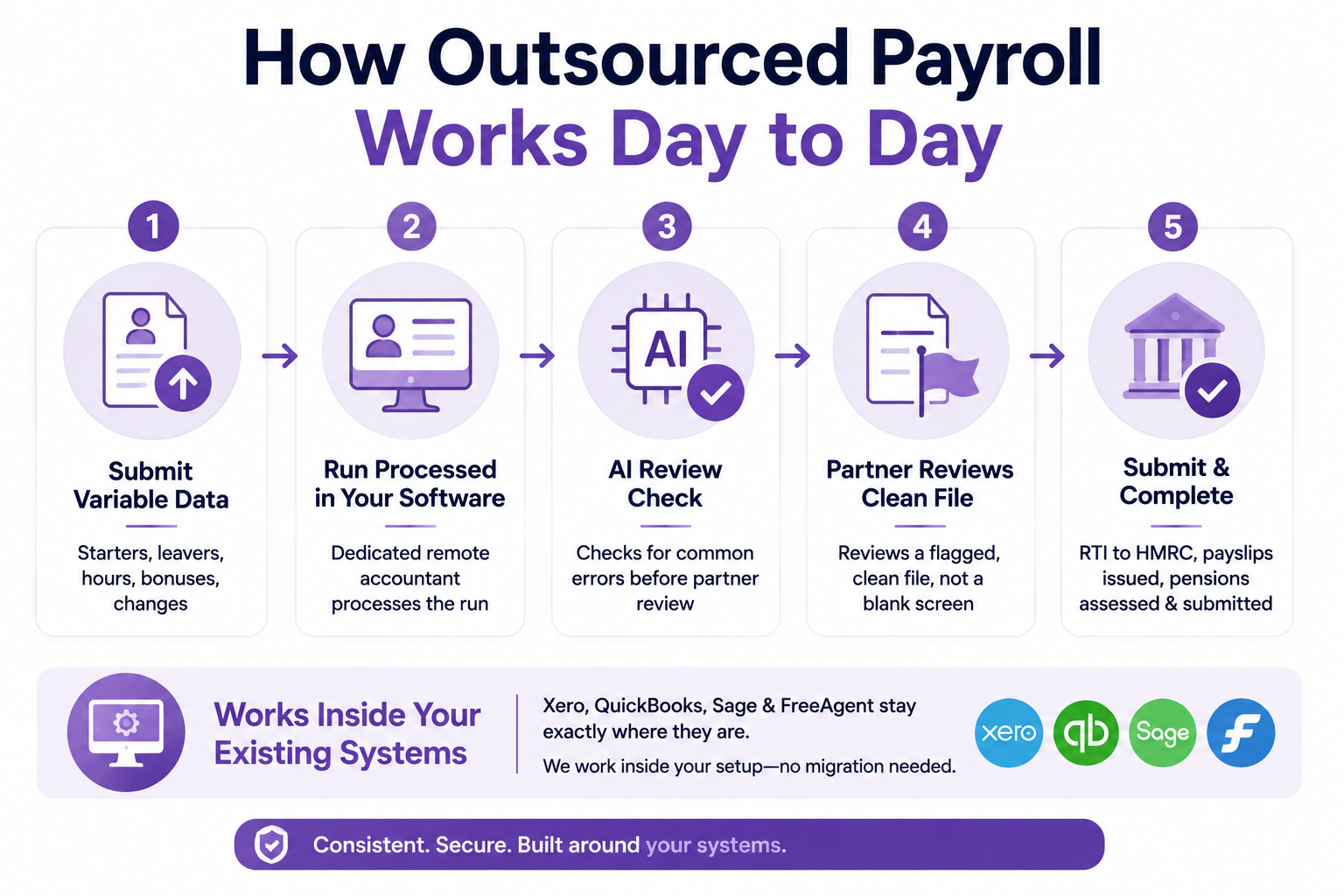
A well-run outsourced payroll setup follows a steady rhythm each pay cycle:
- The practice or client submits variable data: new starters, leavers, hours, bonuses, and changes
- The dedicated remote accountant processes the run inside your existing payroll software
- Finqube's AI review software checks the run for common errors before it reaches partner review
- The partner reviews a flagged, clean file, rather than starting from a blank screen
- RTI submission goes to HMRC, payslips get issued, and pension contributions are assessed and submitted
This all sits inside the systems you already use. Xero, QuickBooks, Sage, FreeAgent, or any other software stay exactly where they are. The dedicated accountant works inside your existing setup. You do not migrate anything.
The rhythm matters as much as the individual steps. Because the same accountant runs the same clients every cycle, patterns build up over time. They know which client always has a late starter form. They know which client's directors take irregular dividends instead of salary in certain months. That accumulated familiarity is exactly what a rotating or ad hoc setup struggles to replicate, and it is one of the quieter reasons dedicated models tend to catch more errors than pooled or freelance arrangements.
In-House vs Outsourced Payroll
Payroll Pricing Approaches
There is no single right pricing structure. A practice with 15 payroll clients whose headcount barely changes month to month usually finds a fixed fee easier to budget against. A practice with a lot of seasonal or hospitality clients, where headcount swings by 30 or 40 percent through the year, often prefers per-payslip pricing so they are not paying for capacity they are not using. Whichever structure you choose, the important question is the same one to ask about cost anywhere else in the practice: what exactly is included, and what triggers an extra charge.
What This Looks Like Across a Full Client Book
It helps to think about this at the level of a whole client book, not just one payroll run. A practice with 30 payroll clients is not managing one deadline a month. It is managing 30 separate data collection windows, 30 separate review checks, and 30 separate RTI submissions, all converging on the same handful of days.
Spread across a team of two or three, that workload is manageable most months. It becomes unmanageable the moment one person is unavailable, a new client onboards mid-cycle, or a pension re-enrolment date falls in the same week as month-end accounts. Outsourcing does not remove any of these individual tasks. It removes the single point of failure that turns a normal busy week into a crisis week.
Real Scenario
Priya Shah runs Shah & Co Accountants in Leeds. She ran payroll in-house for 35 clients, with one staff member responsible for the whole function.
When that staff member took two weeks of annual leave in May, payroll fell to Priya personally, on top of her own client work. Two RTI submissions went in late that month. One client's pension contributions got calculated incorrectly, which triggered a call from the pension provider.
Priya brought in a dedicated Finqube accountant, with AI review software built into the payroll workflow. For the first time, payroll cover became continuous. It stopped depending on one person's holiday calendar. The AI review caught a statutory maternity pay error before it reached a payslip.
By month two, Priya had recovered around 12 hours a week. She stopped reviewing payroll files line by line herself. She also stopped dreading the calendar reminder for pay run week, which she says was the change she noticed first, before she noticed the hours back.
How Finqube Can Help
Payroll is a service where small mistakes carry big consequences. A practice owner does not need to know every auto enrolment rule by heart. They need to know someone reliable is checking for mistakes before a client ever sees one.
Every Finqube engagement includes a dedicated remote accountant who works inside your existing payroll software, plus AI review software at no extra cost. Before a payroll run reaches your review, the software has already flagged statutory payment errors, auto enrolment threshold issues, and reconciliation mismatches. You review work that is already clean, rather than checking every figure from scratch.
This shifts partner time on payroll from line-by-line checking to a final sign-off. That frees up capacity for advisory work and client relationships, the parts of the practice that actually grow revenue.
There is no minimum commitment attached. Explore Finqube's engagement models to see which structure fits your payroll workload.
Conclusion
Payroll demands the same fixed monthly attention whether a firm has 10 clients or 100. The difference is where that attention comes from.
It can come from a stretched in-house team checking their own work under deadline pressure. Or it can come from a dedicated remote accountant, backed by review software built to catch the mistakes that slip through when people are rushing.
Outsourcing payroll is not about handing over control. It is about getting the visibility and the time back, without the risk of a missed RTI deadline or an auto enrolment error landing on a client's desk.
If you want to see how this works with your own client payroll, book a discovery call. There is no minimum commitment, so you can see the difference before you decide anything.
Payroll problems rarely announce themselves early. By the time a client calls about a missed deadline, the pattern behind it has usually been building for months.
One month. No contract.
See how a dedicated Finqube accountant fits into your MTD workflow before you decide.
Start your free pilotFAQ
What does payroll outsourcing actually cost for a UK accounting firm?
Pricing typically runs per payslip or as a fixed monthly fee, depending on client volume and consistency. Most practices find the cost is offset by the staff time and error-correction time it removes from the partner's schedule.
Will my clients know that payroll has been outsourced?
No. The practice keeps the client relationship and final sign-off. The dedicated remote accountant works inside your existing systems and branding, so the change stays invisible to clients.
How does outsourced payroll handle auto enrolment compliance?
Every pay run gets assessed for auto enrolment qualifying earnings. AI review software flags any worker who crosses a threshold or needs reassessment, before the run is submitted.
What happens if there is a payroll query from HMRC or a client?
The dedicated accountant who processed the run handles the query directly, with full visibility into that client's payroll history, rather than the practice needing to reconstruct what happened.
Can outsourced payroll work alongside an in-house team rather than replacing it?
Yes. Many practices start by outsourcing overflow payroll clients or cover for staff absence, then expand once they see the time saved.
How long does it take to move payroll processing to an outsourced provider?
A dedicated Finqube accountant typically deploys within one to two weeks, compared with three or more months to hire and train an in-house replacement.
Is outsourced payroll suitable for firms with complex client needs, like CIS or multi-state payroll?
Yes, provided the provider has direct experience with those schemes. Confirm CIS, salary sacrifice, and any sector-specific payroll experience before onboarding a client with complex requirements.
Is there a minimum contract length with Finqube?
No. Finqube's engagement models come with no minimum commitment, so you can start with one payroll client or your full book.